
How Japan is Turning 9 Million Abandoned Homes Into a Rural Revitalization Engine
Faced with a shrinking population and millions of vacant properties, Japan has overhauled its tax and inheritance laws to force housing turnover. Paired with generous municipal subsidies, the strategy is successfully drawing remote workers and international buyers to revitalize the countryside.
By Factlen Editorial Team
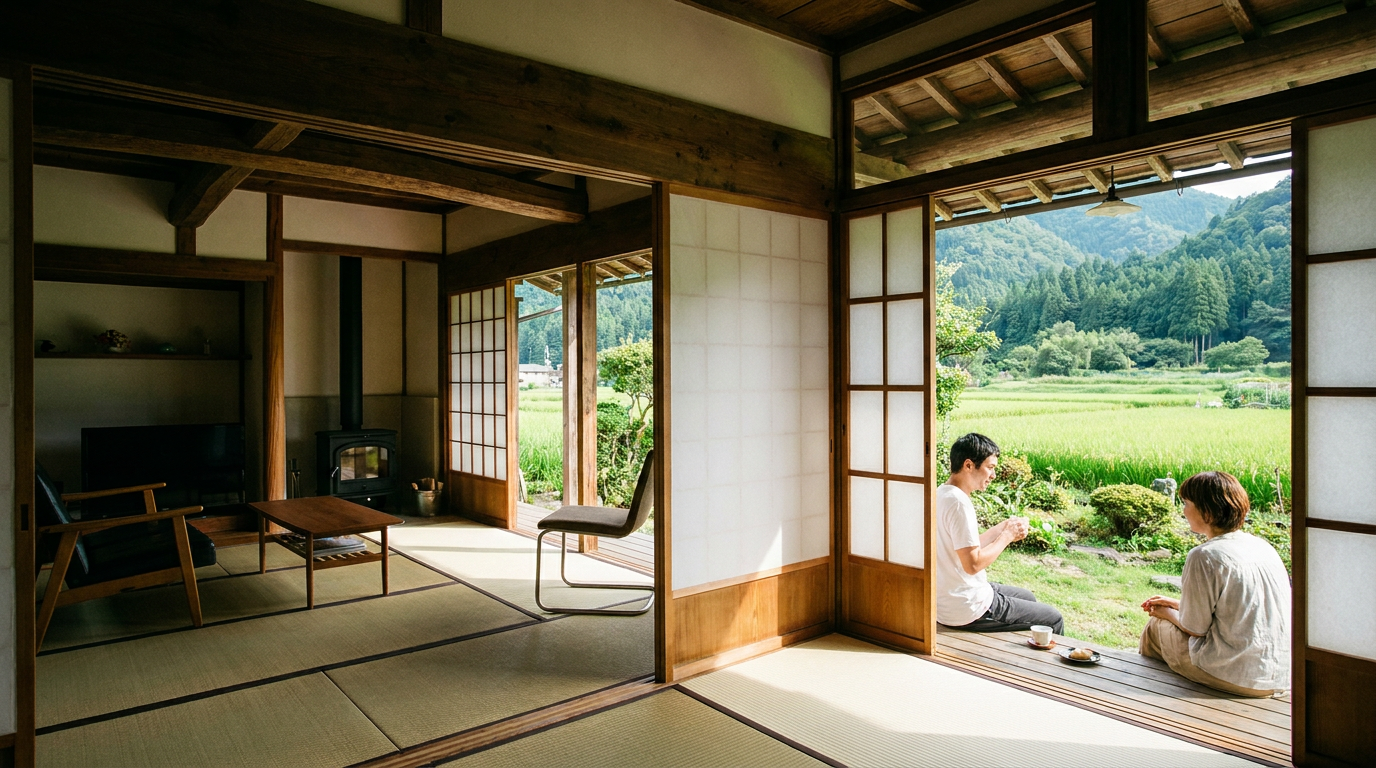
- Rural Municipalities
- Desperate to reverse population decline, these local governments view akiya banks and renovation subsidies as their best tool to attract tax-paying families and entrepreneurs.
- Urban & International Buyers
- Drawn by the prospect of mortgage-free homeownership and traditional architecture, this group sees rural Japan as a lifestyle upgrade and a blank canvas for hospitality businesses.
- National Policy Makers
- Focused on the macroeconomic threat of 9 million rotting assets, the central government is wielding tax penalties and strict inheritance laws to force owners to sell, rent, or demolish.
- Local Communities
- While welcoming the economic boost, elderly residents emphasize the need for newcomers to respect strict neighborhood rules, communal duties, and traditional village cohesion.
What's not represented
- · Construction and renovation contractors facing labor shortages
- · Heirs who cannot afford demolition costs
Why this matters
Japan is turning a massive demographic crisis into a blueprint for rural revitalization. By wielding aggressive tax penalties against neglect while offering generous subsidies to buyers, the country is creating an unprecedented opportunity for affordable homeownership and hospitality innovation.
Key points
- Japan's population decline has resulted in 9 million vacant homes, known as akiya.
- Recent tax reforms allow municipalities to revoke tax breaks for neglected properties, raising bills by up to 6x.
- New laws passed in 2024 make inheritance registration mandatory to prevent owner-unknown properties.
- Over 1,000 municipalities now operate akiya banks to connect buyers with cheap homes.
- Local governments are offering renovation subsidies ranging from ¥500,000 to ¥5,000,000.
- The strategy is successfully attracting remote workers, international buyers, and hospitality entrepreneurs.
The internet is awash with viral videos of young urbanites and international buyers purchasing sprawling homes in Japan for the price of a used car. But behind the social media trend of ultra-cheap real estate lies a massive, coordinated structural shift in the world’s fourth-largest economy. Faced with an unprecedented demographic transition, Japan is fundamentally rewriting the rules of property ownership. The government is deploying a sophisticated combination of aggressive tax penalties and generous municipal subsidies to solve one of its most visible crises: the millions of abandoned houses slowly decaying across the countryside.[7]
The scale of the problem is difficult to overstate. Japan is aging faster than any nation in history, with its population projected to plummet from 123 million today to roughly 107 million by 2040. As younger generations migrated to megacities like Tokyo and Osaka for employment, they left behind a staggering 9 million vacant homes—known locally as akiya. Today, these empty properties account for nearly 14 percent of all residential real estate in the country, transforming once-vibrant rural neighborhoods into quiet, hollowed-out landscapes.[1][5]
For decades, these homes sat rotting, trapped in a bizarre legal and financial limbo that paralyzed the real estate market. The root cause was a well-intentioned but ultimately destructive national tax policy designed during the post-war boom. Historically, the Japanese property tax system heavily favored developed land to encourage rapid housing construction. If a plot of land had any residential structure standing on it, the owner’s annual property tax burden was drastically reduced, often falling to as little as one-sixth the rate of an empty, cleared lot.[3][7]

This framework created a perverse economic incentive for families. If a younger relative inherited an aging rural home from a deceased grandparent, spending the money to demolish the decaying structure would paradoxically cause their annual tax bill to multiply by six. Consequently, the most rational financial decision was to simply leave the house standing, allowing it to slowly collapse into the overgrowth while paying the minimum possible tax rate to the local government.[3]
Compounding the issue was Japan’s historically lenient inheritance system. Until recently, formally registering the inheritance of a property was not strictly mandatory. Millions of homes fell into a legal black hole known as owner-unknown status. As properties were passed down through multiple generations without updated paperwork, the list of legal heirs would multiply and scatter, making it legally impossible for municipalities to seize, sell, or demolish the hazardous structures.[7]
Recognizing that the situation was unsustainable, the Japanese government finally brought down the hammer. In a sweeping policy shift that took full effect between 2023 and 2024, lawmakers amended the Vacant Houses Special Measures Act to fundamentally alter the mathematics of property ownership. Municipalities were granted the unprecedented legal power to inspect deteriorating properties, assess their structural integrity, and officially designate them as management-deficient if they posed a risk to the surrounding neighborhood.[3]
Once a home receives this critical designation, its protective tax exemption is immediately revoked. Owners suddenly face property tax bills up to six times higher than before. Coupled with new laws enacted in April 2024 that made inheritance registration mandatory under threat of financial penalties, the passive ownership of an akiya transformed overnight. What was once a cheap, ignorable nuisance became an active, escalating financial liability that families were desperate to offload.[3][7]

Once a home receives this critical designation, its protective tax exemption is immediately revoked.
This aggressive stick of taxation has been strategically paired with a massive carrot designed to lure new blood into dying towns. Across Japan, over 1,000 municipalities have established akiya banks—official, government-run databases that bypass traditional real estate agents. These platforms directly connect the owners of unwanted homes with a new generation of buyers looking for affordable property and a change of pace.[1][6]
To sweeten the deal and ensure these homes are actually restored rather than hoarded, local governments are offering aggressive financial incentives. Depending on the region's desperation for taxpayers, buyers can access renovation grants ranging from ¥500,000 to ¥5,000,000. Many towns offer stacked subsidies: extra funds if the buyer is under forty, has young children, plans to start a local business, or commits to converting the property into a community-serving guesthouse.[1][2]
The dual strategy is working, drawing a diverse and highly motivated coalition of buyers to the countryside. Young Japanese professionals, untethered from Tokyo office buildings by the permanent normalization of remote work, are trading cramped, expensive city apartments for spacious rural homes. Simultaneously, a massive surge of international buyers—drawn by the historically weak yen, the safety of Japanese society, and the romanticism of traditional wooden architecture—are eagerly entering the market to secure their own piece of the countryside.[6]

The economic ripple effects are becoming highly visible in once-forgotten regions. On places like Ōmishima Island, abandoned homes have been successfully converted into honeybee farms and boutique inns. In the town of Sasayama, developers have pioneered the albergo diffuso—or scattered hotel—concept. Instead of building a new concrete resort, they transform entire clusters of empty village homes into decentralized luxury accommodations that share a central reception and dining area, directly integrating tourists into the local economy.[2][6]
Even major urban centers are utilizing the new tax mechanisms to force housing turnover. Kyoto, which suffers from a severe housing shortage and skyrocketing prices that are driving young families away, recently secured national approval to implement Japan’s first specific empty home tax. Scheduled to take effect in the coming years, the policy targets thousands of unused vacation properties and inherited homes within the city limits, aiming to push them onto the rental or sales market.[4]
However, real estate experts and successful renovators caution that the akiya dream is not without significant friction. A house purchased for a few thousand dollars is rarely a turnkey property. Decades of neglect in Japan’s humid, earthquake-prone environment often result in catastrophic termite damage, rotting wooden foundations, and outdated plumbing. Bringing an abandoned home up to modern seismic and livability standards can easily cost tens of thousands of dollars, quickly eclipsing the initial purchase price.[2][7]

Furthermore, rural integration requires delicate cultural navigation that goes beyond simply repairing a building. Japanese village life is highly communal, often involving mandatory neighborhood cleaning days, local association fees, and strict waste disposal rules that can surprise urbanites. Municipalities that succeed in long-term revitalization actively mediate between enthusiastic newcomers and conservative elderly residents, ensuring that the influx of new ideas respects the established social fabric and contributes to the town's cohesion.[2]
Ultimately, the akiya phenomenon represents a profound pivot in how Japan manages its demographic destiny. Rather than viewing the 9 million empty homes purely as a symbol of national decline, policymakers, local mayors, and creative entrepreneurs are successfully repositioning them. Through a clever mix of tax reform and community support, Japan's abandoned houses are becoming the country’s most accessible resource for hospitality innovation and a decentralized, sustainable future.[7]
How we got here
2015
Japan passes the initial Vacant House Special Measures Law to address the growing akiya crisis.
March 2023
Kyoto secures national approval to implement Japan's first specific empty home tax.
December 2023
The national government expands enforcement, allowing tax breaks to be revoked for management-deficient homes.
April 2024
Inheritance registration becomes mandatory nationwide to prevent properties from falling into owner-unknown status.
2026
Over 1,000 municipalities actively operate subsidized akiya banks, drawing a surge of new buyers.
Viewpoints in depth
Rural Municipalities
Local governments view the akiya trend as a lifeline for economic survival.
Faced with shrinking tax bases and the high cost of maintaining infrastructure for dwindling populations, rural mayors are aggressively courting newcomers. By offering renovation subsidies and operating akiya banks, they hope to convert decaying liabilities into tax-paying households and vibrant local businesses.
Urban & International Buyers
Newcomers see rural Japan as a lifestyle upgrade and a blank canvas.
Priced out of major global cities, remote workers and international buyers are drawn to the prospect of mortgage-free homeownership. For this group, the appeal lies not just in the low purchase price, but in the opportunity to preserve traditional architecture and build hospitality businesses in scenic, safe environments.
National Policy Makers
The central government is using financial pressure to force a market correction.
Viewing 9 million rotting assets as a macroeconomic threat, Tokyo has shifted from passive observation to active enforcement. By revoking long-standing tax exemptions and mandating inheritance registration, policymakers are intentionally making it economically irrational to hoard or abandon unusable real estate.
Local Communities
Elderly residents balance the need for economic revival with cultural preservation.
While long-term residents generally welcome the influx of youth and capital, they remain protective of village cohesion. Success in these communities often hinges on the willingness of newcomers to participate in mandatory neighborhood cleaning days, pay association dues, and adapt to strict local customs regarding waste disposal and noise.
What we don't know
- Whether the influx of remote workers and foreign buyers can scale enough to meaningfully offset the projected loss of 16 million citizens by 2040.
- How many of the 9 million currently vacant homes are structurally salvageable versus requiring complete demolition.
- The long-term impact of Kyoto's upcoming empty home tax on the city's severe housing shortage.
Key terms
- Akiya
- A vacant or abandoned home in Japan, often left empty due to rural depopulation and aging demographics.
- Akiya Bank
- A municipal database that lists vacant homes for sale or rent, designed to connect owners directly with new residents.
- Albergo Diffuso
- A scattered hotel concept where multiple restored vacant homes in a village serve as guest rooms sharing a central reception area.
- Kominka
- A traditional Japanese wooden house, highly sought after by renovators for its classic architecture and intricate joinery.
Frequently asked
Can foreigners buy abandoned houses in Japan?
Yes. There are no legal restrictions preventing non-citizens from purchasing real estate in Japan, and many municipalities actively welcome foreign investment in akiya.
Why were these houses left empty in the first place?
Historically, Japanese property tax was up to six times cheaper if a house stood on the land, incentivizing heirs to leave rotting structures standing rather than paying to demolish them.
Are the ultra-cheap houses actually livable?
Rarely. Homes sold for a few thousand dollars usually require extensive renovations for termite damage, plumbing, and structural safety, which can cost tens of thousands of dollars.
Sources
Source coverage
7 outlets
4 viewpoints surfaced







[1]Akiya JapanUrban & International Buyers
The Future of Akiya: How Japan's Aging Population Creates Opportunity
Read on Akiya Japan →[2]EHL InsightsRural Municipalities
Revitalizing Japan's Akiya: A New Era for Rural Hospitality
Read on EHL Insights →[3]Japan TaxesNational Policy Makers
Japan's Property Tax Increase for Vacant Houses
Read on Japan Taxes →[4]SoraNews24National Policy Makers
Kyoto to introduce Japan's first 'empty home tax'
Read on SoraNews24 →[5]The Japan TimesNational Policy Makers
Number of vacant homes in Japan hits record high of 9 million
Read on The Japan Times →[6]Chosun IlboRural Municipalities
Japan focuses policy efforts on empty houses
Read on Chosun Ilbo →[7]Factlen Editorial TeamLocal Communities
Synthesis by Factlen editorial team
Read on Factlen Editorial Team →
Every angle. Every day.
Get world stories with full source coverage and perspective breakdowns delivered to your inbox.