
The End of the Green Screen: How LED Volumes Became Television's Default Reality
Once a $100 million experiment reserved for blockbuster sci-fi, virtual production has democratized in 2026, allowing indie creators and broadcast networks to shoot anywhere in the universe from a single soundstage.
By Factlen Editorial Team
- Studio Operations & Executives
- Values virtual production for its ability to lock in locations early, eliminate weather delays, and provide highly predictable budgeting.
- Technical VFX Specialists
- Emphasizes the massive workflow shift required, noting that the pressure has moved from post-production compositing to live, on-set rendering.
- Hardware & Indie Integrators
- Focuses on the democratization of the technology, highlighting how $50k micro-volumes allow smaller creators to achieve blockbuster scale.
- Media Analysts
- Observes the broader industry trends, tracking how virtual production is fundamentally changing the aesthetics and economics of modern television.
What's not represented
- · Traditional Location Scouts
- · Post-Production Compositors
Why this matters
The democratization of virtual production means higher-quality television shows can be produced faster and cheaper, allowing mid-tier networks and independent creators to deliver blockbuster-scale visuals without relying on massive studio budgets.
Key points
- Virtual production using LED volumes has largely replaced green screens as the default for modern television.
- The technology uses real-time rendering engines to adjust digital backgrounds based on physical camera movements.
- Indie creators can now build functional 'micro-volumes' for as little as $50,000, democratizing high-end visual effects.
- The workflow shifts the burden of visual effects from post-production editing to pre-production planning.
- Actors benefit from natural lighting and the ability to see the digital environments they are performing in.
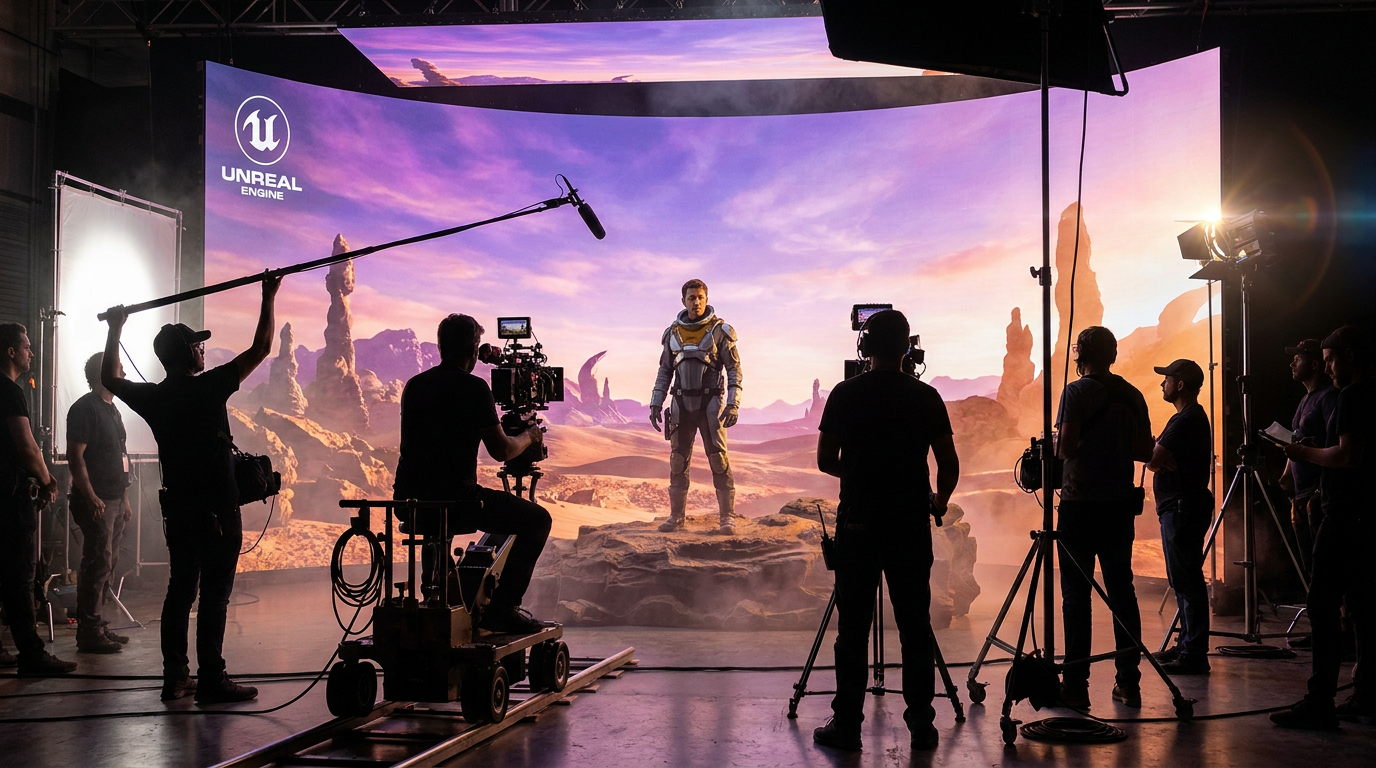
For decades, the magic of television relied on a simple, brightly colored illusion: the green screen. Actors delivered emotional monologues to tennis balls on sticks, trusting that months later, a team of visual effects artists would digitally paint a sprawling alien landscape or a bustling New York street behind them. In 2026, that workflow is rapidly becoming a relic of the past. Walk onto a modern television set today, and you are less likely to see a sea of neon green than a massive, glowing, curved wall of high-definition screens. This is the era of the LED volume, the beating heart of a filmmaking revolution known as virtual production. What began in 2019 as a highly experimental, wildly expensive tool built by Industrial Light & Magic for blockbuster sci-fi has now matured into the television industry's default method for capturing reality.[2][7]
The shift is monumental, driven by both creative ambition and hard economics. According to industry analysts, the virtual production market has reached $3.3 billion in 2026, with forecasts projecting a surge to $6.5 billion by 2030. But the real story isn't just the capital flowing into the space—it is how the technology is fundamentally democratizing visual storytelling. To understand why LED volumes are taking over, one must understand the mechanism of In-Camera Visual Effects, or ICVFX. In a traditional green screen shoot, the background is added in post-production, long after the actors have gone home. With ICVFX, the background is rendered live, in real-time, right on the set, allowing the camera to capture the final composite directly through the lens.[3][5][6]

The system relies on three core components working in perfect synchronization: a modular wall of high-brightness LED panels, a real-time 3D rendering engine like Epic Games' Unreal Engine, and a sophisticated physical camera tracking system. As the physical camera moves across the stage—panning, tilting, or pushing forward on a dolly—the tracking system feeds its exact coordinates to the rendering engine. The engine then instantly recalculates the perspective of the digital background displayed on the LED wall. This creates perfect parallax, the optical illusion where objects in the foreground appear to move faster than objects in the distance. To the human eye, and more importantly to the camera lens, the flat LED wall suddenly possesses infinite depth, seamlessly transforming a small soundstage into the summit of Mount Everest or a sun-drenched beach.[1][5][6][7]
Beyond the visual trickery, the raw economics of virtual production are driving its widespread adoption across broadcast and streaming networks. In the early days of the technology, building a Hollywood-scale volume could cost upwards of $15 million, restricting its use to the wealthiest studios. Today, while premium stages still command top dollar, the hardware has scaled down dramatically. Independent filmmakers and mid-tier television productions are now utilizing 'micro-volumes,' where a functional, smaller-scale LED setup can be assembled for roughly $50,000. This newfound accessibility is allowing creators without massive budgets to achieve cinematic scale, leveling the playing field between indie studios and major networks.[2]

Beyond the visual trickery, the raw economics of virtual production are driving its widespread adoption across broadcast and streaming networks.
The operational savings of utilizing these volumes are equally compelling for producers. Shooting on a soundstage entirely eliminates the unpredictable variables of location shoots. There are no weather delays, no lost sunlight, and no exorbitant travel costs to fly a massive crew across the globe. The financial efficiency of staying indoors cannot be overstated. For example, the FX television series Snowfall reportedly saved up to $49,000 per episode simply by using virtual production for its driving scenes, drastically reducing transportation logistics and crew man-hours. This predictability allows showrunners to allocate their budgets toward on-screen talent and writing rather than logistical contingencies.[3][4][6]
Furthermore, the technology solves one of the most persistent headaches of the green screen era: green spill. When bright studio lights hit a traditional green screen, they bounce green-tinted light back onto the actors and the set, requiring painstaking digital removal later. In an LED volume, the wall itself acts as the primary light source. If an actor is standing in a virtual desert sunset, they are physically bathed in the warm, amber light emitting from the screens. If they are sitting in a car, the neon signs of the virtual city reflect perfectly and naturally across the vehicle's glass, creating an in-camera composite that requires zero post-production manipulation.[1][2][5]

This level of immersion profoundly impacts the actors and the overall quality of the performance. Performers no longer have to imagine their surroundings; they can physically see the world they are inhabiting. Directors report that this leads to more grounded, natural performances, as actors react to genuine visual stimuli rather than a blank void. However, the transition to virtual production is not without its growing pains. The technology fundamentally upends the traditional filmmaking timeline. Historically, visual effects were a problem to be solved in post-production—the infamous industry mantra of 'we'll fix it in post.' Virtual production forces those critical decisions into pre-production.[1][4]

The digital environments must be fully built, lit, and approved by executives before the cameras ever roll. If a digital mountain is in the wrong place on the day of the shoot, it cannot be easily moved later, meaning the pressure on the set is immediate and unforgiving. Furthermore, the industry is currently facing a bottleneck regarding talent; operating an LED volume requires a hybrid crew that understands both traditional cinematography and real-time video game engines. Despite these hurdles, the trajectory of the medium is clear. By bringing the world into the studio, virtual production has not only cut costs and expanded creative boundaries, but it has also made the grueling process of making television a little more predictable, and a lot more magical.[3][4][7]
How we got here
2019
Industrial Light & Magic debuts the StageCraft LED volume for the first season of The Mandalorian, proving the concept at a blockbuster scale.
2021
The pandemic accelerates the adoption of virtual production as travel restrictions force commercial and television shoots indoors.
2024
Epic Games releases advanced updates to Unreal Engine, making real-time rendering more accessible to mid-tier television productions.
2026
The virtual production market surpasses $3.3 billion, with $50,000 'micro-volumes' becoming widely available to independent filmmakers.
Viewpoints in depth
Studio Operations & Executives
Production leaders value virtual production for its ability to lock in locations early and eliminate unpredictable variables.
For studio executives, the primary appeal of virtual production is risk mitigation. Traditional location shoots are vulnerable to weather delays, permitting issues, and exorbitant travel costs. By moving production into a controlled LED volume, showrunners can guarantee their shooting schedules and lock in their budgets. The ability to shoot a scene set in Tokyo in the morning and a scene set in the Sahara Desert in the afternoon—without ever leaving a London soundstage—provides unprecedented logistical efficiency.
Hardware & Indie Integrators
Independent creators focus on the democratization of the technology, highlighting how smaller setups allow them to achieve blockbuster scale.
While the massive $15 million stages grab the headlines, the hardware sector is increasingly focused on scalability. Integrators are building 'micro-volumes' for independent filmmakers that cost around $50,000. These smaller setups still utilize the same Unreal Engine software and camera tracking technology as the major studios, allowing indie creators to punch far above their weight class. For this camp, virtual production is the great equalizer, removing the financial barrier to high-end visual storytelling.
Technical VFX Specialists
Visual effects artists emphasize the massive workflow shift required, noting that the pressure has moved from post-production to live rendering.
For the technicians actually running the volumes, the transition has been jarring. The traditional safety net of 'fixing it in post' has vanished. Because the visual effects are captured in-camera, the digital environments must be perfectly designed, lit, and color-calibrated before the actors ever step on set. This requires a new breed of hybrid crew members who understand both traditional cinematography and real-time video game engines, leading to a current talent bottleneck in the industry.
What we don't know
- Whether the high initial capital costs of building premium LED volumes will eventually consolidate power among a few massive studio conglomerates.
- How the role of traditional location scouts and set builders will permanently adapt as digital environments become the industry standard.
- Whether the supply of technicians trained in real-time game engines can scale fast enough to meet the exploding demand from television networks.
Key terms
- Virtual Production (VP)
- A filmmaking method that combines physical sets with digital environments, allowing creators to capture visual effects in real-time.
- LED Volume
- A large, often curved wall of high-definition screens used to display digital backgrounds behind actors on a soundstage.
- In-Camera Visual Effects (ICVFX)
- The process of capturing final visual effects directly through the camera lens during filming, rather than adding them later in post-production.
- Parallax
- The optical illusion where objects closer to the camera appear to move faster than objects in the distance, creating a sense of depth.
- Green Spill
- The unwanted green-tinted light that bounces off a traditional green screen and onto actors, requiring digital removal.
- Real-Time Rendering
- The instantaneous generation of 3D computer graphics, allowing digital environments to react immediately to camera movements.
Frequently asked
Is the traditional green screen completely dead?
Not entirely. Green screens are still used for specific visual effects and lower-budget composite shots, but LED volumes are rapidly replacing them for environmental backgrounds.
Why do actors prefer working with LED volumes?
LED walls allow actors to physically see the environment they are supposed to be in, rather than forcing them to imagine a world while staring at a blank green wall.
If the screens are so expensive, how does this save money?
Virtual production eliminates the need to travel to expensive locations, prevents weather-related shooting delays, and drastically reduces the hours needed for post-production editing.
Sources
Source coverage
7 outlets
4 viewpoints surfaced







[1]3Peak StudioTechnical VFX Specialists
Virtual Production in 2026: How LED Volumes Cut Costs and Time
Read on 3Peak Studio →[2]Royal DisplayHardware & Indie Integrators
Virtual Production LED Wall Price: Complete Cost Guide (2026)
Read on Royal Display →[3]Garden StudiosStudio Operations & Executives
Virtual production in 2026: Did the industry predictions come true?
Read on Garden Studios →[4]CUBE StudioStudio Operations & Executives
The Business Case for Virtual Production in 2026
Read on CUBE Studio →[5]Capernaum StudiosTechnical VFX Specialists
What is ICVFX and how does it relate to Virtual Production?
Read on Capernaum Studios →[6]NEP GroupTechnical VFX Specialists
In-Camera Visual Effects (ICVFX)
Read on NEP Group →[7]Factlen Editorial TeamMedia Analysts
Synthesis by Factlen editorial team
Read on Factlen Editorial Team →
Every angle. Every day.
Get entertainment stories with full source coverage and perspective breakdowns delivered to your inbox.