
The Era of the Disposable Phone is Ending: A Guide to 2026's Repairable Smartphones
Driven by sweeping new European regulations and consumer fatigue over rising prices, the smartphone industry is fundamentally redesigning devices to be easily repaired. From modular mid-range models to flagships with ultra-durable batteries, the market is shifting toward longevity.
By Factlen Editorial Team
- Right-to-Repair Advocates
- Campaigners who believe modularity and open access are fundamental consumer rights.
- Premium Device Manufacturers
- Tech giants prioritizing structural integrity and advanced materials over modular designs.
- Everyday Consumers
- Smartphone users focused on practical longevity and avoiding the high costs of frequent upgrades.
What's not represented
- · E-waste recycling facilities handling older, glued-together devices
- · Independent local repair shop owners navigating the transition
Why this matters
For years, a degraded battery or a cracked screen meant spending upwards of $1,000 on a brand-new device. The shift toward user-repairable phones puts control back in the hands of consumers, drastically lowering the long-term cost of ownership while curbing the millions of tons of electronic waste generated annually.
Key points
- Sweeping EU regulations taking effect between 2025 and 2027 are forcing smartphone manufacturers to prioritize repairability and longevity.
- Devices must feature user-replaceable batteries or utilize advanced chemistry that guarantees 80 percent capacity after 1,000 charge cycles.
- Manufacturers are also required to provide spare parts and continuous software updates for up to seven years.
- Mid-range phones are adopting modular designs with simple screws, while premium flagships are relying on highly durable sealed batteries.
- The shift empowers consumers to keep their devices longer, saving money and significantly reducing global electronic waste.
For the better part of a decade, buying a smartphone meant accepting a ticking clock. Devices were sealed shut with industrial adhesives, transforming a simple degraded battery into a fatal flaw that required buying a completely new phone. But in 2026, the era of the disposable smartphone is rapidly coming to a close. Driven by consumer frustration and sweeping legislative changes, manufacturers are fundamentally redesigning their hardware to ensure that when a single component fails, the rest of the device does not have to end up in a landfill.[1][5]
The catalyst for this industry-wide pivot is the European Union, which has effectively weaponized its market size to force a global standard. Since mid-2025, the EU's Ecodesign regulation has mandated that any smartphone sold within its borders must meet strict requirements for spare parts availability and software support. Manufacturers are now legally required to supply key replacement parts, such as screens and charging ports, for at least seven years after a model is discontinued.[5]
But the most transformative rule is still on the horizon. Starting in February 2027, a new EU battery directive will require that portable devices feature batteries that end-users can remove and replace using standard, commercially available tools. Because tech giants rely on streamlined global supply chains, they rarely design separate hardware chassis for different continents. As a result, the European mandate is quietly dictating the physical architecture of phones sold in North America, Asia, and beyond.[1][4]

The immediate result of these regulations is a new wave of devices built explicitly for easy disassembly. The Fairphone 5 set the early gold standard, earning a perfect repairability score by utilizing a fully modular design where every component can be swapped with a standard Philips screwdriver. However, mainstream manufacturers are now adopting similar philosophies without sacrificing modern aesthetics.[8]
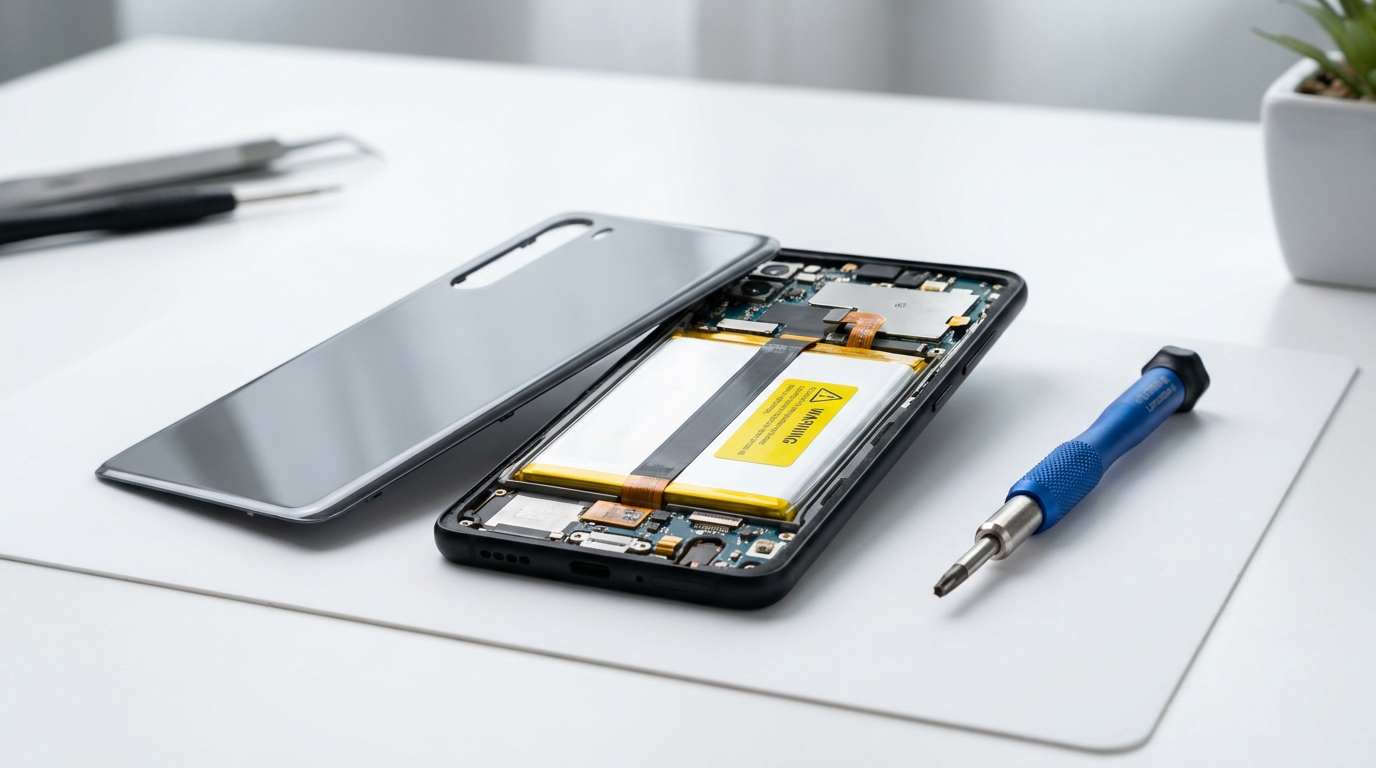
Consider the HMD Skyline, a mid-range Android device released to widespread acclaim for its "Gen2" repairability. Instead of requiring heat guns and specialized prying tools to melt away glue, the Skyline features a single Torx screw at its base. Turning this screw releases a cam mechanism that pops off the back cover, granting immediate access to the battery and internal components.[2][3][6]
To achieve this, HMD replaced the stubborn adhesives traditionally used to secure displays with a specialized foam gasket. The battery is still held in place with a mild adhesive, but it is calibrated so that a gentle pull is enough to free it. This approach earned the Skyline a 9/10 repairability score from iFixit, proving that a phone can be easily serviceable while still supporting premium features like Qi2 magnetic wireless charging and a 144Hz OLED display.[2][3][7]

While modular designs are thriving in the mid-range market, ultra-premium flagships from companies like Apple, Samsung, and Google are taking a slightly different path to compliance. The upcoming 2027 EU battery law includes a crucial exemption: manufacturers can bypass the removable battery mandate if their devices meet exceptionally high durability standards.[1][5]
Specifically, if a smartphone battery is engineered to retain at least 80 percent of its original capacity after 1,000 full charge cycles, it is legally permitted to remain sealed within the device. This loophole has sparked a quiet arms race in battery chemistry. Apple's recent iPhone Pro models and Samsung's Galaxy S-series Ultra devices are already hitting or exceeding this 1,000-cycle threshold, allowing them to maintain their tightly sealed, highly water-resistant designs.[8]
This loophole has sparked a quiet arms race in battery chemistry.
This dynamic is effectively creating a two-tier market for smartphone longevity. Premium devices are achieving long lifespans through advanced, degradation-resistant battery cells, while budget and mid-range phones—which cannot absorb the cost of high-end battery chemistry—are adopting modular, user-replaceable designs. Both approaches ultimately serve the consumer by extending the viable life of the hardware.[5][8]
The repair ecosystem itself is also maturing rapidly. Independent repair shops and do-it-yourself enthusiasts across Europe and the United States report that sourcing high-quality, original equipment manufacturer (OEM) parts is easier now than at any point in the last decade. The most frequently requested components remain OLED screen assemblies, replacement batteries, and charging port flex cables.[8]

As hardware lifespans stretch from the historical average of 2.5 years to a projected five or even seven years, the bottleneck for device longevity has shifted from physical components to software. A phone with a brand-new battery is virtually useless if its operating system can no longer run modern applications or receive critical security patches.[5]
Regulators anticipated this gap. The EU's ecodesign rules stipulate that operating system updates must remain available for at least five years from the date the last unit of a specific model is sold. Because popular models are often manufactured and sold for two to three years after their initial launch, this effectively forces manufacturers to provide up to eight years of continuous software support.[5]
Google and Samsung have already preempted these rules by promising seven years of major OS and security updates for their flagship Pixel and Galaxy devices. This commitment fundamentally alters the value proposition of a high-end smartphone. While the initial purchase price may exceed $1,000, the ability to easily replace a degraded battery in year four and continue receiving software updates through year seven dramatically lowers the annualized cost of ownership.[8]

Environmental advocates view this shift as a critical victory in the fight against electronic waste. The United Nations estimates that the world generates over 53 million metric tons of e-waste annually, with discarded smartphones acting as a primary contributor due to their sheer volume and toxic battery chemistry. By keeping devices in pockets and out of shredders, the industry is taking a measurable step toward a circular economy.
Challenges remain, particularly regarding the balance between repairability and physical durability. Devices designed to be easily opened often struggle to achieve the highest IP68 ratings for water and dust submersion. The HMD Skyline, for instance, carries an IP54 rating, meaning it can survive splashes but not a drop into a swimming pool. Consumers must weigh whether they value absolute waterproofing over the ability to perform a $30 battery swap at their kitchen table.[3]
Furthermore, while the stigma around self-repair is fading, building consumer trust takes time. For years, manufacturers utilized software locks and intimidating warning messages to discourage users from installing third-party parts. The new right-to-repair regulations explicitly ban these obstruction tactics, but overcoming a decade of conditioned consumer anxiety requires sustained effort and education.[5][8]
Ultimately, the smartphones of 2026 represent a profound course correction. Technology companies are no longer treating their products like perishable goods with an expiration date dictated by a sealed lithium-ion pouch. Whether through modular engineering or advanced battery chemistry, the industry is finally building devices that respect the consumer's investment, proving that sustainability and cutting-edge technology are not mutually exclusive.
How we got here
2023
The European Union approves a sweeping package of e-waste reduction laws, including mandates for replaceable batteries.
Mid-2025
EU Ecodesign rules take effect, requiring manufacturers to provide spare parts and software updates for up to seven years.
July 2024
HMD releases the Skyline, popularizing 'Gen2' repairability with a simple cam-lock screw mechanism for easy disassembly.
February 2027
The EU battery directive officially comes into force, requiring all new portable devices to feature user-replaceable batteries or meet the 1,000-cycle durability exemption.
Viewpoints in depth
Right-to-Repair Advocates
Campaigners who believe modularity and open access are fundamental consumer rights.
For right-to-repair advocates, the shift toward modularity is about dismantling the artificial barriers erected by tech giants. Organizations like iFixit argue that true ownership means having the ability to open a device with a standard screwdriver, swap a failing component, and turn it back on without encountering software locks or warning messages. They view the 1,000-cycle battery exemption with skepticism, warning that it allows premium manufacturers to maintain a monopoly on the repair process by keeping devices sealed shut.
Premium Device Manufacturers
Tech giants prioritizing structural integrity and advanced materials over modular designs.
Companies producing ultra-premium flagships argue that consumers demand sleek, lightweight, and highly durable devices that can survive being dropped in a pool. By investing heavily in advanced battery chemistry that degrades much slower than traditional lithium-ion cells, they argue they are achieving the same environmental goals—keeping phones out of landfills—without compromising on design or water resistance. For these manufacturers, the 1,000-cycle exemption is a feature of high-end engineering, not a loophole.
Everyday Consumers
Smartphone users focused on practical longevity and avoiding the high costs of frequent upgrades.
For the average consumer, the ideological battle over hardware architecture is secondary to the financial reality of smartphone ownership. With flagship devices regularly crossing the $1,000 threshold, buyers are increasingly viewing phones as long-term investments rather than two-year rentals. Consumers are embracing the repairability trend because it offers a practical safety net: the assurance that a single cracked screen or degraded battery won't force them to finance an entirely new device.
What we don't know
- Whether the 1,000-cycle battery exemption will ultimately undermine the EU's goal of fostering a universal DIY repair culture.
- How strictly regulators will enforce the mandate requiring manufacturers to provide software updates for five years after the last unit is sold.
- If the increased availability of OEM parts will lead to a significant drop in the cost of professional repair services.
Key terms
- Planned Obsolescence
- The practice of designing products with an artificially limited useful life so that consumers are forced to purchase replacements sooner.
- Ecodesign Regulation
- A set of European Union rules mandating that products be designed for energy efficiency, durability, and easy repair to reduce environmental impact.
- Charge Cycle
- The process of fully draining a rechargeable battery and then recharging it back to 100 percent capacity.
- OEM Parts
- Original Equipment Manufacturer parts; components made by the same company that produced the original parts for the device.
- IP Rating
- Ingress Protection rating, a standard that defines how well a device is sealed against dust and water.
Frequently asked
Can I easily replace the battery in my current phone?
If your phone was manufactured before 2025, likely not without specialized tools or a heat gun to melt the adhesive. However, newer models are increasingly adopting pull-tabs and screws to make the process easier.
Will repairable phones still be waterproof?
It is a trade-off. Highly modular phones often carry lower water-resistance ratings (like IP54 for splashes), whereas fully sealed flagship phones achieve IP68 submersion ratings but are harder to open.
Does replacing parts myself void the manufacturer warranty?
Under new right-to-repair laws in the EU and parts of the US, performing a repair yourself does not automatically void the warranty, provided you do not damage other components during the process.
Why are Apple and Samsung not making pop-out batteries?
EU regulations allow manufacturers to keep batteries sealed if they can retain 80% of their capacity after 1,000 charge cycles. Premium brands are using this exemption to maintain sleek, water-resistant designs.
Sources
Source coverage
8 outlets
3 viewpoints surfaced








[1]TechRadarPremium Device Manufacturers
The EU requires phone makers to fit 'readily removable' batteries from next year
Read on TechRadar →[2]Android PoliceEveryday Consumers
HMD Skyline review: Repairability and Qi2 charging
Read on Android Police →[3]How-To GeekEveryday Consumers
HMD's Skyline is a Highly-Repairable Android Phone
Read on How-To Geek →[4]The Olive PressPremium Device Manufacturers
EU to force replaceable batteries in phones and tablets from 2027
Read on The Olive Press →[5]Gadget HacksRight-to-Repair Advocates
EU Repairable Smartphones Rules: What Changed and What Hasn't
Read on Gadget Hacks →[6]NotebookCheckEveryday Consumers
HMD Skyline review - Easily repairable mid-range phone
Read on NotebookCheck →[7]iFixitRight-to-Repair Advocates
HMD Skyline Repairability and Teardown
Read on iFixit →[8]Digi4UEveryday Consumers
Most Repairable Smartphones in 2026 – Which Brands Are Easier to Fix?
Read on Digi4U →


Every angle. Every day.
Get shopping stories with full source coverage and perspective breakdowns delivered to your inbox.