
The Science of Pilates: How Controlled Movement Changes the Body
Modern biomechanics and ultrasound imaging are revealing exactly how Pilates transforms the body's deep stabilizing muscles. Research shows the century-old practice fundamentally alters core activation, though the choice between mat and reformer depends on specific fitness goals.
By Factlen Editorial Team
- Clinical Researchers & Physiotherapists
- Focuses on the method's ability to repair the mind-muscle connection, increase deep muscle thickness, and serve as a frontline treatment for chronic musculoskeletal pain.
- Athletic Performance Coaches
- Views the practice as a supplemental tool to enhance dynamic flexibility, correct muscular imbalances, and improve explosive power through targeted core stability.
- General Fitness Advocates
- Values the accessibility of the mat repertoire, the low-impact nature of the movements, and the profound improvements in daily posture and stress reduction.
What's not represented
- · Yoga Practitioners comparing methodologies
- · Budget-conscious consumers priced out of studio classes
Why this matters
Understanding the biomechanics behind Pilates helps practitioners choose the right modality—mat or reformer—for their specific goals, from rehabilitating back pain to enhancing athletic performance.
Key points
- Pilates targets deep stabilizing muscles rather than superficial abdominal muscles.
- Ultrasound imaging confirms Pilates physically increases the thickness of the transverse abdominis.
- The practice repairs the neurological timing of muscle contractions, aiding in back pain relief.
- Reformer Pilates uses spring resistance to build explosive power and active flexibility.
For decades, the Pilates method was largely viewed by the general public as a niche conditioning secret reserved for ballet dancers, or simply as a trendy boutique workout for the affluent. Developed in the 1920s by German physical trainer Joseph Pilates—who initially used rigged hospital beds and springs to rehabilitate bedridden inmates during World War I—the method has steadily exploded into a global fitness phenomenon. Yet, while millions of dedicated practitioners have long sworn by its transformative effects on posture, flexibility, and core strength, the scientific and medical communities have only recently developed the advanced imaging technology necessary to prove exactly how the practice alters the human body from the inside out.[4][6]
The shift from anecdotal praise to rigorous empirical validation has been driven largely by the advent of rehabilitative ultrasound imaging (RUSI) and advanced electromyography (EMG). These sophisticated diagnostic tools allow sports scientists and physiotherapists to look beneath the skin and observe individual muscle fibers contracting in real time. What researchers have found fundamentally challenges traditional approaches to abdominal training and core conditioning. The imaging reveals that the true power of Pilates lies not in the visible, superficial muscles that most gym-goers focus on, but rather in a hidden, internal corset of deep spinal stabilizers that dictate how the entire body moves and absorbs impact.[2][6]
In biomechanical terms, the human 'core' is not merely the front of the stomach, but a complex, three-dimensional cylinder of musculature that supports the spine and pelvis. Traditional abdominal exercises, such as standard crunches or sit-ups, primarily target the rectus abdominis—the superficial layer of muscle responsible for flexing the spine forward. Pilates, however, bypasses these superficial movers to intentionally target the deep anticipatory stabilizers. The primary focus is the transverse abdominis (TrA), which wraps horizontally around the lower torso like a weightlifting belt, and the lumbar multifidus, a series of small, intricate muscles that lace up the back of the spine to stabilize individual vertebrae.[2][5]

A landmark 2025 clinical study published in the National Institutes of Health repository utilized rehabilitative ultrasound imaging to track the precise physiological changes in adults undergoing a six-week Pilates-based core stabilization program. The researchers discovered that the practice did not just improve subjective feelings of strength; it physically altered the participants' internal anatomy. Compared to a control group performing standard aerobic exercise, the Pilates group demonstrated statistically significant increases in the actual physical thickness of their transverse abdominis and internal oblique muscles, proving that the controlled movements induce genuine muscular hypertrophy in the deep core.[2]
Beyond sheer muscle size and thickness, the ultrasound study highlighted a critical neurological adaptation: the restoration of contraction timing. In a healthy, optimally functioning body, deep core muscles are 'anticipatory'—meaning they are neurologically wired to fire milliseconds before the arms or legs move, bracing the spine against the impending mechanical load. In people suffering from chronic pain, or those with highly sedentary lifestyles, this vital firing sequence is often delayed or inhibited, leaving the spine vulnerable to injury. The 2025 data confirmed that Pilates actively repairs this mind-muscle connection, restoring the precise, rapid timing of deep muscle activation.[1][2][6]

Beyond sheer muscle size and thickness, the ultrasound study highlighted a critical neurological adaptation: the restoration of contraction timing.
This neurological repair mechanism explains exactly why Pilates has become a frontline, evidence-based treatment for chronic lower back pain. A comprehensive 2023 systematic review of randomized controlled trials evaluated the method's clinical efficacy for patients suffering from persistent spinal discomfort. The review concluded that Pilates is not only highly effective at reducing pain and physical disability, but it specifically succeeds by reversing the core muscle inhibition that typically accompanies spinal issues. By forcing the brain to consciously engage the pelvic floor and deep abdominals during movement, the practice systematically rebuilds the body's internal support structure.[1][6]
While the internal biomechanical mechanics of Pilates remain consistent, the external application of the method is divided into two primary modalities: Mat Pilates and Reformer Pilates. Mat Pilates is the foundational, original practice, utilizing gravity and the practitioner's own body weight across a defined repertoire of roughly 34 classical exercises. Because the body must create its own resistance and support without any external mechanical assistance, mat work is highly effective for developing raw spatial awareness, balance, and foundational core control. It forces the practitioner to rely entirely on their internal strength to execute the precise movements.[3][4]
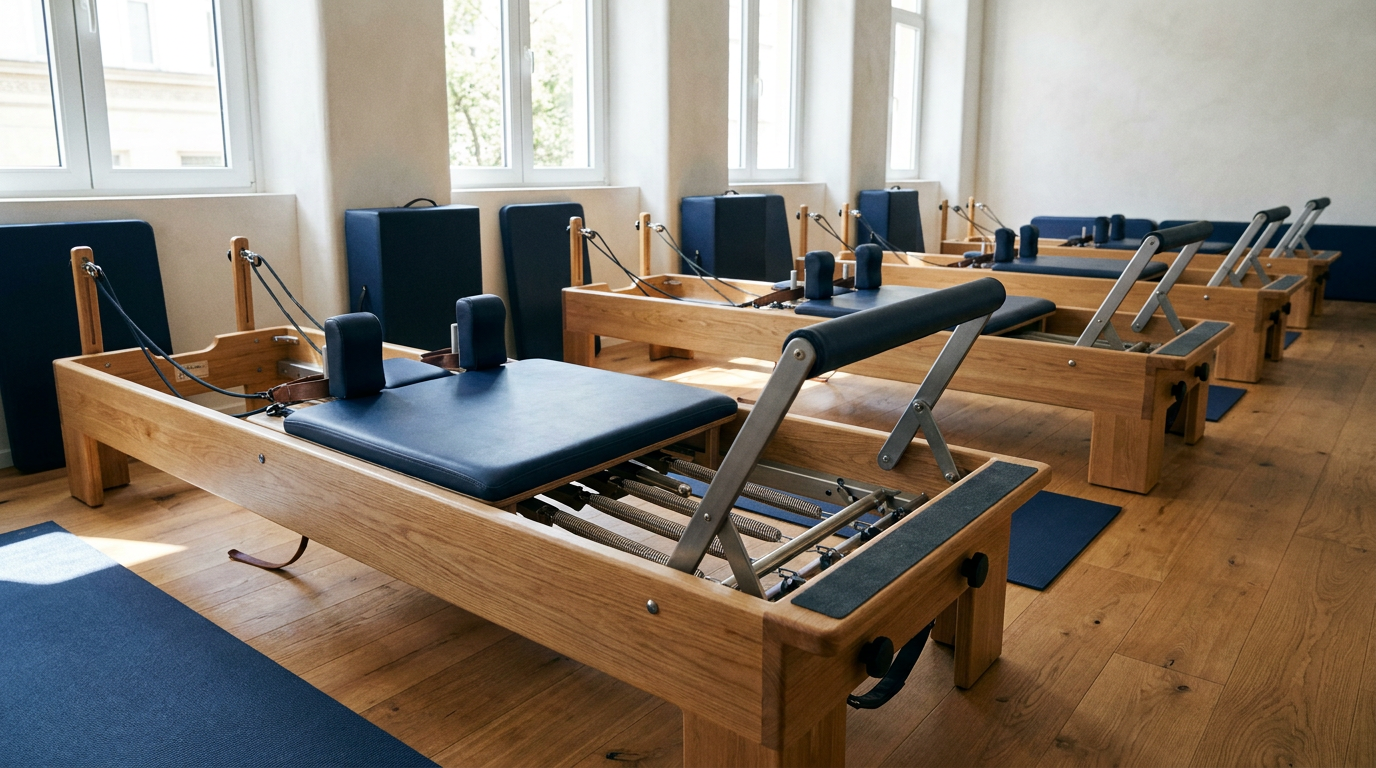
Reformer Pilates, conversely, utilizes a specialized, bed-like machine featuring a sliding carriage, adjustable spring tension, ropes, and pulleys. While the complex apparatus may appear intimidating to newcomers, the reformer paradoxically offers significantly more support for beginners than the mat. The adjustable springs provide constant tactile feedback, physically guiding the body through the correct range of motion and assisting with movements that might be impossible against pure gravity. This allows individuals with limited mobility or those recovering from injuries to safely access the benefits of the practice under controlled conditions.[3][6]

As practitioners advance in their training, the reformer's springs transform from a supportive safety net into a mechanism for progressive, heavy overload. A 2025 analysis comparing the two modalities found that while both improve overall fitness, the reformer's bilateral resistance yields faster and more significant results in specific athletic performance metrics. For example, soccer players utilizing reformer Pilates demonstrated superior improvements in explosive power, agility, and short sprint times compared to those doing exclusively mat work. This is largely due to the machine's unique ability to challenge muscles through a wider, loaded range of motion.[4]
The dynamic, spring-loaded resistance of the reformer also plays a crucial role in developing functional flexibility. Unlike traditional static stretching, which simply pulls passively on resting muscle fibers, Pilates builds 'active flexibility'—the athletic ability to control a joint safely through its absolute full range of motion. Sports science studies show that the core stability developed through Pilates directly correlates with increased hamstring and hip flexibility. When the central nervous system feels secure in the spine's stability, it naturally allows the peripheral limbs to extend further without triggering protective muscle tightness.[5]

Despite its extensive, scientifically validated benefits, sports scientists and physiotherapists are careful to define the specific limitations of the Pilates method. Pilates is not a replacement for dedicated cardiovascular conditioning, nor is it a substitute for heavy, progressive resistance training aimed at maximal muscle hypertrophy or absolute strength. Furthermore, health authorities caution that the moving parts, straps, and spring tension of the reformer carry a risk of strain or joint injury if used without proper, certified supervision, particularly for individuals dealing with severe osteoporosis or acute joint instability.[3][5]
Ultimately, the modern scientific consensus serves to validate exactly what Joseph Pilates claimed over a century ago: physical fitness is the first requisite of happiness, and it begins fundamentally with a strong, supple spine. Whether practiced on a simple foam mat in a living room or on a complex, spring-loaded carriage in a boutique studio, the method's true innovation lies in its strict demand for mindful, precise movement. It is a profound neurological and muscular re-education that builds resilient strength from the inside out, proving that the mind and body are inextricably linked.[4][6]
How we got here
1920s
Joseph Pilates develops the method, initially using rigged hospital beds to rehabilitate bedridden inmates.
1990s-2000s
Pilates gains mainstream popularity as a boutique fitness trend favored by dancers and celebrities.
2010s
Rehabilitative ultrasound imaging (RUSI) allows researchers to observe deep core muscle activation in real-time.
2023-2025
Major systematic reviews and clinical trials confirm the method's ability to physically alter muscle thickness and neurological contraction timing.
Viewpoints in depth
Clinical Rehabilitators
Focuses on the method's ability to repair the mind-muscle connection and treat chronic pain.
For physiotherapists and clinical researchers, the value of Pilates lies in its neurological impact. By forcing patients to consciously engage their pelvic floor and transverse abdominis, the practice rewires the brain to fire these stabilizing muscles automatically before movement occurs. This anticipatory stabilization is considered the gold standard for treating chronic lower back pain and preventing future spinal injuries.
Athletic Conditioning Coaches
Views the practice as a supplemental tool to enhance dynamic flexibility and explosive power.
Sports scientists and athletic trainers utilize Pilates not as a primary strength builder, but as a corrective mechanism. They point to data showing that the bilateral resistance of the reformer improves active flexibility and joint stability, which directly translates to better agility and sprint times on the field. For athletes, it is a tool to correct muscular imbalances caused by repetitive, sport-specific movements.
General Fitness Practitioners
Values the accessibility, posture improvements, and mind-body connection of the practice.
For the average gym-goer, the appeal of Pilates is its low-impact nature and focus on movement quality over sheer volume. General fitness advocates emphasize that the mat repertoire can be performed anywhere without equipment, making it highly accessible. They highlight the method's ability to counteract the postural damage caused by prolonged sitting, while also providing significant stress relief through controlled, mindful breathing.
What we don't know
- Whether the neurological improvements in muscle contraction timing persist long-term if a practitioner stops doing Pilates.
- The exact threshold of spring resistance on a reformer required to maximize athletic power without risking joint strain.
- How Pilates compares directly to heavy barbell squats and deadlifts for overall bone density preservation in older adults.
Key terms
- Transverse Abdominis (TrA)
- The deepest abdominal muscle layer that wraps horizontally around the torso like a corset to stabilize the spine.
- Lumbar Multifidus
- A series of small, deep muscles that lace up the spine to stabilize individual vertebrae during movement.
- Anticipatory Stabilization
- The neurological process where deep core muscles contract milliseconds before limb movement to protect the spine.
- Reformer
- A specialized Pilates machine featuring a sliding carriage, adjustable spring tension, ropes, and pulleys.
Frequently asked
Can Pilates help with chronic lower back pain?
Yes. Systematic reviews show Pilates is highly effective for reducing lower back pain by strengthening the deep stabilizing muscles that support the spine.
Is reformer Pilates better than mat Pilates?
Both are effective, but they serve different purposes. The reformer offers adjustable resistance for faster strength gains and athletic power, while mat Pilates excels at building foundational body awareness and balance.
Does Pilates build visible muscle mass?
Pilates primarily targets deep stabilizing muscles rather than superficial ones. While it improves muscle tone, posture, and core strength, it is not designed for maximal muscle hypertrophy like heavy weightlifting.
Is Pilates a good replacement for cardiovascular exercise?
No. While vigorous Pilates can elevate the heart rate, it is primarily a strength, stability, and flexibility practice that should be paired with dedicated aerobic exercise.
Sources
Source coverage
6 outlets
3 viewpoints surfaced






[1]Healthcare JournalClinical Researchers & Physiotherapists
Pilates to Improve Core Muscle Activation in Chronic Low Back Pain: A Systematic Review
Read on Healthcare Journal →[2]PubMed CentralClinical Researchers & Physiotherapists
Effects of Pilates-Based Core Stabilization Training on Deep Stabilizing Muscles
Read on PubMed Central →[3]Medical News TodayGeneral Fitness Advocates
Reformer vs. Mat Pilates: Which is better?
Read on Medical News Today →[4]HealthlineGeneral Fitness Advocates
Mat vs. Reformer Pilates: Which One Is Best For You?
Read on Healthline →[5]IDEA Health & Fitness AssociationAthletic Performance Coaches
The Science of Pilates Research
Read on IDEA Health & Fitness Association →[6]Factlen Editorial TeamGeneral Fitness Advocates
Synthesis by Factlen editorial team
Read on Factlen Editorial Team →

Every angle. Every day.
Get fitness stories with full source coverage and perspective breakdowns delivered to your inbox.