
As a Potentially Historic El Niño Begins, Scientists Debate the Role of Climate Change
NOAA has declared the arrival of a 2026 El Niño that has a 63 percent chance of becoming a 'very strong' event. While the baseline warming of the planet guarantees severe impacts, researchers are divided on whether greenhouse gases are actively altering the mechanics of the ENSO cycle.
By Factlen Editorial Team
- Climate Attribution Researchers
- Scientists who argue that greenhouse gas emissions are actively altering the mechanics and increasing the amplitude of the ENSO cycle.
- Natural Variability Proponents
- Researchers who emphasize that ENSO is inherently chaotic and that recent extremes cannot yet be definitively separated from natural historical cycles.
- Global Impact Forecasters
- Meteorologists and economists focused on the downstream consequences of the event, regardless of the exact attribution mechanics.
What's not represented
- · Vulnerable coastal and agricultural communities in the Global South
- · Insurance and risk-management actuaries pricing the economic fallout
Why this matters
A 'very strong' El Niño layered on top of record global warming threatens to trigger trillions of dollars in economic damage, disrupt global food supplies, and unleash extreme weather events worldwide over the next year.
Key points
- NOAA has officially declared the arrival of El Niño conditions in the tropical Pacific as of June 2026.
- Forecasters predict a 63 percent probability that the phenomenon will intensify into a 'very strong' event by winter.
- Scientists universally agree that global warming raises the baseline temperature, making El Niño impacts more severe.
- Researchers are actively debating whether greenhouse gas emissions are also altering the internal mechanics and frequency of the ENSO cycle.
- The IPCC states with high confidence that ENSO-related precipitation variability will increase, leading to more extreme floods and droughts.
- A supercharged El Niño could trigger trillions of dollars in global economic damage and severe agricultural disruptions.
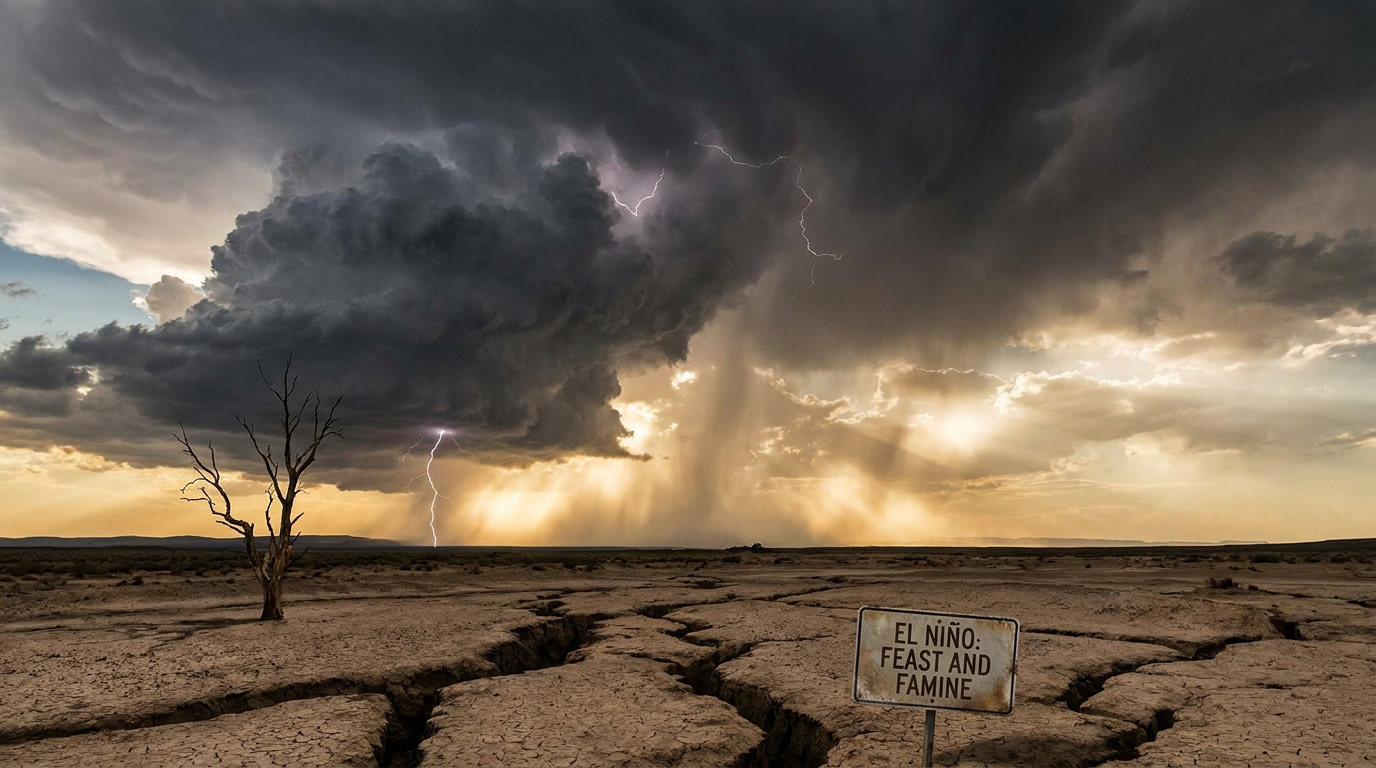
The global climate system has officially entered a new, highly volatile phase. In June 2026, the National Oceanic and Atmospheric Administration (NOAA) declared the arrival of El Niño, the warm phase of the El Niño-Southern Oscillation (ENSO) that periodically disrupts weather patterns worldwide. But this is not a routine cyclical shift. The World Meteorological Organization warns that the developing phenomenon threatens to pour fuel on an already overheating planet, dramatically amplifying the risk of extreme weather events. As sea surface temperatures in the tropical Pacific surge past historical averages, the world faces the prospect of a climate double-whammy: a naturally potent warming event layered on top of record-breaking anthropogenic global warming.[2][3]
The immediate forecasts point to a potentially historic anomaly. NOAA’s Climate Prediction Center currently estimates a 63 percent probability that this El Niño will intensify into a "very strong" event by the Northern Hemisphere winter of 2026-2027. To meet this threshold, ocean surface temperatures in the central and eastern equatorial Pacific must rise at least 2.0 degrees Celsius above the long-term average. If realized, this would place the 2026 event in the same rarefied category as the devastating "super" El Niños of 1997-1998 and 2015-2016. Those previous episodes triggered cascading global crises, from catastrophic flooding in the Americas to severe droughts in Southeast Asia and Australia.[2]
As this formidable weather pattern takes shape, a vigorous debate has emerged within the scientific community regarding the exact relationship between human-caused climate change and ENSO dynamics. Researchers universally agree that global warming raises the baseline temperature, making the impacts of El Niño more severe. However, they remain divided on whether greenhouse gas emissions are fundamentally altering the internal mechanics of the ENSO cycle itself—essentially, whether climate change is actively "supercharging" the intensity and frequency of the phenomenon. This distinction is critical for long-term climate modeling and global disaster preparedness.[1][7]
To understand the debate, one must first understand the baseline mechanism of El Niño. Under neutral conditions, strong easterly trade winds blow across the tropical Pacific, pushing warm surface water toward Asia and allowing cold, nutrient-rich water to upwell off the coast of South America. During an El Niño event, these trade winds inexplicably weaken or even reverse. The massive pool of warm water sloshes back eastward across the Pacific, fundamentally altering the transfer of heat and moisture between the ocean and the atmosphere. This shift reshapes the Walker Circulation, displacing the Pacific jet stream and triggering a domino effect of atmospheric disruptions across the globe.[2]

The clearest intersection between climate change and El Niño lies in the baseline thermodynamics of the ocean. Because the world's oceans have absorbed roughly 90 percent of the excess heat trapped by greenhouse gases, an El Niño event today operates in a fundamentally different environment than it did a century ago. When the weakened trade winds allow that deep reservoir of oceanic heat to vent into the atmosphere, it pushes global average temperatures to unprecedented heights. This is why the United Nations has warned that the current El Niño, combined with the anthropogenic baseline, makes it almost certain that the world will temporarily breach the 1.5-degree Celsius warming threshold established by the Paris Agreement.[3][6]
Beyond the baseline warming, there is growing evidence supporting the claim that climate change is directly increasing the variability and extremity of ENSO events. Recent climate modeling research, including comprehensive studies published in the journal Nature, has analyzed the rapid increase in greenhouse gas emissions since the 1960s. By comparing simulations of the early 20th century with the post-1960s era, researchers found a consensus across dozens of global climate models indicating that the amplitude of ENSO variability has measurably increased. This suggests that the pendulum swings between El Niño and its cooling counterpart, La Niña, are becoming more violent due to human interference.[5]
The Intergovernmental Panel on Climate Change (IPCC) provides another critical piece of the evidence pack: the hydrological extremes. While the IPCC's Sixth Assessment Report notes that there is no absolute consensus on whether sea surface temperature anomalies will permanently shift, it states with high confidence that ENSO-related precipitation variability will increase significantly. In simpler terms, climate change dictates that the wet regions during an El Niño will experience far heavier, more destructive rainfall, while the dry regions will suffer more profound and prolonged droughts. The atmosphere holds about 7 percent more moisture for every 1 degree Celsius of warming, turning El Niño's altered storm tracks into atmospheric firehoses.[4]

The Intergovernmental Panel on Climate Change (IPCC) provides another critical piece of the evidence pack: the hydrological extremes.
Despite these findings, attributing specific changes in El Niño's behavior directly to global warming remains one of the most complex challenges in atmospheric science. The ENSO cycle is heavily governed by "natural internal variability"—the chaotic, inherent fluctuations of the Earth's climate system that occur without any external forcing. Because reliable, high-quality instrumental records of the equatorial Pacific only date back a few decades, scientists struggle to definitively separate the signal of human-caused climate change from the noise of natural oceanic cycles. Some researchers argue that the recent string of intense El Niños could still fall within the statistical bounds of historical, pre-industrial variability.[1][4]
Complicating the measurement further is the phenomenon of uniform ocean warming. Traditionally, El Niño is defined by the temperature difference between the anomalously warm eastern Pacific and the rest of the ocean. But because climate change is warming the entire global ocean simultaneously, the relative temperature gradients that drive atmospheric circulation are shifting. Meteorologists are increasingly debating whether to use "relative" indices rather than absolute temperature thresholds to define ENSO strength. If the entire Pacific is boiling, a localized warm patch might not generate the same atmospheric pressure differentials it historically would, adding a layer of profound uncertainty to seasonal forecasts.[7]
Regardless of the precise mechanical attribution, the real-world consequences of the 2026 El Niño are already materializing. The World Meteorological Organization has urged governments to prepare for severe disruptions to global agriculture. Historically, strong El Niño events suppress the Indian monsoon, leading to diminished crop yields in South Asia, while simultaneously causing severe droughts in the Amazon basin and Central America. With global food supply chains already strained by geopolitical conflicts and previous climate disasters, a sharp drop in agricultural output from these key regions could trigger a spike in global food prices and exacerbate food insecurity in vulnerable nations.[3][6]
The threat of supercharged wildfires is equally alarming. Researchers at the World Weather Attribution group note that the transition into El Niño drastically increases the likelihood of severe, hot, and dry conditions across Australia, Indonesia, and western North America. The combination of a desiccated landscape and record-high baseline temperatures creates a tinderbox environment. During the 2015-2016 El Niño, massive peatland fires in Indonesia released billions of tons of carbon dioxide, creating a dangerous feedback loop. Forecasters warn that the 2026 event could trigger a similar or worse crisis, particularly in the Amazon rainforest, where drought conditions are already severe.[6]

Marine ecosystems are also bracing for catastrophic impacts. The influx of unusually warm water into the eastern Pacific suppresses the upwelling of cold, nutrient-rich deep water, which forms the foundation of the marine food web. This leads to massive die-offs of phytoplankton, crashing fish populations, and devastating the commercial fishing industries of South American nations like Peru and Ecuador. Furthermore, the sustained thermal stress across the tropics is expected to trigger a global mass coral bleaching event, threatening the survival of reef ecosystems that are already living at the absolute upper limit of their thermal tolerance.[2]
The economic toll of these combined impacts is staggering. Economic analyses of past extreme ENSO events suggest that the global damages from a "very strong" El Niño can range from $2 trillion to $4 trillion in lost gross domestic product, factoring in agricultural losses, infrastructure damage from flooding, and suppressed labor productivity due to extreme heat. If climate change is indeed increasing the frequency of these high-amplitude events, the compounded economic damage over the 21st century could reach tens of trillions of dollars, fundamentally altering the financial calculus of climate adaptation and loss-and-damage compensation.[5]

Significant unknowns remain as the 2026 event unfolds. Forecasters cannot yet predict exactly how the altered Pacific jet stream will interact with a rapidly warming Arctic, which is experiencing its own unprecedented ice loss. The interplay between a strong El Niño and a weakened polar vortex could lead to highly unpredictable winter weather patterns across North America and Europe. Additionally, it remains unclear whether this El Niño will be a short-lived spike or a prolonged, multi-year event that fundamentally resets the global temperature baseline to a new, hotter normal.[1][7]
Ultimately, the 2026 El Niño serves as a real-time stress test for a planet in transition. While the scientific debate over the exact mechanics of ENSO supercharging will continue to evolve with new data, the practical reality is already clear. The convergence of a powerful natural climate cycle with the relentless upward trajectory of human-caused global warming guarantees that the impacts will be felt in every corner of the globe. As the Pacific Ocean continues to vent its accumulated heat, the world must navigate an era where the boundaries between natural weather extremes and unnatural climate disruption have been permanently erased.[1][3]
How we got here
1997–1998
A devastating 'super' El Niño causes massive global disruptions and record temperatures.
2015–2016
The last recorded 'very strong' El Niño triggers severe droughts in the Amazon and massive coral bleaching.
June 2026
NOAA officially declares the arrival of El Niño conditions in the tropical Pacific.
Winter 2026–2027
Forecasters predict a 63 percent probability that the current event will peak as a 'very strong' El Niño.
Viewpoints in depth
Climate Attribution Researchers
Scientists who argue that greenhouse gas emissions are actively altering the mechanics and increasing the amplitude of the ENSO cycle.
This camp points to advanced climate modeling and historical comparisons that show a distinct shift in ENSO behavior since the 1960s. They argue that the rapid accumulation of oceanic heat is not just a passive baseline, but an active driver that makes the pendulum swings between El Niño and La Niña more violent. By analyzing the frequency of 'super' events over the past few decades, they conclude that human interference has already fundamentally changed the tropical Pacific's internal dynamics.
Natural Variability Proponents
Researchers who emphasize that ENSO is inherently chaotic and that recent extremes cannot yet be definitively separated from natural historical cycles.
These scientists caution against premature attribution, noting that the Earth's climate system is deeply complex and capable of producing extreme anomalies without external forcing. Because reliable instrumental records of the equatorial Pacific only go back a few decades, they argue that we lack the long-term data necessary to prove that recent 'very strong' El Niños fall outside the bounds of pre-industrial natural variability. They maintain that while the baseline is warmer, the engine of ENSO remains largely natural.
Global Impact Forecasters
Meteorologists and economists focused on the downstream consequences of the event, regardless of the exact attribution mechanics.
For this group, the mechanical debate over attribution is secondary to the immediate physical and economic threats. They focus on the reality that a strong El Niño, when combined with record-high global baseline temperatures, will inevitably produce unprecedented extreme weather. Their primary concern is mobilizing governments and supply chains to prepare for the trillions of dollars in potential damages, agricultural failures, and infrastructure stress that the 2026 event is projected to unleash.
What we don't know
- Whether the 2026 El Niño will be a short-lived seasonal spike or a prolonged, multi-year event.
- Exactly how the altered Pacific jet stream will interact with unprecedented Arctic ice loss during the Northern Hemisphere winter.
- To what extent recent 'super' El Niños are driven by human-caused climate change versus the Earth's natural internal variability.
Key terms
- El Niño-Southern Oscillation (ENSO)
- A recurring climate pattern involving changes in the temperature of waters in the central and eastern tropical Pacific Ocean.
- Walker Circulation
- An east-west atmospheric circulation pattern across the tropical Pacific, driven by ocean temperature differences.
- Upwelling
- An oceanographic process where deep, cold, nutrient-rich water rises to the surface, typically suppressed during an El Niño.
- Teleconnections
- Climate anomalies that are related to each other at large distances, such as how Pacific ocean temperatures affect rainfall in North America.
- Internal Variability
- Natural, chaotic fluctuations within the Earth's climate system that occur without any external forcing like greenhouse gases.
Frequently asked
What makes an El Niño 'very strong' or 'super'?
An El Niño is classified as 'very strong' when sea surface temperatures in the central and eastern equatorial Pacific rise at least 2.0 degrees Celsius above the long-term average.
How does El Niño affect global temperatures?
During an El Niño, the ocean releases massive amounts of stored heat into the atmosphere, which temporarily spikes global average temperatures, often leading to record-breaking warm years.
Is climate change causing El Niño?
No, El Niño is a natural climate cycle that has existed for thousands of years. However, scientists are actively debating whether climate change is making these events more frequent or intense.
What are the economic impacts of a strong El Niño?
Extreme El Niño events can cause trillions of dollars in global economic damage due to agricultural failures, infrastructure destruction from flooding, and suppressed labor productivity.
Sources
Source coverage
7 outlets
3 viewpoints surfaced







[1]The New York TimesNatural Variability Proponents
Is Climate Change Supercharging El Niño?
Read on The New York Times →[2]NOAAGlobal Impact Forecasters
El Niño conditions are present and expected to strengthen into the Northern Hemisphere winter 2026-27
Read on NOAA →[3]World Meteorological OrganizationGlobal Impact Forecasters
WMO Update: Prepare for El Niño and supercharged weather extremes
Read on World Meteorological Organization →[4]IPCCNatural Variability Proponents
Climate Change 2021: The Physical Science Basis
Read on IPCC →[5]NatureClimate Attribution Researchers
Anthropogenic impacts on El Niño-Southern Oscillation variability
Read on Nature →[6]The GuardianGlobal Impact Forecasters
UN agency predicts phenomenon that supercharges weather extremes has 80% chance of forming before September
Read on The Guardian →[7]Factlen Editorial TeamClimate Attribution Researchers
Synthesis by Factlen editorial team
Read on Factlen Editorial Team →


Every angle. Every day.
Get science stories with full source coverage and perspective breakdowns delivered to your inbox.