
Hardside vs. Softside Luggage: The 2026 Durability and Trade-Off Analysis
Choosing between hardside and softside luggage comes down to a calculated trade-off between impact protection and packing flexibility. Lab tests and real-world travel data reveal exactly which material suits different travel styles and itineraries.
By Factlen Editorial Team
- Hardside Advocates
- Travelers and analysts who prioritize structural protection and security over packing flexibility.
- Softside Loyalists
- Frequent flyers who value spatial flexibility, expandability, and quick access to essentials.
- Material Innovators
- Industry experts focused on bridging the gap between rigid protection and fabric flexibility.
What's not represented
- · Airline Baggage Handlers
- · Sustainable Luggage Manufacturers
Why this matters
Luggage failure during transit can ruin a trip, destroy valuable electronics, and result in costly replacement fees. Understanding the exact material trade-offs ensures travelers invest in gear that matches their specific itinerary and packing habits, eliminating airport anxiety.
Key points
- Hardside luggage offers superior impact protection and weather resistance, ideal for checked bags and fragile items.
- Softside luggage provides unmatched flexibility, allowing travelers to overpack and squeeze bags into tight overhead bins.
- Modern polycarbonate hardshells are now just as lightweight as traditional ballistic nylon bags.
- Hardside cases lack external pockets, making it difficult to access laptops or passports on the go.
- Softside luggage is vulnerable to heavy impacts and moisture, making it less ideal for extreme weather or rough baggage handling.
The choice between hardside and softside luggage is no longer just an aesthetic preference; it is a calculated decision based on travel habits, airline restrictions, and material science. As airlines handle nearly 4.5 billion bags globally each year, the durability and functionality of travel gear have never been more critical.[1][6]
Historically, the luggage market was sharply divided: hardside meant heavy, brittle plastic, and softside meant fragile fabric. Today, the landscape is dominated by aerospace-grade polycarbonate and high-denier ballistic nylon, blurring the traditional lines of weight and durability while introducing new complexities for consumers.[2][5]
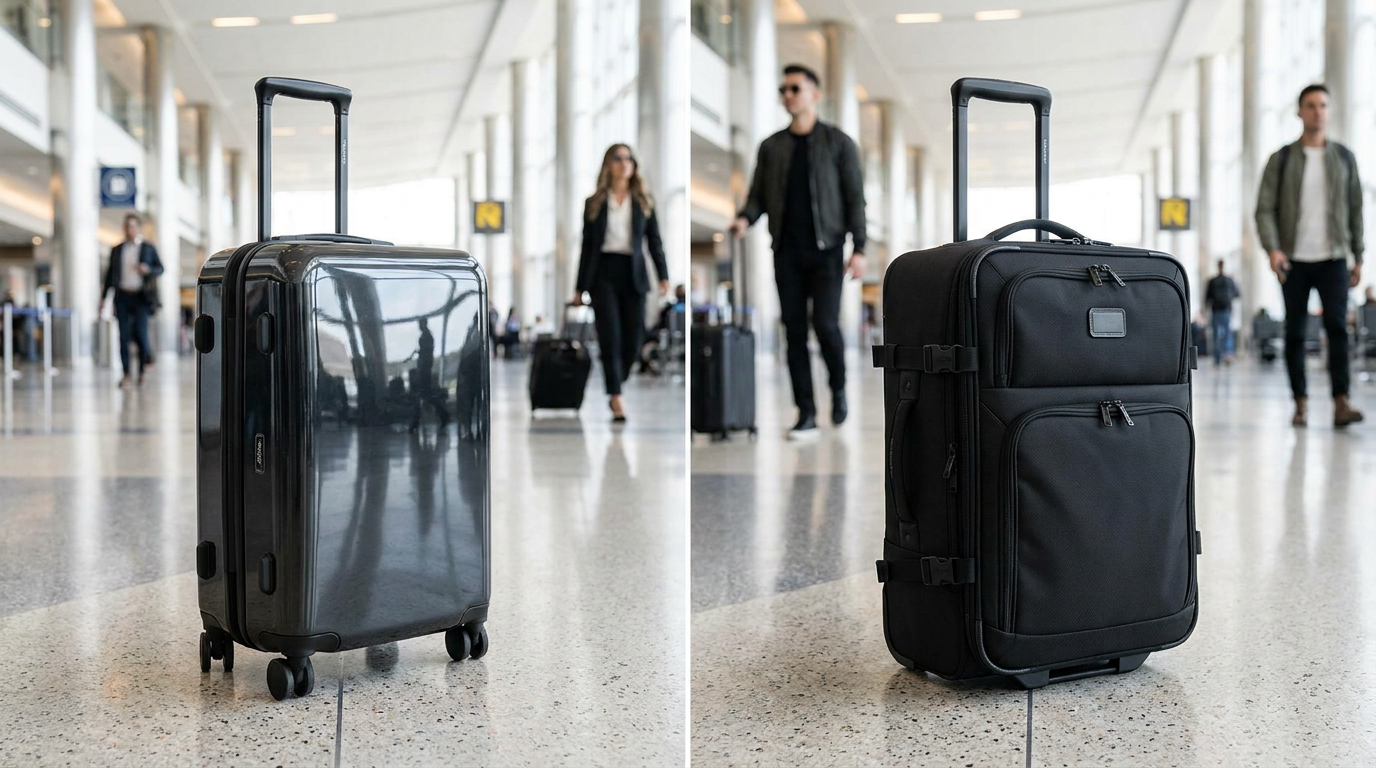
When evaluating hardside luggage, the primary argument for its use centers on structural integrity and impact protection. Travelers carrying fragile items, electronics, or tailored clothing rely on the rigid shell to absorb the brunt of unpredictable baggage handling and turbulent flights.[1][3]
The evidence supporting this protection comes from quantifiable lab tests. In controlled drop tests from 1.2 meters, premium aluminum and polycarbonate shells consistently score between 8.5 and 9.5 out of 10 for impact resistance, effectively shielding internal contents from crushing forces of up to 25 kilograms.[1]

Conversely, the argument against hardside luggage focuses on its inflexibility and lack of external accessibility. Because the shell cannot stretch, a bag that is even slightly overpacked will simply refuse to zip shut, offering zero margin for error for travelers who accumulate items during their trip.[2][3]
Furthermore, traditional hardside cases rarely feature external pockets. Travelers must open the entire clamshell—often laying it flat on a crowded airport floor—just to retrieve a laptop, a passport, or a jacket, which can be highly inconvenient during fast-paced transit.[2][5]
Turning to softside luggage, the primary argument for its use is spatial flexibility and expandability. Woven fabrics like ballistic nylon and polyester can stretch, allowing travelers to squeeze in last-minute items, irregularly shaped gear, or bulky winter clothing.[2][5]
The evidence for softside utility is seen in overhead bin compatibility and volume metrics. Softside bags often feature expansion zippers that add up to two inches of depth, and their pliable nature allows them to be compressed into tight compartments where a rigid hardside case of the exact same dimensions might catch on a bin hinge.[3][4]
The evidence for softside utility is seen in overhead bin compatibility and volume metrics.
Softside luggage also excels in organization. The inclusion of multiple external zippered compartments allows travelers to keep essential documents, reading materials, and toiletries readily accessible without exposing their entire wardrobe to the boarding area.[2][4]

However, the argument against softside luggage involves its vulnerability to extreme abuse and the elements. While high-quality nylon resists tearing, it cannot prevent heavy impacts from transferring directly to the items inside, making it a risky choice for checking fragile goods.[1][3]
Additionally, softside fabrics are susceptible to moisture and stains. While many modern nylons feature water-resistant coatings, they cannot match the natural waterproofing of a solid polycarbonate or aluminum shell during a heavy downpour on an exposed airport tarmac.[1][5]
Weight is another critical metric where the gap has narrowed significantly. While aluminum remains heavy—often weighing eight to nine pounds empty—modern polycarbonate cases can be just as light as their nylon counterparts, meaning travelers no longer have to sacrifice weight for a hard shell.[1][2]
Wear and tear manifest differently on each material. Hardside luggage is prone to cosmetic damage, quickly accumulating scratches, scuffs, and dents that do not affect performance but alter the aesthetic. Softside luggage hides scratches but is vulnerable to frayed edges, ripped seams, and broken zippers if overstuffed.[1][5]

Security considerations also play a role in the trade-off analysis. Hardside cases, particularly those with latch closures and integrated TSA locks, offer a higher barrier to entry against tampering, whereas the fabric of softside bags can theoretically be slashed by a determined thief.[3][5]
Ultimately, hardside luggage fits well when checking bags on international flights, transporting fragile electronics, or navigating wet weather. It provides essential peace of mind when the bag leaves the traveler's sight and enters the unpredictable baggage handling system.[1][3]
However, hardside luggage does not fit well when relying on tight overhead bins on regional jets, road-tripping in vehicles with limited trunk space, or requiring quick access to travel documents on the go.[3][4]

How we got here
1980s
Softside ballistic nylon luggage becomes the standard for frequent flyers due to its durability and lighter weight compared to early hard cases.
2000s
Polycarbonate is introduced to the luggage market, revolutionizing hardside suitcases by offering a lightweight, flexible alternative to heavy metals.
2010s
The rise of strict airline carry-on size limits fuels a surge in hardside popularity, as rigid shells prevent travelers from over-expanding their bags.
2024
Global airline baggage handling reaches record volumes, prompting independent labs to begin rigorous drop and crush testing on luggage materials.
2026
Hybrid designs, such as hardside carry-ons with soft external laptop pockets, gain significant market share by blending the benefits of both materials.
Viewpoints in depth
Hardside Advocates
Travelers and analysts who prioritize structural protection and security over packing flexibility.
This camp argues that the primary function of luggage is to protect its contents from the unpredictable and often brutal environment of transit. They point to lab tests showing that polycarbonate and aluminum shells absorb impacts that would otherwise crush electronics or toiletries. For these travelers, the lack of external pockets is a worthwhile trade-off for the peace of mind that comes with a waterproof, slash-resistant, and crush-proof exterior, especially when checking bags on international flights.
Softside Loyalists
Frequent flyers who value spatial flexibility, expandability, and quick access to essentials.
Softside loyalists view luggage as a dynamic tool that must adapt to varying trip lengths and strict airline overhead bin constraints. They emphasize that high-denier ballistic nylon is incredibly resilient to tearing and can be squeezed into tight spaces where a rigid shell would fail. The ability to stuff a jacket into an expandable compartment or grab a laptop from a front pocket without opening the entire suitcase makes softside luggage the preferred choice for carry-on-only travelers and road-trippers.
Material Innovators
Industry experts focused on bridging the gap between rigid protection and fabric flexibility.
This perspective highlights the rapid advancements in luggage manufacturing that blur the traditional lines between hardside and softside. Innovators point to the development of ultra-lightweight polycarbonate that flexes under pressure without cracking, as well as softside bags engineered with rigid internal honeycomb frames. By focusing on hybrid designs—such as hardshells with zippered front laptop compartments—this camp believes the future of travel gear lies in eliminating the need to choose between protection and convenience.
What we don't know
- Whether airlines will begin weighing carry-on bags more strictly, which would heavily penalize heavier hardside materials.
- How long-term UV exposure affects the structural integrity of newer ultra-lightweight polycarbonate blends over a decade of use.
Key terms
- Polycarbonate
- A highly durable, flexible thermoplastic used in premium hardside luggage that resists cracking by bending under impact.
- Ballistic Nylon
- A thick, synthetic nylon fabric originally developed for military use, known for its exceptional resistance to abrasion and tearing in softside luggage.
- ABS Plastic
- Acrylonitrile butadiene styrene, a rigid and inexpensive plastic often used in budget hardside luggage, though it is more prone to cracking than polycarbonate.
- Denier
- A unit of measurement used to determine the fiber thickness of individual threads or yarns in fabric; a higher denier indicates a thicker, more durable material.
- Clamshell Design
- A suitcase design typical of hardside luggage that opens completely in half, splitting the packing space into two equal, shallow compartments.
Frequently asked
Is polycarbonate or ABS plastic better for hardside luggage?
Polycarbonate is significantly more durable and flexible than ABS plastic. While ABS is cheaper, it is rigid and prone to cracking under pressure, whereas polycarbonate can flex and absorb impacts.
Can softside luggage protect fragile items?
Softside luggage offers minimal crush protection compared to hardshells. While the fabric resists tearing, heavy impacts can transfer through the nylon and damage fragile items packed inside.
Which type of luggage is lighter?
Historically, softside was lighter, but modern polycarbonate hardshells now weigh roughly the same as high-denier nylon bags. Aluminum hardshells remain the heaviest option.
Do airlines prefer hardside or softside carry-ons?
Airlines do not have a strict preference, but softside bags are often easier to squeeze into full overhead bins. However, rigid hardside bags prevent travelers from overpacking beyond the airline's dimensional limits.
Sources
Source coverage
6 outlets
3 viewpoints surfaced






[1]Eume WorldHardside Advocates
The Most Durable Luggage Materials: A Lab-Tested Breakdown
Read on Eume World →[2]ForbesHardside Advocates
Hardside Vs. Softside Luggage: Overview
Read on Forbes →[3]Travel For BusinessSoftside Loyalists
Hardside vs Softside: What's Best for Your Business Travel?
Read on Travel For Business →[4]OutdoorGearLabSoftside Loyalists
Best Carry-On Luggage of 2026
Read on OutdoorGearLab →[5]DelseyMaterial Innovators
What's the Difference Between Hardside and Soft-Side Luggage?
Read on Delsey →[6]Factlen Editorial TeamMaterial Innovators
Synthesis by Factlen editorial team
Read on Factlen Editorial Team →


Every angle. Every day.
Get shopping stories with full source coverage and perspective breakdowns delivered to your inbox.