
How "Via Ferrata" is Democratizing Mountain Climbing Worldwide
Engineered "iron paths" are allowing everyday hikers to safely scale sheer vertical cliffs, sparking a global boom in accessible alpine adventure.
By Factlen Editorial Team
- Tourism & Recreation Advocates
- View via ferratas as a crucial tool for democratizing mountain access and expanding four-season resort revenue.
- Safety & Technical Experts
- Emphasize that the engineered nature of the routes requires specialized gear and training to prevent catastrophic falls.
- Academic & Historical Researchers
- Focus on the historical context of the routes and the need for sustainable, evidence-based environmental management as the sport grows.
What's not represented
- · Local residents in mountain towns dealing with increased traffic and tourism infrastructure.
- · Traditional free-climbers who may oppose the bolting of iron fixtures into pristine rock faces.
Why this matters
Via ferratas bridge the massive gap between a strenuous hike and technical rock climbing, allowing millions of people to experience high-altitude environments safely. However, understanding the specialized gear is critical to preventing catastrophic accidents as the sport expands.
Key points
- Via ferratas are engineered mountain routes equipped with fixed cables, ladders, and rungs that allow hikers to safely scale vertical cliffs.
- Originally developed to move troops through the Italian Dolomites during World War I, the routes have evolved into a booming global tourism industry.
- Climbers use a specialized Y-lanyard with a built-in shock absorber, which tears open to safely decelerate the body in the event of a fall.
- The sport is experiencing massive growth in North America, prompting calls for better research on how to manage the environmental impact on alpine cliffs.
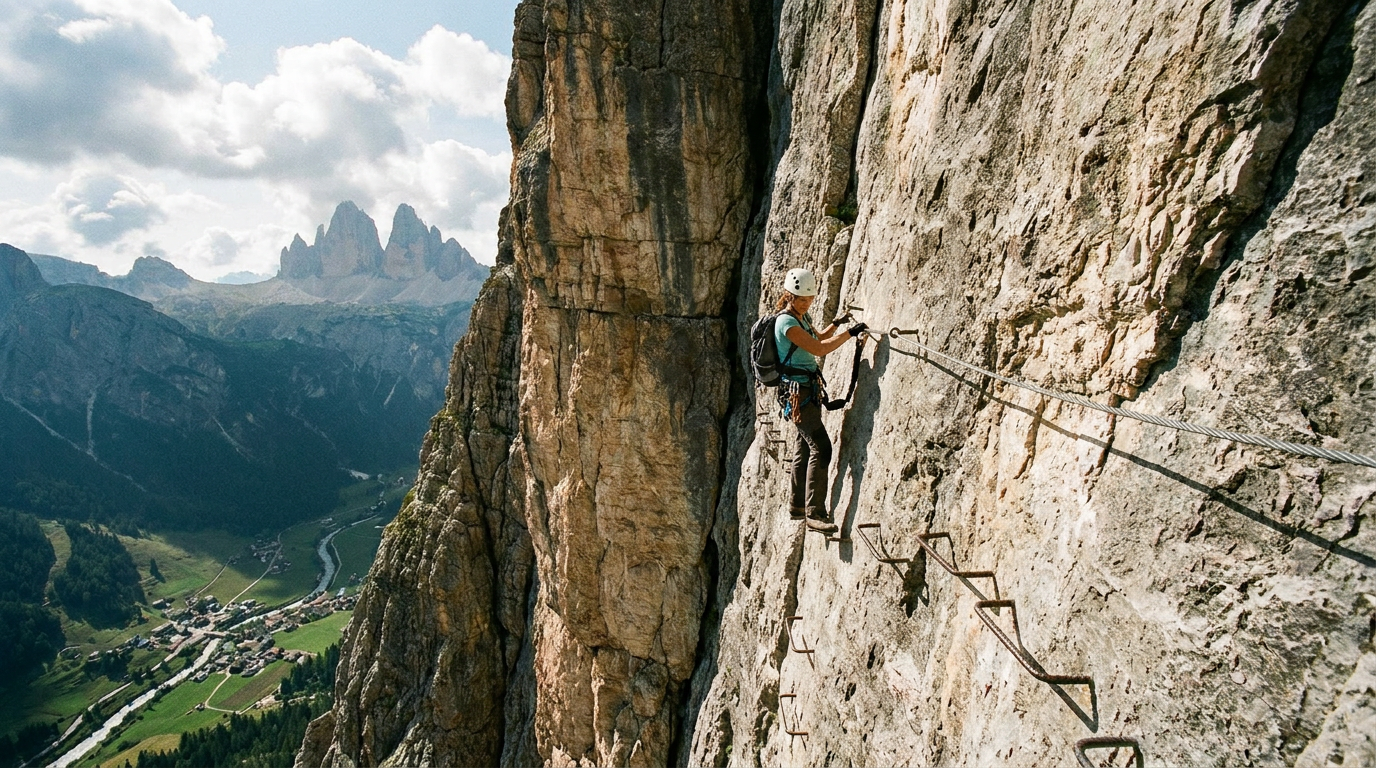
The sensation is entirely unnatural: you are hanging 500 feet above a valley floor, the toes of your boots resting on a two-inch metal rung, your hands gripping a cold steel cable. To your left, a sheer limestone cliff drops away into the abyss. It feels like the domain of elite, sponsored rock climbers, but the person executing this maneuver might be a complete novice on their first alpine vacation.[1][2]
This is the magic of the "via ferrata," an alpine innovation that is rapidly democratizing access to the world's most dramatic vertical landscapes. Once a niche European curiosity, these engineered climbing systems are experiencing a massive global boom, opening up terrain that would otherwise be completely inaccessible to the general public.[1][8]
In North America, the expansion has surged dramatically since 2020. Ski resorts and mountain towns from the Rocky Mountains of Colorado to the Shawangunk Ridge in New York are investing heavily in these routes to attract summer visitors and diversify their seasonal offerings. The global market for via ferrata equipment and tourism hit $300 million in 2024 and is projected to grow by 10 percent annually through 2032.[2][3][4]
But what exactly is a via ferrata? Translating directly to "iron path" in Italian, it is a protected climbing route built directly into a rock face. It features permanently fixed steel cables, iron rungs, pegs, ladders, and suspension bridges bolted deep into the stone.[7]

These permanent fixtures allow hikers with absolutely no technical rock-climbing background to navigate sheer cliffs and exposed ridges safely. It bridges the massive gap between a strenuous uphill hike and a technical, roped-up rock climb, offering the adrenaline of the latter with the accessibility of the former.[1][8]
The origins of the iron path are deeply rooted in alpine history. While early, rudimentary versions appeared in Austria on the Dachstein massif in the 1840s, the via ferrata as we know it today was forged in the crucible of World War I.[3][7]
High in the Italian Dolomites, Italian "Alpini" and Austro-Hungarian "Kaiserjäger" troops fought a brutal, high-altitude war. To move soldiers, artillery, and supplies across impassable, freezing mountain fronts, both armies drilled hundreds of iron rungs and thick cables into the vertical rock.[3][7]
After the war, these sprawling military logistics networks were largely abandoned. Decades later, local alpine clubs began restoring and expanding them for civilian recreation, transforming former battlefields into some of the most spectacular adventure tourism destinations on Earth.[3][7]

Today, the European Alps boast over 2,000 distinct routes. But as the sport crosses the Atlantic and attracts a new generation of adventurers, the underlying mechanics of how climbers actually stay safe on these sheer walls remain a mystery to many new participants.[7][8]
The safety system relies entirely on a specialized piece of gear called a via ferrata set, or a Y-lanyard. This device connects the climber's sitting harness directly to the steel cable running alongside the route.[5][6]
The safety system relies entirely on a specialized piece of gear called a via ferrata set, or a Y-lanyard.
The golden rule of via ferrata is simple: always stay clipped in. The Y-lanyard features two elasticized arms, each ending in an auto-locking carabiner. When a climber reaches an anchor point where the cable is bolted to the rock, they move one carabiner past the anchor, then the other, ensuring they are never fully detached from the mountain.[5][8]
However, the most critical component of the lanyard is the shock absorber. In traditional rock climbing, a dynamic nylon rope stretches significantly to absorb the kinetic energy of a falling climber. On a via ferrata, the steel cable does not stretch at all, and climbers often fall vertically past the last solid anchor point, creating a highly dangerous "fall factor."[5][6]
Without a shock absorber, a via ferrata fall would generate enough static force to instantly snap carabiners or cause severe, life-threatening spinal injuries to the climber. To prevent this catastrophic outcome, the lanyard contains a tightly folded package of webbing held together by specialized, calibrated stitching.[5][6]
In the event of a fall, this stitching is designed to tear open in a controlled manner. As the webbing unravels, it absorbs the kinetic energy of the fall, decelerating the climber and keeping the maximum force exerted on the body strictly below 6 kilonewtons. Once this shock absorber is deployed, the lanyard is permanently destroyed and must be replaced.[5][6]

This brilliantly engineered safety net has made the sport highly accessible, but technical experts consistently warn against the "illusion of safety." A via ferrata, no matter how well-equipped, is still a serious alpine environment where mistakes have severe consequences.[4][8]
Weather is a primary, often underestimated hazard. A continuous steel cable running to the top of an exposed mountain is essentially a giant lightning rod. Climbers caught on a via ferrata during a sudden afternoon thunderstorm face extreme peril, making early starts and rigorous weather checks mandatory.[5][8]
Furthermore, the rapid commercialization of the sport is beginning to outpace academic and environmental research. A 2026 scoping study led by researchers at Lakehead University and the University of Eastern Finland highlighted a critical lack of data on how these routes impact sensitive alpine ecosystems.[4]
Researchers point out that while via ferratas successfully concentrate human impact along a single hardened path, they also introduce unprecedented crowds to previously untouched vertical habitats, potentially disturbing nesting birds and fragile cliff-dwelling flora.[4]

As the industry matures, land managers and resort operators are working to balance this booming demand with sustainable practices. New routes are undergoing stricter environmental assessments, and guided tours are increasingly emphasizing alpine education alongside the physical adrenaline rush.[4][8]
Ultimately, the via ferrata represents a profound shift in how humanity interacts with the mountains. By bolting a path of iron into the stone, the most intimidating peaks on Earth have opened their doors to anyone equipped with a harness, a helmet, and the courage to take the first step upward.[1][8]
How we got here
1843
The first rudimentary via ferrata is installed on the Dachstein massif in Austria to aid mountaineers and researchers.
1914–1918
Italian and Austro-Hungarian armies construct hundreds of iron paths in the Dolomites to move troops and artillery during World War I.
1990s
A boom in recreational via ferratas begins in France as ski resorts look for new ways to attract summer tourists.
2020s
Via ferrata installations surge across North America, driven by a post-pandemic increase in demand for accessible outdoor adventure.
Viewpoints in depth
Tourism & Recreation Advocates
View via ferratas as a crucial tool for democratizing mountain access and expanding four-season resort revenue.
For mountain towns and ski resorts, via ferratas represent a highly lucrative, low-footprint way to attract summer tourism. Advocates argue that these routes democratize the outdoors, allowing families and non-athletes to experience the profound psychological rewards of high-altitude exposure without needing years of technical rock-climbing training. By providing a structured, guided experience, resorts can safely introduce a broader demographic to alpine environments.
Safety & Technical Experts
Emphasize that the engineered nature of the routes requires specialized gear and training to prevent catastrophic falls.
Safety professionals worry about the "theme park" illusion that via ferratas can project. Because the path is bolted into the rock, beginners often underestimate the objective hazards of the mountains, such as rapidly changing weather, lightning strikes, and rockfall. Technical experts stress that using improper gear—such as a static rope instead of a certified shock-absorbing lanyard—can turn a routine slip into a fatal accident due to the immense static forces generated during a via ferrata fall.
Academic & Historical Researchers
Focus on the historical context of the routes and the need for sustainable, evidence-based environmental management as the sport grows.
Researchers point out that via ferratas are expanding much faster than our understanding of their ecological impact. While traditional hiking trails have decades of environmental management data behind them, the specific impact of routing hundreds of humans through vertical cliff habitats remains under-researched. Academics are calling for a consolidated evidence base to help land managers balance the booming commercial demand with the preservation of fragile alpine ecosystems.
What we don't know
- The long-term ecological impact of routing high volumes of human traffic through previously untouched vertical cliff habitats.
- How climate change and increased rockfall from thawing permafrost will affect the structural integrity of via ferrata anchors in the high Alps.
- Whether the rapid expansion of routes in North America will lead to stricter federal or state regulations regarding safety and land use.
Key terms
- Via Ferrata
- Italian for "iron path," a protected mountain route equipped with fixed cables, ladders, and bridges to aid climbers.
- Y-Lanyard
- A specialized piece of safety equipment with two arms and carabiners that connect a climber's harness to the steel cable.
- Shock Absorber
- A deployable webbing system built into the lanyard that tears open during a fall to reduce the impact force on the climber's body.
- Fall Factor
- A ratio used to determine the severity of a climbing fall; via ferrata falls can be uniquely dangerous because climbers fall past fixed anchor points.
- Carabiner
- A specialized metal loop with a sprung gate used to quickly connect components, designed in via ferrata to be easily operated with one hand.
Frequently asked
Do I need rock climbing experience to do a via ferrata?
No. Via ferratas are designed to be accessible to hikers with basic fitness and a head for heights. However, beginners are strongly encouraged to hire a guide for their first experience.
Can I just use a regular climbing rope and carabiners?
Absolutely not. A standard static rope or sling without a deployable shock absorber will transfer lethal force to your body and equipment during a via ferrata fall.
What happens if I fall on the route?
The shock absorber in your lanyard will tear open to catch you safely and reduce the impact force. However, the lanyard is destroyed in the process and must be replaced immediately.
Where are the most via ferrata routes located?
The vast majority are located in the European Alps, particularly in the Italian Dolomites and Austria, though North America is rapidly expanding its offerings.
Sources
Source coverage
8 outlets
3 viewpoints surfaced








[1]Outside MagazineTourism & Recreation Advocates
Eagle Cliff Via Ferrata, New York, U.S.
Read on Outside Magazine →[2]Field MagTourism & Recreation Advocates
12 Best Via Ferrata Routes in the US
Read on Field Mag →[3]Adventure Park InsiderTourism & Recreation Advocates
The Iron Way: Via Ferrata Growth
Read on Adventure Park Insider →[4]EurekAlertAcademic & Historical Researchers
Via Ferrata's global rise prompts call for industry collaboration
Read on EurekAlert →[5]EdelridSafety & Technical Experts
The via ferrata lanyard knowledge base
Read on Edelrid →[6]CanyonZoneSafety & Technical Experts
How does the fall protection via ferrata set work?
Read on CanyonZone →[7]WikipediaAcademic & Historical Researchers
Via ferrata
Read on Wikipedia →[8]Factlen Editorial TeamSafety & Technical Experts
Synthesis by Factlen editorial team
Read on Factlen Editorial Team →
Every angle. Every day.
Get travel stories with full source coverage and perspective breakdowns delivered to your inbox.