
How Zero-Waste Restaurants Actually Operate: The Mechanics of Circular Gastronomy
By redesigning supply chains and utilizing commercial composters, a new wave of restaurants is proving that eliminating food waste is both an environmental necessity and a highly profitable business model.
By Factlen Editorial Team
- Circular Gastronomy Pioneers
- Chefs and restaurateurs pushing for 100% closed-loop systems and radical zero-waste innovation.
- Pragmatic Operators
- Industry professionals focused on the economic margins of waste reduction and realistic diversion rates.
- Industry Evaluators
- Critics and guides grappling with how to standardize, measure, and reward sustainability in fine dining.
What's not represented
- · Local Farmers
- · Waste Management Municipalities
Why this matters
The restaurant industry loses billions annually to food waste, driving up menu prices and environmental costs. Understanding how circular kitchens operate reveals a blueprint for sustainable businesses that actually improve their profit margins while eliminating their ecological footprint.
Key points
- The US restaurant industry loses an estimated $162 billion annually to food waste.
- Circular gastronomy aims to eliminate waste by refusing single-use packaging and utilizing root-to-stem cooking.
- Investments in food waste reduction yield an average 14x return by lowering disposal fees and food costs.
- Commercial composters allow kitchens to turn unavoidable organic scraps into nutrient-rich soil within 24 hours.
- While 100% zero waste is difficult due to health codes, a 90% diversion rate is a highly profitable and realistic target.
The global restaurant industry has long operated on a linear "take-make-dispose" model, generating staggering amounts of refuse. In the United States alone, restaurants collectively lose an estimated $162 billion annually through food waste, while the UK hospitality sector discards over a million tonnes of food each year. For decades, this inefficiency was accepted as an unavoidable cost of doing business in a high-pressure, margin-thin industry.[1][7]
But a growing movement known as "circular gastronomy" is systematically dismantling that assumption. By redesigning supply chains, rethinking menu development, and deploying new kitchen technologies, a wave of pioneering chefs is proving that a restaurant can operate without a traditional trash bin. This is not merely an environmental crusade; it is a fundamental restructuring of hospitality economics.[2][7]
The financial case for eliminating waste is remarkably robust. Industry analyses indicate that for every single dollar a restaurant invests in food waste reduction, it yields approximately $14 in returns. By maximizing ingredient utility and slashing disposal fees, operators are transforming what was once a costly liability into a reliable revenue stream.[1]

The mechanics of a zero-waste restaurant begin long before ingredients reach the cutting board. The first step is "refusing"—rejecting single-use packaging entirely. Establishments operating under this model require suppliers to deliver produce, meat, and dairy in reusable crates or pails, establishing a direct, packaging-free relationship with local farmers.[3]
To further bypass industrial packaging, many circular kitchens bring processing in-house. It is increasingly common for these restaurants to mill their own flour from whole grains, churn their own butter, and ferment their own beverages. By controlling the primary processing, chefs eliminate the plastic and cardboard that typically accompany staple ingredients.[4]
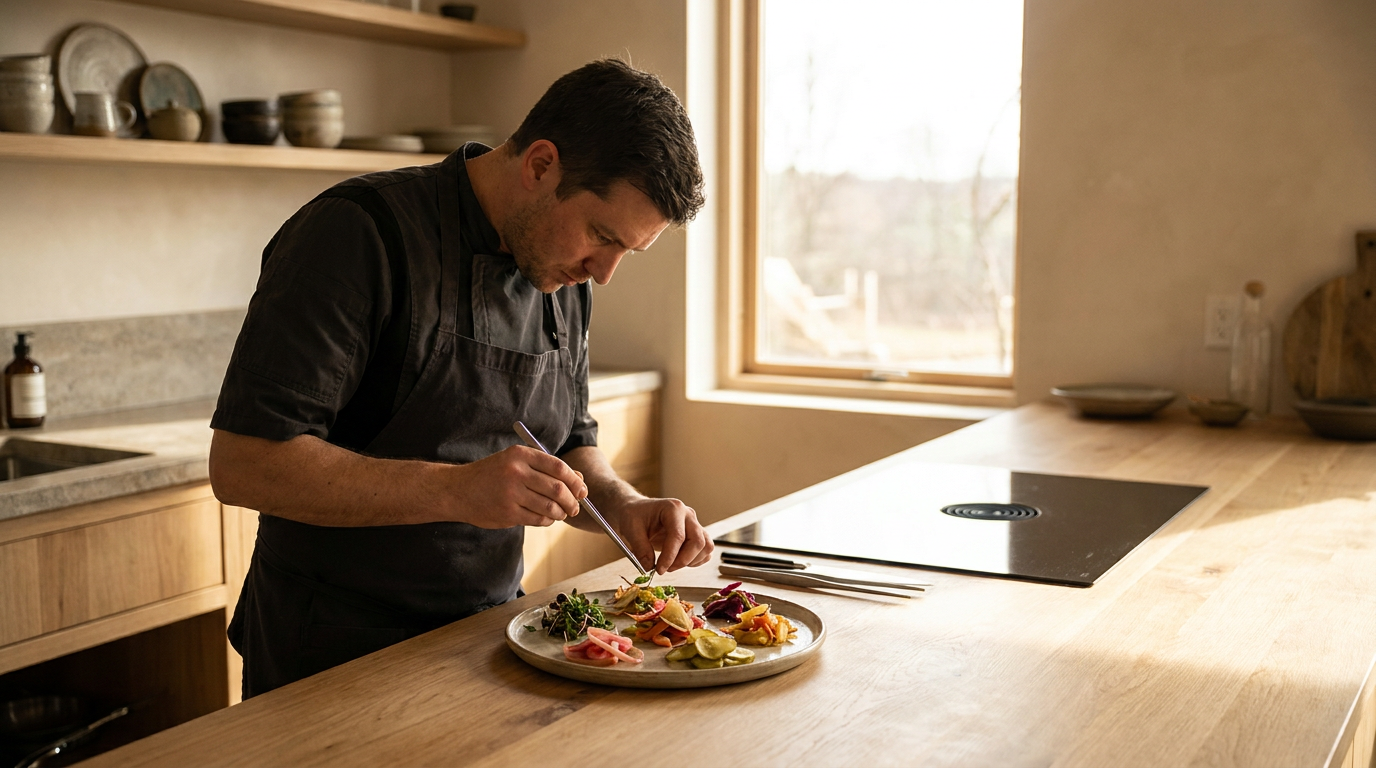
Once the raw materials are in the kitchen, the philosophy of "root-to-stem" and "nose-to-tail" cooking takes over. Culinary teams are trained to view every component of an ingredient as valuable. Carrot tops are blended into vibrant pestos, broccoli stems are pickled for acidity, and cauliflower leaves are roasted into crispy garnishes.[3]
What cannot be served in its original form is upcycled through fermentation and preservation. Fish bones and trimmings are fermented into umami-rich garums, fruit peels are transformed into natural dyes or cocktail infusions, and stale bread is repurposed into breadcrumbs or even brewed into craft beer. These techniques extract maximum flavor and financial value from items that traditional kitchens simply throw away.[1][3]
What cannot be served in its original form is upcycled through fermentation and preservation.
The zero-waste ethos frequently extends beyond the menu and into the physical dining room. At Silo in London, widely recognized as the world's first zero-waste restaurant, the interior design itself is a masterclass in upcycling. The restaurant's tables are crafted from compressed food packaging, and its plates are formed from melted-down plastic bags.[4]

Even with meticulous planning and creative upcycling, some organic waste—like eggshells, coffee grounds, and customer plate scrapings—is inevitable. To handle this, circular restaurants rely on advanced commercial composting technology.[2][5]
Machines like the EcoRich Elite II or the TMK-5000 have become essential fixtures in these kitchens. These aerobic composters use heat, agitation, and specialized microbes to break down organic matter rapidly, transforming vegetable waste and food scraps into nutrient-rich compost overnight.[5]
This creates the final link in the circular gastronomy chain. The freshly generated compost is packaged and sent back to the very farmers who supplied the restaurant's produce. At establishments like Frea in Berlin—the world's first fully vegan zero-waste restaurant—and the Harbor House Inn in California, this closed-loop system ensures that today's food scraps literally fertilize tomorrow's harvest.[4][5]

Despite these innovations, achieving absolute, 100 percent zero waste remains incredibly difficult. Strict municipal health codes, complex supply chain limitations, and local infrastructure gaps present constant hurdles for operators.[1]
Consequently, pragmatic restaurateurs generally aim for a 90 percent waste diversion rate. Reaching this threshold requires intense operational discipline, but it is widely considered the most realistic and profitable target for modern commercial kitchens looking to minimize their environmental footprint.[1]
As the movement has grown, the broader culinary establishment has struggled to standardize and evaluate these practices. In 2020, the Michelin Guide introduced the Green Star to recognize restaurants demonstrating exceptional commitment to sustainable gastronomy and resource management.[6]
However, the evaluation of sustainability proved complex. In May 2026, Michelin abruptly announced that it would phase out the Green Star by the end of the year, replacing it with an editorial platform called "Mindful Voices." The decision frustrated many sustainable chefs who viewed the star as a vital benchmark, highlighting the ongoing tension between traditional fine-dining metrics and modern ecological imperatives.[6]

Yet, the momentum of circular gastronomy appears largely independent of institutional accolades. Consumer demand for ethical, transparent dining experiences continues to rise, and the operational savings provide a permanent incentive for chefs to keep innovating.[1][7]
Ultimately, the zero-waste restaurant is transitioning from a radical experiment into a practical blueprint. By proving that sustainability and profitability can coexist, these kitchens are writing a new operational playbook that promises to reshape the future of the global hospitality industry.[1][2][7]
How we got here
2014
Silo opens in London, widely recognized as the world's first zero-waste restaurant.
2020
The Michelin Guide introduces the Green Star to recognize restaurants demonstrating exceptional commitment to sustainable practices.
2023
Frea in Berlin earns a Michelin Green Star, becoming the first fully vegan zero-waste restaurant to receive the accolade.
May 2026
Michelin announces the retirement of the Green Star in favor of the "Mindful Voices" platform, sparking debate over sustainability metrics.
Viewpoints in depth
Circular Gastronomy Pioneers
Chefs pushing for absolute zero-waste operations through radical innovation.
This camp, exemplified by restaurants like Silo and Frea, views any waste as a "failure of the imagination." They advocate for completely redesigning the restaurant model from the ground up—milling their own flour, churning butter, and upcycling interior furniture to avoid industrial packaging entirely. For these pioneers, the goal is a 100% closed-loop system where nothing enters a landfill.
Pragmatic Operators
Industry professionals focused on the economic benefits of waste reduction.
Pragmatists acknowledge that achieving absolute zero waste is often hindered by strict health codes and supply chain realities. Instead, they target a highly efficient 90% waste diversion rate. This camp emphasizes the financial mathematics of sustainability: by reducing food waste, restaurants can lower their Cost of Goods Sold (CoGS) and achieve a 14x return on investment, making eco-friendly practices a core strategy for business survival.
Industry Evaluators
Critics and guides grappling with how to measure and reward sustainability.
Organizations like the Michelin Guide and academic researchers fall into this camp. They recognize the importance of circular gastronomy but struggle with standardizing the metrics. Michelin's 2026 decision to replace the Green Star with the "Mindful Voices" platform highlights the difficulty of verifying self-reported sustainability claims and the tension between traditional fine-dining standards and modern ecological requirements.
What we don't know
- How the broader hospitality industry will standardize sustainability metrics now that Michelin is phasing out the Green Star.
- Whether municipal health codes will evolve to make 100% zero-waste operations legally feasible for mainstream restaurants.
Key terms
- Circular Gastronomy
- A systemic approach to food preparation that eliminates waste by keeping resources in a continuous loop of use, recovery, and regeneration.
- Root-to-Stem Cooking
- A culinary philosophy that utilizes every edible part of a plant—including leaves, stems, and peels—to maximize yield and minimize waste.
- Upcycling
- The process of transforming byproducts, waste materials, or unwanted items into new materials or products of better quality and environmental value.
- Closed-Loop Sourcing
- A supply chain model where materials are continuously recycled or returned to their origin, such as sending restaurant compost back to the farms that grew the produce.
Frequently asked
What is a zero-waste restaurant?
A zero-waste restaurant is an establishment that aims to eliminate all trash sent to landfills by refusing single-use packaging, utilizing every part of an ingredient, and composting unavoidable organic waste.
How do zero-waste restaurants handle unavoidable food scraps?
Most utilize advanced commercial composters that use heat and microbes to break down organic matter into nutrient-rich soil within 24 hours, which is then returned to partner farms.
Is zero-waste dining more expensive for the customer?
Not necessarily. Because zero-waste practices drastically reduce food costs and disposal fees, restaurants often improve their profit margins, allowing them to maintain competitive menu prices.
Why is Michelin retiring the Green Star in 2026?
Michelin announced it will phase out the Green Star by the end of 2026 in favor of an editorial platform called "Mindful Voices," reflecting the ongoing challenge of standardizing and evaluating sustainability metrics across the global industry.
Sources
Source coverage
7 outlets
3 viewpoints surfaced







[1]Plastic Container CityPragmatic Operators
How to Turn Waste into Profit: A Scrap Dining Guide
Read on Plastic Container City →[2]MDPIIndustry Evaluators
Restaurants without Bins: How Does a Circular Restaurant Operate?
Read on MDPI →[3]JoinstoredCircular Gastronomy Pioneers
Zero-Waste Restaurant Guide: Turn Food Waste into Profit
Read on Joinstored →[4]4OceanCircular Gastronomy Pioneers
Zero-Waste Success Stories: How Restaurants Are Leading the Way
Read on 4Ocean →[5]Elite TravelerIndustry Evaluators
The Fine Dining Zero Waste Restaurants in the USA
Read on Elite Traveler →[6]The GuardianIndustry Evaluators
'We feel let down': sustainable chefs in UK mourn end of Michelin green star
Read on The Guardian →[7]Factlen Editorial TeamPragmatic Operators
Synthesis by Factlen editorial team
Read on Factlen Editorial Team →

Every angle. Every day.
Get lifestyle stories with full source coverage and perspective breakdowns delivered to your inbox.