
White Earth Nation Activates Solar Microgrid, Transforming Tribal School Into a 'Resilience Hub'
The Pine Point School in northern Minnesota has launched a 500-kilowatt solar and battery microgrid, securing energy independence and emergency backup power for a community that has historically faced severe energy burdens.
By Factlen Editorial Team
- Tribal Leadership & Community
- Values energy sovereignty, cultural stewardship, and protecting vulnerable residents from outages.
- Clean Energy Developers
- Focuses on climate justice, scaling microgrid technology, and local workforce development.
- State & Federal Policymakers
- Prioritizes grid modernization, rural electrification, and the effective deployment of federal grants.
What's not represented
- · Local utility cooperative managers
- · Regional grid operators
Why this matters
For rural and tribal communities vulnerable to extreme weather and high utility costs, decentralized microgrids offer a blueprint for energy sovereignty—keeping the lights on during storms while redirecting hundreds of thousands of dollars from utility bills back into classrooms.
Key points
- The Pine Point School on the White Earth Reservation has officially commissioned a 500-kilowatt solar and 2.76-megawatt-hour battery microgrid.
- The decentralized system allows the school to operate independently during severe winter storms, serving as a reliable emergency shelter.
- The project is projected to save the school district $825,000 over 25 years, with funds being redirected into classrooms.
- Students are using real-time data from the array in an Ojibwe-language curriculum focused on renewable energy and environmental stewardship.
- The initiative highlights a broader trend of tribal nations pursuing energy sovereignty to combat historically high utility burdens.
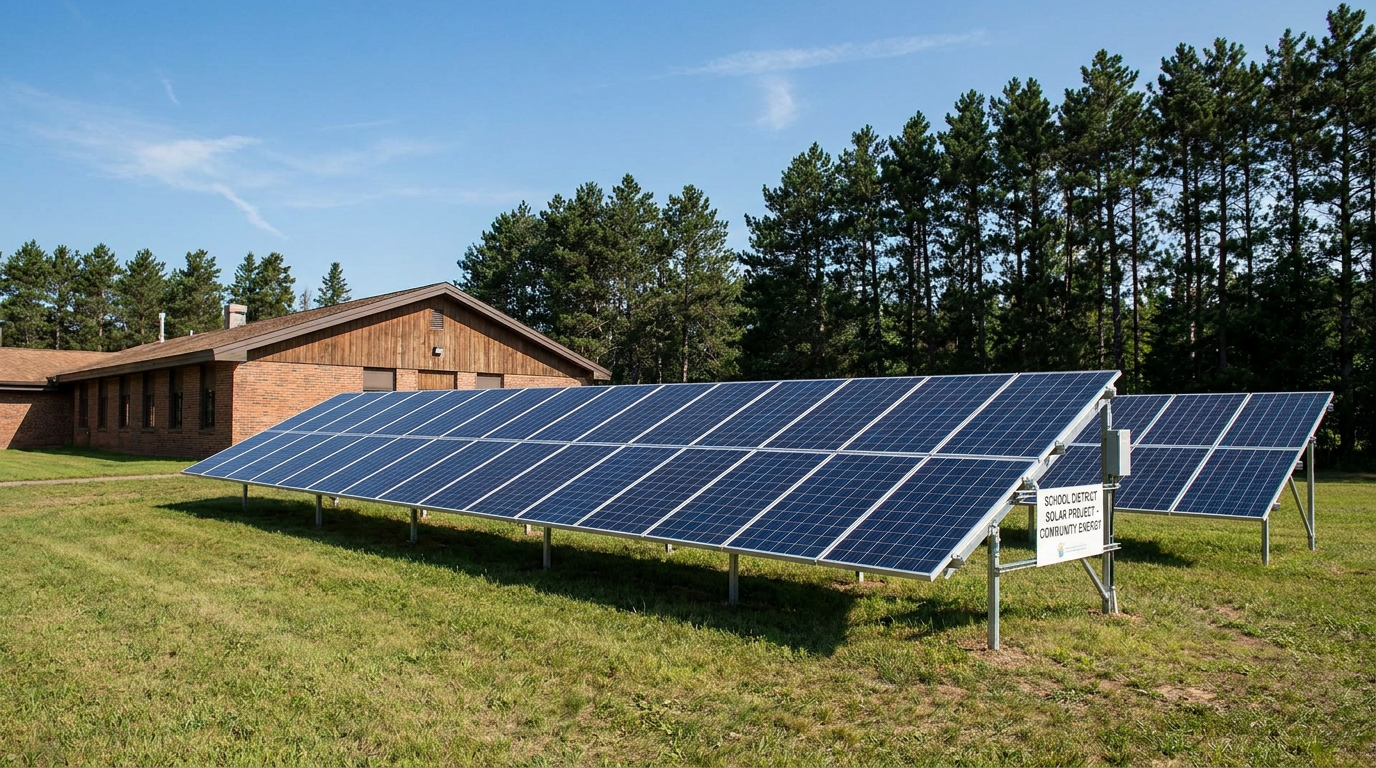
In the Anishinaabe village of Pine Point, deep in northern Minnesota's White Earth Reservation, a group of elementary school students recently gathered to flip a ceremonial switch. The May 2026 ribbon-cutting marked the official commissioning of the Pine Point Resilience Hub, a decentralized energy system designed to power the local K-8 school and community center.[2][6]
The newly operational microgrid pairs a 500-kilowatt solar array with a massive 2.76-megawatt-hour battery energy storage system (BESS). Unlike traditional solar installations that simply feed excess power back to the regional utility, this hybrid setup allows the school to capture and store the electrons it generates during the day.[2][4][5]
When the sun sets or the broader electrical grid fails, the facility can seamlessly draw from its battery reserves, operating entirely on its own. The word "resilience" in the project's title was chosen with deliberate care, reflecting the critical role the building plays in the community.[3][7]

The Pine Point School serves as a vital gathering place for the village's 330 residents, acting as a designated storm shelter during the region's notoriously brutal winters. In the past, severe weather events have frequently severed the community's connection to the outside world, leaving vulnerable residents without heat or communication.[2][3][7]
The historical context of this vulnerability runs deep. During the massive, federally funded push to electrify rural America under the Rural Electrification Act of 1936, tribal communities were largely bypassed. As a result, grid infrastructure on many reservations remains insufficient today, with an estimated 14 percent of Native American households on reservations still lacking electricity connections entirely.[3][7]
In Pine Point, those infrastructure gaps translate into tangible hardships. The local utility cooperative has recorded eleven significant power outages in the area over the last five years alone. Furthermore, residents face some of the highest energy burdens in the country—ranking in the 97th percentile nationwide for the proportion of household income spent on utility bills.[3][5]

In Pine Point, those infrastructure gaps translate into tangible hardships.
The new battery system fundamentally changes that equation. By storing enough energy to provide roughly 12 hours of continuous backup power, the microgrid ensures that the school can keep its lights on, run its electric heating systems, and provide a charging station for medical equipment and cell phones during extended blackouts.[3][5]
Beyond emergency preparedness, the financial implications for the school district are transformative. Prior to the installation, the all-electric school was paying an average of $71,000 annually for power. The microgrid is projected to generate more than 100 percent of the facility's total annual usage, effectively slashing power bills by nearly half.[4][5]
Over the 25-year lifespan of the equipment, the district expects to save approximately $825,000—funds that will be redirected straight back into classrooms and student resources. Because the system is wholly owned by the Pine Point School, all economic benefits will remain within the community.[5]

The project's success stems from a complex, multi-year collaboration. The development was spearheaded by 10Power, a climate justice enterprise, in partnership with 8th Fire Solar, a Native-run solar thermal organization based on the White Earth Reservation. Ziegler Energy Solutions managed the physical installation, working closely with the Pine Point Community Council to ensure the project aligned with local needs.[3][5][6]
Financing the multi-million-dollar hub required piecing together a diverse stack of funding. In 2024, the project secured a critical $1.75 million grant from the U.S. Department of Energy's Energy Storage for Social Equity program. That federal support was bolstered by grants from the Minnesota Department of Commerce's Solar for Schools program, philanthropic foundations, and federal solar investment tax credits.[3][4][7]

The microgrid is also serving as a living laboratory for the students it powers. The Pine Point School District has integrated the solar and battery system into an Ojibwe-language curriculum focused on renewable energy, utilizing a digital monitoring interface that allows students to track real-time data on energy generation and consumption.[3][4]
Pine Point's achievement is part of a broader surge of renewable energy development across Indian Country. Just east of White Earth, the Red Lake Nation recently broke ground on a massive 3-megawatt solar array, while the Shakopee Mdewakanton Sioux Community is developing a $9 million microgrid in suburban Minneapolis. For the White Earth Nation, the Resilience Hub is viewed as both a technological leap forward and an act of "reindigenization"—blending modern engineering with a timeless Anishinaabe commitment to environmental stewardship.[1][3][4][7]
How we got here
1936
The federal Rural Electrification Act largely bypasses tribal communities, leaving a legacy of insufficient grid infrastructure.
2017
8th Fire Solar launches in Pine Point as a community development initiative aimed at building a local green economy.
June 2024
The U.S. Department of Energy awards the project $1.75 million through its Energy Storage for Social Equity program.
Summer 2025
Construction officially begins on the Pine Point Resilience Hub's solar array and battery storage system.
May 2026
The microgrid is officially commissioned with a community ribbon-cutting ceremony, bringing the system online.
Viewpoints in depth
Tribal Leadership & Community
Focuses on energy sovereignty, cultural stewardship, and protecting vulnerable residents.
For residents of the White Earth Reservation, the microgrid is about far more than just lowering utility bills—it is a critical step toward energy sovereignty. Community leaders and Anishinaabe activists emphasize that owning their means of power production frees the village from a historical reliance on outside utilities that have often left them vulnerable during severe weather. They view the project through the lens of 'reindigenization,' framing renewable energy generation as a modern extension of their traditional mandate to be responsible stewards of the earth.
Clean Energy Developers
Focuses on climate justice, overcoming funding hurdles, and scaling microgrid technology.
Organizations like 10Power and 8th Fire Solar approach the Pine Point project as a scalable blueprint for climate justice. They highlight the stark disparities in rural electrification, noting that tribal lands suffer from disproportionately high rates of energy poverty. For these developers, the primary challenge is navigating complex financial headwinds—stacking federal grants, state funds, and tax credits to make capital-intensive battery systems viable in low-income areas. Their ultimate goal is to prove that decentralized microgrids can be financially sustainable while driving local workforce development.
State & Federal Policymakers
Focuses on grid modernization, rural electrification, and the impact of federal grants.
State energy officials and federal agencies view tribal microgrid projects as essential testing grounds for broader grid modernization. Through programs like the DOE's Energy Storage for Social Equity initiative, policymakers are actively funding decentralized energy hubs to reduce the strain on aging regional grids. They point to the success of the White Earth and Red Lake Nation projects as evidence that targeted federal investments can simultaneously lower emissions, improve rural reliability, and stimulate local green economies.
What we don't know
- How changes to federal solar investment tax credits under the new administration will impact the timeline for future tribal microgrid projects.
- When the White Earth Nation will be able to secure the funding necessary to expand similar solar-plus-storage systems to individual residential homes.
Key terms
- Microgrid
- A localized energy system that can disconnect from the traditional grid to operate autonomously during outages.
- Battery Energy Storage System (BESS)
- Large-scale batteries that store excess solar power for use at night or during emergencies.
- Energy Burden
- The percentage of a household's income that goes toward paying utility bills.
- Energy Sovereignty
- A community's inherent right to make its own decisions regarding energy generation, distribution, and consumption.
Frequently asked
How does the microgrid help during winter storms?
The 2.76-megawatt-hour battery stores excess solar energy, allowing the school to act as an emergency shelter with heating, lighting, and medical equipment charging even if the main grid fails.
Who owns the Pine Point Resilience Hub?
The system is wholly owned by the Pine Point School and the White Earth Nation, ensuring that all economic benefits and energy savings remain within the community.
How is the project being used for education?
The school has integrated the microgrid's real-time data into an Ojibwe-language curriculum on renewable energy, while local colleges are using the site to train future clean energy workers.
Sources
Source coverage
7 outlets
3 viewpoints surfaced






[1]MPR NewsState & Federal Policymakers
Red Lake Nation breaks ground on solar array, following White Earth's lead
Read on MPR News →[2]ElectrekClean Energy Developers
Pine Point Schools cuts the ribbon on new, 2.7 MWh microgrid project
Read on Electrek →[3]KAXEState & Federal Policymakers
White Earth's solar-powered resilience hub would save costs, back up power
Read on KAXE →[4]The Circle NewsTribal Leadership & Community
Pine Point Community Resilience Hub Poised to Launch
Read on The Circle News →[5]10PowerClean Energy Developers
Solar and Energy Storage Project on White Earth Reservation Breaks Ground
Read on 10Power →[6]White Earth NationTribal Leadership & Community
June 2026 District 3 Report
Read on White Earth Nation →[7]TCB MagState & Federal Policymakers
Tribal communities, like the White Earth village of Pine Point, are increasingly pursuing renewable energy development
Read on TCB Mag →
Every angle. Every day.
Get community stories with full source coverage and perspective breakdowns delivered to your inbox.