
Spirit Airlines Liquidation Auctions Signal the End of the Ultra-Low-Cost Era
Following its abrupt shutdown in May, Spirit Airlines is auctioning off its headquarters, flight slots, and loyalty program as the U.S. budget airline model faces an existential crisis.
By Factlen Editorial Team
- Legacy Carriers & Analysts
- Argue the ultra-low-cost model is fundamentally broken as consumers demand premium experiences and legacy airlines successfully match budget base fares.
- Budget Airline Defenders
- Maintain that the low-cost model remains viable if managed tightly, attributing Spirit's collapse to its specific debt load and exposure to congested airports.
- Consumer Advocates & Regulators
- Warn that the liquidation of a major discount carrier will remove downward pricing pressure, leading to higher ticket prices and reduced competition.
What's not represented
- · Airport authorities managing the sudden loss of terminal revenue
- · Former Spirit Airlines employees navigating the job market
Why this matters
Spirit Airlines' liquidation removes 5% of U.S. flight capacity and eliminates the industry's primary downward anchor on ticket prices. As legacy carriers absorb the market, travelers can expect to pay significantly more for flights, marking the end of the ultra-cheap, no-frills era of American aviation.
Key points
- Spirit Airlines ceased operations on May 2, 2026, after failing to secure a federal bailout amid a massive spike in jet fuel prices.
- The airline is currently auctioning off its major assets, including its $133 million Dania Beach headquarters and $87 million LaGuardia flight slots.
- Legacy carriers have successfully squeezed budget airlines by offering 'Basic Economy' fares while capturing a surge in premium travel demand.
- Consumer advocates warn that the loss of Spirit's 5% market share will remove downward pricing pressure, leading to higher fares across the industry.
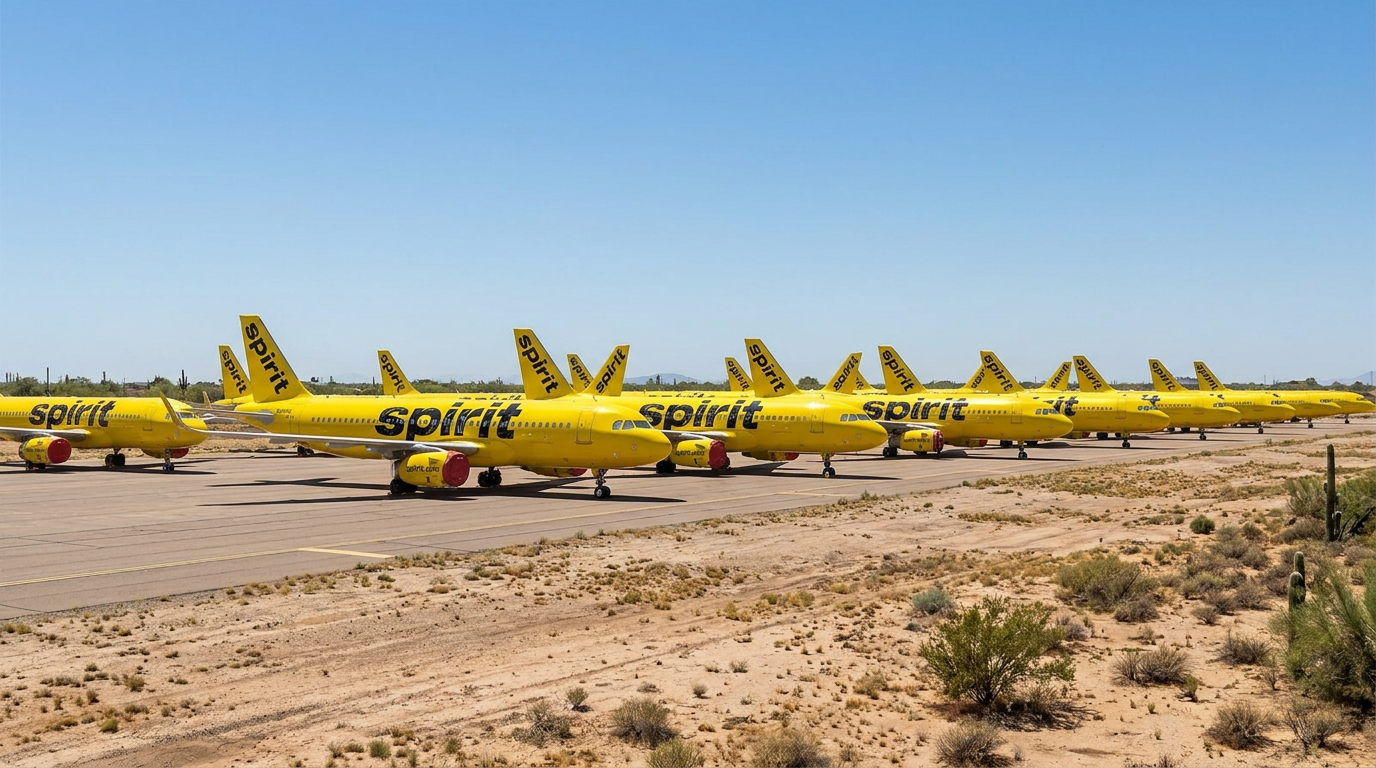
The bright yellow planes are now parked wing-to-wing in the Arizona desert, and roughly 17,000 employees are suddenly out of work. Spirit Airlines, the unapologetic pioneer of the American ultra-low-cost carrier model, abruptly ceased operations on May 2, 2026, ending a turbulent 34-year run in the aviation industry. The collapse marks the first time in two decades that a U.S. carrier of this size has completely liquidated, sending shockwaves through the travel sector and leaving a massive void in the domestic market. For millions of price-sensitive travelers, the shutdown severs a vital lifeline to affordable vacations and family visits.[2][3][6][7]
Now, in June 2026, the carcass of the airline is being carved up in bankruptcy court. A massive, multi-track liquidation effort is underway to auction off the carrier's most valuable remnants. Bidders are currently circling highly coveted takeoff and landing slots at New York's LaGuardia Airport, a brand-new corporate campus in South Florida, and the intellectual property of the Free Spirit loyalty program. The speed of the dismantling underscores the brutal financial realities of the aviation business, where physical assets are quickly repossessed and sold to the highest bidder the moment the cash stops flowing.[2][4][5]
While Spirit had struggled with unprofitability and mounting debt for years, the fatal blow was delivered by macroeconomic shocks far beyond its control. The escalating conflict in Iran caused global energy markets to panic, leading jet fuel prices to double in early 2026. According to bankruptcy filings, Spirit's restructuring models had assumed fuel costs of roughly $2.24 a gallon, but prices surged to an unsustainable $4.51 a gallon by late April. For an airline operating on razor-thin margins, the sudden doubling of its largest variable expense was a death sentence.[3]
That fuel shock rapidly drained the airline's remaining liquidity. A proposed $500 million federal bailout championed by President Donald Trump failed to secure creditor support, as advisors concluded that no viable path to continued operations remained. Without fresh financing, Spirit was forced to pivot from a planned Chapter 11 reorganization to a complete, court-supervised wind-down. Passengers were told not to go to the airport, and all flights were immediately canceled, stranding thousands and triggering a scramble among rival airlines to accommodate the displaced travelers.[3][6]

To understand why Spirit collapsed while legacy carriers like Delta and United are currently posting record profits, one must look at the underlying mechanics of the budget airline model. Ultra-low-cost carriers rely on rock-bottom base fares to fill planes, generating their actual profit through a relentless barrage of ancillary fees for carry-on bags, seat selection, printed boarding passes, and onboard water. When the model works, it democratizes travel; when it fails, it leaves the airline with no financial cushion to absorb external shocks.[1]
For years, this unbundled model successfully disrupted the industry, but legacy carriers eventually learned to neutralize the threat. By introducing "Basic Economy" fares, major airlines matched Spirit's base prices on travel search engines while offering a vastly superior and more reliable operational network. Consumers searching for the cheapest flight suddenly found Delta and American appearing alongside Spirit. Given the choice between a bare-bones budget carrier and a legacy airline at the same base price, travelers increasingly opted for the legacy brand, stripping Spirit of its primary competitive advantage.[1][8]
Simultaneously, consumer preferences shifted dramatically in the post-pandemic era. Travelers—particularly high-income households—began prioritizing comfort, space, and reliability over absolute savings. Legacy carriers saw premium cabin revenue surge, insulating them from the broader slump in budget leisure travel that devastated Spirit's core demographic. Delta Air Lines, for example, recently noted that premium seats now generate more profit than its main economy cabins. This industry-wide shift toward premiumization left budget carriers fighting over a shrinking pool of highly price-sensitive customers.[1]
Caught in this vice, Spirit faced an impossible dilemma. It could not raise its base fares without alienating its core demographic, yet it could not absorb the rising costs of labor, airport fees, and jet fuel. Furthermore, the airline was forced to compete head-to-head with major carriers at expensive, congested hub airports—a strategy that rapidly drained its cash reserves. Unlike smaller budget airlines that fly point-to-point routes between secondary cities, Spirit's exposure to major hubs meant it paid premium operational costs while collecting discount revenues.[5][8]

It could not raise its base fares without alienating its core demographic, yet it could not absorb the rising costs of labor, airport fees, and jet fuel.
The liquidation process currently unfolding highlights the immense capital required to operate—and dismantle—a major airline. On July 22, Spirit's 615,600-square-foot headquarters in Dania Beach, Florida, will be auctioned at a law office in New York City. The $275 million campus, dubbed "Spirit Central," opened just seven months before the airline filed for bankruptcy. It features a 180,000-square-foot office building, an amenity center with a gym, an in-flight training facility, and housing for up to 400 visiting workers.[4][7]
The real estate auction has drawn significant local interest. Broward County officials are currently considering a $100 million bid to acquire the 8.5-acre property to convert it into a new government building, bypassing the need to construct a new facility in Fort Lauderdale. The property appraiser values the land and buildings at roughly $133 million, making it a potentially lucrative acquisition for the county or a private commercial real estate developer looking to capitalize on the airline's misfortune.[4][7]
Even more fiercely contested than the real estate are Spirit's 22 daily flight slots at LaGuardia Airport, an asset valued at up to $87 million. Because the Federal Aviation Administration strictly limits takeoffs and landings at the highly congested New York hub, these slots represent a rare and incredibly valuable opportunity for rival airlines to expand their footprint. The slot auction, scheduled for late June, is expected to draw aggressive bidding from both legacy carriers and surviving budget airlines eager to capture Spirit's abandoned market share.[5]

However, the slot auction has created a complex regulatory headache that threatens to stall the liquidation. The Port Authority of New York and New Jersey insists that whoever acquires the slots must also take over Spirit's lease at Terminal A to prevent operational imbalances across the airport. This strict requirement complicates the sale for smaller budget rivals who may desperately want the flight slots but simply cannot afford the terminal's massive overhead costs. Consequently, the mandate risks tilting the auction heavily in favor of well-capitalized legacy carriers, further consolidating power at the top of the industry.[5]
Amid the grim reality of the liquidation, a faint pulse remains. Mooney International, a small general aviation manufacturer, submitted a formal bid in mid-June to acquire the Spirit brand and related assets. The company proposed combining Spirit with other entities to preserve the legacy and create a new low-cost travel group. However, industry analysts remain highly skeptical that the airline will ever fly again in its previous form, viewing the bid as a long-shot effort in a market that has already moved on.[2][6]
Spirit's demise leaves a massive structural void in the American travel landscape. At its peak, the carrier accounted for 5% of all U.S. flights. More importantly, its mere presence on a route reliably forced competitors to lower their fares—a phenomenon economists dubbed the "Spirit Effect." When Spirit entered a new market, average ticket prices dropped across the board; when it exited, fares inevitably crept back up. The loss of this dynamic removes the industry's most effective downward anchor on pricing.[3]
Without Spirit forcing the issue, consumer advocates warn that ticket prices will inevitably rise, particularly on popular leisure routes to Florida, Las Vegas, and the Caribbean. Surviving competitors like JetBlue and Frontier have already begun expanding their services to fill the gaps left by Spirit's exit, but they are highly unlikely to match the defunct carrier's rock-bottom pricing. For the average American family planning a summer vacation, the cost of flying is poised to become noticeably more expensive in the coming years.[3]

The collapse has sparked a fierce, industry-wide debate over the future of the ultra-low-cost model. While executives at legacy airlines have publicly declared the demise of the budget carrier, defenders argue the obituary is entirely premature. They point to airlines like Allegiant and Sun Country that remain highly profitable by strictly controlling costs, flying older aircraft, and avoiding congested hubs. In their view, the model isn't dead; rather, Spirit simply executed it poorly by taking on too much debt and fighting the wrong battles.[1][8]
Ultimately, Spirit's fatal flaw was attempting to fight legacy carriers on their own turf while carrying billions of dollars in debt. The airline tried to grow too fast, expanding aggressively into expensive primary airports where inevitable operational delays and high landing fees quickly erased its structural cost advantages. When the macroeconomic environment turned hostile with the sudden, war-driven spike in jet fuel prices, the airline simply ran out of runway. It was unable to outrun its creditors, unable to secure a government lifeline, and unable to outmaneuver its larger, wealthier rivals.[1][5][8]
As the final gavels fall on Spirit's physical assets this summer, the U.S. aviation industry enters a distinctly new era. The age of the heavily subsidized $19 flight may be over, replaced by a consolidated, top-heavy market where passengers pay a premium for reliability and comfort. While the domestic flying experience may become less chaotic without the bare-bones, fee-heavy budget carriers dominating the terminals, the true cost of aviation is finally being fully reflected in the ticket price. For millions of budget-conscious travelers, the new reality of American air travel means staying permanently grounded.[1][3]
How we got here
Nov 2024
Spirit files for Chapter 11 bankruptcy for the first time, converting $795 million of debt to equity.
Aug 2025
Spirit files for Chapter 11 a second time as financial pressures mount.
May 2026
A proposed $500 million federal bailout fails, forcing Spirit to cease all flight operations.
June 2026
Bidding procedures begin for the liquidation of Spirit's real estate, flight slots, and loyalty program.
July 2026
Final auctions scheduled for the airline's Dania Beach headquarters and operating assets.
Viewpoints in depth
Legacy Carriers' View
The ultra-low-cost model is obsolete in an era where consumers demand premium experiences.
Executives at legacy airlines like United and Delta argue that the budget airline model is fundamentally broken. They point out that modern travelers, even those on a budget, prioritize reliability and a baseline level of comfort over absolute savings. By introducing 'Basic Economy' fares, legacy carriers successfully siphoned off price-sensitive customers while leveraging their massive, reliable networks. In their view, Spirit's collapse is proof that airlines cannot survive solely on ancillary fees and bare-bones service when macroeconomic pressures rise.
Budget Airline Defenders
The low-cost model still works if managed tightly and kept away from congested hub airports.
Proponents of the ultra-low-cost model argue that Spirit's downfall was a failure of execution, not a failure of the concept. They point to profitable budget carriers like Allegiant and Sun Country, which succeed by flying point-to-point routes between smaller, underserved cities rather than competing head-to-head with Delta and United at expensive mega-hubs. From this perspective, Spirit's fatal mistake was taking on billions in debt to expand into congested airports where high landing fees and operational delays erased its cost advantages.
Consumer Advocates
The loss of Spirit Airlines will lead to a consolidated market and higher ticket prices for everyone.
Consumer watchdogs view Spirit's liquidation as a major blow to the American traveling public. Even for passengers who hated flying the no-frills carrier, Spirit served a vital economic function: the 'Spirit Effect.' Its presence on a route forced legacy carriers to lower their prices to compete. Advocates warn that as Spirit's 5% market share is absorbed by larger airlines, the industry will become further consolidated, removing the downward pricing pressure that made air travel accessible to lower-income households.
What we don't know
- Whether Mooney International's bid to acquire the Spirit brand will result in the airline flying again in any capacity.
- Which rival airlines will successfully acquire Spirit's highly coveted takeoff and landing slots at LaGuardia Airport.
- Exactly how much average ticket prices will rise on routes where Spirit previously forced legacy carriers to compete on price.
Key terms
- Ultra-Low-Cost Carrier (ULCC)
- An airline business model that offers extremely low base fares but generates profit by charging extra fees for almost every amenity, including carry-on bags and seat selection.
- Chapter 11 Bankruptcy
- A legal process allowing a company to reorganize its debts while continuing to operate, though Spirit ultimately pivoted to a complete liquidation.
- Stalking Horse Bid
- An initial bid on a bankrupt company's assets that sets a minimum floor price for the subsequent public auction.
- Basic Economy
- A stripped-down fare class introduced by legacy airlines to compete directly with budget carriers on price search engines.
- Flight Slots
- Authorizations granted by aviation regulators that allow an airline to take off or land at a highly congested airport at a specific time.
Frequently asked
Will Spirit Airlines ever fly again?
While a small aviation manufacturer has submitted a bid to acquire the brand, Spirit as it existed has ceased operations and its physical assets are being sold off.
Why did Spirit Airlines go out of business?
The airline was crushed by a combination of billions in debt, intense competition from legacy carriers, and a sudden doubling of jet fuel prices linked to the conflict in Iran.
Will ticket prices go up because of this?
Industry analysts and consumer advocates warn that fares are likely to rise, as Spirit's presence in a market reliably forced competitors to lower their prices.
What is happening to Spirit's airplanes?
Dozens of Spirit's Airbus A320 aircraft have been flown to desert storage facilities in Arizona while they await auction or return to their leasing companies.
Sources
Source coverage
8 outlets
3 viewpoints surfaced








[1]CNBCLegacy Carriers & Analysts
The budget airline model in the U.S. is running out of runway
Read on CNBC →[2]TheStreetConsumer Advocates & Regulators
Spirit Airlines lands a buyout offer after shutdown, may fly again
Read on TheStreet →[3]Times of IsraelConsumer Advocates & Regulators
Telling passengers not to go to the airport, the major, low-cost US airline cites 'oil prices and other pressures' for abruptly shutting down
Read on Times of Israel →[4]The Real DealConsumer Advocates & Regulators
Spirit Airlines is auctioning off its Dania Beach headquarters next month
Read on The Real Deal →[5]Simple FlyingConsumer Advocates & Regulators
Spirit Airlines' LaGuardia Slots Are Worth $87 Million, But Maybe Not To Budget Carriers
Read on Simple Flying →[6]Aerospace Global NewsBudget Airline Defenders
All in good Spirit: Bidders circle to acquire assets of collapsed ultra-low-cost airline
Read on Aerospace Global News →[7]BisnowConsumer Advocates & Regulators
Spirit Airlines' South Florida HQ Scheduled For July Auction
Read on Bisnow →[8]Live and Let's FlyBudget Airline Defenders
Spirit Airlines May Be Struggling, But Don't Count Out The Budget Airline Model Yet
Read on Live and Let's Fly →

Every angle. Every day.
Get business stories with full source coverage and perspective breakdowns delivered to your inbox.