
The Physics of the 'Fifth Stroke': Why the Fastest Way to Swim is Underwater
Elite swimmers are shaving crucial seconds off their times by mastering the underwater dolphin kick, a full-body undulation that exploits fluid dynamics to bypass surface drag.
By Factlen Editorial Team
- Elite Coaches
- View the underwater phase as the ultimate competitive advantage and the primary area for shaving hundredths of a second off race times.
- Sports Biomechanists
- Focus on using computational fluid dynamics and physics to minimize drag and maximize vortex-driven propulsion.
- Swimming Regulators
- Value preserving the integrity of the original four strokes and enforcing the 15-meter limit to prevent hypoxia-related safety risks.
What's not represented
- · Recreational swimmers who struggle with breath control
- · Pool engineers designing gutter systems to reduce surface turbulence
Why this matters
Understanding the physics of underwater swimming reveals how modern athletic records are broken not just through raw power, but through a profound mastery of fluid dynamics and biomechanical efficiency.
Key points
- The underwater dolphin kick is widely considered the fastest form of human swimming due to reduced hydrodynamic drag.
- Swimming on the surface creates wave drag, which can account for up to 50% of the total resistance an athlete faces.
- Elite swimmers use a full-body undulation to create invisible water vortices, which they push off to generate massive forward thrust.
- The 15-meter rule was introduced after the 1988 Olympics to prevent athletes from swimming entire races underwater.
- In a standard short-course pool, an elite swimmer can legally spend up to 60 percent of the race submerged.
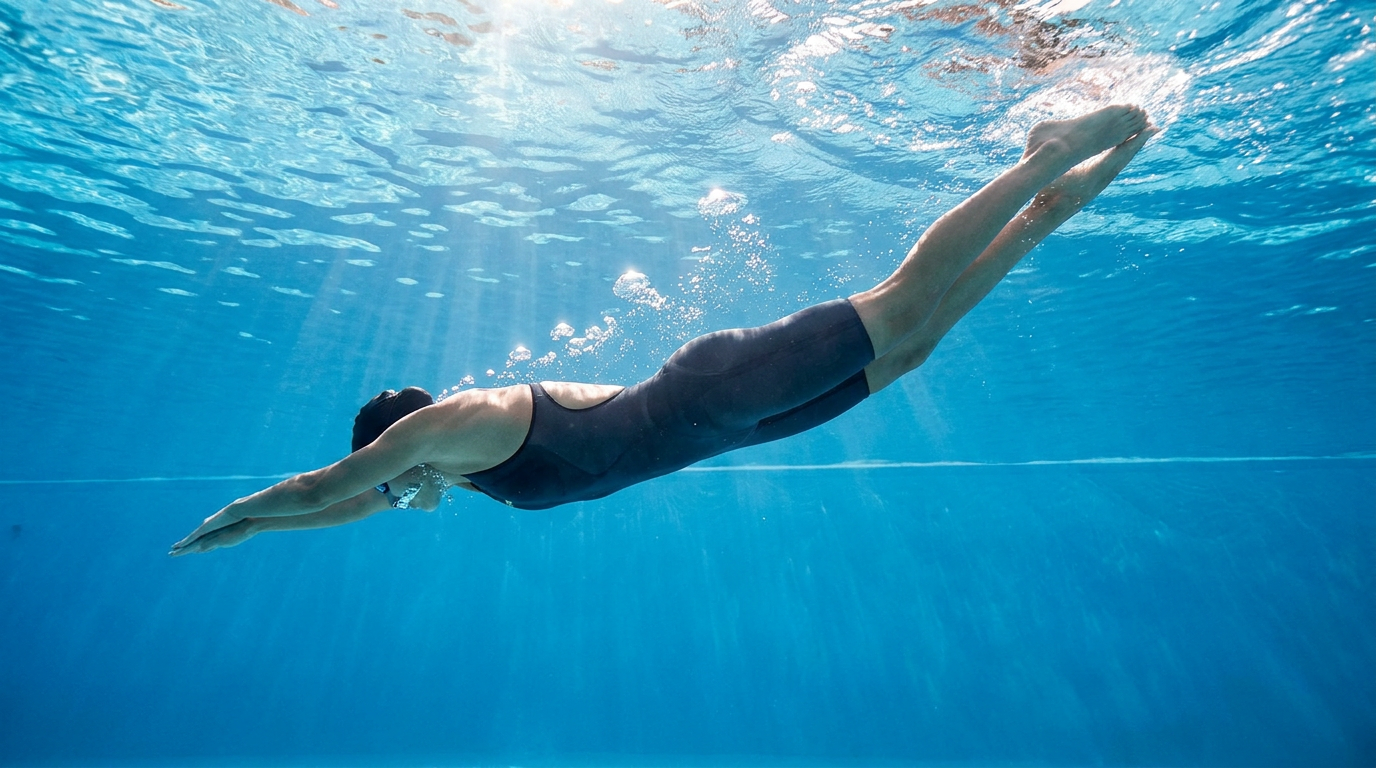
To watch a modern Olympic swimming race is to witness a sport that takes place largely out of sight. When the starting buzzer sounds, the athletes do not immediately begin churning the surface of the water with their arms. Instead, they disappear. For the first several seconds of the race, the pool surface remains eerily calm while a subterranean drag race occurs below. This submerged phase is driven by the "fifth stroke"—the underwater dolphin kick—a technique that has fundamentally rewritten the physics and strategy of competitive swimming.[3][7]
The counterintuitive truth of aquatic sports is that the surface of the water is the absolute slowest place to be. When a swimmer moves along the surface, they are fighting a brutal battle against physics. They must displace the water in front of them, pushing it up into the air and creating a bow wave, much like a speedboat. This phenomenon, known as wave drag, acts as an invisible brake on the athlete's forward momentum.[1][7]
Biomechanical research demonstrates just how punishing this surface tension can be. Depending on the athlete's velocity, wave drag can account for a staggering 20 to 50 percent of the total resistance a swimmer faces. The faster an athlete tries to swim on the surface, the exponentially larger the wave they create, and the harder the water pushes back. The only way to break this mathematical speed limit is to dive under it.[1]

By descending just a few feet below the chaotic boundary between air and water, a swimmer enters a realm of pure fluid dynamics. Studies indicate that traveling at least 0.5 meters (about 20 inches) below the surface allows an athlete to bypass the worst of the wave drag entirely. In this submerged corridor, the water flows smoothly over the back and shoulders, allowing the swimmer to maintain the explosive momentum generated from diving off the starting block or pushing off the wall.[1][7]
But gliding only lasts so long. To maintain that high-speed momentum, swimmers employ Undulatory Underwater Swimming (UUS), commonly known as the dolphin kick. Unlike the alternating flutter kick used in freestyle, the dolphin kick is not driven solely by the legs. It is a full-body wave that originates in the chest and core, snapping down through the hips, knees, and finally the ankles, mimicking the powerful tail propulsion of cetaceans.[2][5]
Advanced computational fluid dynamics (CFD) modeling has finally allowed sports scientists to visualize exactly why this undulating motion is so effective. As the swimmer's body snaps through the wave motion, it generates microscopic whirlpools, or vortices, in the water. The most efficient swimmers create a large, high-circulation vortex on the ventral (stomach) side of their trunk, and another powerful vortex trailing behind their feet.[2]
These vortices act as temporary, invisible walls of water pressure. By perfectly timing their undulations, elite swimmers literally push off these swirling pockets of water, generating massive forward thrust without the braking effect of surface drag. The result is a burst velocity that can reach between 2.2 and 3.0 meters per second—speeds that are physically impossible to sustain once the swimmer breaks the surface and begins a traditional stroke.[2][7]

These vortices act as temporary, invisible walls of water pressure.
The realization that underwater swimming was vastly superior to surface swimming did not happen in a laboratory; it happened in the pool, sparking one of the greatest controversies in the sport's history. In the late 1980s, an American backstroker named David Berkoff began experimenting with staying underwater for extended periods. He realized that if he simply held his breath and dolphin-kicked on his back, he could easily outpace competitors who were swimming traditional backstroke on the surface.[3][4][6]
Berkoff unleashed this technique, dubbed the "Berkoff Blastoff," at the 1988 Olympic Games in Seoul. He stunned the world by swimming more than 30 meters of the 100-meter race completely submerged, shattering the world record in the process. His dominance proved unequivocally that traditional surface strokes were obsolete compared to the raw hydrodynamic efficiency of the dolphin kick.[4][6]
The international governing body for swimming, FINA (now World Aquatics), panicked. Regulators feared that if left unchecked, swimming would devolve into a breath-holding contest where athletes simply dolphin-kicked underwater for the entire length of the pool, rendering the traditional disciplines of backstroke, butterfly, and freestyle unrecognizable. Furthermore, coaches raised severe safety concerns about athletes pushing themselves into hypoxia and risking shallow water blackout.[4][6]
In response, regulators instituted the now-famous 15-meter rule. The mandate is strict: after every start and every turn, a swimmer's head must break the surface of the water by the time they reach the 15-meter mark. Originally applied only to backstroke in 1988, the rule was eventually expanded to govern butterfly and freestyle events in the late 1990s, forever changing the geometry of a swimming race.[4][6]
Today, that 15-meter zone is the most heavily contested real estate in the pool. In a standard 50-meter Olympic pool, a swimmer can legally spend 30 percent of the race underwater. In a 25-yard short-course pool, where turns happen twice as often, an athlete can spend up to 60 percent of the race submerged. Races are no longer won purely on surface speed; they are won in the transitions.[7]

Coaches have spent the last two decades engineering new ways to maximize this underwater advantage. Legendary coach Bob Gillett pioneered the use of the monofin—a single, large flipper that binds the feet together—to teach swimmers the precise core-driven undulation required for a perfect dolphin kick. Gillett's protégé, Misty Hyman, used these techniques to perfect a lateral (side-lying) underwater kick, which further reduced wave drag and propelled her to a stunning gold medal in the 200-meter butterfly at the 2000 Sydney Olympics.[3][5]
Biomechanical research continues to refine the technique. Recent studies suggest that the lateral position Hyman used is indeed hydrodynamically superior when an athlete is forced to swim close to the surface, as it deflects water differently than a flat stomach-down or back-down posture. Swimmers are now trained to dynamically adjust their body rotation as they ascend toward their breakout point to shave off microscopic fractions of drag.[1][5]

The evolution of the fifth stroke represents a perfect marriage of athletic endurance and applied physics. As human physiology approaches its natural limits on the surface of the water, the quest for speed has driven the sport downward. The modern swimmer is no longer just an athlete pulling themselves across a pool; they are a hydrodynamic vessel, engineered to slip through the water with the silent, devastating efficiency of the marine life they emulate.[7]
How we got here
1988
David Berkoff uses the 'Berkoff Blastoff' to swim 30+ meters underwater, shattering the 100m backstroke world record at the Seoul Olympics.
1988
FINA implements the 15-meter underwater limit for backstroke events to preserve the traditional stroke.
1998
The 15-meter rule is officially expanded to cover butterfly and freestyle events.
2000
Misty Hyman wins Olympic gold in the 200m butterfly using a highly optimized lateral (side-lying) underwater dolphin kick.
Viewpoints in depth
Sports Biomechanists
Focus on using computational fluid dynamics and physics to minimize drag and maximize vortex-driven propulsion.
For sports scientists and biomechanists, the pool is a fluid dynamics laboratory. They view the swimmer not just as an athlete, but as a hydrodynamic vessel that must be optimized to slip through a dense medium. Using advanced computational fluid dynamics (CFD) modeling, these researchers analyze how different body positions generate microscopic whirlpools, or vortices, in the water. They argue that the future of swimming speed lies entirely in minimizing wave drag by finding the optimal depth—typically around 0.5 meters—and perfecting the timing of the undulatory kick to push off the generated vortices for maximum thrust.
Elite Coaches
View the underwater phase as the ultimate competitive advantage and the primary area for shaving hundredths of a second off race times.
At the elite coaching level, the traditional surface strokes are almost viewed as a necessary evil to get from one wall to the next. Coaches emphasize that the highest velocities an athlete will ever achieve in a race occur during the underwater glide and kick immediately following a dive or a turn. Because of this, modern training programs dedicate massive amounts of time to breath control, core strength, and monofin training. For these coaches, the 15-meter rule is a tactical boundary, and their goal is to ensure their athletes ride that underwater speed as close to the 14.9-meter mark as physically possible.
Swimming Regulators
Value preserving the integrity of the original four strokes and enforcing the 15-meter limit to prevent hypoxia-related safety risks.
Governing bodies like World Aquatics approach the fifth stroke with a mix of awe and caution. Their primary mandate is to preserve the historical integrity of the sport; without the 15-meter rule, they argue, backstroke and butterfly events would simply become underwater breath-holding contests, rendering the distinct disciplines obsolete. Furthermore, regulators are deeply concerned with athlete safety. Pushing the limits of underwater swimming requires athletes to operate in a state of oxygen deprivation. Strict enforcement of the 15-meter limit is viewed as a necessary safeguard against shallow water blackout, ensuring athletes are forced to surface and breathe.
What we don't know
- Whether future advancements in computational fluid dynamics will reveal even faster, currently unknown variations of the underwater kick.
- How close human physiology is to the absolute maximum burst velocity achievable through undulatory swimming.
Key terms
- Wave Drag
- The hydrodynamic resistance created when a swimmer moves along the surface and displaces water, forming a bow wave.
- Undulatory Underwater Swimming (UUS)
- The technical biomechanical term for the dolphin kick, characterized by a wave-like motion traveling from the chest down to the toes.
- Computational Fluid Dynamics (CFD)
- The use of applied mathematics and software to model and analyze how fluids flow around an object, used to study swimming efficiency.
- Hypoxia
- A dangerous condition in which the body or a region of the body is deprived of adequate oxygen supply, a risk for swimmers who hold their breath too long.
- Monofin
- A type of swim fin that consists of a single blade attached to foot pockets for both feet, used to train the dolphin kick.
Frequently asked
What is the fifth stroke in swimming?
The 'fifth stroke' refers to the underwater dolphin kick, a full-body undulating motion used by swimmers while submerged after diving or pushing off a wall.
Why is swimming underwater faster?
Swimming underwater bypasses wave drag—the resistance caused by pushing surface water out of the way. Submerging at least 0.5 meters allows the athlete to slip through the water with significantly less friction.
What is the 15-meter rule?
The 15-meter rule dictates that a swimmer's head must break the surface of the water within 15 meters of the start and every turn, preventing athletes from swimming the entire race underwater.
Who invented the Berkoff Blastoff?
The technique was popularized by American backstroker David Berkoff, who used an extended underwater dolphin kick to shatter world records at the 1988 Olympics.
Sources
Source coverage
7 outlets
3 viewpoints surfaced







[1]MDPISports Biomechanists
Hydrodynamic Characteristics of Undulatory Underwater Swimming
Read on MDPI →[2]Taylor & FrancisSports Biomechanists
Computational Fluid Dynamics Analysis of Underwater Undulatory Swimming
Read on Taylor & Francis →[3]Swimming World MagazineSwimming Regulators
Fluid Dynamics and the Fifth Stroke
Read on Swimming World Magazine →[4]InstaSwimSwimming Regulators
The History and Science Behind Swimming's 15-Meter Rule
Read on InstaSwim →[5]American Swimming Coaches AssociationElite Coaches
Developing Underwater Speed and the Monofin
Read on American Swimming Coaches Association →[6]360SwimSwimming Regulators
The Evolution of the Strokes and the Berkoff Blastoff
Read on 360Swim →[7]Factlen Editorial TeamElite Coaches
Synthesis by Factlen editorial team
Read on Factlen Editorial Team →

More in sports
See all 8 stories →Sports Finance
The Billion-Dollar Era of Women's Team Sports: How Valuations Skyrocketed in 2026
12 sources

Injury
Toronto Tempo Guards Brittney Sykes and Kiki Rice Sidelined with Leg Injuries, Expected to Return in 2026
6 sources

Standings
WNBA Standings Heat Up as Aces and Liberty Secure Commissioner's Cup Final Amid League Expansion
8 sources

Storyline
USMNT Cruises to Knockout Stage in Historic 2026 World Cup Start
6 sources

Every angle. Every day.
Get sports stories with full source coverage and perspective breakdowns delivered to your inbox.