
Supreme Court Revokes California's Authority to Set Stricter Auto Emissions Standards
In a landmark 6-3 decision, the Supreme Court ruled that the EPA cannot grant California waivers to enforce stricter tailpipe emissions than the federal government, upending decades of environmental policy and the US auto market.
By Factlen Editorial Team
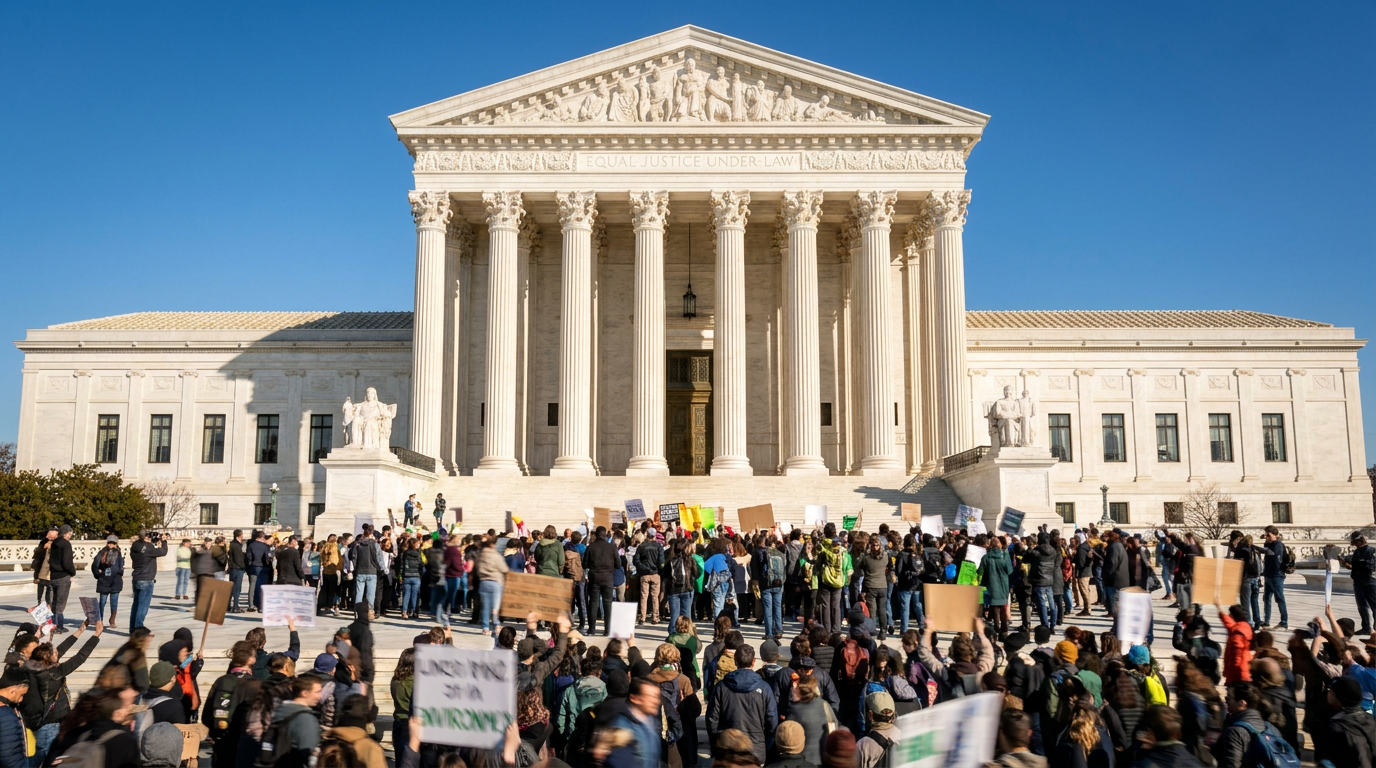
- State-Level Regulators & Environmentalists
- Argue that states have a constitutional and moral right to protect their citizens from localized pollution and drive climate innovation.
- Federalists & Deregulation Advocates
- Argue that a single national standard prevents interstate commerce chaos, lowers vehicle costs, and protects consumer choice.
- Automotive Industry & Supply Chain
- Caught in the middle, prioritizing regulatory certainty and unified supply chains over specific emissions targets, while fearing stranded EV investments.
What's not represented
- · International climate negotiators
- · Public transit and urban planning advocates
Why this matters
This ruling instantly alters the vehicles available to American consumers and removes the single largest regulatory driver of the US transition to electric vehicles, fundamentally changing the nation's climate trajectory.
Key points
- The Supreme Court ruled 6-3 to revoke California's authority to set stricter auto emissions standards than the federal government.
- The decision invalidates California's mandate to phase out the sale of new gas-powered cars by 2035.
- Seventeen other states that had adopted California's standards must now revert to the federal baseline.
- The ruling creates a unified national emissions standard but disrupts billions in automaker EV investments.
- Environmental groups warn the decision will add hundreds of millions of metric tons of carbon to the atmosphere.
In a landmark 6-3 decision that fundamentally alters the trajectory of American environmental policy, the Supreme Court has ruled that the Environmental Protection Agency can no longer grant California waivers to enforce stricter tailpipe emissions than the federal government. The ruling in Ohio v. EPA effectively strips the state of a unique regulatory authority it has held for over half a century under the Clean Air Act. By invalidating the waiver, the Court has instantly dismantled California's ambitious Advanced Clean Cars II framework, which sought to mandate that all new passenger vehicles sold in the state be zero-emission by 2035. The decision sends immediate shockwaves through the global automotive industry, which had largely calibrated its long-term manufacturing and supply chain strategies to meet the stringent requirements of the massive California market.[1][3][7]
Chief Justice John Roberts, writing for the conservative majority, argued that the Clean Air Act’s waiver provision violates the constitutional principle of equal sovereignty among the states. Roberts asserted that allowing a single state to dictate a de facto national emissions standard—given the interconnected nature of interstate commerce and the automotive supply chain—grants California an outsized and unconstitutional regulatory power over the rest of the country. "The Constitution does not permit one state to leverage its market size to impose its preferred environmental and economic policies on the citizens of the other forty-nine," Roberts wrote. The majority concluded that environmental regulations with such sweeping national economic impacts must be set uniformly by the federal government or explicitly legislated by Congress, rather than delegated to a single state environmental board.[2][7]
In a blistering dissent, Justice Elena Kagan, joined by Justices Sotomayor and Jackson, accused the majority of judicial overreach and of ignoring the explicit, plain text of the 1970 Clean Air Act. Kagan noted that Congress intentionally carved out the California waiver to allow the state to combat its unique smog crises and to serve as a "laboratory of democracy" for environmental innovation. She argued that the Court's invocation of the equal sovereignty doctrine in this context is a novel and dangerous expansion that threatens to unravel decades of established administrative law. "Today, the Court substitutes its own deregulatory preferences for the clear statutory design of Congress, stripping states of their most effective tool to protect their citizens from the escalating and localized ravages of climate change," Kagan wrote.[3][7]
The immediate practical impact of the ruling extends far beyond California's borders. Under Section 177 of the Clean Air Act, other states were previously permitted to adopt California's stricter emissions standards rather than defaulting to the federal baseline. Seventeen states—including New York, Massachusetts, and Washington, representing roughly 40 percent of the total United States auto market—had legally bound themselves to California's phase-out of internal combustion engines. With the Supreme Court striking down the underlying waiver, these state-level mandates are instantly rendered null and void. All 50 states will now operate under a single, unified federal emissions standard, which the current administration has already moved to significantly relax compared to the targets set during the previous administration.[1][6]

The immediate practical impact of the ruling extends far beyond California's borders.
The Trump administration immediately celebrated the ruling as a massive victory for consumer choice, economic deregulation, and the traditional energy sector. Administration officials have long argued that California's electric vehicle mandates artificially inflate car prices, strain the electrical grid, and force consumers into purchasing vehicles they do not want. Speaking from the White House, officials framed the Supreme Court decision as a necessary correction against "coastal overreach," arguing that families in the Midwest and South should not have their vehicle options constrained by regulators in Sacramento. The ruling aligns perfectly with the administration's broader agenda to maximize domestic oil and gas production and roll back federal subsidies and mandates associated with the green energy transition.[2][5]
For the global auto industry, the ruling introduces a complex mix of regulatory relief and profound logistical chaos. On one hand, legacy automakers and their lobbying groups have quietly chafed at the difficulty of navigating a bifurcated US market, and many welcome the return to a single national standard that lowers compliance costs. On the other hand, the industry has already committed hundreds of billions of dollars to battery plants, critical mineral supply chains, and electric vehicle platform development, largely predicated on the assumption that 40 percent of the US market would legally require zero-emission vehicles by the next decade. Industry analysts warn that this sudden regulatory whiplash could strand massive capital investments and cede the future of the global EV market to heavily subsidized Chinese manufacturers.[4][5]

Environmental organizations and climate modelers are characterizing the decision as a catastrophic setback for global emissions targets. The transportation sector is the largest single source of greenhouse gas emissions in the United States, and California's mandate was widely considered the most consequential policy lever for driving the nation toward its Paris Agreement commitments. Early projections from environmental research groups suggest that reverting to the relaxed federal standard could add hundreds of millions of metric tons of carbon dioxide to the atmosphere over the next decade. Advocates warn that without the regulatory stick of the California waiver, automakers will inevitably slow their transition to electric vehicles, prioritizing highly profitable, gas-powered SUVs and trucks for as long as legally permissible.[3][6]

In Sacramento, state officials are already scrambling to develop alternative mechanisms to bypass the Supreme Court's restriction and maintain their climate trajectory. California policymakers have vowed that they will not abandon their 2035 zero-emission goals, floating potential workarounds such as implementing aggressive, emissions-based vehicle registration fees, instituting zero-emission zones in major metropolitan areas, or heavily taxing the sale of gasoline. However, legal experts caution that any state-level policy designed to act as a de facto ban on internal combustion engines will likely face immediate legal challenges from the same coalition of red states and fossil fuel groups that successfully defeated the Clean Air Act waiver.[4][6]
The ruling also places immense pressure on Congress, shifting the battleground over climate policy from the executive branch and the courts directly to the legislative arena. While environmental advocates are demanding that lawmakers amend the Clean Air Act to explicitly codify state-level emissions authority, such legislative action is considered virtually impossible under the current divided government. As the dust settles on the Supreme Court's term, the decision stands as one of the most consequential environmental rulings in American history, fundamentally redefining the balance of power between the states and the federal government while rewriting the future of the American road.[1][3][7]
How we got here
1970
The Clean Air Act is passed, granting California a unique waiver to set stricter pollution standards due to its severe smog.
2022
California adopts the Advanced Clean Cars II rule, mandating 100% zero-emission new vehicle sales by 2035.
2025
A coalition of red states and fossil fuel groups files a federal lawsuit challenging the constitutionality of California's waiver.
June 2026
The Supreme Court strikes down the waiver in a 6-3 decision, ending California's unique regulatory authority.
Viewpoints in depth
State-Level Regulators & Environmentalists
This camp views the ruling as a disastrous judicial overreach that cripples the nation's ability to fight climate change.
Environmental advocates and blue-state policymakers argue that the Clean Air Act explicitly intended for California to act as a proving ground for aggressive environmental policy. They point to the escalating localized impacts of climate change—from severe wildfires to urban smog—as proof that states need the autonomy to protect their citizens when the federal government fails to act. This camp views the Court's invocation of the 'equal sovereignty' doctrine as a legally dubious pretext designed specifically to dismantle environmental regulations and protect the fossil fuel industry's market share.
Federalists & Deregulation Advocates
This camp argues that a single national standard is essential for a functioning interstate economy and protects consumers from coastal mandates.
Conservative legal scholars, fossil fuel groups, and the current administration argue that California's waiver had morphed from a local smog-reduction tool into a mechanism for dictating global industrial policy. Because automakers cannot feasibly design different cars for different states, California's rules effectively forced the entire country to adopt its preferred climate policies. This camp argues that such sweeping economic transformations must be legislated by Congress, not mandated by unelected environmental boards in a single state, and that removing the waiver will ultimately keep vehicles affordable for working-class Americans.
Automotive Industry & Supply Chain
Automakers are caught in a regulatory whiplash, balancing the relief of a unified standard against the threat of stranded capital investments.
The global auto industry's reaction is highly conflicted. While manufacturers have historically lobbied against strict emissions targets and prefer the simplicity of a single national standard, they have spent the last five years fundamentally restructuring their businesses around the expectation of a rapid EV transition. Billions of dollars have been poured into domestic battery manufacturing and critical mineral supply chains. Industry analysts warn that suddenly removing the regulatory mandate could cause a collapse in domestic EV demand, stranding those massive investments and allowing heavily subsidized foreign competitors to dominate the future of automotive technology.
What we don't know
- How major automakers will adjust their long-term EV production targets now that the regulatory mandate is gone.
- Whether California will successfully implement alternative workarounds, such as emissions-based vehicle registration fees, without facing immediate injunctions.
- How this ruling will impact the United States' negotiating position at upcoming international climate summits.
Key terms
- Clean Air Act Waiver
- A specific legal provision that historically allowed California to seek federal permission to enforce stricter air pollution standards than the national baseline.
- Advanced Clean Cars II
- California's regulatory framework designed to systematically phase out the sale of new internal combustion engine vehicles by the year 2035.
- Equal Sovereignty Doctrine
- A constitutional principle cited by the Court's majority arguing that all states must have equal regulatory power, preventing one state from dictating national economic policy.
Frequently asked
Does this mean I can't buy an EV in California?
No. Electric vehicles will still be widely sold in California and nationwide. However, automakers are no longer legally required by the state to phase out the sale of new gas-powered cars by 2035.
Will car prices change because of this ruling?
Proponents of the ruling argue it will keep gas-powered cars cheaper by removing regulatory burdens. Critics warn that disrupting automaker investments could create supply chain inefficiencies, potentially raising long-term costs.
Can Congress reverse this Supreme Court decision?
Yes. Congress could theoretically pass new legislation amending the Clean Air Act to explicitly grant states the authority to set their own emissions mandates, though this is highly unlikely under the current divided government.
Sources
Source coverage
7 outlets
3 viewpoints surfaced







[1]ReutersAutomotive Industry & Supply Chain
Supreme Court strikes down California emissions waiver in 6-3 ruling
Read on Reuters →[2]Fox NewsFederalists & Deregulation Advocates
Supreme Court ends California's 'radical' EV mandate, restoring federal standard
Read on Fox News →[3]The New York TimesState-Level Regulators & Environmentalists
In a Blow to Climate Efforts, Supreme Court Revokes California's Tailpipe Authority
Read on The New York Times →[4]PoliticoAutomotive Industry & Supply Chain
What the SCOTUS emissions ruling means for the US auto industry
Read on Politico →[5]The Wall Street JournalFederalists & Deregulation Advocates
Auto Makers Face Unified Federal Standard After Supreme Court Ruling
Read on The Wall Street Journal →[6]E&E NewsState-Level Regulators & Environmentalists
Blue states scramble as Supreme Court erases decades of clean air precedent
Read on E&E News →[7]SCOTUSblogFederalists & Deregulation Advocates
Opinion analysis: Court limits state authority under the Clean Air Act
Read on SCOTUSblog →

More in news politics
See all 8 stories →Strait of Hormuz
Iran Closes Strait of Hormuz as U.S.-Brokered Ceasefire Collapses Over Lebanon Strikes
9 sources

Islamabad Memorandum
US and Iran Sign 'Islamabad Memorandum' to End 110-Day War and Reopen Strait of Hormuz
8 sources

Climate Finance
UN Climate Talks End in Gridlock Over $300 Billion Finance Goal Amid G7 Silence
8 sources
US-Iran Peace Deal
US and Iran Sign 'Islamabad Memorandum' to End 110-Day War and Reopen Strait of Hormuz
6 sources

Every angle. Every day.
Get news politics stories with full source coverage and perspective breakdowns delivered to your inbox.