
The Science of Aquafaba: How Chickpea Water Replaces Eggs in Baking
Once discarded as waste, the brine from canned chickpeas has revolutionized plant-based cooking. Food scientists and culinary experts are now unraveling the complex chemistry that allows this humble liquid to whip, bind, and emulsify just like egg whites.
By Factlen Editorial Team
- Food Scientists
- Researchers focused on the rheological properties, molecular interactions, and industrial standardization of aquafaba.
- Culinary Experts
- Chefs and bakers focused on practical kitchen applications, recipe adaptation, and stabilizing techniques.
- Sustainability Advocates
- Environmentalists championing aquafaba as a way to upcycle food waste and reduce reliance on animal agriculture.
What's not represented
- · Commercial egg producers
- · Industrial bakery manufacturers
Why this matters
Understanding the chemistry of aquafaba empowers home cooks to confidently adapt recipes for egg allergies or plant-based diets. It also highlights a practical way to reduce household food waste by utilizing an ingredient that is usually poured down the drain.
Key points
- Aquafaba is the liquid from cooked chickpeas, used as a highly effective vegan egg substitute.
- It foams and emulsifies thanks to a delicate balance of saponins, proteins, and carbohydrates.
- Adding an acid like cream of tartar lowers the pH, helping the proteins form a more stable structure.
- While excellent for meringues and mayo, aquafaba lacks the coagulating properties needed for heavy cakes.
For decades, the murky liquid inside a can of chickpeas was destined for one place: the kitchen sink. Home cooks and professional chefs alike drained their legumes, rinsed the beans for hummus or salads, and washed the brine away without a second thought.[6]
But over the last decade, that discarded liquid has undergone a culinary rebranding. Now known as "aquafaba"—a portmanteau of the Latin words for water and bean, coined by an American software engineer in 2015—it has become one of the most significant plant-based innovations in modern baking.[2][6]
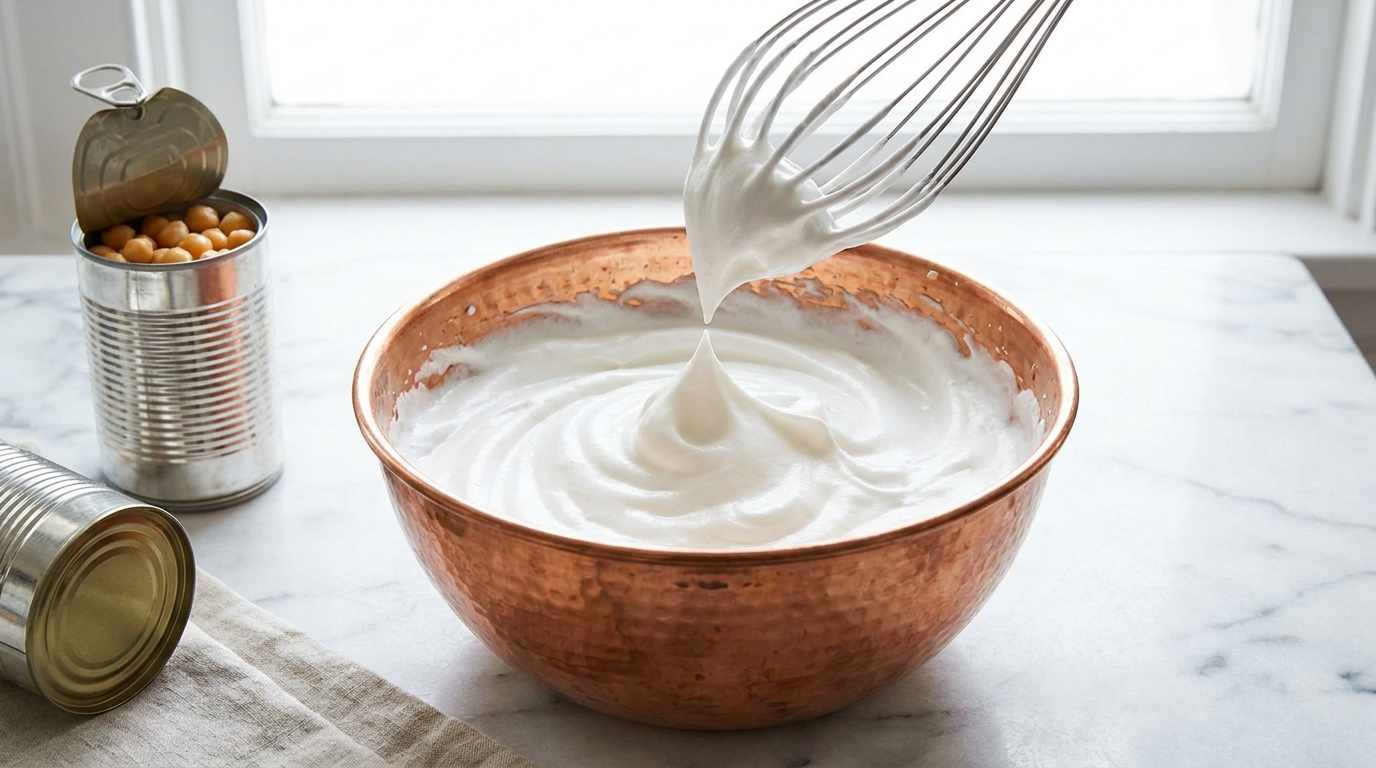
From glossy meringues and airy chocolate mousses to creamy vegan mayonnaise, aquafaba mimics the structural properties of egg whites with uncanny precision. What began as an experimental hack on a vegan social media group has since evolved into a subject of rigorous study in food science journals and a staple in test kitchens worldwide.[1][2]
The core claim behind aquafaba is simple but revolutionary: the water in which legumes are cooked leaches out a specific ratio of compounds that can foam, bind, and emulsify exactly like an egg. This allows it to act as a highly effective, plant-based rheological additive.[3][4]
For bakers dealing with egg allergies or following a plant-based diet, this solved a historic problem. While flax seeds or mashed bananas can add moisture to a cake, they cannot trap air to create the delicate, shattering crust of a macaron or the stiff peaks of a meringue. Aquafaba can.[6]
To understand how bean water achieves this, food scientists have broken down its chemical composition. When chickpeas are boiled or pressure-cooked, about 5% of their dry weight migrates into the surrounding water over time.[3]
This resulting broth is remarkably dilute, containing only 5% to 8% dry matter and roughly 0.85% to 1.5% protein. Yet, according to research published in the journal Applied Sciences, it is this exact, delicate balance of proteins, carbohydrates, and specialized plant compounds that gives aquafaba its structural magic.[3]

The foaming mechanism relies heavily on a class of chemical compounds called saponins. Saponins are natural surfactants found in many plants; their name derives from the Latin word for soap, referencing their tendency to lather when agitated.[3][4]
Saponins have an amphiphilic structure, meaning one end of the molecule loves water while the other end repels it. When aquafaba is whipped, these molecules rush to the boundaries between the water and the newly introduced air bubbles, lowering the surface tension and allowing a voluminous foam to build rapidly.[3][5]
Saponins have an amphiphilic structure, meaning one end of the molecule loves water while the other end repels it.
But foam is inherently fragile. Without a support system, the air bubbles would quickly pop and the mixture would collapse back into a puddle. This is where aquafaba's proteins and carbohydrates take over the heavy lifting.[6]
The trace proteins in the chickpea liquid—primarily albumins, similar to those found in egg whites—unfold during whipping and form a rigid network around the air bubbles. Simultaneously, the dissolved carbohydrates (polysaccharides) thicken the water phase, acting like a microscopic scaffolding that holds the entire foamy structure in place.[3][5]

Beyond foaming, aquafaba excels at emulsification—the forcing together of two liquids that naturally repel each other, like oil and water. In vegan mayonnaise, the amphiphilic proteins and saponins in aquafaba coat the droplets of oil, suspending them evenly in the water phase to create a smooth, creamy spread.[3][4]
Despite its natural abilities, aquafaba often needs a chemical assist to match the sheer resilience of an egg white. Culinary experts have found that aquafaba whips into stiff peaks much faster—and holds them longer—when a small amount of cream of tartar is added to the bowl.[1][2]
Cream of tartar is an acid, and lowering the pH of the aquafaba alters the electrical charge of its proteins. This slight acidic shift encourages the proteins to bond more tightly, creating a stronger, more stable network that can survive the folding of sugar and the heat of an oven.[5][6]
Interestingly, the brand of chickpeas matters. Some commercial canneries line their cans with kombu, a type of seaweed that contains carrageenan. Carrageenan is a powerful natural stabilizer, and its presence in certain brands of chickpea brine yields an exceptionally sturdy aquafaba that requires less whipping and fewer acidic additives.[1]

However, aquafaba is not a flawless, universal egg replacement. While it excels in foams and emulsions, it lacks the coagulating properties of egg proteins, which solidify when heated to provide the dense crumb structure in heavy baked goods.[4][5]
Studies in Food Hydrocolloids and other journals note that when aquafaba is used in high-ratio cakes, the centers can collapse unless commercial gums—like xanthan or hydroxypropyl-methylcellulose—are added to reinforce the batter's architecture.[4]
Furthermore, aquafaba foam is highly sensitive to fat. Just as a speck of egg yolk can ruin a batch of egg white meringue, any residual oil on a mixing bowl or whisk will coat the aquafaba proteins, preventing them from trapping air and leaving the cook with a flat, soapy liquid.[2][6]

Despite these limitations, the rise of aquafaba represents a triumph of sustainable food science. By transforming an industrial byproduct into a highly functional ingredient, it offers a blueprint for reducing food waste on both a domestic and commercial scale.[3][6]
What was once poured down the drain is now recognized as a complex, valuable culinary tool—proving that sometimes, the most innovative breakthroughs are already sitting in the pantry, waiting to be discovered.[6]
How we got here
2014
A French musician discovers that the cooking liquid from beans can be whipped into a foam similar to egg whites.
March 2015
American software engineer Goose Wohlt successfully uses chickpea brine and sugar to bake vegan meringues, coining the term "aquafaba."
2016–2018
Aquafaba goes viral in culinary circles, prompting test kitchens to develop vegan recipes for mayonnaise, mousses, and macarons.
2019–Present
Food science journals begin publishing peer-reviewed studies detailing the specific proteins, saponins, and carbohydrates responsible for aquafaba's unique properties.
Viewpoints in depth
Food Scientists' view
Researchers view aquafaba as a complex rheological puzzle that requires standardization.
For food chemists, aquafaba is a fascinating but inconsistent hydrocolloid. Because the concentration of proteins and saponins varies wildly depending on the chickpea cultivar, soaking time, and canning process, scientists are focused on standardizing its extraction. Their goal is to turn a variable kitchen byproduct into a reliable, commercial-grade plant-based additive for the broader food industry.
Culinary Experts' view
Chefs and bakers focus on practical techniques to overcome aquafaba's structural fragility.
Test kitchens approach aquafaba pragmatically, acknowledging both its magic and its limitations. Culinary experts emphasize that while it mimics egg whites visually, it lacks the heat-activated coagulating proteins of real eggs. Therefore, they advocate for precise interventions—like adding cream of tartar to lower the pH, or using specific stabilizers—to ensure vegan baked goods don't collapse in the oven.
Sustainability Advocates' view
Environmentalists champion aquafaba as a dual solution for food waste and animal welfare.
From a sustainability perspective, aquafaba is a massive win. It upcycles a liquid that millions of households previously poured down the drain, reducing municipal food waste. Furthermore, by providing a highly effective, cheap, and accessible alternative to eggs, it lowers the barrier to entry for plant-based baking, indirectly reducing reliance on resource-intensive poultry farming.
What we don't know
- How to perfectly standardize the protein and saponin content across different commercial brands of canned chickpeas.
- Whether aquafaba can be processed into a shelf-stable commercial powder that retains 100% of its foaming capacity without degrading.
Key terms
- Aquafaba
- The viscous liquid left over after cooking legumes, most commonly chickpeas, used as a plant-based egg substitute.
- Saponins
- Natural plant compounds that act as surfactants, reducing surface tension and allowing liquids to foam easily when agitated.
- Amphiphilic
- A molecule that has both water-loving (hydrophilic) and water-repelling (hydrophobic) parts, allowing it to bind oil and water together.
- Rheological additive
- A substance added to a mixture to change its flow, viscosity, or texture—such as thickening a sauce or stabilizing a foam.
- Emulsion
- A stable mixture of two liquids that normally do not mix, such as oil and water, held together by an emulsifying agent.
Frequently asked
Can I use the liquid from beans other than chickpeas?
Yes, the liquid from white beans, black beans, and lentils also contains proteins and starches. However, chickpea liquid is the most popular because of its neutral flavor and pale color, which won't alter the look or taste of baked goods.
Why do recipes call for cream of tartar when whipping aquafaba?
Cream of tartar is an acid that lowers the pH of the aquafaba. This slight acidic shift helps the proteins bond more tightly, creating a stronger, more stable foam that reaches stiff peaks faster and holds its shape longer.
Does aquafaba make desserts taste like chickpeas?
While the liquid smells like beans straight out of the can, the flavor dissipates entirely once whipped and mixed with sugar and extracts. Baked meringues and mousses will not taste like chickpeas.
Can I freeze leftover aquafaba?
Yes. Culinary experts recommend freezing leftover aquafaba in ice cube trays (about one tablespoon per cube) and transferring them to a freezer bag. Thawed aquafaba whips and performs exactly like fresh.
Sources
Source coverage
6 outlets
3 viewpoints surfaced





[1]Tasting TableCulinary Experts
The Ingredient You Should Look For When Buying Canned Chickpeas For Aquafaba
Read on Tasting Table →[2]MashedCulinary Experts
What You Need To Know Before Cooking With Aquafaba
Read on Mashed →[3]Applied SciencesFood Scientists
Aquafaba—A New Plant-Based Rheological Additive for Food Applications
Read on Applied Sciences →[4]Trends in Food Science & TechnologyFood Scientists
Aquafaba, a new plant-based rheological additive for food applications
Read on Trends in Food Science & Technology →Aquafaba as an egg white substitute in food foams and emulsions
Read on Food Hydrocolloids →[6]Factlen Editorial TeamSustainability Advocates
Synthesis by Factlen editorial team
Read on Factlen Editorial Team →
Every angle. Every day.
Get food drink stories with full source coverage and perspective breakdowns delivered to your inbox.