
How Digital Publishers Are Building 'Proof of Human' Test Kitchens to Combat AI Slop
As AI-generated recipes flood the internet with hallucinated ingredients and dangerous cooking times, major food publishers are investing heavily in massive physical test kitchens to verify their content, turning human culinary expertise into a premium business asset.
By Factlen Editorial Team
- Legacy Publishers
- Viewing human expertise as the ultimate premium product.
- Independent Food Creators
- Fighting to protect their intellectual property and livelihoods.
- Consumer Advocates
- Warning about the safety risks of automated culinary advice.
What's not represented
- · Home cooks relying on AI for dietary restrictions
- · Grocery retailers integrating AI meal planning
Why this matters
In an era where anyone can generate a recipe in seconds, the value of digital content is shifting from quantity to verified quality. This 'proof of human' model is changing how media companies invest their capital and how consumers trust what they read.
Key points
- Generative AI is flooding the internet with untested, error-ridden recipes dubbed 'AI slop.'
- AI models lack an understanding of food chemistry, leading to 'Frankenstein' recipes and unsafe cooking instructions.
- Major publishers are investing heavily in physical test kitchens to verify their culinary content.
- Human-tested recipes are becoming a premium business asset that algorithms cannot easily replicate.
- Advertisers are shifting their spending toward verified, brand-safe environments to avoid association with AI failures.
The internet is currently drowning in a sea of perfectly lit, impossibly flawless food photography attached to recipes that defy the fundamental laws of chemistry. Across social media platforms and search engine results, home cooks are increasingly encountering beautiful images of gooey cheese pulls and towering cakes, only to discover that the accompanying instructions are a fast track to a ruined dinner. This phenomenon, widely dubbed "AI slop," is the direct result of generative artificial intelligence flooding the digital landscape with automated, untested culinary content designed purely to capture clicks and advertising revenue.[2][3]
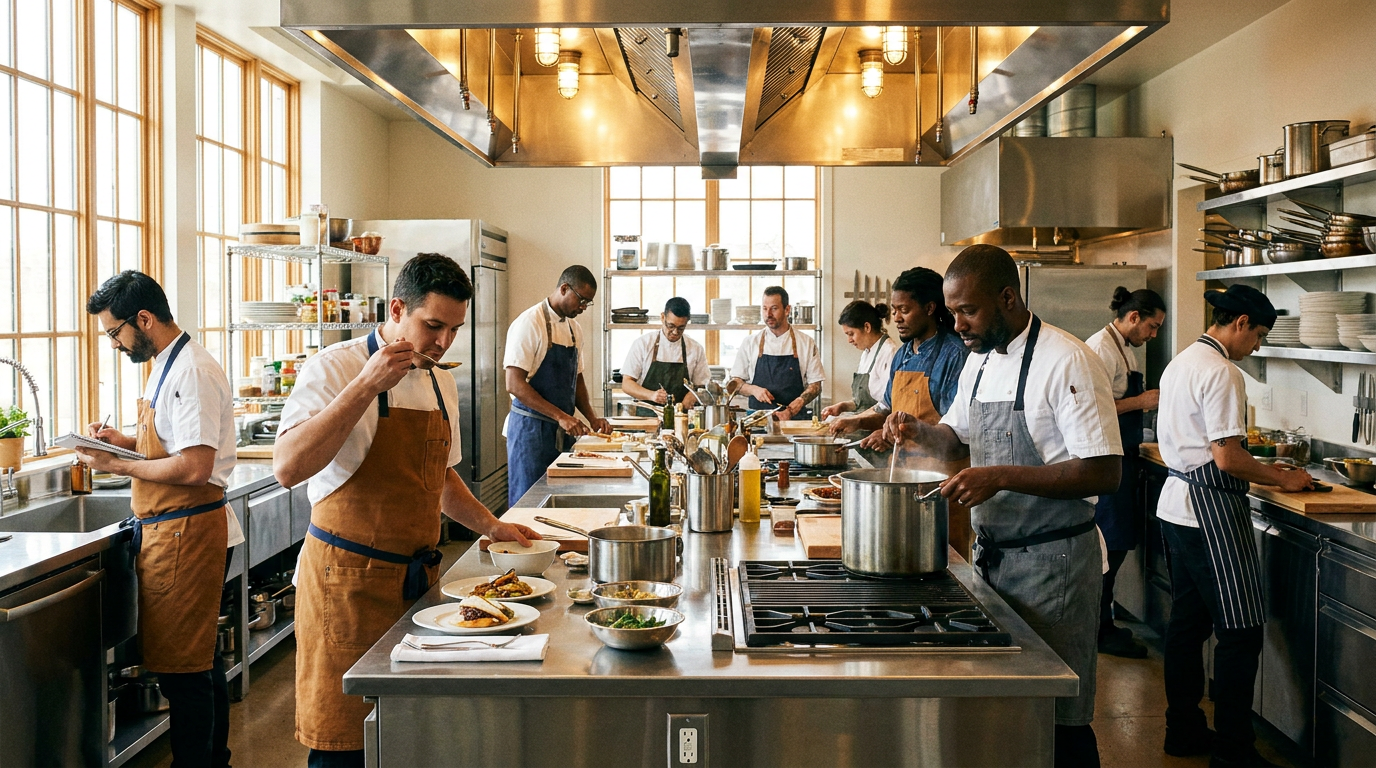
As the web becomes saturated with these synthetic creations, major media companies are discovering a surprisingly analog competitive advantage. Rather than racing to the bottom to produce the highest volume of cheap, automated content, legacy publishers are investing heavily in massive, physical test kitchens staffed by human beings. It is a strategic pivot that turns human culinary expertise into a premium business asset, proving that in an era of infinite digital noise, authenticity and reliability are the ultimate commodities that readers are willing to seek out and trust.[1]
To understand the necessity of this pivot, one must first understand how artificial intelligence approaches the art of cooking. Large language models do not possess taste buds, nor do they understand the Maillard reaction, how gluten develops in dough, or the delicate structural integrity of a baked meringue. Instead, they function as highly advanced predictive text engines, stringing together words based on vast datasets of existing online recipes without any comprehension of how those ingredients actually interact when exposed to heat in a real-world kitchen.[4]
This predictive mechanism often results in what industry veterans call "Frankenstein recipes"—a digital mashup of ingredients and instructions that look highly plausible on a screen but fail disastrously in an actual oven. Because the artificial intelligence is simply remixing text without any grounding in physical reality, it frequently combines the moisture ratios of a bread recipe with the baking times of a roast, leading to culinary disasters that waste home cooks' time, money, and expensive grocery ingredients. Independent food bloggers have watched in horror as AI summaries scrape their carefully crafted recipes, strip away the crucial context, and present a mangled, unworkable version to the public.[4]

The resulting errors range from mildly disappointing to outright hazardous. In some documented cases, AI-generated holiday cake recipes have instructed users to bake their desserts at high temperatures for four hours, guaranteeing a charred, inedible ruin that destroys holiday centerpieces. Other models have hallucinated instructions to cook poultry to unsafe internal temperatures, or bizarrely suggested adding non-toxic glue to pizza cheese to artificially increase its stretchiness for the perfect photograph. These high-profile failures have made consumers increasingly wary of untested online advice.[2][3][4]
Recognizing this growing crisis of consumer trust, legacy publishers are aggressively marketing their human verification processes as a gold standard. People Inc., the massive publishing conglomerate behind stalwarts like Food & Wine and Southern Living, has transformed its sprawling culinary hub into a frontline defense against the bots. They are deliberately leaning into the physical reality of their work, showcasing the messy, tangible process of recipe development to prove that real hands and real palates are behind every dish they publish.[1]
Recognizing this growing crisis of consumer trust, legacy publishers are aggressively marketing their human verification processes as a gold standard.
Inside these massive test kitchens, professional recipe developers, food stylists, and culinary scientists spend their days chopping, searing, and tasting. Every recipe published under their banners must survive rigorous physical testing, ensuring that the measurements are accurate, the steps are logical, and the final dish is actually delicious. This human-in-the-loop approach is heavily promoted to readers as an ironclad guarantee of quality, creating a stark contrast to the sterile, automated output of content farms. Editors meticulously track the sourcing of ingredients and the exact timing of cooking stages, documenting the process so that a home cook can replicate the success without fear of failure.[1]
From a pure business perspective, this rigorous testing is becoming a highly lucrative economic moat. In an era where a digital competitor can spin up a thousand AI-generated recipes in an hour for mere pennies, the sheer cost, time, and friction of running a physical test kitchen serves as a powerful differentiator. It proves to the consumer that the publisher has genuine skin in the game and respects the reader's time and grocery budget, fostering a deep brand loyalty that algorithms struggle to replicate.[1]

The strategy extends well beyond a single publishing house, reflecting a broader industry trend. Institutions like America's Test Kitchen have long leaned into their rigorous, science-based testing methodology, and they are now actively using it to prove their superiority over machine-generated alternatives. In a recent head-to-head experiment, culinary experts pitted a classic, human-developed chocolate chip cookie recipe against versions generated by popular AI chatbots to see if the machines could truly match human intuition. The results highlighted the stark limitations of current generative models when applied to the physical world.[5]
While the artificial intelligence produced a passable, if somewhat boring, mimicry of a standard Toll House cookie, it completely missed the nuanced techniques that elevate a recipe from average to exceptional. The human-developed version utilized browned butter for a chewier texture and nuttier flavor—an innovation born from physical experimentation, sensory feedback, and a deep understanding of flavor profiles that the AI engines simply could not conceptualize or replicate. The machines could follow a basic formula, but they lacked the capacity for culinary inspiration.[5]
The missing ingredient in synthetic content, experts argue, is the emotional and cultural context of food. A machine can aggregate the most common ratios of flour to sugar across millions of websites, but it cannot replicate the nostalgia, tradition, or regional specificity that makes a recipe resonate deeply with a home cook. Food is inherently tied to human experience, and recipes are often stories passed down through generations, carrying memories and cultural significance that a large language model cannot synthesize.[6]
This dynamic is fundamentally reshaping the economics of digital publishing and content creation. While technology giants are currently depleting their cash reserves to build massive data centers for AI processing, food media companies are finding that their most valuable infrastructure is a room full of ovens, stand mixers, and experienced chefs. The physical world is becoming the ultimate premium tier, where the inability to scale infinitely is actually a feature rather than a bug, ensuring scarcity and quality. Investors are beginning to recognize that businesses anchored in physical reality and human expertise possess a resilience that purely digital content farms lack.

Advertisers are also taking keen notice of this shift in consumer trust. Brands selling premium ingredients, high-end kitchen appliances, or luxury cookware are increasingly wary of having their products associated with AI-generated slop that might ruin a consumer's dinner and damage their brand by association. They are actively shifting their premium advertising dollars toward verified, human-tested environments where brand safety is guaranteed and consumer trust remains intact, further funding the test kitchen renaissance. This flight to quality ensures that publishers who invest in human talent are rewarded with higher ad rates and more lucrative sponsorships.[4]
Ultimately, the battle between the test kitchen and the chatbot represents a broader shift in the digital economy. As the cost of creating synthetic content drops to zero, the value of verified, human authenticity is skyrocketing across all sectors. For home cooks and publishers alike, the proof is no longer just in the pudding—it is in the human who stood at the stove, adjusted the seasoning, and tasted it first to ensure it was worthy of the dinner table. In the age of artificial intelligence, the most innovative thing a media company can do is prove that it is still fundamentally human.
How we got here
Nov 2022
Food journalists begin experimenting with early AI models to generate holiday menus, noting the technology's limitations.
Late 2023
Generative AI image tools flood social media with hyper-realistic but physically impossible food photography.
Mid 2024
Independent food bloggers report significant traffic drops as search engines prioritize AI-generated recipe summaries.
Dec 2025
Consumers experience a wave of holiday cooking disasters caused by hallucinated AI instructions.
June 2026
Major publishers double down on physical test kitchens, marketing 'human-tested' as a premium guarantee.
Viewpoints in depth
Legacy Publishers
Viewing human expertise as the ultimate premium product.
For massive media conglomerates, the rise of AI slop is actually a business opportunity. By investing heavily in physical test kitchens, they can offer a 'proof of human' guarantee that automated content farms cannot match. This rigorous testing builds deep consumer trust and attracts premium advertisers who are wary of having their brands associated with hallucinated, unsafe recipes.
Independent Food Creators
Fighting to protect their intellectual property and livelihoods.
Independent bloggers and recipe developers view AI not as a tool, but as an existential threat. They argue that tech companies are scraping their years of hard work, stripping away the context and testing, and serving it up as 'Frankenstein' summaries that steal their web traffic and ruin their readers' dinners.
Consumer Advocates
Warning about the safety risks of automated culinary advice.
Food safety experts and consumer advocates are raising alarms about the physical dangers of AI hallucinations. When a chatbot confidently tells a home cook to undercook poultry or add non-edible substances to a dish, it crosses the line from a digital annoyance to a real-world health hazard, necessitating stricter verification.
What we don't know
- Whether search engines will eventually penalize AI-generated recipe slop in their rankings.
- How independent food bloggers will survive the traffic drops caused by AI summaries.
- If future AI models will be able to accurately simulate food chemistry and physics.
Key terms
- AI Slop
- Low-quality, mass-produced synthetic content generated by artificial intelligence, often riddled with errors and designed purely for clicks.
- Large Language Model (LLM)
- An AI system trained on vast amounts of text to predict and generate human-like language, without actual comprehension of the physical world.
- Hallucination
- When an AI confidently generates false, nonsensical, or physically impossible information, such as unsafe cooking temperatures.
- Test Kitchen
- A professional culinary facility where recipes are rigorously developed, measured, and tasted by humans before publication.
Frequently asked
Why do AI-generated recipes often fail?
AI models don't understand food chemistry or taste; they simply predict the next logical word based on existing text, leading to mismatched ingredients and incorrect cooking times.
How can I tell if a recipe is AI-generated?
Look for overly perfect or physically impossible photos, bizarre ingredient combinations, a lack of personal narrative, and instructions that skip crucial culinary steps.
Why are publishers investing in physical kitchens?
To create a competitive advantage. By proving their recipes are tested by humans, they build trust and offer a premium product that AI cannot replicate.
Sources
Source coverage
6 outlets
3 viewpoints surfaced






[1]The New York TimesLegacy Publishers
The Giant Test Kitchen Where Cooks Battle A.I. Slop
Read on The New York Times →[2]NBC NewsConsumer Advocates
AI slop recipes threaten holiday meals
Read on NBC News →[3]FuturismIndependent Food Creators
AI-generated recipes are drowning social media
Read on Futurism →[4]The StarIndependent Food Creators
Frankenstein AI recipes are distorting online cooking advice
Read on The Star →[5]LAistLegacy Publishers
Can artificial intelligence make a tastier chocolate chip cookie?
Read on LAist →[6]CBC NewsConsumer Advocates
Cooking an entire Thanksgiving dinner using AI-generated recipes
Read on CBC News →



Every angle. Every day.
Get business stories with full source coverage and perspective breakdowns delivered to your inbox.