
How the U.S.-Iran Deal is Unfreezing the Global Oil Market
The reopening of the Strait of Hormuz has sent crude prices tumbling from wartime highs, but logistical backlogs and depleted inventories mean consumer relief will take time.
By Factlen Editorial Team
- Energy Markets & Consumers
- Focused on the immediate relief of falling crude prices but cautious about tight summer inventories.
- Regional Oil Producers
- Prioritizes the rapid restoration of physical output and export capacity after months of forced cuts.
- Geopolitical Skeptics
- Views the 60-day memorandum as highly fragile and vulnerable to unresolved regional conflicts.
What's not represented
- · Logistics and shipping companies managing the maritime backlog
- · European central bankers monitoring inflation impacts
Why this matters
The reopening of the Strait of Hormuz removes the largest chokehold on the global economy, directly lowering the cost of energy, manufacturing, and shipping. However, the fragility of the 60-day truce means the threat of a renewed inflation shock still hangs over global markets.
Key points
- The U.S. and Iran signed a 14-point memorandum of understanding to end a four-month conflict.
- The agreement reopens the Strait of Hormuz, allowing over 12 million barrels of oil to transit immediately.
- Brent crude prices have fallen from a wartime peak of $126 to roughly $79 per barrel.
- Iraq is moving to restore its oil production to 3.3 million barrels per day after a 60% cut.
- Retail gas prices will lag behind crude drops due to depleted refinery inventories and logistical backlogs.
- The 60-day interim deal remains fragile, with upcoming negotiations planned in Switzerland.
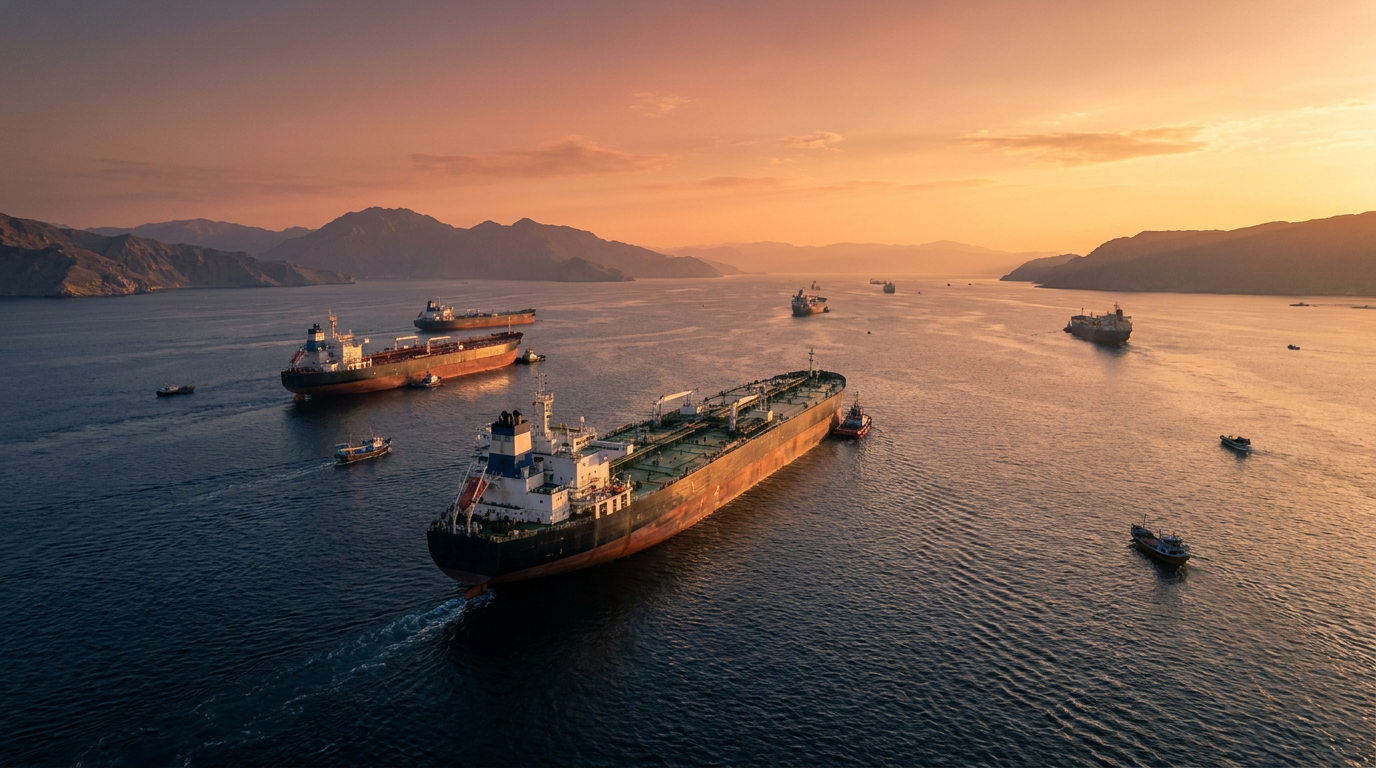
The global economy is exhaling after the United States and Iran signed a 14-point memorandum of understanding to end a nearly four-month-long conflict that had choked off the world's most critical energy artery. The interim agreement initiates a 60-day ceasefire and negotiation period. Its most immediate economic consequence is the full reopening of the Strait of Hormuz, a narrow waterway that handles roughly one-fifth of global oil trade.[3][4]
The market reaction was swift and dramatic. Brent crude, the international oil benchmark, tumbled to around $79 a barrel shortly after the framework was announced, a steep drop from its wartime peak of $126. Wholesale gas prices also fell by roughly 6%. For months, severe restrictions on maritime traffic had created an unprecedented energy shock, threatening to drag the global economy into a recession and keeping inflation stubbornly high.[2][6]

The logistical unfreezing began almost immediately. U.S. Vice President J.D. Vance confirmed that tankers carrying over 12 million barrels of oil crossed the Strait of Hormuz overnight following the deal's signing. Simultaneously, the United States lifted its naval blockade of Iranian ports, a key concession that allowed more than a dozen ships to dock and begin unloading.[4]
The closure of the Strait had not just trapped oil in transit; it forced major producers to physically shut down their operations. Iraq, OPEC's second-largest producer, was among the hardest hit. Before the conflict erupted in late February, Iraq exported about 3.3 million barrels per day, the vast majority flowing south through the Persian Gulf.[8]
When the Strait became impassable due to the threat of Iranian missiles, drones, and naval mines, Iraqi storage reservoirs quickly filled to capacity. With nowhere to put the crude, Baghdad was forced to slash production by roughly 60%, dropping output to a mere 1.3 million barrels per day and relying entirely on limited export routes through Turkey and Syria.[8]

Now, the Iraqi Oil Ministry has instructed operators at five major southern oil fields to rapidly boost production back to prewar levels. Salim Farhoud, a spokesman for the ministry, indicated that restoration work has already begun, with international firms ramping up output at reduced-capacity sites.[1][8]
However, turning the taps back on is not instantaneous. Iraqi officials caution that returning to the 3.3 million barrel-per-day threshold will take one to two months. The delay is driven by varying reservoir pressures, the technical complexities of restarting dormant wells, and the sheer logistical backlog of clearing the maritime traffic jam in the Gulf.[8]
Iraqi officials caution that returning to the 3.3 million barrel-per-day threshold will take one to two months.
That lag between diplomatic signatures and physical delivery is why everyday consumers will not see immediate relief at the gas pump. While futures contracts—predictions of where oil prices are heading—have plummeted, the spot price for physical delivery remains elevated.[7]
The U.S. Chamber of Commerce notes that refiners are still paying a premium for crude as they wait for supplies to normalize. The Strait must be fully cleared of mines—a process that could take weeks—and the backlog of waiting ships must be processed before fresh oil can be loaded and shipped to global refineries.[2][7]

Furthermore, the energy market is entering its most vulnerable seasonal window. The summer driving season typically brings peak demand for gasoline. Refineries are currently operating with tightly depleted emergency crude stockpiles, which were drawn down heavily during the 100-day crisis.[2]
As buyers race to refill those strategic and commercial reserves, the sudden surge in purchasing could put a floor under oil prices, keeping them hovering between $80 and $90 a barrel for the remainder of the year. If global demand, particularly from a recovering Chinese economy, outpaces the slow return of Middle Eastern supply, prices could even tick upward in the short term.[2][7]
Beyond the physical constraints, the market is pricing in a significant geopolitical risk premium. The current agreement is only a preliminary memorandum of understanding, not a permanent peace treaty. It defers some of the most intractable issues, including the future of Iran's nuclear program and the management of maritime services in the Strait itself.[4][5]
The 60-day negotiation window, with talks expected to continue in Switzerland, leaves ample room for the deal to collapse. Credit rating agencies and shipping analysts warn that any breakdown in talks could instantly send prices soaring again.[5]
A particular flashpoint is the ongoing violence in Lebanon. The U.S.-Iran memorandum calls for the termination of hostilities on all fronts, but Israel has thus far refused to cease its operations against Hezbollah in Lebanon. Analysts warn that this regional friction could easily derail the fragile detente between Washington and Tehran.[5]

Despite these vulnerabilities, the macroeconomic picture is undeniably brighter than it was a week ago. By avoiding a prolonged, multi-year closure of the Strait of Hormuz, the global economy has likely dodged the worst-case stagflation scenarios modeled by central banks earlier this year.[2][6]
For policymakers, the easing of energy costs provides crucial breathing room. Central banks, which had been forced to maintain high interest rates to combat war-driven inflation, may now have the flexibility to consider rate cuts later in the year, provided the ceasefire holds and the oil flows uninterrupted.[2][6]
How we got here
Late February 2026
Conflict erupts, leading to the militarization and closure of the Strait of Hormuz.
April 2026
Brent crude oil prices hit a wartime peak of $126 per barrel amid severe supply shocks.
Mid-June 2026
The U.S. and Iran sign a 14-point memorandum of understanding to end hostilities.
June 18, 2026
Over 12 million barrels of oil cross the Strait overnight as the U.S. lifts its naval blockade of Iranian ports.
Late June 2026
Iraq orders its southern oil fields to begin restoring production to prewar levels.
Viewpoints in depth
Energy Markets & Consumers
Focused on the immediate relief of falling crude prices but cautious about tight summer inventories.
Market analysts emphasize that while the worst-case macroeconomic scenario has been avoided, the physical reality of the oil supply chain will delay relief for everyday consumers. Refineries are currently operating with heavily depleted stockpiles, meaning any new crude flowing through the Strait will likely be bought up immediately to replenish strategic reserves rather than flooding the retail market. This dynamic, combined with peak summer driving demand, is expected to keep a floor under prices for several months.
Regional Oil Producers
Prioritizes the rapid restoration of physical output and export capacity after months of forced cuts.
For countries like Iraq, the blockade of the Strait of Hormuz was an economic catastrophe that forced the shutdown of major southern oil fields as storage reservoirs hit maximum capacity. Their primary focus is now on the technical and logistical hurdles of restarting dormant wells and clearing the massive backlog of maritime traffic. Producers view the 60-day window as a critical race against time to export as much volume as possible before any potential collapse of the diplomatic framework.
Geopolitical Skeptics
Views the 60-day memorandum as highly fragile and vulnerable to unresolved regional conflicts.
Security analysts and credit rating agencies warn that the market is prematurely pricing in a permanent peace. The 14-point memorandum defers the most intractable issues—including Iran's nuclear program and the ultimate administrative control of the Strait of Hormuz—to future talks in Switzerland. Skeptics point to ongoing hostilities in Lebanon and domestic political pressures in both Washington and Tehran as immediate flashpoints that could easily derail the ceasefire and trigger a renewed blockade.
What we don't know
- Whether the 60-day memorandum will successfully transition into a permanent peace treaty in Switzerland.
- How quickly the logistical backlog of waiting oil tankers can be cleared through the Strait.
- If ongoing regional hostilities, particularly in Lebanon, will derail the U.S.-Iran ceasefire.
Key terms
- Strait of Hormuz
- A narrow waterway between the Persian Gulf and the Gulf of Oman through which roughly 20% of the world's oil supply passes.
- Brent Crude
- The primary international benchmark price for purchases of oil worldwide.
- Spot Price
- The current market price at which a physical commodity, like a barrel of oil, can be bought or sold for immediate delivery.
- Futures Contract
- A legal agreement to buy or sell a commodity at a predetermined price at a specified time in the future.
- Memorandum of Understanding (MOU)
- A non-binding agreement that outlines the broad terms and details of a mutual understanding, often serving as the foundation for a final treaty.
Frequently asked
Will gas prices drop immediately?
No. While crude oil futures have fallen, it will take weeks to clear the shipping backlog and refill depleted refinery inventories before savings reach the retail pump.
How much oil was blocked by the conflict?
The closure of the Strait of Hormuz disrupted an estimated 14 million barrels of daily global oil supply, representing nearly a fifth of all global trade.
Why did Iraq have to cut its oil production?
With the Strait of Hormuz blocked, Iraq could not export its oil by sea. Its storage reservoirs quickly filled up, forcing the country to slash production by 60%.
Is the war permanently over?
The current deal is a 60-day interim agreement. Permanent peace depends on upcoming negotiations in Switzerland regarding broader regional conflicts and nuclear policy.
Sources
Source coverage
8 outlets
3 viewpoints surfaced








[1]BloombergRegional Oil Producers
Iraq Tells Oil Fields to Start Lifting Output After US-Iran Deal
Read on Bloomberg →[2]The GuardianEnergy Markets & Consumers
Markets welcome US-Iran peace deal but prices may stay high as buyers race to refill depleted emergency crude stockpiles
Read on The Guardian →[3]Fox Business
Oil prices fluctuate as Trump's Iran deal could fully reopen Strait of Hormuz
Read on Fox Business →[4]The HinduGeopolitical Skeptics
Oil prices fall on US, Iran deal announcement
Read on The Hindu →[5]TIMEEnergy Markets & Consumers
Gas Prices Could Take Months to Return to Pre-War Levels Even After U.S.-Iran Deal
Read on TIME →[6]Al JazeeraGeopolitical Skeptics
Oil prices continue slide amid hopes for peace, opening of Strait of Hormuz
Read on Al Jazeera →[7]U.S. Chamber of CommerceEnergy Markets & Consumers
Oil prices may ease, but tight inventories, global demand, and lingering inflation could keep gas prices elevated
Read on U.S. Chamber of Commerce →[8]Anadolu AgencyRegional Oil Producers
Iraq wants to restore 3M barrels of oil production daily: Ministry
Read on Anadolu Agency →

More in business
See all 5 stories →

Every angle. Every day.
Get business stories with full source coverage and perspective breakdowns delivered to your inbox.