
How AI Tutors Are Actually Working in K-12 Classrooms
Millions of students are now using AI-powered tutoring platforms, shifting the technology from a novelty to a core classroom tool. Early data shows these systems work best as a 'force multiplier' for human teachers, not a replacement.
By Factlen Editorial Team
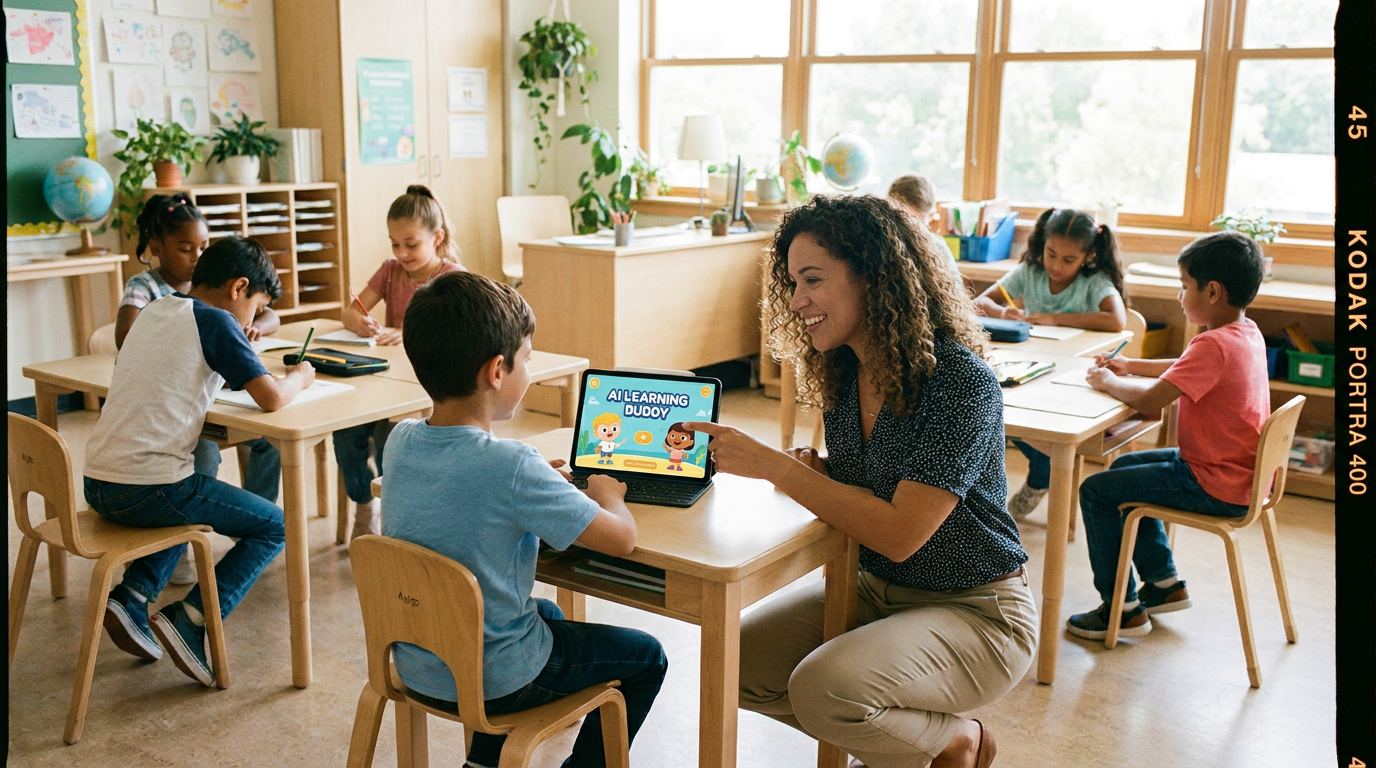
- Education Researchers
- Focused on evidence-based outcomes and the necessity of teacher integration.
- Classroom Advocates
- Focused on protecting the human elements of teaching while using AI to reduce burnout.
- EdTech Developers
- Focused on scaling personalized learning and democratizing access to one-on-one tutoring.
What's not represented
- · Students using the platforms daily
- · Parents navigating AI homework help at home
Why this matters
As AI tutoring platforms scale to millions of K-12 students in 2026, understanding how they actually work—and why they require human teachers to be effective—is crucial for parents, educators, and policymakers navigating the new educational landscape.
Key points
- AI tutoring platforms like Khanmigo are projected to reach over one million K-12 students in the 2025-2026 school year.
- Leading AI tutors use 'Socratic refusal,' withholding direct answers to encourage critical thinking and problem-solving.
- A 2026 Stanford study found that students rarely engage with AI tutors for meaningful durations when left unguided.
- Engagement and outcomes improve significantly when human teachers actively integrate AI tools into their lesson plans.
- Educators are using AI to handle routine grading and basic concepts, freeing them to provide complex emotional and academic support.
In the 2025-2026 academic year, artificial intelligence in K-12 education transitioned from a speculative pilot program to core classroom infrastructure. Platforms like Khan Academy's Khanmigo saw their usage leap from 40,000 to over 700,000 students, with projections crossing the one million mark as the school year concludes. This surge underscores a broader shift in how schools approach personalized learning, moving past the initial anxieties of the generative AI boom to embrace purpose-built educational tools that integrate directly into daily lesson plans.[3]
The financial and systemic footprint of this transition is massive. The global market for AI tutors is projected to reach $2.75 billion in 2026, driven heavily by K-12 adoption across thousands of school districts. States are increasingly rolling out massive, centralized initiatives rather than leaving adoption to individual schools. Arizona, for example, deployed Khanmigo to 170,000 public school students—roughly 16 percent of its entire student body—backed by a $1.5 million state investment. Similarly, Iowa launched a $3 million project for Amira, an AI-powered reading tutor designed specifically for elementary students, while Maryland and Indiana have funded their own extensive high-dosage tutoring pilots.[1][4]
Unlike the open-ended chatbots that sparked widespread cheating panics in 2023, purpose-built K-12 AI tutors operate on a strict pedagogical principle known as 'Socratic refusal.' When a student asks one of these platforms for the answer to a pre-algebra equation or a history prompt, the system is explicitly programmed to withhold the direct solution. Instead, the AI acts as a digital coach, offering contextual hints, deploying visual manipulatives, and asking guiding questions that force the student to think through the problem themselves. This design choice is intended to build critical thinking and persistence rather than simply providing a shortcut to finished homework.[3][5]
Historically, high-dosage, one-on-one tutoring has been a luxury reserved for affluent families, creating a persistent equity gap in education. The new wave of AI tutors is attempting to democratize this level of personalized academic support at an unprecedented scale. At a typical district cost of roughly $15 per student annually—and often entirely free for individual US teachers to use in their classrooms—these platforms offer a financially viable way for public schools to provide individualized attention. For families opting to use the tools at home, consumer plans hover around an accessible $4 per month, setting a new floor for educational software pricing.[4][5]

While math has been the strongest and most widely adopted subject for chat-based tutors, early literacy is seeing highly specialized, voice-driven applications. Platforms like Amira use advanced speech recognition to listen to elementary students read aloud in real time. When a child stumbles over a word or mispronounces a phoneme, the AI provides instant, personalized corrections and adapts the difficulty level of the text on the fly. This immediate feedback loop is designed to mimic the experience of reading alongside a dedicated adult, offering crucial phonics support in districts where reading specialists are stretched thin.[1][2]
But as the technology scales across the country, early efficacy data is providing a crucial reality check for districts hoping AI might be a silver bullet for learning loss. A June 2026 Stanford University study analyzing state-level rollouts found that simply giving students access to an AI tutor does not guarantee meaningful engagement. The research highlights a significant gap between the theoretical capabilities of the software and the practical realities of how children interact with digital tools when left to their own devices.[1]
A June 2026 Stanford University study analyzing state-level rollouts found that simply giving students access to an AI tutor does not guarantee meaningful engagement.
The Stanford researchers discovered that when students were left to use the AI tutor independently, even with dedicated time carved out in the school day, average weekly usage hovered between a mere two to five minutes. Without structured human oversight, the novelty of the chatbot quickly wore off. Students largely failed to reach the 30 minutes of weekly practice recommended by platform providers to achieve measurable academic gains, demonstrating that access alone is insufficient to drive educational outcomes.[1]
The data points to a clear conclusion that is reshaping district procurement strategies: AI tutoring requires 'human-AI hybrid vigor' to succeed. When teachers actively integrated the AI into their specific lesson plans, modeled its use, and guided students through the interface, student engagement increased significantly. The technology works best as a 'force multiplier' for educators, extending their reach and providing supplementary support, rather than acting as an autonomous replacement for traditional instruction. Schools that treat AI as a collaborative tool for teachers are seeing far better utilization rates than those that treat it as a standalone software solution.[1][3][4]

For overburdened classrooms facing historic teacher shortages, this hybrid model offers real, tangible relief. AI systems can provide instant feedback on practice problems and explain basic concepts privately, allowing students to work through their mistakes without the social pressure of raising their hand in front of peers. This on-demand support is particularly valuable for students who need extra time to grasp foundational concepts, as the AI can infinitely generate new practice variations without losing patience or needing to move on to the next lesson.[2]
By offloading routine academic troubleshooting and basic grading to the AI, teachers are freed to focus on the complex, relational aspects of education that machines cannot replicate. Educators can dedicate more of their limited classroom time to small-group instruction, emotional support, and helping students who require highly specialized interventions. In this model, the AI acts as a tireless teaching assistant, handling the repetitive tasks so the human professional can focus on high-level pedagogical strategy and student wellbeing.[2][3]
Despite the optimism surrounding these tools, educational advocates stress that responsible integration requires clear, unyielding boundaries. While an AI can seamlessly translate stories across languages, adapt math problems to a student's interests, or generate a lesson plan in seconds, it cannot provide the eye contact, patience, and genuine encouragement of a human adult. Child development experts warn against the temptation to outsource the fundamental acts of caregiving and mentorship to algorithms, no matter how sophisticated they become. The emotional safety that allows a child to take intellectual risks is built on human trust, not computational efficiency.[2]

School districts and policymakers are increasingly adopting frameworks that prioritize human-centered design alongside technological innovation. The consensus emerging in 2026 is that children will inevitably grow up surrounded by artificial intelligence, but they still need adults who genuinely care about their progress. A relationship matters more than the pure efficiency of an algorithm, and successful school districts are ensuring that their AI policies explicitly protect the human connections at the heart of the educational experience. Technology is being positioned as a bridge to better human interaction, rather than a wall that separates students from their teachers.[2]
As the 2026-2027 school year approaches, developers are already iterating based on these hard-won classroom realities. Major platforms are shifting away from the broad, open-ended chat interfaces that characterized the first wave of educational AI, moving instead toward tighter, goal-driven tutoring flows. These redesigned interfaces are specifically structured to keep students on task, minimize distractions, and integrate more seamlessly with the specific curricula and pacing guides that teachers are already using in their classrooms. The focus has shifted from showing off the AI's conversational abilities to maximizing its utility as a focused academic tool.[6]
The integration of AI tutors into K-12 education represents a profound shift in how personalized learning is delivered at scale. By proving that technology is most effective when actively guided by a human educator, the 2026 rollout has dispelled the myth of the autonomous robot teacher. Instead, it has ultimately reinforced the irreplaceable value of the classroom professional, offering a hopeful vision where technology and human empathy work in tandem to support every student. As these tools become standard infrastructure, the future of education looks less like a science fiction dystopia and more like a highly supported, deeply human endeavor.[2][3]
How we got here
2023
Early AI tutoring pilots launch, sparking debates over academic integrity and cheating.
2024
States like Arizona and Iowa begin investing millions in statewide AI tutoring initiatives.
2025
FERPA rules shift student-data consent, requiring stricter compliance for district-wide AI adoption.
June 2026
Stanford study reveals that AI tutors require active teacher integration to achieve meaningful student engagement.
Viewpoints in depth
EdTech Developers
Focused on scaling personalized learning and democratizing access to one-on-one tutoring.
Platform creators argue that AI can fundamentally solve the 'two sigma problem'—the long-standing educational theory that one-on-one tutoring yields vastly superior results to group instruction. By offering tools at $15 per student rather than $50 an hour, they believe they can close equity gaps. They emphasize that their systems are explicitly designed not to cheat, using Socratic methods to force students to do the cognitive work.
Education Researchers
Focused on evidence-based outcomes and the necessity of teacher integration.
Researchers caution against treating AI as a plug-and-play solution. Early data from 2026 shows that simply handing a student a tablet with an AI tutor results in minimal engagement. They argue that the technology is only effective when embedded into a teacher's broader pedagogical strategy, requiring schools to invest as much in professional development as they do in software licenses.
Classroom Advocates
Focused on protecting the human elements of teaching while using AI to reduce burnout.
Educators and child development experts welcome AI as a tool to handle routine grading and basic concept reinforcement, which helps alleviate severe teacher burnout. However, they draw a hard line at outsourcing caregiving. They argue that the emotional support, patience, and relational trust provided by human adults are irreplaceable, and that AI should remain strictly an academic assistant rather than a holistic mentor.
What we don't know
- How the shift toward tighter, goal-driven AI interfaces in the 2026-2027 school year will impact long-term student engagement.
- Whether the academic gains seen in highly structured hybrid classrooms can be replicated in under-resourced districts with higher teacher turnover.
Key terms
- Socratic refusal
- An AI design choice where the system refuses to provide direct answers, instead asking guiding questions to help the student solve the problem.
- Human-AI hybrid vigor
- An instructional model where the effectiveness of an AI tool is maximized by active human teacher guidance.
- High-dosage tutoring
- Intensive, one-on-one or small-group tutoring provided frequently to help students catch up or accelerate learning.
Frequently asked
Will AI tutors replace human teachers?
No. Research shows AI tutors are largely ineffective without a human teacher to guide their use, and they cannot provide the emotional support children need.
How much do these AI tools cost for schools?
District-wide licenses typically cost around $15 per student annually, though many platforms offer free access for individual teachers.
Do AI tutors just do the homework for the students?
Leading K-12 platforms use 'Socratic refusal,' meaning they are programmed to withhold direct answers and instead offer hints and guiding questions.
Sources
Source coverage
6 outlets
3 viewpoints surfaced






[1]K-12 DiveEducation Researchers
Stanford study finds AI tutoring requires human guidance to boost student engagement
Read on K-12 Dive →[2]EdWeekClassroom Advocates
Welcome to the 'Funky' Politics of the Tech in Schools Debate
Read on EdWeek →[3]Global SocietyClassroom Advocates
Khan Academy expands AI tutor Khanmigo to classrooms at scale
Read on Global Society →[4]Third Rock TechknoEdTech Developers
Best AI Tutoring Software for School in 2026: Full Comparison and Custom Build Guide
Read on Third Rock Techkno →[5]ZogMathEdTech Developers
Khanmigo in 2026: Is the free AI math tutor actually good?
Read on ZogMath →[6]AI Tools BakeryEdTech Developers
Khanmigo Review 2026: Pricing, Features, and Redesign
Read on AI Tools Bakery →
Every angle. Every day.
Get education stories with full source coverage and perspective breakdowns delivered to your inbox.