
Gas Detected Deep Inside Uranus Confirms the Planet is a True 'Ice Giant'
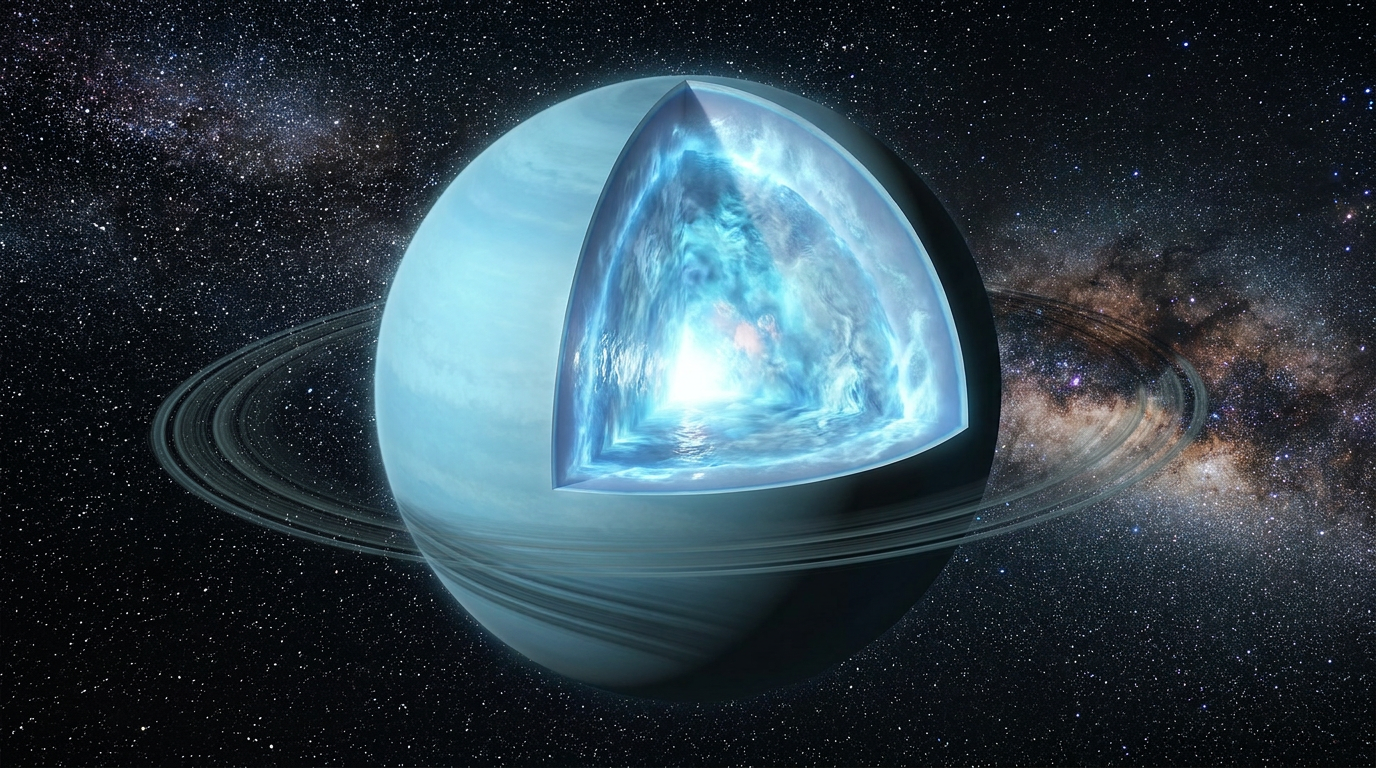
A new detection of carbon monoxide deep in Uranus's atmosphere confirms the planet is packed with water and ice, settling a long-standing debate over whether it was actually a rock-dominated world.
By Factlen Editorial Team
- Planetary Formation Theorists
- Focus on how the discovery unifies the origin stories of the outer solar system.
- Exoplanet Researchers
- View Uranus as a critical local template for understanding distant worlds.
- Observational Astronomers
- Focus on the technical triumph of using radio telescopes to probe deep planetary atmospheres.
What's not represented
- · Space agency budget planners
- · Astrobiologists studying supercritical oceans
Why this matters
Confirming the true composition of Uranus not only solves a decades-old mystery about our own solar system's formation, but it also provides a crucial baseline for understanding the thousands of similar 'ice giant' exoplanets that dominate the Milky Way.
Key points
- Astronomers detected carbon monoxide in Uranus's deep atmosphere for the first time.
- The discovery confirms Uranus is an 'ice giant' packed with water and ammonia, not a 'rock giant'.
- The finding settles a long-standing debate and suggests Uranus and Neptune formed similarly.
- The 'ice' inside Uranus actually exists as a searing-hot, highly pressurized supercritical fluid.
- Understanding Uranus helps scientists model the most common type of exoplanet in the galaxy.
The outer solar system is a realm of thick atmospheres and hidden depths, where the true nature of the planets has long been obscured. For decades, astronomers have debated the fundamental composition of Uranus, the seventh planet from the Sun.[1][6]
While colloquially known as an "ice giant," alongside its neighbor Neptune, the actual ratio of rock to ice inside Uranus has remained one of planetary science's most stubborn mysteries.[3][8]
Now, a breakthrough observation has pierced the planet's opaque cloud decks. A team of astronomers led by Thibault Cavalié at the University of Bordeaux has detected carbon monoxide deep within Uranus's lower atmosphere for the first time.[2][5]
The findings, based on data gathered between 2022 and 2024 by the Atacama Large Millimeter/submillimeter Array (ALMA) in Chile, provide the missing chemical signature needed to peer inside the planet.[2][7]
To understand why carbon monoxide matters, one must look at the competing models of planetary interiors. Planetary scientists have long divided the possibilities into two camps: the "ice giant" model, where the bulk of the planet is made of water, ammonia, and methane, and the "rock giant" model, where silicates and metals dominate.[1][3]

Neptune has long exhibited a clear carbon monoxide signature in its troposphere—the lowest layer of its atmosphere. In the extreme heat and pressure of a planetary interior, abundant water ice reacts with carbon to produce carbon monoxide, which then dredges up into the observable atmosphere.[3][8]
Uranus, however, had stubbornly refused to show any signs of deep atmospheric carbon monoxide. This glaring absence led a growing faction of researchers to hypothesize that Uranus was actually a rock giant, fundamentally different from Neptune.[2][3]
If Uranus were rock-dominated, it would imply that the two neighboring planets formed under drastically different conditions or via different mechanisms, complicating our models of the early solar system.[3][5]
The new ALMA observations put that controversy to rest. By detecting the faint microwave emissions of carbon monoxide welling up from the deep troposphere, Cavalié's team confirmed that Uranus possesses the massive internal reservoir of oxygen required to produce the gas.[2][4]

"We find that Uranus is more on the ice-giant side than on the rock-giant side," Cavalié noted in the wake of the discovery, adding that the long-standing controversy over its fundamental classification is effectively over.[5]
The term "ice," however, is somewhat of a misnomer when applied to the deep interiors of these planets. The water, ammonia, and methane inside Uranus are not frozen solid like ice on Earth.[1][6]
The term "ice," however, is somewhat of a misnomer when applied to the deep interiors of these planets.
Instead, the crushing pressures and searing temperatures—reaching thousands of degrees—force these molecules into a supercritical fluid state. This dense, electrically conductive "slush" behaves simultaneously like a liquid and a gas.[6][8]
The confirmation of Uranus's icy interior brings it back into alignment with Neptune, suggesting the two worlds share a similar formation history. Both likely coalesced in the outer reaches of the primordial solar nebula, sweeping up vast quantities of frozen volatiles.[3][8]

Interestingly, the ALMA data also revealed carbon monoxide in Uranus's upper atmosphere, or stratosphere. However, researchers believe this high-altitude gas has a completely different origin than the deep-seated supply.[2][4]
The stratospheric carbon monoxide was likely delivered by a massive comet that slammed into Uranus several centuries ago, leaving a chemical scar that is still diffusing through the upper atmosphere today.[4][5]
Resolving the composition of Uranus has implications far beyond our own solar system. Data from the Kepler and James Webb space telescopes indicate that planets roughly the size of Uranus and Neptune are the most common type of world in the Milky Way.[1][8]
By understanding the true nature of our local ice giants, astronomers can better calibrate their models for thousands of distant exoplanets, predicting their compositions, internal dynamics, and potential habitability.[1][8]

Despite this breakthrough, remote observations from Earth can only reveal so much. The exact ratio of ice to rock, the mechanics of Uranus's bizarre off-center magnetic field, and the dynamics of its supercritical mantle remain partially obscured.[3][6]
These lingering questions underscore the growing consensus within the planetary science community for a dedicated flagship mission to Uranus. A spacecraft equipped with an atmospheric entry probe could directly sample the troposphere, measuring the exact isotopic ratios of carbon, nitrogen, and oxygen.[3][8]
How we got here
1986
Voyager 2 flies past Uranus, providing the only close-up data to date.
2013
Herschel Space Observatory detects upper-atmosphere carbon monoxide, sparking debate about its origin.
2020
Theoretical models suggest Uranus might be a 'rock giant' due to the lack of deep carbon monoxide.
2022–2024
ALMA telescope conducts deep microwave observations of Uranus's troposphere.
June 2026
Researchers announce the detection of deep carbon monoxide, confirming the ice giant model.
Viewpoints in depth
Planetary Formation Theorists
Focus on how the discovery unifies the origin stories of the outer solar system.
For theorists modeling the early solar system, the confirmation of Uranus as a true ice giant is a massive relief. If Uranus had been a rock giant, models of the protoplanetary disk would have required complex, highly specific conditions to explain how two adjacent planets formed so differently. Now, the prevailing theory of core accretion—where both planets swept up vast amounts of frozen volatiles beyond the 'snow line'—remains robust and applicable to both worlds.
Exoplanet Researchers
View Uranus as a critical local template for understanding distant worlds.
Astronomers studying exoplanets rely heavily on our solar system's planets as ground truth. With Kepler and James Webb data showing that 'sub-Neptunes' and ice giants are the most abundant planets in the galaxy, knowing the exact internal chemistry of Uranus allows researchers to better interpret the atmospheric spectra of worlds light-years away. It shifts the baseline assumption for what these ubiquitous planets are made of.
Space Mission Advocates
Emphasize the limitations of Earth-based observation and the need for a dedicated probe.
While the ALMA observations are a triumph of remote sensing, mission advocates argue they highlight the urgent need for a flagship Uranus orbiter. Earth-based telescopes cannot measure the precise isotopic ratios or map the complex, off-center magnetic field generated by the supercritical ocean. Only an atmospheric entry probe can provide the definitive ground-truth data required to fully understand the ice giant's mechanics.
What we don't know
- The exact ratio of water, ammonia, and methane within the supercritical mantle.
- How the deep icy interior generates Uranus's highly unusual, off-center magnetic field.
- Whether the stratospheric carbon monoxide was delivered by a single massive comet or multiple smaller impacts.
Key terms
- Ice Giant
- A giant planet composed largely of elements heavier than hydrogen and helium, such as oxygen, carbon, nitrogen, and sulfur.
- Supercritical Fluid
- A state of matter where distinct liquid and gas phases do not exist, occurring at extremely high temperatures and pressures.
- Troposphere
- The lowest, densest layer of a planet's atmosphere where weather occurs and deep gases mix upward.
- Core Accretion
- The leading model for planetary formation, where a solid core gathers enough mass to pull in a thick gaseous envelope.
Frequently asked
Why is Uranus called an ice giant if it's not frozen?
The term refers to the planet's bulk composition of water, ammonia, and methane, which astronomers traditionally call 'ices,' even though they exist as a hot, dense fluid inside the planet.
How did scientists see inside Uranus?
They used the ALMA radio telescope to detect microwave emissions from carbon monoxide gas welling up from the deep interior into the lower atmosphere.
Does this mean Uranus and Neptune are identical?
While they share a similar internal structure, they still have differences, such as Uranus's extreme axial tilt and lack of internal heat emission.
Sources
Source coverage
8 outlets
3 viewpoints surfaced








[1]Factlen Editorial TeamExoplanet Researchers
Synthesis by Factlen editorial team
Read on Factlen Editorial Team →[2]New ScientistObservational Astronomers
Gas from Uranus reveals it has an icy centre
Read on New Scientist →[3]Philosophical Transactions of the Royal Society APlanetary Formation Theorists
Neptune and Uranus: ice or rock giants?
Read on Philosophical Transactions of the Royal Society A →[4]Astronomy & AstrophysicsPlanetary Formation Theorists
The first submillimeter observation of CO in the stratosphere of Uranus
Read on Astronomy & Astrophysics →[5]Daily StarObservational Astronomers
Scientists studying Uranus find carbon monoxide, suggesting massive icy secret
Read on Daily Star →[6]NASA ScienceObservational Astronomers
Uranus: Facts, Moons, Rings, and More
Read on NASA Science →[7]ALMA ObservatoryObservational Astronomers
Atacama Large Millimeter/submillimeter Array
Read on ALMA Observatory →[8]arXivExoplanet Researchers
The Interiors of Uranus and Neptune: Current Understanding and Open Questions
Read on arXiv →

More in science
See all 7 stories →Gut-Brain Axis
Young Gut Bacteria Can Restore Childhood-Level Brain Plasticity in Adults, New Evidence Shows
8 sources

Male Fertility
GLP-1 Weight-Loss Drugs Show Unexpected Benefits for Male Fertility and Testosterone
7 sources

ENSO Cycle
Is Climate Change Supercharging El Niño? The Evidence, Explained
6 sources

Turfgrass Science
The 2026 World Cup's Biggest Engineering Feat Is the Grass Beneath the Players' Feet
7 sources

Every angle. Every day.
Get science stories with full source coverage and perspective breakdowns delivered to your inbox.