
The Thermodynamic Flaw in Most Portable Air Conditioners
Millions of single-hose portable air conditioners actively pull hot air into homes by creating negative pressure. Upgrading to a dual-hose design solves this mechanical flaw, saving energy and cooling rooms faster.
By Factlen Editorial Team
- Thermodynamic Critics
- Argue that single-hose units are fundamentally flawed due to negative pressure and should be phased out.
- Consumer Advocates
- Emphasize that accurate SACC ratings are the best metric, and single-hose units still serve budget buyers.
- Regulators
- Focus on updating testing standards to accurately reflect real-world efficiency and reduce overall grid load.
What's not represented
- · Renters who are prohibited by landlords from installing window units and can only afford single-hose models.
- · Manufacturers of single-hose units defending their cost-to-cooling ratio.
Why this matters
Millions of consumers waste money on single-hose portable air conditioners that actively pull hot air into their homes. Understanding the physics of dual-hose designs and the new SACC ratings can save you hundreds of dollars in electricity while keeping your home significantly cooler.
Key points
- Single-hose portable air conditioners create negative pressure, sucking hot outdoor air into the room they are trying to cool.
- Dual-hose models solve this thermodynamic flaw by using outside air to cool their internal condenser, keeping the room sealed.
- The Department of Energy's new SACC rating system exposes the true inefficiency of single-hose units by accounting for infiltration heat.
- While dual-hose units are more expensive and harder to install, they cool rooms faster and use less electricity over time.
Summer heat is driving millions of people to buy portable air conditioners, but a recent column in New Scientist highlights a dirty secret: the most popular models on the market are actively fighting the laws of physics. The core issue lies in the engineering of the single-hose portable air conditioner. While these units dominate store shelves because they are cheap, lightweight, and easy to install, they suffer from a fundamental thermodynamic flaw that makes them highly inefficient. By understanding the mechanics of how these machines operate, consumers can avoid purchasing an appliance that actively works against its own cooling efforts.[1][6]
To understand the flaw, one must look at how air conditioning actually works. An air conditioner does not create cold air; rather, it absorbs heat from the inside of a room and moves it outside. To accomplish this continuous heat transfer, the machine must continuously cool its own internal condenser coils. In a single-hose unit, the machine pulls in the already-cooled air from the room, runs it over the hot condenser coils to cool them down, and then blasts that heated air out the window through the single exhaust duct.[3][5][6]
This exhaust process creates a severe mechanical problem known as negative pressure. By constantly pumping indoor air outside, the single-hose unit acts like a vacuum cleaner, lowering the air pressure inside the sealed room. Because nature abhors a vacuum, the room must replace the air that was just expelled. It does this by sucking in unconditioned, hot air from outside through cracks in window frames, under doors, and through ventilation shafts.[1][5][6]

The evidence for this inefficiency is robust and frustrating for consumers. You are essentially paying for the electricity to cool a volume of air, only to throw a portion of it out the window, while simultaneously pulling hot summer air into the very room you are trying to cool. Michael Le Page, writing in New Scientist, argues that this design is so inherently inefficient that single-hose units should arguably be banned entirely. The easy fix, he notes, is simply shifting the market to a different mechanical design that respects the laws of thermodynamics.[1][3][6]
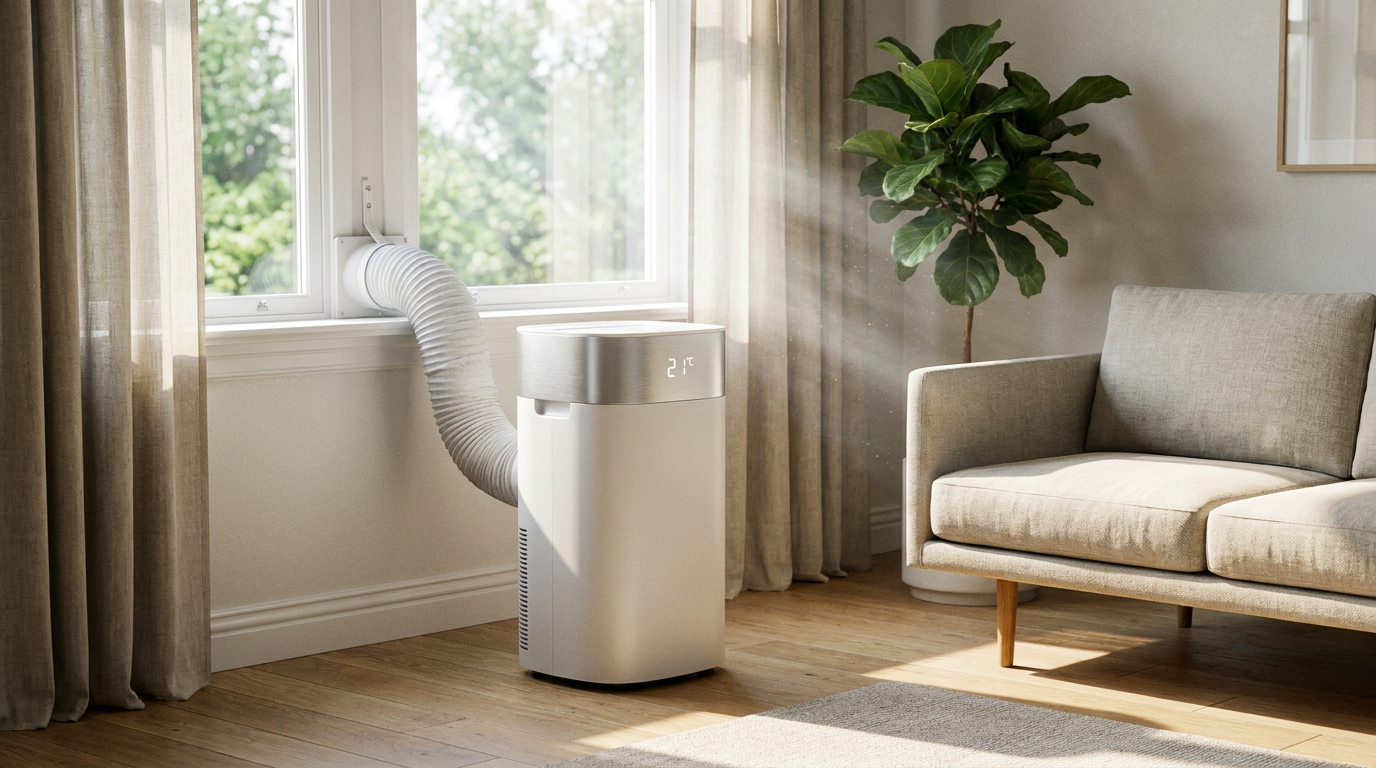
That fix is the dual-hose portable air conditioner. As the name suggests, this design utilizes two separate hoses connected to the window bracket, fundamentally changing the airflow dynamics. The first hose pulls in hot, unconditioned air from the outside specifically to cool the machine's internal condenser. The second hose then exhausts that same air—now even hotter—back outside, completely bypassing the indoor environment.[3][5][6]
As the name suggests, this design utilizes two separate hoses connected to the window bracket, fundamentally changing the airflow dynamics.
The thermodynamic advantage of this two-hose system is clear: the indoor air is completely isolated from the condenser-cooling loop. The machine cools the room's air and recirculates it without creating a vacuum, keeping the room's pressure balanced and preventing hot air from seeping in. HVAC experts and consumer testing consistently show that dual-hose units cool rooms faster and more evenly, particularly in larger spaces or during extreme heat waves where infiltration air would otherwise overwhelm a single-hose unit.[3][4][5]

However, the evidence also shows that dual-hose units are not entirely without flaws, which is why the debate continues. The two hoses themselves radiate some heat back into the room, and the second hose introduces more potential for air leaks at the window bracket. To help consumers navigate these competing variables and understand true performance, the US Department of Energy recently overhauled how portable air conditioners are tested and rated across the industry.[2][4]
The old metric, known as ASHRAE, only measured the cold air coming out of the front of the machine, ignoring the vacuum effect. The new metric, known as Seasonally Adjusted Cooling Capacity (SACC), explicitly accounts for the heat added by the infiltration air that single-hose units suck into the room. Under the SACC standard, the rated cooling power of single-hose units plummeted, revealing their true, lower efficiency to consumers. The Department of Energy estimates that stricter efficiency standards across the broader AC industry will save consumers $25 billion over 30 years.[2][4][6]

Despite the physics, single-hose units continue to sell in massive numbers. They are cheaper to manufacture, lighter to move, and require less window space for installation, making them highly accessible for renters on a budget. For very small rooms—under 150 square feet—consumer testing indicates that a high-SACC single-hose unit can still perform adequately, as the volume of the room is small enough to overcome the negative pressure penalty.[3][4]
Yet, as global temperatures rise and electricity grids face unprecedented strain, the tolerance for inherently wasteful appliances is shrinking. The consensus among thermodynamic experts is definitive: if you must rely on a portable air conditioner rather than a traditional window unit, investing the extra money and setup time into a dual-hose model is the only way to avoid fighting the laws of physics. By choosing a balanced-pressure system, consumers can stay cooler while reducing their overall energy footprint.[1][2][3][6]
How we got here
1990s-2010s
Single-hose portable ACs dominate the market due to low cost and easy installation.
2016
The Department of Energy begins evaluating energy efficiency standards specifically for portable air conditioners.
2020
The DOE finalizes new testing procedures, introducing the SACC metric to account for infiltration air.
2024-2026
Stricter DOE efficiency rules take effect, forcing manufacturers to improve real-world performance.
Viewpoints in depth
Thermodynamic Critics
Argue that single-hose units are fundamentally flawed due to negative pressure and should be phased out.
This camp, including science journalists and air-quality engineers, views the single-hose portable AC as a mechanical contradiction. Because the unit constantly exhausts indoor air to cool its condenser, it creates a vacuum that actively pulls hot, unfiltered outdoor air into the home. Critics argue this design is so inherently wasteful that it defeats the purpose of air conditioning, forcing the machine to work overtime just to offset the heat it is inadvertently drawing inside. Some argue these units should be banned entirely in favor of closed-loop designs.
Consumer Advocates
Emphasize that accurate SACC ratings are the best metric, and single-hose units still serve budget buyers.
While acknowledging the physics of negative pressure, consumer testing groups point out that dual-hose units are not perfect—their two hoses radiate heat back into the room, and they are significantly more expensive. This camp argues that the Department of Energy's new SACC metric is the great equalizer, allowing buyers to compare actual cooling power regardless of hose count. For renters with very small rooms or strict budgets, they maintain that a highly rated single-hose unit can still provide adequate, accessible relief.
Regulators
Focus on updating testing standards to accurately reflect real-world efficiency and reduce overall grid load.
Federal agencies are less concerned with banning specific designs and more focused on ensuring that marketing matches reality. By shifting the industry from the old ASHRAE standard to the new SACC standard, regulators force manufacturers to account for the infiltration heat caused by single-hose units. This transparency is designed to drive the market toward more efficient engineering over time, with the Department of Energy projecting that stricter appliance standards will save consumers billions of dollars while reducing strain on the electrical grid.
What we don't know
- Whether the Department of Energy will eventually ban single-hose designs entirely, or simply regulate them into niche use cases.
- Exactly how much heat is radiated back into the room by the uninsulated exhaust hoses, which remains a minor inefficiency in both designs.
Key terms
- Condenser
- The component in an air conditioner that releases the heat absorbed from the room into the outside air.
- Negative Pressure
- A state where the air pressure inside a room is lower than the outside, causing outdoor air to be sucked in through gaps.
- SACC
- Seasonally Adjusted Cooling Capacity, a Department of Energy testing standard that measures the true cooling output of a portable AC by factoring in the heat of infiltration air.
- Infiltration Air
- Unconditioned, warm air from outside or adjacent rooms that leaks into a cooled space.
- BTU
- British Thermal Unit, a traditional unit of heat used to measure the cooling capacity of an air conditioner.
Frequently asked
Why do single-hose ACs pull hot air into the room?
They exhaust indoor air outside to cool their condenser, creating a vacuum (negative pressure) that sucks hot outdoor air in through cracks to replace it.
Are dual-hose portable ACs harder to install?
Slightly. They require a wider window bracket to accommodate two hoses, but the installation process is fundamentally the same as a single-hose unit.
What is a SACC rating?
Seasonally Adjusted Cooling Capacity (SACC) is a newer Department of Energy metric that accurately measures an AC's real-world cooling power by factoring in the hot air it pulls into the room.
Can I convert a single-hose AC to a dual-hose?
Some consumers build DIY intake boxes to attach a second hose, but this voids the warranty and may restrict airflow if not engineered perfectly.
Sources
Source coverage
6 outlets
3 viewpoints surfaced






[1]New ScientistThermodynamic Critics
Most portable air conditioners suck – but there's an easy fix
Read on New Scientist →[2]US Department of EnergyRegulators
New Efficiency Standards Will Save Consumers $25 Billion Over 30 Years
Read on US Department of Energy →[3]ForbesConsumer Advocates
Dual-Hose Vs. Single-Hose Portable AC: Which Is Better?
Read on Forbes →[4]Consumer AnalysisConsumer Advocates
Dual Hose vs Single Hose Portable Air Conditioners
Read on Consumer Analysis →[5]MolekuleThermodynamic Critics
What is a dual-hose portable air conditioner?
Read on Molekule →[6]Factlen Editorial TeamThermodynamic Critics
Synthesis by Factlen editorial team
Read on Factlen Editorial Team →

More in science
See all 7 stories →Gut-Brain Axis
Young Gut Bacteria Can Restore Childhood-Level Brain Plasticity in Adults, New Evidence Shows
8 sources

Male Fertility
GLP-1 Weight-Loss Drugs Show Unexpected Benefits for Male Fertility and Testosterone
7 sources

ENSO Cycle
Is Climate Change Supercharging El Niño? The Evidence, Explained
6 sources

Turfgrass Science
The 2026 World Cup's Biggest Engineering Feat Is the Grass Beneath the Players' Feet
7 sources
Every angle. Every day.
Get science stories with full source coverage and perspective breakdowns delivered to your inbox.