
The New Economics of Orbit: How Reusable Rockets Are Rewriting the Rules of Spaceflight
With SpaceX pushing toward full reusability and Blue Origin successfully recovering its first booster, 2026 marks the tipping point where expendable heavy-lift rockets become obsolete.
By Factlen Editorial Team
- Commercial Space Providers
- Argue that rapid iteration and full reusability are the only paths to a sustainable, high-cadence space economy.
- Global State Competitors
- View reusable launch as a critical strategic capability and are heavily subsidizing domestic programs to break the U.S. monopoly.
- Aerospace Analysts
- Focus on the economic and operational realities, questioning if payload demand can match the massive upcoming launch supply.
What's not represented
- · Atmospheric scientists studying the climate impact of rocket exhaust
- · Satellite operators waiting for lower launch costs
Why this matters
Dropping the cost of orbital access from thousands of dollars per kilogram to mere dollars unlocks previously impossible megaprojects, from space-based solar power to large-scale orbital manufacturing. This shift transforms space from a bespoke government frontier into a foundational pillar of the global commercial economy.
Key points
- The aerospace industry has definitively shifted away from expendable rockets in favor of propulsive landing and rapid reuse.
- SpaceX is transitioning to Starship Version 3 in 2026, aiming for full reusability and over 100 metric tons of payload capacity.
- Blue Origin has emerged as a viable second provider after successfully recovering a New Glenn booster from an orbital mission.
- China and Europe are heavily investing in domestic reusable programs to break the growing U.S. monopoly on low-cost space access.
For the first six decades of the Space Age, reaching orbit required throwing away the vehicle that got you there. Multimillion-dollar machines were routinely discarded into the ocean or burned up in the atmosphere after a single flight. But by mid-2026, the aerospace industry has definitively crossed a point of no return. Expendable heavy-lift rockets are now widely viewed as obsolete, replaced by a new paradigm of propulsive landing and rapid reuse that mirrors commercial aviation. This shift is no longer theoretical; it is being demonstrated on launchpads from South Texas to Cape Canaveral, fundamentally rewriting the economics of spaceflight.[6]
The mechanics of reusable rocketry require a delicate choreography of physics and software. Instead of simply falling back to Earth, a reusable booster must flip itself around in a vacuum, reignite a subset of its engines to slow its hypersonic descent, and deploy grid fins to steer through the thickening atmosphere. Finally, it must execute a precision propulsive landing—either touching down on deployable legs or, increasingly, hovering while being caught by mechanical tower arms. This requires engines capable of multiple restarts, advanced thermal protection systems, and structural margins that can withstand the immense stress of flying backward through the sound barrier.[3][6]
The economic implications of mastering this choreography are staggering. During the Space Shuttle era, delivering a kilogram of payload to Low Earth Orbit (LEO) cost tens of thousands of dollars. SpaceX’s partially reusable Falcon 9, which routinely lands its first stage, brought that figure down to roughly $2,600 per kilogram. Now, the industry is chasing full reusability—recovering both the massive first-stage booster and the orbital upper stage. If successful, next-generation super-heavy vehicles could drive the cost of access to space down to approximately $10 per kilogram. At that price point, previously impossible megaprojects like space-based solar power, orbital manufacturing hubs, and large-scale asteroid mining become economically viable.[2][4]

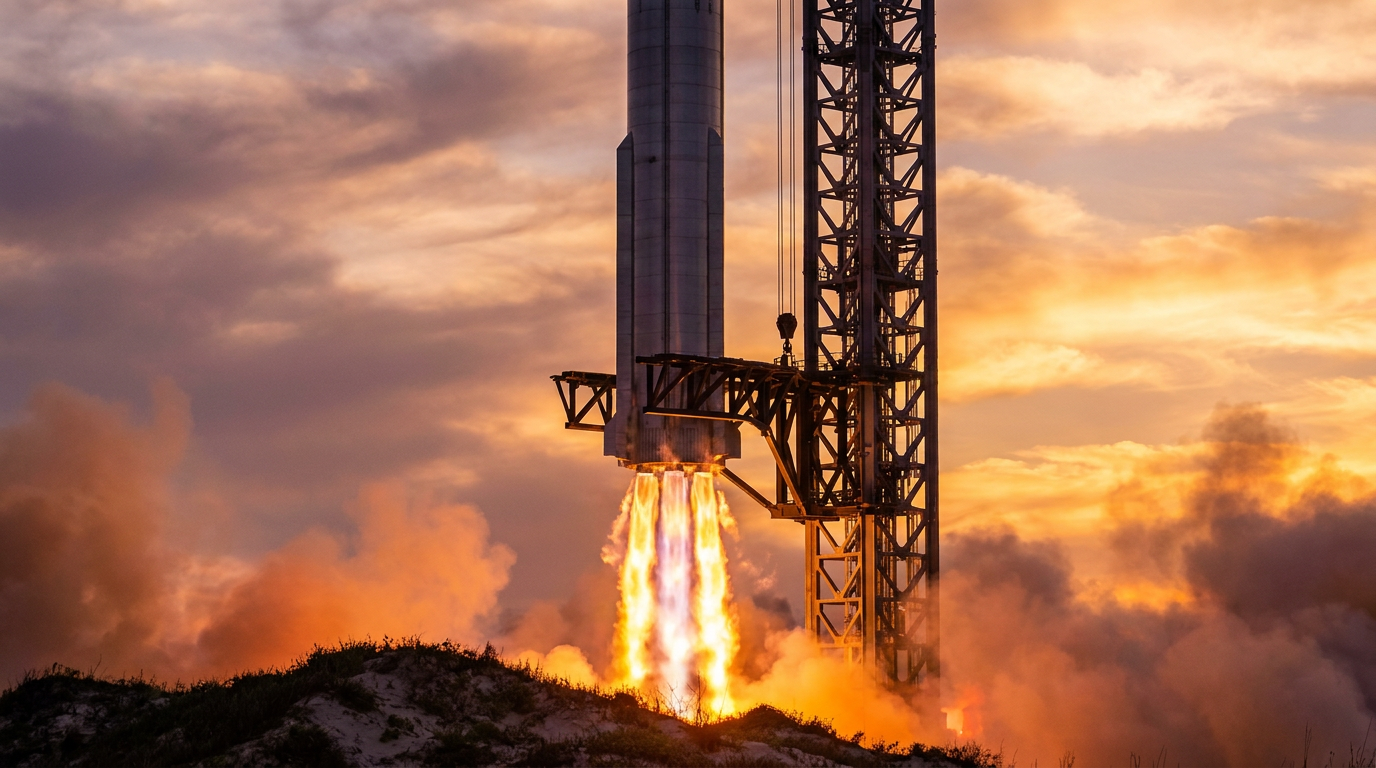
The undisputed behemoth driving this market is SpaceX’s Starship. Standing nearly 400 feet tall, the stainless-steel vehicle is the largest and most powerful rocket ever constructed. Following a dramatic 2025 test campaign that saw the "Mechazilla" launch tower successfully catch a returning Super Heavy booster with its mechanical arms, the company has proven the viability of its rapid-turnaround architecture. By eliminating the dead weight of landing legs, the booster can carry more payload and be restacked on the launch mount almost immediately.[1][3][4]
In 2026, SpaceX is transitioning from its Version 2 hardware to Starship Version 3, a massive upgrade aimed at achieving full, routine reusability. While the company has mastered booster recovery, the orbital upper stage—which endures the brutal 17,500-mph reentry from space—has proven more challenging. The new iteration features upgraded Raptor 3 engines and refined ceramic heat-shield tiles designed to survive the plasma of atmospheric reentry without requiring extensive refurbishment. The goal is to deliver over 100 metric tons to orbit and return both stages intact, a milestone that SpaceX CEO Elon Musk has targeted for this year.[1][3][5]
But SpaceX is no longer running alone. Blue Origin, founded by Jeff Bezos, has emerged as a formidable second player in the heavy-lift market with its New Glenn rocket. After nearly a decade of development, New Glenn established genuine heavy-lift reusability in late 2025 when it successfully landed its massive first stage on a drone ship following an orbital mission. Powered by seven BE-4 engines, New Glenn is closer in capability to the Falcon Heavy and features a cavernous payload fairing capable of launching massive commercial satellites and space station modules.[1][2]
Blue Origin, founded by Jeff Bezos, has emerged as a formidable second player in the heavy-lift market with its New Glenn rocket.
The arrival of New Glenn is a structural shift for the industry. For years, the U.S. government and commercial satellite operators have been entirely dependent on SpaceX for reusable launch services. Blue Origin’s success provides a critical second source, a reality reflected in the U.S. Space Force’s National Security Space Launch (NSSL) Phase 3 program, which awarded billions in contracts to both companies. Blue Origin is now focused on rapid reflight, targeting the turnaround and reuse of its recovered boosters throughout 2026.[1][2]

The race for reusability extends beyond super-heavy vehicles. In the medium-lift sector, Rocket Lab is advancing its Neutron rocket, a carbon-composite vehicle designed specifically for mega-constellation deployment. Unlike traditional rockets, Neutron features a unique "hungry hippo" fairing that opens to release the payload and upper stage before snapping shut, allowing the entire aerodynamic shell to return to Earth with the booster. Although a tank qualification failure in early 2026 pushed Neutron’s maiden flight to late in the year, the vehicle remains one of the most anticipated challengers to the Falcon 9’s dominance.[1][2][6]
Meanwhile, heavily funded startups are attempting to leapfrog the incumbents. Stoke Space, armed with over $1.3 billion in capital, is preparing for the orbital debut of its Nova rocket. Nova aims for 100% reusability by utilizing a radically different upper stage design: a regeneratively cooled metallic heat shield that uses the cryogenic propellants themselves to absorb the heat of reentry, rather than relying on fragile ceramic tiles. If successful, it would represent a major breakthrough in upper-stage recovery.[2][6]
Internationally, the U.S. monopoly on reusable launch is triggering a massive, state-backed response. China has mobilized both its state-owned aerospace corporations and a vibrant sector of private startups to close the gap. In late 2025, two separate Chinese orbital-class rockets came within meters of successful propulsive landings, and companies like Space Pioneer and LandSpace are aggressively testing their own reusable systems. Analysts expect a successful Chinese booster recovery before the end of the year, driven by the strategic imperative to match U.S. launch cadence and deploy their own satellite internet constellations.[1][2]

Europe and Japan are also scrambling to pivot away from expendable designs. The European Space Agency (ESA) is funding the Themis prototype to test propulsive landing technologies, while also contracting Italian firm Avio to demonstrate a reusable upper stage. In Japan, Honda surprised the aerospace sector with a successful hop test of an experimental reusable rocket, signaling non-traditional corporate interest in the space economy. However, legacy programs like Europe’s Ariane 6 remain expendable, leaving them at a severe cost disadvantage in the commercial market.[1][4][6]
As launch capacity scales up, space economists are pointing to a looming bottleneck: payload demand. If Starship and New Glenn fly as frequently as planned, the world will possess the capacity to launch thousands of tons into orbit every week. The challenge will shift from building rockets to building things to put inside them. The industry is betting that ultra-cheap launch costs will induce entirely new markets, but the transition period could see a glut of launch supply outstripping the immediate availability of commercial payloads.[2][6]

There are also growing environmental uncertainties. The upper atmosphere is highly sensitive to the soot, water vapor, and nitrogen oxides deposited by rocket exhaust. Furthermore, the ablation of metals from thousands of returning rocket stages and satellites could alter the chemistry of the stratosphere. As the industry moves from dozens of launches a year to potentially thousands, regulators and atmospheric scientists are racing to understand the long-term climate impacts of an airline-like spaceflight cadence.[6]
Despite these hurdles, the trajectory of the 2026 space economy is clear. The era of bespoke, throwaway aerospace engineering is ending, replaced by a manufacturing mindset focused on fleet operations, rapid turnaround, and economies of scale. Whether it is a Starship caught by mechanical arms in Texas, a New Glenn touching down on the Atlantic, or a Chinese booster sticking its landing in the Gobi Desert, the reusable rocket has become the foundational infrastructure of the 21st-century space age.[1][2][4][5]
How we got here
April 2023
SpaceX launches the first fully integrated Starship, which explodes four minutes into flight.
Late 2025
SpaceX successfully catches a returning Super Heavy booster with the 'Mechazilla' launch tower arms.
November 2025
Blue Origin successfully lands the first stage of its New Glenn rocket on a drone ship.
December 2025
Two Chinese commercial rockets come within meters of successful propulsive landings.
Early 2026
Rocket Lab delays the maiden flight of its reusable Neutron rocket following a tank qualification test failure.
Viewpoints in depth
Commercial Space Providers
Argue that rapid iteration and full reusability are the only paths to a sustainable space economy.
Companies like SpaceX, Blue Origin, and Rocket Lab operate on the premise that rockets should be treated like commercial airliners. They argue that the traditional aerospace model—spending billions to ensure a single-use vehicle never fails—is fundamentally broken. Instead, they advocate for hardware-rich development, where flying, failing, and iterating rapidly leads to robust, fully reusable systems that can fly multiple times a week, driving costs down to a fraction of historical averages.
Global State Competitors
View reusable launch as a critical strategic capability to prevent a U.S. monopoly.
For space agencies and state-backed corporations in China and Europe, the shift to reusability is a matter of strategic autonomy. They recognize that relying on expendable rockets while the U.S. deploys super-heavy reusable vehicles will price them out of the commercial market and limit their ability to deploy massive satellite constellations. Consequently, these nations are heavily subsidizing domestic startups and legacy providers to rapidly clone or develop propulsive landing technologies, accepting high failure rates in the short term to close the technological gap.
Aerospace Analysts
Focus on the economic realities of payload demand and the transition period.
While acknowledging the engineering triumphs of Starship and New Glenn, space economists and industry analysts warn of a looming demand bottleneck. They point out that even if launch costs drop to $10 per kilogram, the world currently lacks the manufacturing capacity to produce enough satellites, habitats, or space-based infrastructure to fill thousands of tons of weekly launch capacity. They argue the industry may face a multi-year period where launch supply vastly outstrips commercial demand, testing the financial endurance of these new rocket programs.
What we don't know
- Whether the commercial market can generate enough payload demand to sustain the massive launch cadence planned by SpaceX and Blue Origin.
- The long-term atmospheric and environmental impacts of thousands of rocket reentries and exhaust emissions per year.
- How quickly Chinese commercial startups can transition from successful landing tests to reliable, operational orbital flights.
Key terms
- Propulsive Landing
- A technique where a spacecraft fires its engines to slow its descent and touch down vertically, rather than relying on parachutes or wings.
- Low Earth Orbit (LEO)
- An orbit relatively close to Earth's surface, typically at an altitude of 2,000 kilometers or less, where most satellites and space stations operate.
- Expendable Launch Vehicle
- A traditional rocket designed to be used only once, with its components either burning up in the atmosphere or falling into the ocean.
- Payload Fairing
- The aerodynamic nose cone of a rocket that protects the spacecraft or satellites during the ascent through the atmosphere.
Frequently asked
Why don't all rockets just use parachutes to land?
Parachutes lack the precision needed to land a massive booster on a specific pad or ship. They also cannot slow down a super-heavy vehicle enough to prevent structural damage upon impact.
What is the difference between partial and full reusability?
Partial reusability, like the Falcon 9, only recovers the first-stage booster. Full reusability aims to recover both the booster and the orbital upper stage, meaning no part of the rocket is thrown away.
How does catching a rocket save money compared to landing legs?
Landing legs add significant weight to the rocket, reducing the amount of payload it can carry. Catching the booster with tower arms eliminates this dead weight and allows for faster restacking.
Sources
Source coverage
7 outlets
3 viewpoints surfaced







[1]AIAAAerospace Analysts
Reusable Launch Vehicles: 2025-2026 Year in Review
Read on AIAA →[2]New Space EconomyGlobal State Competitors
The State of Reusable Heavy-Lift Rockets in 2026
Read on New Space Economy →[3]WikipediaAerospace Analysts
SpaceX Starship
Read on Wikipedia →[4]EnvisioningCommercial Space Providers
Super-Heavy Reusable Launch Systems
Read on Envisioning →[5]Mexico Business NewsCommercial Space Providers
SpaceX Targets 2026 for Starship Version 3
Read on Mexico Business News →[6]Factlen Editorial TeamAerospace Analysts
Synthesis by Factlen editorial team
Read on Factlen Editorial Team →[7]Rocket LabCommercial Space Providers
Neutron: The Reusable Medium-Lift Rocket
Read on Rocket Lab →
Every angle. Every day.
Get transportation stories with full source coverage and perspective breakdowns delivered to your inbox.