
Top Fitness Wearables for Health & Recovery in 2026: Apple Watch vs. Oura vs. WHOOP vs. Garmin
The wearable market has fractured into highly specialized tools, forcing users to choose between active smartwatch features, passive sleep tracking, and deep endurance metrics.
By Factlen Editorial Team
- Recovery & Sleep Specialists
- Focus on passive biometric tracking, HRV accuracy, and sleep stage consistency over active workout data.
- Endurance & Performance Athletes
- Demand rugged hardware, multi-band GPS, deep training load metrics, and multi-week battery life.
- Ecosystem Integration Advocates
- Prioritize seamless smartwatch features, cellular connectivity, and all-in-one lifestyle convenience.
What's not represented
- · Budget-conscious consumers who prefer basic $50 step-trackers without advanced biometrics.
- · Users with darker skin tones, as optical heart rate sensors historically show varying accuracy across different melanin levels.
Why this matters
Choosing the wrong fitness tracker is a frustrating and expensive mistake that often leads to abandoned health goals. By matching the right wearable to your specific daily habits and friction points, you can build a sustainable, data-driven approach to your long-term health and recovery.
Key points
- The wearable market has fractured into specialized devices, making the 'best' tracker dependent on user habits.
- Apple Watch leads in smartwatch features and active tracking but struggles with battery life.
- Oura Ring provides the most comfortable, passive sleep tracking with validated HRV accuracy.
- WHOOP offers unparalleled recovery coaching for athletes but requires a costly subscription.
- Garmin dominates the endurance market with multi-band GPS and multi-week battery life.
The wearable technology landscape in 2026 has fundamentally shifted away from basic step counting toward predictive health and longevity. Modern fitness trackers are no longer just passive loggers; they are sophisticated biometric engines designed to analyze recovery, cardiovascular strain, and sleep architecture. As the technology has matured, the market has fractured into highly specialized tools. Consumers are no longer choosing between generic bands, but rather selecting between distinct health philosophies. This evolution means that the concept of a universally perfect tracker is obsolete, replaced by devices engineered for very specific lifestyles and training demands.[2][4]
Rather than competing on the exact same features, the four major players—Apple, Oura, WHOOP, and Garmin—have engineered their devices around fundamentally different use cases. Understanding these hardware and software trade-offs is crucial to avoiding an expensive mismatch. A device that perfectly serves a marathon runner might deeply frustrate a user focused solely on sleep optimization. To navigate this crowded market, we must examine the specific strengths, weaknesses, and validated evidence behind each platform, moving beyond marketing claims to see how these tools actually perform in daily life and rigorous clinical testing.[5]
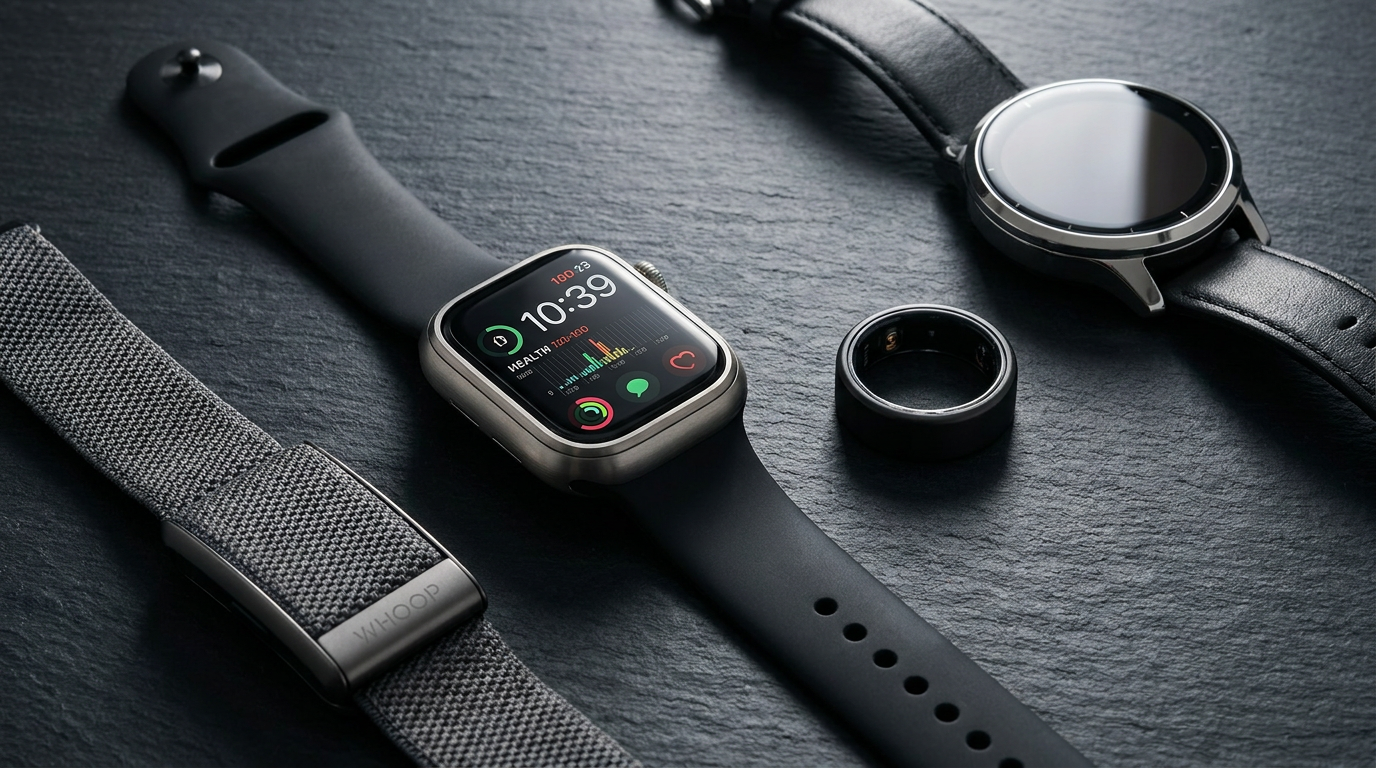
When evaluating the Apple Watch Series 11 and Ultra 3, the trade-offs are sharply defined. **For:** The device offers unmatched iOS integration, FDA-cleared medical features including sleep apnea detection, and highly accurate active heart rate monitoring. **Against:** Battery life remains a significant constraint, requiring daily charging that often interrupts continuous sleep tracking and creates friction for users wanting 24/7 data. **Evidence:** Clinical validations from independent lab testing show a remarkably low 0.98 percent error rate for heart rate tracking during intense exercise, while battery tests confirm a strict 24-hour limit for standard models. This hardware is built for the user who wants a computer on their wrist, packing up to eleven distinct health sensors into a single device.[1][8]

In terms of practical application, the Apple Watch **fits well when** you want a comprehensive smartwatch experience, rely on cellular connectivity, and already live within the Apple ecosystem. It provides the most seamless blend of lifestyle convenience—like mobile payments and text replies—and rigorous fitness tracking. However, it **does not fit when** you want passive, charge-and-forget health tracking. If you prefer a screenless experience to minimize digital distractions, or if you travel frequently and despise carrying proprietary charging pucks, the daily battery anxiety will quickly outweigh the benefits of its advanced sensors.[1][5]
The Oura Ring Gen 4 takes a radically different approach to biometric monitoring. **For:** It delivers exceptional sleep stage accuracy, passive 24-hour wearability, and validated heart rate variability (HRV) precision driven by an 18-path finger-based optical sensor. **Against:** The ring form factor inherently lacks a screen for mid-workout feedback, does not write active workout data to Apple HealthKit, and requires an ongoing subscription for full insights. **Evidence:** Independent sleep lab studies published in 2026 demonstrate a 0.99 intraclass correlation for HRV and highlight the device's superior consistency in detecting night-to-night variations in REM sleep. By reading directly from the finger arteries, the Oura Ring captures a stronger blood signal with significantly less motion noise than wrist-based alternatives.[6][7][8]
The Oura Ring Gen 4 takes a radically different approach to biometric monitoring.
This discreet form factor **fits well when** sleep quality and passive biometric tracking are your primary goals. It allows users to wear traditional mechanical watches during the day or keep their wrists entirely free without sacrificing continuous health data. The device seamlessly blends into daily life without demanding attention or buzzing with notifications. Conversely, it **does not fit when** you need real-time pacing data during a run, want a device to log complex interval workouts, or require GPS tracking for outdoor adventures. It is a recovery monitor first and foremost, not an active training companion.[4][5]

For athletes focused entirely on physiological readiness, the WHOOP 5.0 strap offers a highly specialized toolset. **For:** The system provides deep, actionable recovery coaching, features a screenless design that eliminates notification fatigue, and boasts a newly extended 14-day battery life. **Against:** The hardware is tied to a mandatory, premium subscription model starting at $199 per year, making it the most expensive long-term option on the market. **Evidence:** Validation studies confirm a minimal 0.3 beat-per-minute error rate during sleep, while its 26 hertz sampling rate provides the fastest optical heart rate tracking in its class during intense exercise. The device is singularly focused on balancing daily cardiovascular strain with nightly recovery.[2][5][6]
The WHOOP ecosystem **fits well when** you are a data-driven athlete who wants clinical-grade strain-to-recovery metrics without the distraction of a glowing screen. The companion app excels at telling you exactly how hard to push on any given day, adjusting your target exertion based on how well you slept. It **does not fit when** you want a one-time hardware purchase, need smartwatch features like mobile payments, or prefer to see your live metrics on your wrist during a workout. It is designed for those who view their body as a system to be optimized, rather than a casual step-counter.[1][2]
Garmin’s Venu 4 and Fenix 8 models cater to a demographic that demands rugged reliability and exhaustive data. **For:** These devices offer industry-leading multi-band GPS accuracy, massive battery life stretching up to 29 days, and incredibly deep endurance sport profiles. **Against:** The interface and sheer volume of data can be overwhelming for casual users, and the bulkier design is often less comfortable for sleep tracking compared to a ring or soft band. **Evidence:** Testing confirms unmatched satellite acquisition in dense urban environments or deep forests, alongside reliable data export to third-party coaching platforms via the Garmin Connect ecosystem. They are built to survive extreme conditions while logging every conceivable metric.[3][4][8]

This rugged, data-heavy approach **fits well when** you are a serious outdoor athlete, runner, or cyclist who needs reliable navigation, complex interval programming, and weeks of battery life off the grid. It is the ultimate tool for those who train with specific performance goals and need their hardware to keep up with grueling endurance events. It **does not fit when** your primary focus is general wellness, sleep comfort, or seamless smartphone notification management. If you only exercise occasionally or find complex data dashboards intimidating, the sheer capability of a high-end Garmin will be largely wasted.[3][5]
The hardware differences beneath the surface dictate these specific use cases, proving that sensor count alone does not tell the full story. While all four devices share basic optical sensors and accelerometers, their specialized components drive their unique strengths. Oura's finger-based sensors read from arteries where the blood signal is stronger, while Garmin's dual-frequency GPS chips connect to multiple satellite networks simultaneously. Apple packs up to eleven distinct sensors to achieve FDA-cleared medical features, whereas WHOOP relies on a high-frequency sampling rate to capture rapid heart rate changes during intense functional fitness routines.[8]
Ultimately, buying the wrong fitness tracker is an expensive mistake not because the technology fails, but because the device clashes with user habits. Choosing the right tool comes down to an honest assessment of daily friction points and personal goals. By prioritizing either active performance data, passive recovery insights, or seamless lifestyle integration, users can find the exact wearable that elevates their health without adding unnecessary stress. The best device in 2026 is simply the one that seamlessly integrates into your life and provides the specific insights you need to thrive.[4][5]
How we got here
2015
The original Apple Watch launches, shifting the wearable market from simple step counters to full-featured smartwatches.
2021
Oura releases its Gen 3 ring, popularizing the finger-based form factor for passive sleep and recovery tracking.
2025
WHOOP introduces the 5.0 strap, significantly extending battery life to 14 days while maintaining a screenless design.
2026
Independent sleep lab studies confirm that specialized recovery wearables now rival medical-grade equipment in tracking HRV and sleep stages.
Viewpoints in depth
Ecosystem Integration Advocates
Prioritize seamless smartwatch features and lifestyle convenience.
This perspective argues that the best fitness tracker is the one you never take off because it serves multiple purposes. Advocates highlight that devices like the Apple Watch reduce friction by combining mobile payments, communication, and FDA-cleared health alerts into a single interface. They point to the high accuracy of active heart rate monitoring as proof that you do not need a dedicated fitness band to get clinical-grade data, accepting daily charging as a reasonable trade-off for immense utility.
Recovery & Sleep Specialists
Focus on passive biometric tracking and nervous system readiness.
For this camp, fitness is won or lost during rest. They argue that glowing screens and constant notifications actively harm the recovery process. By relying on screenless devices like the Oura Ring or WHOOP, these users prioritize validated heart rate variability (HRV) and sleep stage consistency. They cite independent sleep lab studies showing that finger-based sensors or high-frequency sampling rates provide superior night-to-night data, allowing athletes to adjust their daily strain based on actual physiological readiness rather than arbitrary workout schedules.
Endurance & Performance Athletes
Demand rugged hardware, precise navigation, and deep training metrics.
This viewpoint is driven by the demands of the outdoors. Endurance athletes argue that a fitness tracker is useless if it dies halfway through an ultramarathon or loses GPS signal in a dense forest. They champion devices like Garmin for their dual-frequency satellite receivers, tactile buttons that work with sweaty hands, and multi-week battery life. For this group, the sheer volume of data—from VO2 max estimates to complex interval programming—is not overwhelming, but rather a necessary toolkit for serious performance optimization.
What we don't know
- How upcoming non-invasive blood glucose monitoring technology will disrupt the current sensor landscape.
- Whether subscription-based models like WHOOP will face consumer fatigue as hardware-only competitors improve their algorithms.
Key terms
- Heart Rate Variability (HRV)
- The variation in time between consecutive heartbeats, used as a key indicator of physical recovery and nervous system readiness.
- Photoplethysmography (PPG)
- An optical sensor technology that uses light to measure changes in blood volume, commonly used in wearables to track heart rate.
- HealthKit
- Apple's centralized health data platform that allows different fitness apps and devices to share metrics on an iPhone.
- Polysomnography
- A comprehensive sleep study that records brain waves, oxygen levels, heart rate, and breathing, serving as the gold standard for sleep tracking accuracy.
Frequently asked
Which fitness tracker is the most accurate for sleep?
Independent sleep lab studies show the Oura Ring and WHOOP provide the highest consistency for tracking sleep stages and night-to-night variations.
Does the Apple Watch track recovery like WHOOP?
While the Apple Watch tracks sleep and HRV, it lacks the native, deep strain-to-recovery coaching algorithms that define the WHOOP ecosystem.
Do I have to pay a subscription for these trackers?
WHOOP requires a mandatory subscription starting at $199 per year, and Oura requires a monthly fee for full insights. Apple Watch and Garmin do not charge ongoing software subscriptions.
Which tracker is best for marathon training?
Garmin devices are widely considered the best for endurance training due to their multi-band GPS accuracy, deep sport profiles, and multi-week battery life.
Sources
Source coverage
8 outlets
3 viewpoints surfaced








[1]CNETEcosystem Integration Advocates
Best Fitness Trackers in 2026: Apple Watch, Whoop, Garmin Compared
Read on CNET →[2]WareableRecovery & Sleep Specialists
The Best Fitness Trackers 2026: Top Bands for Recovery and Activity
Read on Wareable →[3]StuffEcosystem Integration Advocates
Best Fitness Tracker 2026: Top Bands for Tracking Steps, Sleep and Fitness
Read on Stuff →[4]DigiHealth BlogEndurance & Performance Athletes
Best Fitness Trackers in the USA (2026)
Read on DigiHealth Blog →[5]Sensai FitEndurance & Performance Athletes
Apple Watch vs Oura Ring vs WHOOP vs Garmin: Which Fitness Tracker Should You Actually Buy in 2026?
Read on Sensai Fit →[6]MediumRecovery & Sleep Specialists
The Major Validation Study: Six Devices, One Night
Read on Medium →[7]We Love CyclingRecovery & Sleep Specialists
Which Wearable Tracks Sleep Best? A New Study Reveals the Truth
Read on We Love Cycling →[8]Kygo AppEndurance & Performance Athletes
Hardware Differences: What's Actually Inside Each Device
Read on Kygo App →

Every angle. Every day.
Get guides stories with full source coverage and perspective breakdowns delivered to your inbox.