
Solid-State Batteries Hit the Road: How the 2026 Breakthrough Changes EVs
After a decade of laboratory promises, solid-state batteries are entering mass production in 2026, offering electric vehicles double the range, 12-minute charging, and virtual immunity to fire.
By Factlen Editorial Team
- Battery Innovators
- Focused on rapid commercialization and breaking the energy density ceiling.
- Legacy Automakers
- Focused on phased integration, safety validation, and scaling up supply chains.
- Materials Scientists
- Focused on the underlying chemistry and the strict definition of true solid-state.
- Industry Analysts
- Focused on market viability, consumer costs, and the timeline for mass adoption.
What's not represented
- · Lithium Mining Industry
- · Independent Repair Shops
- · Traditional Oil & Gas Sector
Why this matters
Solid-state batteries remove the final major compromises of electric vehicle ownership. By doubling range and slashing charge times to that of a gas station visit, this technology paves the way for mass EV adoption without lifestyle changes.
Key points
- Solid-state batteries replace flammable liquid electrolytes with solid materials, virtually eliminating the risk of battery fires.
- Energy density is expected to double, allowing upcoming electric vehicles to achieve ranges exceeding 1,000 kilometers (620 miles).
- Charging times are drastically reduced, with new cells capable of reaching an 80% charge in just 10 to 12 minutes.
- While pilot production begins in 2026, widespread mass-market adoption is projected for 2027 to 2030 due to initial manufacturing costs.
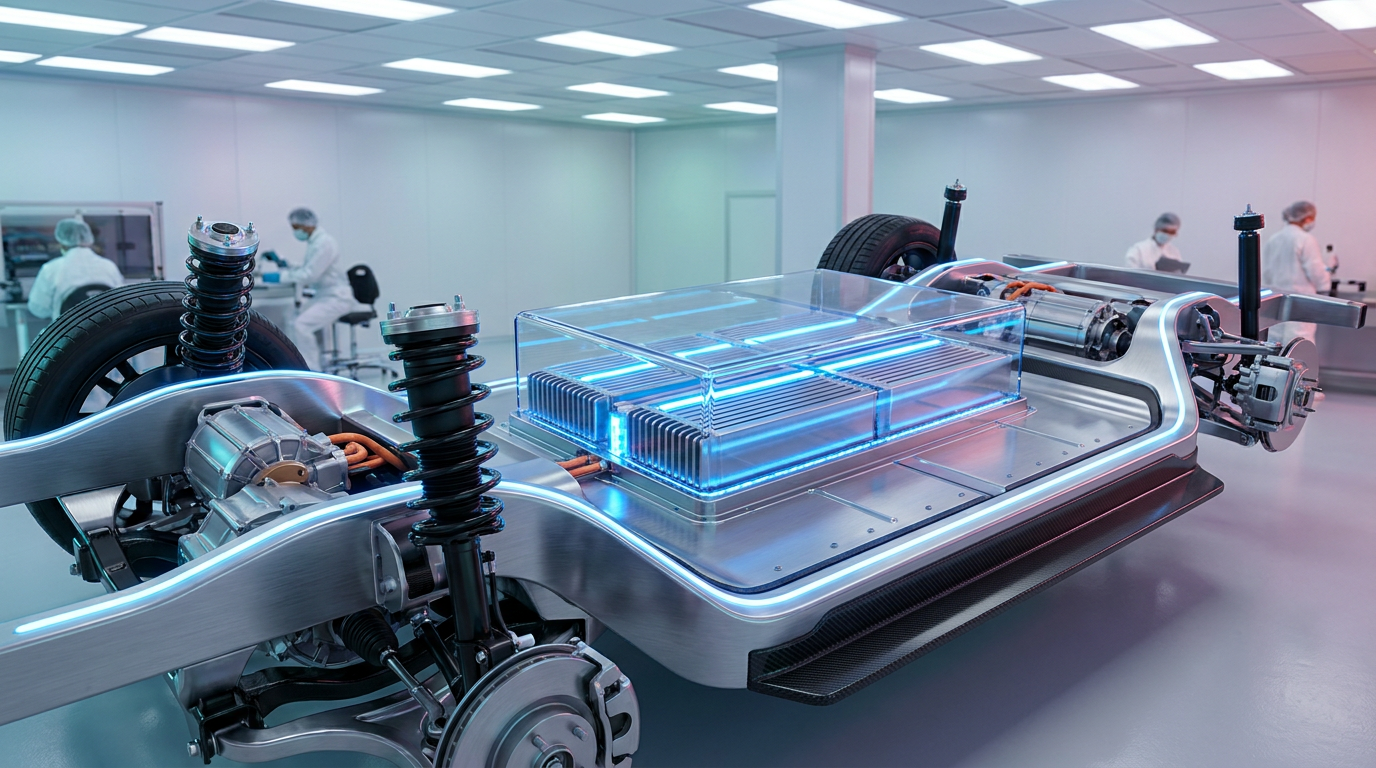
For a decade, solid-state batteries have been the automotive industry's holy grail—a mythical technology promising to double electric vehicle range, eliminate fire risks, and charge in the time it takes to drink a coffee. In 2026, that mythology is finally colliding with mass manufacturing. Across California, Germany, and China, pilot production lines are spinning up, moving the technology out of the laboratory and onto public roads.[3][6]
Companies like QuantumScape, Factorial Energy, and Greater Bay Technology (GBT) have moved beyond coin-sized lab samples to automotive-scale cells. To understand why this matters, one must look inside the battery cell. Traditional lithium-ion batteries rely on a liquid electrolyte—a chemical soup that shuttles lithium ions between the anode and cathode during charging and discharging.[1][2][4]
That liquid is the root of almost every compromise in modern electric vehicles. It is heavy, it degrades over time, and crucially, it is highly flammable. Under extreme stress, overcharging, or manufacturing defects, this liquid can ignite, causing a chain reaction known as thermal runaway. Solid-state batteries replace this liquid with a solid material—typically a polymer, oxide, or sulfide glass.[4][5]
This solid electrolyte acts as both the highway for ions and a physical barrier, fundamentally altering the battery's physics. The most immediate and highly anticipated benefit is energy density, measured in watt-hours per kilogram (Wh/kg). Today's best lithium-ion cells hover around 250 to 300 Wh/kg. Solid-state cells entering production in 2026 are hitting 400 to 600 Wh/kg.[1][3][4]

This leap is possible because solid electrolytes enable the use of pure lithium metal anodes. In liquid batteries, lithium metal tends to form dendrites—microscopic, needle-like structures that grow during charging, eventually piercing the battery separator and causing short circuits. Solid electrolytes physically block these dendrites, allowing engineers to use energy-dense lithium metal safely.[4][5]
For the consumer, this translates to a massive increase in range or a drastic reduction in vehicle weight. Automakers like Dongfeng and GAC are already testing vehicles capable of exceeding 1,000 kilometers (620 miles) on a single charge. A high-performance EV could suddenly weigh 200 to 300 kilograms less, transforming a heavy sedan into a nimble, lightweight vehicle.[1][3][6]
Then there is the charging equation. Because solid materials can handle higher current densities without degrading or forming dendrites, charging times are plummeting. GBT's A-sample cells and QuantumScape's prototypes are demonstrating 10-to-80 percent charge times in the 10-to-12 minute range. This effectively makes a charging stop indistinguishable from a traditional petrol station visit.[1][2][4][6]
Because solid materials can handle higher current densities without degrading or forming dendrites, charging times are plummeting.
Winter range anxiety is also being engineered out of existence. Liquid electrolytes become sluggish in freezing temperatures, slashing an EV's range and increasing internal resistance. Solid-state cells tested in extreme environments have retained over 72 percent of their capacity at a brutal -30 degrees Celsius, ensuring reliable performance in harsh northern climates.[3][6]

But safety is perhaps the most profound upgrade. Comparative testing shows that thermal events in solid-state systems do not begin until around 247 degrees Celsius, compared to just 90 degrees for conventional lithium-ion cells. In needle penetration and extrusion tests, solid-state cells have consistently demonstrated zero smoke or fire, virtually eliminating the risk of catastrophic battery fires.[1][5]
The race to commercialize this technology has fractured into two distinct camps: the aggressive early movers and the methodical giants. Chinese manufacturers are pushing hard into "semi-solid" or hybrid batteries as a stepping stone. These hybrid cells use a mostly solid structure but retain a small amount of liquid electrolyte to ease the manufacturing transition.[3][4]
To prevent marketing claims from outrunning technical reality, China is introducing a national standard in July 2026 that strictly categorizes cells. Under this new framework, a true solid-state battery must show no more than 0.5 percent mass loss in a 120-degree Celsius heating test, drawing a hard line between hybrid stepping stones and the ultimate technological goal.[3][6]
In the West, Volkswagen-backed QuantumScape recently inaugurated its "Eagle Line" in California to produce solid-state cells, while Factorial Energy is supplying test cells for Mercedes-Benz vehicles. These companies are focusing on perfecting the manufacturing process for pure solid-state cells before scaling up to mass-market volumes.[2][4]

Toyota, which holds over 8,000 patents in the solid-state space, is taking a more measured approach. The Japanese giant has locked in its cathode supply chain and is targeting 2027 or 2028 for mass production, aiming to skip the semi-solid phase entirely and deliver vehicles with a 620-mile range and sub-10-minute charging.[2][3]
Despite the immense momentum, significant hurdles remain before solid-state batteries are in every driveway. The primary scientific challenge is interfacial resistance—ensuring the solid electrolyte maintains perfect, microscopic contact with the electrodes as the battery naturally expands and contracts during use.[4][5]
Manufacturing at scale is the other major bottleneck. Building solid-state batteries requires entirely new factory equipment, often involving pressurized environments or specialized thin-film deposition. Because of these supply constraints and high initial production costs, early solid-state pack replacements could be prohibitively expensive out of warranty.[4][6]

Consequently, solid-state batteries will debut almost exclusively in premium, high-margin vehicles and commercial applications over the next two years. As manufacturing efficiencies improve and economies of scale take hold, the technology is expected to trickle down to the mass market by the end of the decade.[2][3][4]
The threshold, however, has been crossed. The technology that promises to make electric vehicles unequivocally superior to internal combustion engines is no longer just a promise—it is actively rolling off pilot assembly lines. For the automotive industry, 2026 will be remembered as the year the solid-state era officially began.[1][6]
How we got here
2020
Toyota announces early patents and development goals for solid-state batteries, sparking industry-wide investment.
2024
Startups achieve major lab breakthroughs, successfully preventing dendrite growth using pure lithium metal anodes.
2025
Automakers begin testing solid-state and semi-solid prototypes in extreme weather conditions, verifying safety and range claims.
2026
The first pilot production lines open globally, and China introduces strict national standards defining true solid-state technology.
2027–2028
Projected timeline for major automakers to begin mass-market production of vehicles equipped with fully solid-state batteries.
Viewpoints in depth
Battery Innovators
Focused on rapid commercialization and breaking the energy density ceiling.
Startups like QuantumScape and Greater Bay Technology view solid-state chemistry as an immediate existential threat to legacy lithium-ion systems. They argue that aggressive pilot production and rapid iteration are necessary to capture market share, prioritizing breakthroughs in charging speed and energy density over waiting for perfect manufacturing scale.
Legacy Automakers
Focused on phased integration, safety validation, and scaling up supply chains.
Giants like Toyota and BMW are taking a more methodical approach. They argue that the true bottleneck is not the chemistry itself, but the ability to manufacture millions of cells consistently without defects. Their strategy involves locking down raw material supply chains and targeting 2027-2028 for full mass-market rollout, ensuring the technology is financially viable before abandoning current lithium-ion investments.
Materials Scientists
Focused on the underlying chemistry and the strict definition of true solid-state.
Academic and industry researchers emphasize the distinction between semi-solid stepping stones and true solid-state systems. They point out that while hybrid batteries offer immediate benefits, the ultimate goal of using pure lithium metal anodes requires solving complex interfacial resistance issues—ensuring the solid layers don't delaminate as the battery expands and contracts over thousands of cycles.
What we don't know
- The exact cost of out-of-warranty battery replacements for early adopters of solid-state technology.
- How quickly global supply chains can scale the specialized manufacturing equipment required for pure solid-state cells.
- Whether the long-term cycle life of mass-produced solid-state batteries will match the 100,000-cycle claims seen in controlled lab environments.
Key terms
- Electrolyte
- The medium inside a battery that allows ions to flow between the anode and cathode during charging and discharging.
- Energy Density
- The amount of energy a battery can store relative to its weight, typically measured in watt-hours per kilogram (Wh/kg).
- Thermal Runaway
- A dangerous chain reaction inside a battery where excess heat causes further heat generation, often leading to a fire or explosion.
- Dendrites
- Microscopic, needle-like structures that can grow inside liquid batteries, potentially piercing internal barriers and causing short circuits.
- Interfacial Resistance
- The friction or barrier to ion flow that occurs where two solid materials meet inside a battery, a key engineering challenge for solid-state tech.
Frequently asked
What is a solid-state battery?
It is a battery that replaces the flammable liquid electrolyte found in traditional lithium-ion cells with a solid material, such as a polymer or ceramic, making it safer and more energy-dense.
How fast can a solid-state EV charge?
Current 2026 prototypes and early production models are demonstrating the ability to charge from 10% to 80% in just 10 to 12 minutes.
Will solid-state batteries work in extreme cold?
Yes. Unlike liquid batteries that become sluggish and lose range in freezing temperatures, solid-state cells have been shown to retain over 72% of their capacity at -30°C.
When can I buy a car with a solid-state battery?
While some premium models and commercial vehicles are debuting the technology in 2026, widespread mass-market availability is expected between 2027 and 2030.
Sources
Source coverage
6 outlets
4 viewpoints surfaced






[1]ElectrekBattery Innovators
China ramps up solid-state EV battery production
Read on Electrek →[2]CleanTechnicaBattery Innovators
Solid-State Battery Milestones Appear Encouraging For Near Future
Read on CleanTechnica →[3]Automotive Tech 360Legacy Automakers
Solid-state batteries are moving from lab to road in 2026
Read on Automotive Tech 360 →[4]MDPIMaterials Scientists
Solid-State Batteries for Electric Vehicles: A Review
Read on MDPI →[5]Battery Tech OnlineMaterials Scientists
Technical advantages and safety improvements of solid-state batteries
Read on Battery Tech Online →[6]Factlen Editorial TeamIndustry Analysts
Synthesis by Factlen editorial team
Read on Factlen Editorial Team →
Every angle. Every day.
Get automotive stories with full source coverage and perspective breakdowns delivered to your inbox.