
How Airlines Are Using AI to Predict and Avoid Severe Turbulence
With climate change increasing the frequency of bumpy flights, major airlines are deploying artificial intelligence and crowdsourced sensor data to map invisible clear-air turbulence.
By Factlen Editorial Team
- Airlines & Technologists
- Believe AI and crowdsourced data can map the skies and eliminate unexpected turbulence encounters.
- Aviation Safety Regulators
- Maintain that AI must remain an advisory tool rather than a direct flight controller due to strict certification standards.
- Atmospheric Researchers
- Focus on the underlying physics and climate trends driving the increase in severe turbulence.
What's not represented
- · Flight Attendants Union
- · Frequent Flyers
Why this matters
Severe turbulence is the leading cause of in-flight injuries and costs the industry hundreds of millions annually. New predictive systems are making air travel significantly smoother and safer for anxious passengers.
Key points
- Climate change has increased the frequency of severe Clear Air Turbulence (CAT), which is invisible to traditional weather radar.
- Airlines like Emirates and ANA are deploying AI platforms to predict and map turbulence with up to 86–95% accuracy.
- Systems like SkyPath use the accelerometers in pilots' iPads to measure aircraft micro-movements and share real-time data globally.
- While AI is highly effective for route planning, strict aviation regulations mean it acts as an advisory tool rather than flying the plane.
Turbulence has long been the great leveler of commercial air travel, a sudden and jarring reminder that no matter how advanced modern jetliners become, the atmosphere remains a chaotic and unpredictable force. For decades, pilots have relied on a combination of onboard weather radar and radio reports from aircraft flying ahead of them to navigate choppy skies. However, the skies are fundamentally changing. Atmospheric shifts driven by climate change are making inflight turbulence both more frequent and significantly more severe. A landmark study conducted by scientists at Reading University revealed that severe turbulence over the North Atlantic surged by an astonishing 55% between 1979 and 2020. This increase is largely driven by changes in global temperature gradients and shifting wind patterns in the jet stream, meaning the historical data pilots once relied upon is becoming less predictive of tomorrow's flights.[3][4]
The most dangerous manifestation of this atmospheric shift is Clear Air Turbulence (CAT). Unlike the turbulence associated with massive thunderstorm clouds—which pilots can easily spot visually and on standard weather radar—CAT occurs in completely cloudless skies. Because there are no water droplets or ice particles for radar waves to bounce off, CAT is entirely invisible to traditional detection methods. It accounts for roughly 70% of all weather-related aviation incidents and costs the global aviation industry an estimated $500 million annually in aircraft damages, flight delays, and unscheduled safety inspections. The urgency of the problem was starkly highlighted by a severe CAT encounter on a Singapore Airlines flight in May 2024, which resulted in dozens of injuries and underscored the critical need for next-generation prediction tools.[3][6]
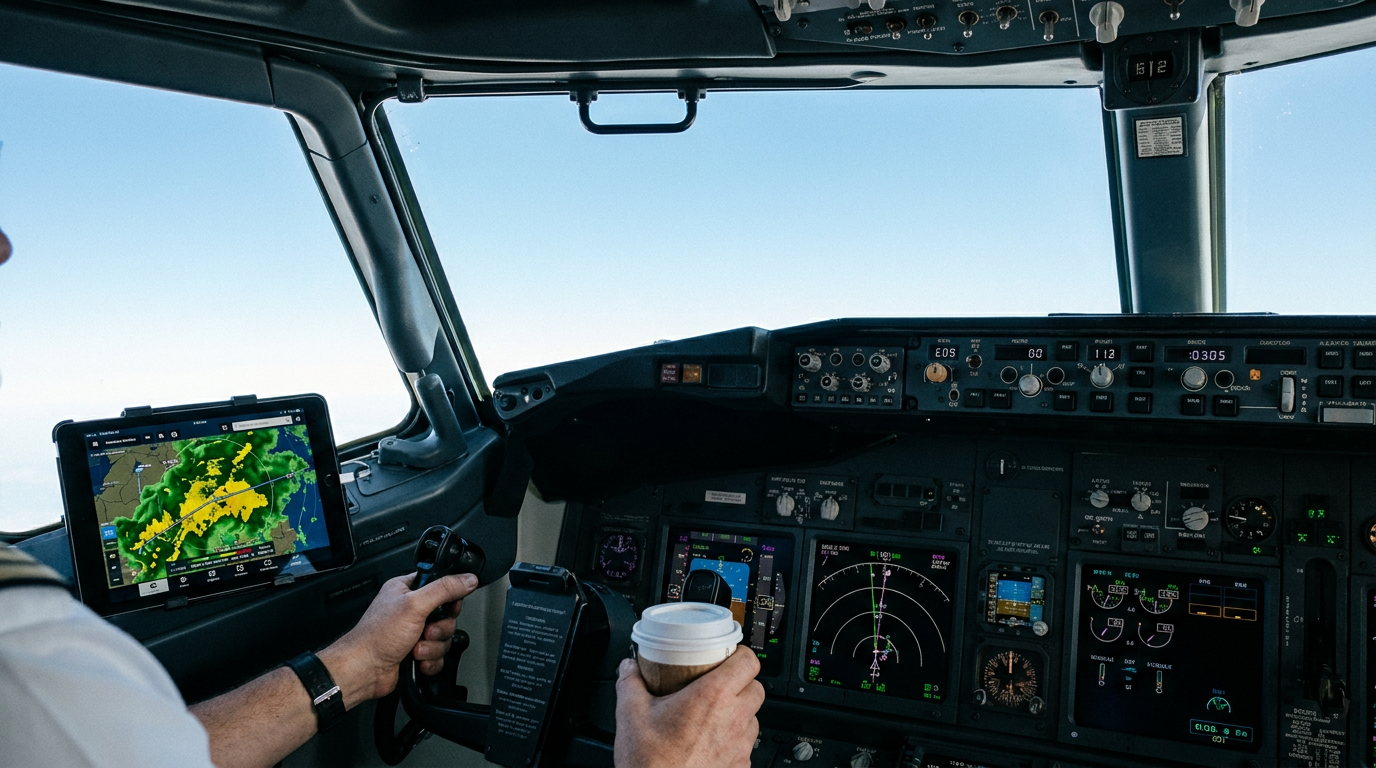
To combat this invisible threat, the aviation industry is increasingly turning to artificial intelligence. Major global carriers are deploying multi-layered AI systems designed to predict, map, and avoid rough air before an aircraft ever enters it. Emirates, for example, has recently overhauled its flight operations with a data-driven strategy that integrates machine learning and real-time global data feeds. The airline has partnered with SkyPath, an AI platform that effectively turns the aircraft itself into a highly sensitive meteorological sensor. Instead of relying solely on external radar arrays, SkyPath utilizes the built-in accelerometers found in the iPads that pilots already use in the cockpit as Electronic Flight Bags.[2][3]

As the aircraft cruises, the iPad continuously measures the exact physical micro-movements of the plane in three-dimensional space. The SkyPath software instantly converts these subtle vibrations into Eddy Dissipation Rate (EDR) readings, which serve as the aviation industry's universal, objective metric for turbulence intensity. This localized data is then beamed via satellite to a centralized AI model, where it is processed alongside Automatic Dependent Surveillance–Broadcast (ADS-B) transponder data and high-resolution weather forecasts from systems like Lufthansa Systems' Lido mPilot. The result is a dynamic, real-time map of atmospheric bumps that reveals the exact location of clear air turbulence with unprecedented precision.[2][3]
"The platform's unique use of iPad accelerometers enables aircraft to act as moving sensors, transmitting turbulence-intensity data even in low-traffic regions," Emirates noted in a recent operational update. This capability allows the AI to predict turbulence in remote areas previously considered beyond the reach of traditional radar or satellite coverage. Crucially, this data is not kept in a silo. Emirates and other participating carriers feed their AI-processed EDR readings into the International Air Transport Association's (IATA) Turbulence Aware program. This creates a shared, global ecosystem where a Delta flight crossing the Atlantic can instantly benefit from the sensor data of an Emirates flight that passed through the exact same air corridor just twenty minutes earlier.[2][4][8]
This capability allows the AI to predict turbulence in remote areas previously considered beyond the reach of traditional radar or satellite coverage.
While Emirates focuses on real-time crowdsourcing, other airlines are taking a deep-learning approach to historical weather data to forecast turbulence hours in advance. Japan's All Nippon Airways (ANA) recently became the first airline in the world to formally implement a proprietary AI turbulence prediction service developed by BlueWX, a company spun out of a joint initiative with Keio University. The ANA model was trained using advanced deep learning techniques on a massive dataset comprising a decade of historical turbulence reports and complex meteorological variables. After rigorous operational trials involving 2,500 ANA pilots, the system demonstrated an impressive 86% accuracy rate, leading to its permanent integration into the airline's weather data infrastructure.[1]
The underlying technology powering these predictions is advancing at a breakneck pace. At the 2026 Regeneron International Science and Engineering Fair, a breakthrough project called ForeCAT demonstrated how integrating artificial intelligence with classical atmospheric physics could push prediction boundaries even further. Traditional algorithms used in the aviation industry, such as Graphical Turbulence Guidance (GTG), rely on linear, empirically thresholded metrics that often struggle with the complex fluid dynamics of clear air turbulence. ForeCAT's neural network, driven by partial differential equations (PDE)-based turbulence diagnostics, captures these complex interactions to achieve a 95% classification accuracy—reportedly three times higher than legacy systems.[6]

For passengers, the practical application of these AI models means a noticeably smoother ride. By predicting the exact location, altitude, and intensity of clear air turbulence, these systems allow flight dispatchers to suggest highly targeted altitude adjustments before the aircraft even leaves the gate. Often, simply adjusting the cruising altitude by 1,000 to 2,000 feet is enough to completely bypass an invisible pocket of rough air. In the cockpit, pilots receive live turbulence visualizations on their electronic flight bags, enabling them to make dynamic, data-backed route adjustments mid-flight rather than waiting to hit a bump and then asking air traffic control for permission to climb or descend.[2][6]
Despite these massive leaps in predictive capability, aviation safety experts are quick to caution against viewing AI as a magic bullet that will soon take over direct flight controls. Neural networks are inherently probabilistic; they provide highly accurate guesses based on pattern recognition rather than deterministic guarantees. "You cannot certify 'something else' for flight safety applications," notes aviation maintenance and software expert Andrii Klymenko, explaining the strict certification standards maintained by regulatory bodies like the FAA and EASA. For the foreseeable future, AI serves strictly as an advanced advisory tool—flagging invisible hazards and optimizing routes so that highly trained human pilots can make the final, authoritative decisions.[7]
Yet, the next frontier of turbulence AI—active, real-time flight control—is already being tested in advanced wind tunnels. Researchers at Caltech and Nvidia recently unveiled FALCON (Fourier Adaptive Learning and CONtrol), an experimental AI system that uses reinforcement learning to understand turbulent dynamics on the fly. Instead of merely warning a pilot, FALCON is designed for unmanned aerial vehicles (UAVs) to automatically adjust flight control surfaces in milliseconds. By representing wind conditions digitally as periodic waves, the AI can compensate for sudden shear flows almost instantly, much like a bird instinctively adjusts its wing feathers in a sudden gust of wind.[5]

While it will likely be decades before such active, AI-driven flight control systems are certified for commercial passenger jets, the current generation of predictive tools is already transforming the daily reality of air travel. Airlines cannot promise completely turbulence-free flights, as the Earth's atmosphere remains a fundamentally chaotic and dynamic system. But by mapping the invisible, crowdsourcing data at the speed of light, and applying deep learning to meteorological physics, artificial intelligence is ensuring that the sudden, terrifying drops of the past become an increasingly rare anomaly rather than a routine part of flying.[3][4][5]
How we got here
1979–2020
Severe turbulence over the North Atlantic increases by 55% due to climate change.
May 2024
A severe Clear Air Turbulence encounter on a Singapore Airlines flight highlights the urgent need for better prediction tools.
Late 2024
Caltech researchers unveil FALCON, an AI system that adjusts drone flight controls to turbulence in real-time.
2025
Emirates rolls out a multi-layered AI approach, integrating SkyPath and Lido mPilot across its fleet.
August 2025
ANA becomes the first airline to officially integrate the BlueWX AI turbulence prediction service.
May 2026
The ForeCAT project demonstrates 95% accuracy in Clear Air Turbulence prediction using physics-based AI.
Viewpoints in depth
Airlines & Technologists
Believe AI and crowdsourced data can map the skies and eliminate unexpected turbulence encounters.
This camp, which includes major carriers like Emirates and ANA alongside tech developers, argues that the atmosphere can be effectively mapped using big data. By turning every aircraft into a meteorological sensor via iPad accelerometers and applying deep learning to historical weather patterns, they believe airlines can predict and bypass Clear Air Turbulence. Their primary evidence is the significant reduction in severe turbulence incidents already recorded by early adopters, which saves millions in aircraft damages and prevents passenger injuries.
Aviation Safety Regulators
Maintain that AI must remain an advisory tool rather than a direct flight controller due to strict certification standards.
Safety experts and regulatory bodies emphasize the fundamental difference between advisory software and deterministic flight control systems. Because neural networks are probabilistic—meaning they offer highly accurate guesses rather than guaranteed outcomes—they cannot be certified to directly control a passenger jet's engines or ailerons. This camp supports the use of AI for route optimization and early warning systems but insists that human pilots must retain ultimate authority over the aircraft's movements.
Atmospheric Researchers
Focus on the underlying physics and climate trends driving the increase in severe turbulence.
Climate scientists and atmospheric physicists point out that while AI is a brilliant adaptation, it is ultimately a response to a worsening underlying problem. Studies show that shifting global temperature gradients are altering the jet stream, leading to a massive increase in severe Clear Air Turbulence over major flight corridors. This camp advocates for integrating complex fluid dynamics and partial differential equations into AI models—as seen in the ForeCAT project—to better understand the changing atmosphere, rather than just reacting to it.
What we don't know
- Whether AI predictive models can maintain their high accuracy rates as climate change introduces unprecedented atmospheric patterns.
- How long it will take for active, AI-driven flight control systems (like Caltech's FALCON) to be certified for commercial passenger jets.
Key terms
- Clear Air Turbulence (CAT)
- Sudden, severe turbulence occurring in cloudless regions of the sky, invisible to standard weather radar.
- Eddy Dissipation Rate (EDR)
- The aviation industry's universal, objective metric for measuring the intensity of turbulence.
- Electronic Flight Bag (EFB)
- A tablet device, usually an iPad, used by flight crews to store aeronautical charts, weather data, and flight management applications.
- Reinforcement Learning
- A type of artificial intelligence where a system learns to make decisions by performing actions and receiving feedback, used to train experimental flight control systems.
Frequently asked
What is Clear Air Turbulence (CAT)?
It is erratic air movement that occurs in cloudless skies, making it completely invisible to traditional weather radar and difficult for pilots to anticipate.
How does an iPad detect turbulence?
AI platforms like SkyPath use the built-in accelerometers in pilots' iPads to measure the exact physical micro-movements of the aircraft, converting them into standardized turbulence metrics.
Will AI fly the plane through turbulence?
Not on commercial flights. While AI is used to advise pilots on route adjustments, aviation regulations require deterministic software for direct flight control, keeping humans firmly in charge.
Sources
Source coverage
8 outlets
3 viewpoints surfaced








[1]Future Travel ExperienceAirlines & Technologists
All Nippon Airways launches innovative AI turbulence prediction tech for enhanced safety and CX
Read on Future Travel Experience →[2]Aerospace Global NewsAirlines & Technologists
Emirates invests in AI to predict and avoid turbulence
Read on Aerospace Global News →[3]The Times of IndiaAirlines & Technologists
No more bumpy flights: How Emirates is using artificial intelligence to make turbulence a thing of the past
Read on The Times of India →[4]World Aviation FestivalAirlines & Technologists
AI analytics help Emirates avoid unexpected turbulence
Read on World Aviation Festival →[5]Caltech AerospaceAtmospheric Researchers
AI-Trained Vehicles Can Adjust to Extreme Turbulence on the Fly
Read on Caltech Aerospace →[6]Society for ScienceAtmospheric Researchers
PHYS026 - ForeCAT: Physics Meets AI to Avoid Bumpy Flights
Read on Society for Science →[7]MediumAviation Safety Regulators
When AI Meets Turbulence
Read on Medium →[8]Simple FlyingAirlines & Technologists
Emirates Tackles Turbulence With AI & Data-Driven Solutions
Read on Simple Flying →



Every angle. Every day.
Get travel stories with full source coverage and perspective breakdowns delivered to your inbox.