
Plummeting Battery Costs Drive Down Wholesale Electricity Prices in 2026
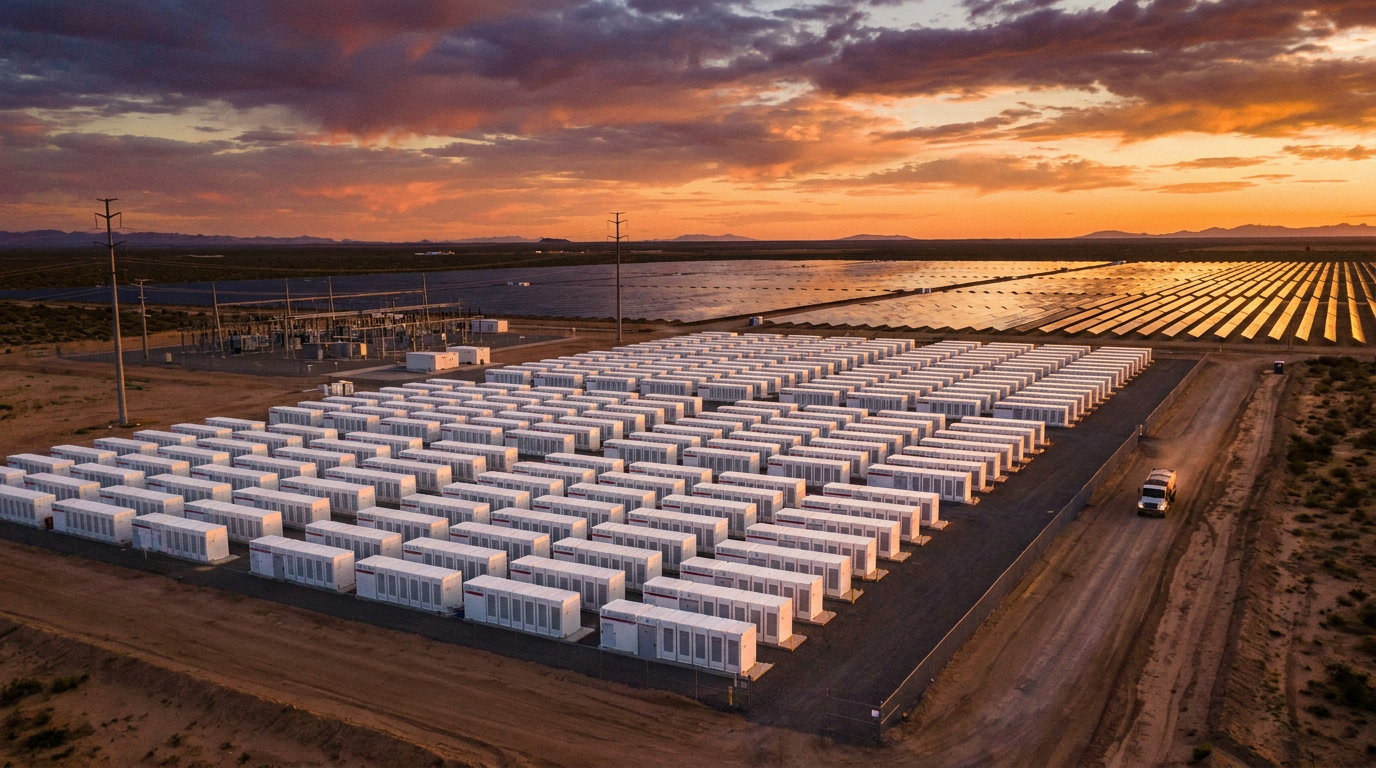
Utility-scale battery storage has reached a critical price threshold, allowing it to displace traditional gas peaker plants and actively lower wholesale power costs across major global markets.
By Factlen Editorial Team
- Renewable Developers
- View storage as the essential key to unlocking 24/7 clean energy contracts and bypassing grid interconnection delays.
- Market Analysts
- Focus on the raw economics, noting that batteries are simply outcompeting gas peaker plants on cost during peak demand hours.
- Grid Operators
- Value batteries for their rapid response times and ability to stabilize grid frequency, though they worry about managing decentralized residential storage.
What's not represented
- · Natural gas peaker plant operators facing stranded asset risks.
- · Local communities living near large-scale battery installations.
Why this matters
For decades, the Achilles' heel of renewable energy was its intermittency. With battery costs finally crossing the threshold of economic parity, power grids can now store cheap midday solar and deploy it during evening peaks, fundamentally lowering electricity bills and reducing reliance on fossil fuels.
Key points
- Utility-scale battery costs have stabilized at $250,000 to $450,000 per megawatt in 2026.
- In advanced markets like Australia, batteries are actively setting wholesale prices, driving a 12% cost reduction in Q1.
- Global energy investment is projected to reach $3.4 trillion this year, with clean tech capturing $2.2 trillion.
- Over half of new utility-scale storage projects are now paired directly with solar generation.
- Rising electricity demand from AI data centers is accelerating the deployment of co-located solar-plus-storage.
In the first quarter of 2026, the global energy transition crossed a quiet but monumental threshold. For years, battery storage was viewed primarily as a green accessory—a necessary but expensive add-on to smooth out the intermittent nature of wind and solar power. Today, utility-scale batteries have reached a price point where they are no longer just supporting the grid; they are actively dictating its economics. Across major advanced economies, battery installations have scaled to the point where they are routinely setting wholesale market prices, fundamentally altering the business model of electricity generation.[2]
The most striking evidence of this shift has emerged in Australia’s National Electricity Market (NEM), long considered a bellwether for high-renewable grids. During the first three months of 2026, batteries operated as the marginal generator—the facility that sets the clearing price for the entire market—nearly a third of the time. By stepping in during peak evening hours, these storage systems drove a remarkable 12 percent reduction in average wholesale electricity costs. It is a definitive proof of concept that storage can structurally lower power bills on a national scale.[2]
The mechanism driving this price collapse is known as energy arbitrage, and it relies on the growing abundance of midday solar power. When the sun is shining, solar farms often produce more electricity than the grid can consume, driving wholesale prices to zero or even into negative territory. Batteries absorb this excess, essentially getting paid to charge. When the sun sets and evening demand spikes, they discharge that stored power into the grid. In doing so, they directly undercut traditional natural gas "peaker" plants, which have historically charged premium rates to fire up on short notice.[2][4]
This market dynamic is entirely the result of a relentless decline in hardware costs. Following years of supply chain volatility and lithium price spikes, the capital expenditure required for utility-scale storage has stabilized at new lows. In 2026, a standard utility-scale project costs between $250,000 and $450,000 per megawatt, depending on whether it is configured for two or four hours of discharge. The widespread adoption of Lithium Iron Phosphate (LFP) chemistry has further improved safety profiles and lifespans, making these multi-million-dollar installations highly bankable assets for infrastructure investors.[4][7]

The broader macroeconomic picture reflects this new reality. According to the International Energy Agency’s 2026 World Energy Investment report, global capital flows into the energy sector are on track to hit a record $3.4 trillion this year. Of that total, a staggering $2.2 trillion is being directed toward clean technologies, electrical grids, and energy storage. This represents a massive decoupling from traditional fossil fuels, which are expected to capture roughly $1.2 trillion, largely driven by legacy natural gas projects.[1][3]
The IEA data underscores a fundamental rewiring of the global economy. Electricity-related spending now accounts for nearly 60 percent of all global energy investment. While upstream spending by major oil companies has more than halved over the past decade, capital is flooding into the infrastructure required to support an electrified, AI-driven world. Investors are increasingly viewing grid-scale storage not as a speculative green technology, but as foundational infrastructure akin to pipelines or transmission wires.[1][6]
The IEA data underscores a fundamental rewiring of the global economy.
As a result, the standalone renewable energy project is rapidly becoming a relic of the past. Developers are increasingly turning to "hybrid" Power Purchase Agreements (PPAs), where solar or wind generation is contractually paired with on-site storage. Over half of the utility-scale storage capacity coming online in the United States by 2026 is physically co-located with solar farms. This pairing allows developers to guarantee a firm, predictable supply of electricity to buyers, completely bypassing the financial risk of negative midday pricing.[4]
A major catalyst for this hybrid boom is the explosive growth of artificial intelligence. Hyperscalers and data center operators are driving the most significant surge in electricity demand seen in decades, but their corporate mandates require 24/7 clean energy. Because traditional grid interconnection queues are bogged down by years-long delays, tech giants are increasingly signing massive contracts for co-located solar-plus-storage facilities to secure reliable, firm power off-grid or behind the meter.[4][8]

The storage revolution is not confined to massive industrial sites; it is simultaneously reshaping residential neighborhoods. In Germany, a pioneer in distributed energy, the combination of falling battery prices and elevated retail electricity rates has triggered a wave of household adoption. Total installed battery storage capacity in the country has now reached 24 gigawatt-hours. For many homeowners, pairing rooftop solar with a wall-mounted battery is no longer an environmental statement, but a strictly financial decision to insulate themselves from utility rate hikes.[2][5]
This mass defection from the traditional grid presents a looming crisis for legacy power companies. Research from Harvard Business School indicates that as solar-plus-storage becomes profitable for a majority of households in high-cost markets, residential demand for utility-provided electricity could plummet by nearly 40 percent. This dynamic threatens to upend the century-old pay-per-use utility model, forcing grid operators to raise rates on those who cannot afford batteries, or fundamentally restructure how they charge for grid maintenance.[5]
To prevent this "utility death spiral," grid operators are increasingly turning to Virtual Power Plants (VPPs). Rather than fighting residential storage, utilities are paying homeowners for the right to tap into their batteries during grid emergencies. By aggregating thousands of distributed home batteries, electric vehicles, and smart thermostats, software platforms can coordinate these devices to act as a single, massive power plant. In the U.S. alone, VPP enrollment is expected to scale rapidly as new federal regulations mandate their inclusion in wholesale markets.[4]

Despite the triumph of lithium-ion technology in the two-to-four-hour market, the energy transition still faces a critical hurdle: multi-day weather lulls. When wind and solar generation drop for an extended period, short-duration batteries quickly deplete. To solve this, the industry is accelerating pilots for Long-Duration Energy Storage (LDES). Technologies like 100-hour iron-air batteries and hydrogen-lithium hybrid systems are moving from the laboratory to commercial deployment in 2026, aiming to provide the deep reserves necessary to fully retire coal and gas.[2][4]
Beyond economics and climate goals, the deployment of battery storage has taken on profound geopolitical weight. The recent closure of the Strait of Hormuz and ongoing conflicts in the Middle East have starkly highlighted the vulnerabilities of relying on imported fossil fuels. For policymakers in Europe, Asia, and the Americas, domestically produced renewable energy—firmed and secured by battery storage—is now viewed as a critical national security asset.[1][3]
As 2026 unfolds, the energy market has entered a new paradigm. The debate over whether renewable energy can provide reliable, baseload power is being settled not by policy mandates, but by raw market forces. With battery costs continuing their downward trajectory, the economic moat protecting traditional combustion power plants is evaporating, clearing the path for an electrical grid that is both cheaper and fundamentally cleaner.[1][7]
How we got here
2020-2022
Lithium-ion battery costs drop significantly but face supply chain volatility during the pandemic.
2024
Global renewable energy investment surges, but grid interconnection queues create massive backlogs for standalone solar.
2025
Renewables overtake coal as the world's largest source of electricity, while battery installations hit record highs.
Q1 2026
Batteries begin setting marginal wholesale prices in major markets like Australia, actively undercutting gas peaker plants.
Viewpoints in depth
Grid Operators & Utilities
Balancing the benefits of grid stability with the threat of residential defection.
For grid operators, batteries are a double-edged sword. On a utility scale, they are invaluable assets that provide rapid frequency regulation and smooth out the volatile output of wind and solar farms. However, the rapid adoption of residential solar-plus-storage systems threatens the traditional utility business model. As more households generate and store their own power, they rely less on the grid, leaving utilities with fewer paying customers to cover the fixed costs of maintaining transmission infrastructure.
Renewable Energy Developers
Shifting entirely to hybrid projects to guarantee revenue and bypass grid delays.
Developers are increasingly abandoning standalone solar and wind projects in favor of hybrid facilities that include on-site storage. This shift is driven by the need to avoid negative pricing during midday solar peaks, ensuring that the power generated can actually be sold profitably during evening hours. Furthermore, pairing storage with generation allows developers to offer 24/7 firm power contracts, which are highly sought after by hyperscalers and AI data centers looking to meet aggressive corporate sustainability goals.
Fossil Fuel Generators
Facing an existential threat to the highly profitable peaker plant model.
Operators of natural gas peaker plants are watching their most profitable operating hours evaporate. Historically, these plants sat idle for most of the year, firing up only during extreme demand peaks and charging premium rates for their rapid response. Today, utility-scale batteries can respond to demand spikes in milliseconds, entirely undercutting the price of gas generation. As battery capacity grows, fossil fuel generators face the increasing risk of their peaker plants becoming stranded assets long before the end of their operational lifespans.
What we don't know
- How quickly long-duration energy storage (LDES) technologies, like iron-air batteries, can scale to replace gas plants during multi-day weather lulls.
- Whether utility business models can adapt fast enough to the revenue losses caused by widespread residential storage adoption.
- How potential supply chain bottlenecks for critical minerals might impact the next phase of battery deployment.
Key terms
- Peaker Plant
- A power plant, typically burning natural gas, that only runs during periods of high electricity demand.
- Energy Arbitrage
- The practice of storing electricity when prices are low (or negative) and discharging it to the grid when prices are high.
- Virtual Power Plant (VPP)
- A network of decentralized, grid-connected energy resources—like home batteries—coordinated to act as a single power plant.
- Hybrid PPA
- A Power Purchase Agreement that combines renewable energy generation (like solar) with battery storage in a single contract.
- Long-Duration Energy Storage (LDES)
- Storage systems designed to discharge power for 8 to 100+ hours, crucial for managing multi-day periods of low wind or sun.
Frequently asked
Why are battery storage costs dropping?
Costs have fallen due to stabilized lithium prices, massive economies of scale in manufacturing, and advancements in battery chemistry like Lithium Iron Phosphate (LFP).
How do batteries lower electricity bills?
They absorb excess solar power during the day when it is cheap or free, and discharge it during the evening peak, replacing expensive natural gas power.
Can batteries power the grid for days at a time?
Current lithium-ion batteries typically provide 2 to 4 hours of power. Multi-day storage requires emerging 'long-duration' technologies, which are currently in the pilot phase.
What is a Virtual Power Plant?
It is a software-driven network that connects thousands of small home batteries, allowing them to discharge simultaneously to support the broader grid during emergencies.
Sources
Source coverage
8 outlets
3 viewpoints surfaced








[1]International Energy AgencyGrid Operators
World Energy Investment 2026
Read on International Energy Agency →[2]ESS NewsMarket Analysts
Batteries drive 12% reduction in average wholesale electricity costs in Q1 2026
Read on ESS News →[3]S&P GlobalMarket Analysts
Global energy investment is on track to hit a record $3.4 trillion in 2026
Read on S&P Global →[4]DeloitteGrid Operators
2026 Energy, Resources, and Industrials Outlook
Read on Deloitte →[5]Harvard Business SchoolMarket Analysts
Falling Battery Storage Costs Are Quietly Reshaping Electricity Markets
Read on Harvard Business School →[6]Power Gen AdvancementMarket Analysts
Global energy investment is set to hit $3.4 Tn as per IEA
Read on Power Gen Advancement →[7]BloombergNEFRenewable Developers
Levelized Cost of Electricity 2026
Read on BloombergNEF →[8]EcohzRenewable Developers
Renewable Energy Trends 2026
Read on Ecohz →
Every angle. Every day.
Get energy stories with full source coverage and perspective breakdowns delivered to your inbox.