
How Blended Wing Body Aircraft Will Reshape Commercial Flight
Aerospace engineers are abandoning the traditional tube-and-wing design in favor of a seamless, flying-wing architecture that could cut fuel consumption by up to 50%. With major funding secured and test flights slated for 2027, the blended wing body is moving from military concept to commercial reality.
By Factlen Editorial Team
- Aviation Startups
- Companies aggressively pushing to bring BWB aircraft to market by 2030 to solve the emissions crisis.
- Legacy Planemakers
- Established manufacturers taking a cautious, long-term approach to radical airframe redesigns.
- Aerospace Researchers
- Scientists and engineers focused on validating the physics, aerodynamics, and safety of the airframe.
What's not represented
- · Airport Infrastructure Operators
- · Aviation Regulators (FAA/EASA)
Why this matters
Aviation accounts for a rapidly growing share of global emissions, and current incremental improvements aren't enough to reach net-zero. A fundamental redesign of the airplane could drastically lower the carbon footprint of air travel while creating wider, more spacious cabins for passengers.
Key points
- Blended wing body (BWB) aircraft merge the fuselage and wings into a single lifting surface, drastically reducing aerodynamic drag.
- The design could reduce commercial aviation fuel consumption and greenhouse gas emissions by up to 50%.
- Startup JetZero recently secured $175 million to accelerate a full-scale demonstrator, targeting a first flight in 2027.
- The ultra-wide architecture allows for 30% to 40% more interior space but will likely require windowless, theater-style seating.
For more than six decades, the silhouette of the commercial airliner has remained stubbornly unchanged. From the dawn of the Jet Age to today's modern widebodies, the industry has relied on the "tube-and-wing" architecture: a cylindrical fuselage designed to hold people, attached to long, swept wings designed to generate lift. It is a proven, safe, and highly optimized design.[6]
But that optimization has hit a plateau. As the aviation industry faces mounting pressure to reach net-zero emissions by 2050, engineers are realizing that squeezing another few percentage points of efficiency out of the traditional tube-and-wing shape is no longer enough. To achieve a quantum leap in performance, the fundamental geometry of the airplane must change.[4][6]
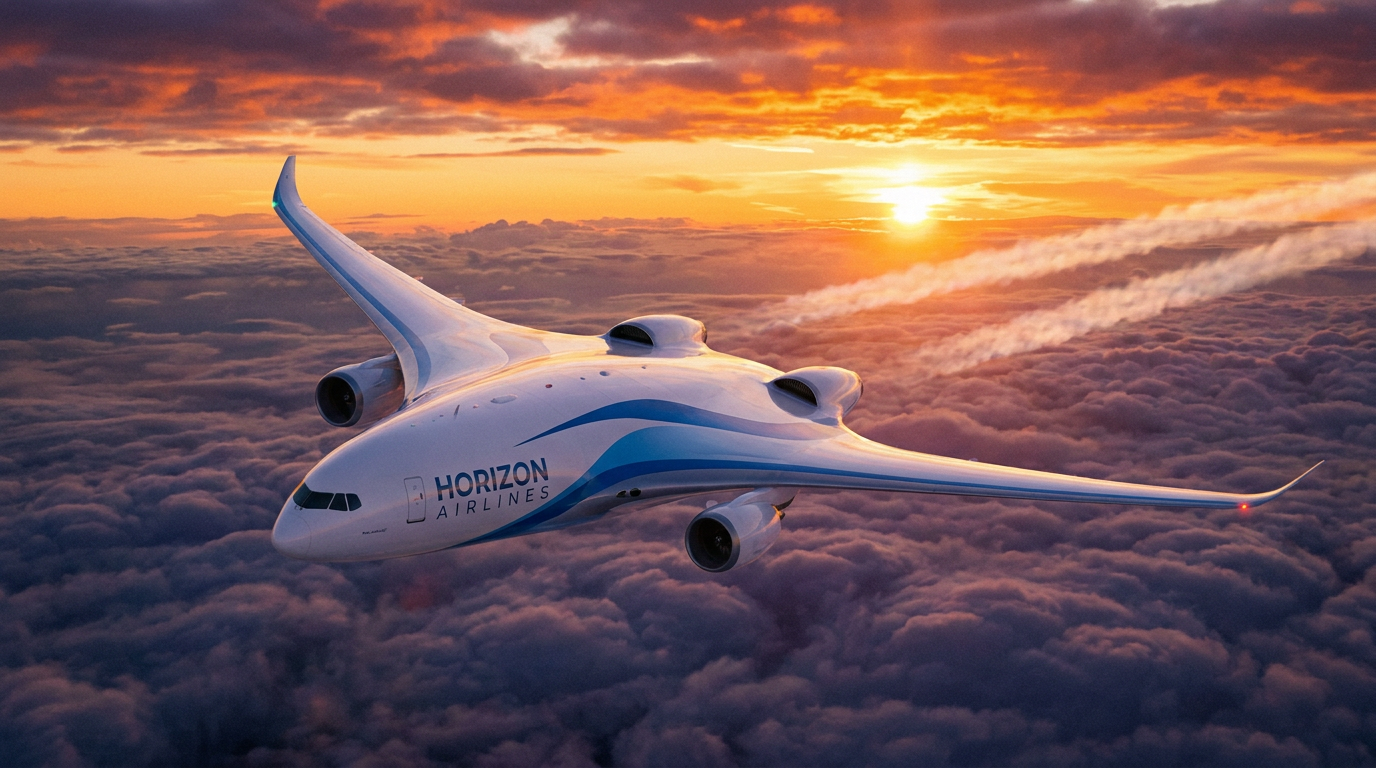
Enter the Blended Wing Body (BWB). Instead of a distinct fuselage and separate wings, a BWB aircraft features a flattened, aerodynamic center body that seamlessly merges into the outboard wings. The result looks less like a traditional airliner and more like a sleek, futuristic manta ray—or the triangular paper airplanes of childhood.[2][5]
The concept is rapidly moving from science fiction to the assembly line. In January 2026, California-based startup JetZero secured $175 million in Series B financing to accelerate the development of its Z4 blended-wing airliner. Backed by major industry players including United Airlines and Delta Air Lines, JetZero aims to fly a full-scale demonstrator aircraft by 2027.[1][3][4]

Legacy manufacturers are also signaling a shift. In a late 2025 interview, Airbus CEO Guillaume Faury acknowledged that over the next 30 to 40 years, planemakers may entirely abandon the traditional tube layout in favor of a single, thick wing with the passenger cabin built inside. Airbus has already been testing sub-scale BWB models under its ZEROe initiative.[2]
The primary advantage of the blended wing body lies in its revolutionary aerodynamics. In a conventional aircraft, the wings do almost all the heavy lifting—carrying about 90% of the aircraft's weight. The cylindrical fuselage, meanwhile, is essentially dead weight; it generates virtually no lift and creates immense aerodynamic drag as it pushes through the air.[5][6]
A BWB design elegantly solves this inefficiency. By flattening the center body into an airfoil shape, the fuselage itself becomes a lifting surface. In a blended wing aircraft, the center body can generate up to 50% of the total lift. Because the entire airframe is working to keep the plane aloft, the aircraft can achieve the same payload capacity with a significantly smaller overall footprint.[1][5]
By flattening the center body into an airfoil shape, the fuselage itself becomes a lifting surface.
This seamless integration also drastically reduces the aircraft's "wetted area"—the total surface area of the plane's skin exposed to the airflow. Less surface area means less skin friction drag. Combined with the elimination of the sharp angles where wings normally meet a fuselage, the BWB glides through the air with unprecedented aerodynamic efficiency.[5]

The compounding benefits of this aerodynamic leap are staggering. Because the airframe is so efficient, it requires less thrust to maintain cruising speed. Less thrust means the aircraft can be equipped with smaller, lighter engines. Ultimately, JetZero and its partners project that a BWB airliner could reduce fuel burn and greenhouse gas emissions by up to 50% compared to today's comparable tube-and-wing jets.[3][4]
That 50% reduction is the holy grail for aviation sustainability. While the industry is heavily investing in Sustainable Aviation Fuel (SAF), the alternative fuel remains expensive and scarce. By cutting the aircraft's fuel appetite in half, BWB designs make the transition to 100% SAF economically viable, effectively doubling the impact of every gallon produced.[4][6]
The unique geometry of the BWB also changes how engines are integrated. Instead of hanging beneath the wings, the engines on a blended wing aircraft are typically mounted on top of the rear fuselage. This top-mounted configuration shields the ground from engine noise, potentially reducing the aircraft's acoustic footprint by 15 to 20 decibels—a massive relief for communities surrounding busy airports.[5]
For passengers, stepping onto a blended wing airliner will feel entirely different. Because the center body must be thick enough to blend into the wings, the cabin is inherently wider and shorter than a traditional tube. Instead of a long, narrow corridor with one or two aisles, a BWB cabin resembles a wide theater, potentially featuring three or four aisles and a stadium-like seating arrangement.[2][6]

This wide-body layout provides 30% to 40% more usable interior space, opening the door for innovative cabin designs, lounges, and improved passenger comfort. However, the architecture comes with a significant trade-off: the elimination of traditional windows. Because the passenger cabin is buried deep within the thick center wing, only a fraction of passengers would be seated near an exterior wall.[2]
To combat potential claustrophobia and disorientation, designers are exploring the use of high-definition curved screens that act as "virtual windows," projecting live feeds of the outside sky into the cabin. Still, industry experts acknowledge that convincing the flying public to embrace a windowless, theater-style cabin will require a major psychological shift.[2][6]
Safety and certification present another formidable hurdle. The wide cabin means that passengers seated in the center are physically further from emergency exits than they would be in a standard narrowbody jet. Evacuating hundreds of passengers within the FAA's strict 90-second regulatory limit will require novel exit strategies and rigorous testing before any BWB carries commercial travelers.[2]

Despite these challenges, the momentum behind the blended wing body is undeniable. The U.S. Air Force has invested $235 million into JetZero's program, recognizing that the fuel efficiency of a BWB could revolutionize military transport and aerial refueling logistics. The technology that makes commercial flights greener will also extend the range and payload of military fleets.[1][3]
As the 2027 demonstrator flight approaches, the aviation world is watching closely. If the full-scale prototypes can validate the wind-tunnel data and overcome the interior design challenges, the blended wing body won't just be a novel alternative to the airplanes of today—it will become the definitive blueprint for the next century of flight.[3][6]
How we got here
1990s
McDonnell Douglas and NASA begin extensive research into blended wing body concepts for transport aircraft.
2007–2012
NASA and Boeing successfully fly the X-48, a series of unmanned sub-scale BWB prototypes, validating the aerodynamics.
Aug 2023
The U.S. Air Force awards JetZero a $235 million contract to develop a full-scale BWB demonstrator.
Dec 2025
Airbus CEO Guillaume Faury publicly states the industry may abandon tube-and-wing designs in the coming decades.
Jan 2026
JetZero secures $175 million in Series B funding to push its demonstrator toward a 2027 first flight.
Viewpoints in depth
Aviation Startups
Emerging companies believe the BWB is ready for immediate commercialization to solve the emissions crisis.
Startups like JetZero and Natilus argue that the aviation industry does not have the luxury of waiting decades for a new airframe. They point out that the aerodynamic principles of the blended wing body have been proven by military aircraft like the B-2 bomber and NASA's X-48 test flights. By utilizing existing engine technology rather than waiting for unproven hydrogen or electric propulsion, these companies believe they can bring a 50% more efficient aircraft to market by the early 2030s, providing an immediate and drastic reduction in carbon emissions.
Legacy Planemakers
Established giants view the BWB as a long-term evolution rather than a near-term disruption.
While Airbus and Boeing acknowledge the aerodynamic superiority of the blended wing design, they view the transition as a multi-decade process. Legacy manufacturers emphasize the immense complexity of certifying a radically new airframe, particularly concerning emergency evacuation protocols and the structural integrity of a non-cylindrical pressurized cabin. They argue that the immediate future of commercial flight will rely on highly optimized tube-and-wing designs paired with Sustainable Aviation Fuel, with the BWB serving as a potential successor in the 2040s or 2050s.
Passenger Advocates
Consumer groups are concerned about the psychological impact of windowless, theater-style cabins.
For passenger experience experts, the BWB presents a psychological hurdle. The ultra-wide cabin means the vast majority of passengers will be seated far from the aircraft's exterior, completely cut off from natural light. Skeptics worry that this configuration could induce claustrophobia and motion sickness, arguing that virtual windows—no matter how high-definition—cannot replace the spatial awareness provided by a physical view of the horizon. They caution that aerodynamic efficiency must not come at the cost of basic passenger comfort.
What we don't know
- How quickly regulatory bodies like the FAA will certify a radically new airframe design for commercial passenger use.
- Whether the flying public will embrace ultra-wide, theater-style cabins that lack physical windows.
- If existing airport gates and taxiways will require significant modifications to accommodate the unique wingspan of BWB airliners.
Key terms
- Blended Wing Body (BWB)
- An aircraft architecture where the fuselage and wings are merged into a single, continuous aerodynamic shape.
- Wetted Area
- The total surface area of an aircraft's exterior skin that comes into contact with the airflow, which directly impacts drag.
- Tube-and-Wing
- The traditional design of modern airliners, featuring a cylindrical passenger cabin attached to separate, swept wings.
- Sustainable Aviation Fuel (SAF)
- A liquid fuel made from renewable sources that can significantly reduce the lifecycle carbon emissions of air travel.
Frequently asked
What is a blended wing body aircraft?
It is an airplane design where the traditional cylindrical fuselage is flattened and seamlessly merged with the wings, creating a single, continuous lifting surface.
How much fuel does a blended wing aircraft save?
Developers estimate that a blended wing body can reduce fuel consumption and greenhouse gas emissions by up to 50% compared to conventional aircraft.
Will blended wing airplanes have windows?
Most passengers will not have access to physical windows due to the cabin's extreme width. Designers plan to use high-definition screens as 'virtual windows' to display the outside environment.
When will blended wing aircraft fly commercially?
Startups like JetZero aim to fly full-scale demonstrators by 2027, with hopes of entering commercial passenger service in the early to mid-2030s.
Sources
Source coverage
6 outlets
3 viewpoints surfaced






[1]Aerospace Global NewsAviation Startups
JetZero secures $175m to push blended-wing demonstrator toward 2027 flight
Read on Aerospace Global News →[2]Business InsiderLegacy Planemakers
Airbus CEO said the future of commercial aviation could be a B-2 bomber-like plane
Read on Business Insider →[3]AIN OnlineAviation Startups
JetZero Aims To Shake Up Commercial Aviation With BWB Airliner
Read on AIN Online →[4]Delta Air LinesAviation Startups
Delta Air Lines is partnering with JetZero on a revolutionary, more sustainable aircraft
Read on Delta Air Lines →[5]NASAAerospace Researchers
Blended Wing Body Technology
Read on NASA →[6]Factlen Editorial TeamAerospace Researchers
Synthesis by Factlen editorial team
Read on Factlen Editorial Team →
Every angle. Every day.
Get automotive stories with full source coverage and perspective breakdowns delivered to your inbox.