
The Invisible Engineering Behind Short Track Speed Skating
From reverse-osmosis ice to offset blades and Kevlar suits, the chaotic thrill of short track speed skating is governed by microscopic technological margins.
By Factlen Editorial Team
- Sports Biomechanists
- Focusing on how the human body interacts with extreme centrifugal forces and air resistance.
- Ice Technicians
- Viewing the racing surface as a highly engineered chemical and thermodynamic system.
- Equipment Manufacturers
- Focusing on custom carbon molding, Kevlar safety integration, and blade metallurgy.
- Short Track Athletes
- Prioritizing tactile feel, micro-adjustments, and real-time tactical decision-making.
What's not represented
- · Medical professionals treating lacerations
- · Long-track speed skaters transitioning to short track
Why this matters
While short track speed skating looks like pure athletic chaos, it is actually a masterclass in applied physics. Understanding the hidden technology—from the ice composition to the blade geometry—transforms how viewers experience one of the Winter Olympics' most thrilling events.
Key points
- Short track speed skating features pack racing on a tight 111.12-meter oval, requiring intense tactical decision-making.
- The ice is purified using reverse osmosis and kept at −3°C to provide optimal grip for cornering.
- Skate blades are offset to the left, allowing athletes to lean at extreme angles without their boots touching the ice.
- Racing suits are wind-tunnel tested for aerodynamics and woven with Kevlar to protect against blade lacerations.
- Athletes wear specialized gloves with plastic tips on the left hand to reduce friction when touching the ice for balance.
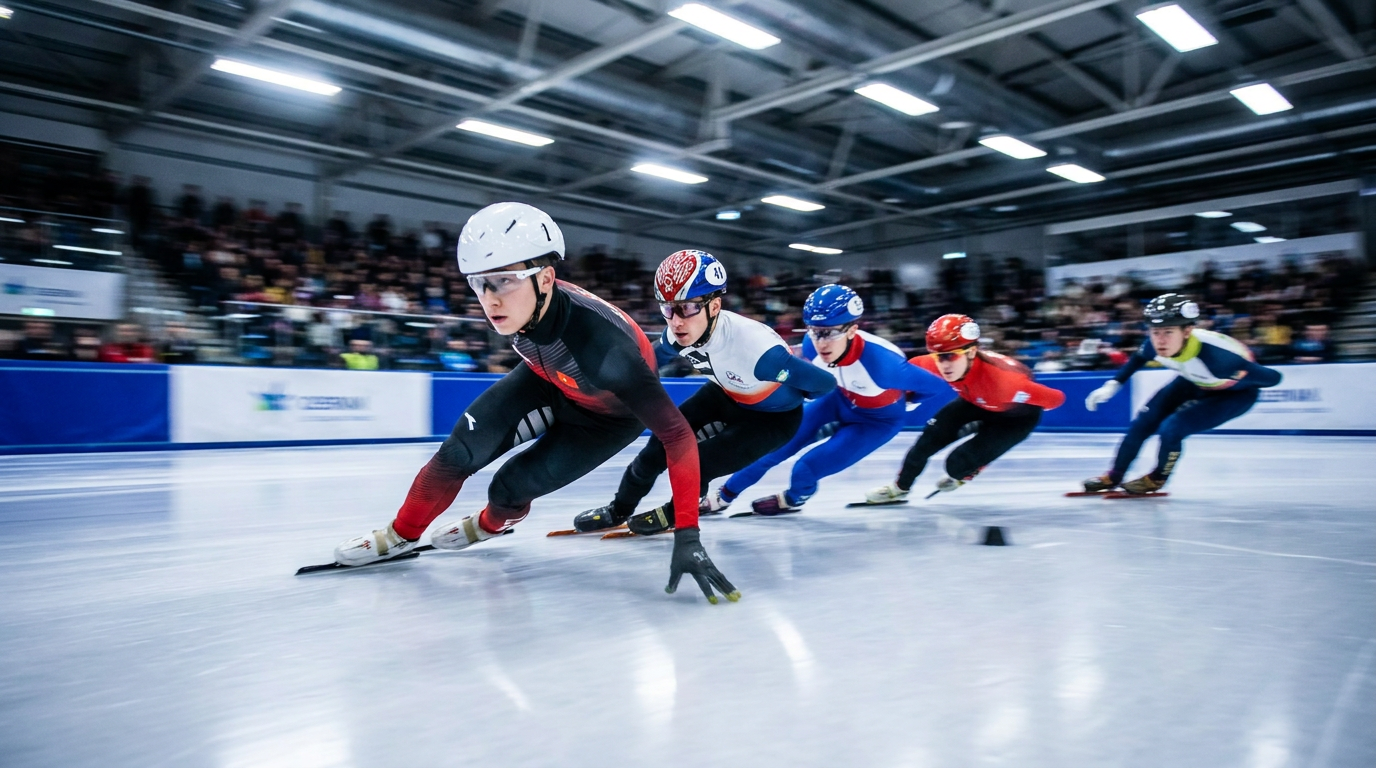
Short track speed skating is often described as roller derby on ice. Athletes reach speeds of 50 kilometers per hour, racing shoulder-to-shoulder without lanes, navigating tight corners where a single misstep can send the entire pack crashing into the padded boards. But beneath the sheer athletic chaos lies a world of microscopic engineering.[5][6]
The fundamental difference between traditional long-track speed skating and short track is the format. While long-track athletes race against the clock in designated lanes, short-track skaters compete directly against each other in a pack. This transforms the event from a pure time trial into a high-speed tactical chess match, where drafting, positioning, and split-second passing decisions dictate the podium.[1][5]
The arena itself dictates the extreme physics of the sport. Short track events are held on a 111.12-meter oval carved into a standard international-sized hockey rink. Because the straightaways are brief and the corners are incredibly tight, skaters spend the majority of the race leaning at severe angles, fighting immense centrifugal forces to maintain their racing line.[5][6]

To survive those forces, the ice must be engineered to exact specifications. Olympic ice technicians, often referred to as "ice masters," do not simply freeze tap water. They use reverse-osmosis purification to strip the water of minerals and impurities that could cause micro-roughness or unpredictable freezing patterns. The result is a silky, ultra-consistent surface that allows for predictable blade behavior.[1][4]
Temperature control is equally vital, and short track requires a different thermal profile than its long-track sibling. Long-track ice is kept extremely cold—typically between −5 and −6 degrees Celsius—to create a hard surface that maximizes glide and minimizes friction. Short track ice, however, is kept slightly warmer at around −3 degrees Celsius. This softer surface allows the skaters' blades to bite into the ice, providing the crucial grip needed to hold their edge through the tight, high-speed turns.[1][4]
The equipment connecting the athlete to the ice is highly customized. A short-track speed skate begins with the boot, which is built specifically for each individual skater. Using 3D computer scans and plaster casts, manufacturers wrap layers of rigid carbon fiber around the mold, creating a stiff shell that perfectly contours to the athlete's foot, ensuring that every ounce of force is transmitted directly to the ice.[3][4]
The equipment connecting the athlete to the ice is highly customized.
Attached to those custom boots are the blades, which feature one of the sport's most defining innovations. In the early 1980s, a Canadian inventor named Raymond Laberge revolutionized the discipline by offsetting the blades to the left side of the boot. Because short-track skaters only ever turn left, this offset design allows them to lean their bodies dangerously close to the ice without the side of the boot scraping the surface and causing a crash.[2][3]
The blades themselves are marvels of metallurgy. They measure just 1.1 millimeters thick—roughly half the thickness of a standard ice hockey blade—and are hand-sharpened with a succession of stones to a buttery 90-degree angle. Skaters often travel with multiple sets of identical blades, micro-adjusting their setups based on the specific feel and temperature of the ice on any given day.[2][3]

Unlike long-track speed skaters, who use "clap skates" with a hinged heel to keep the blade on the ice longer during a stride, short-track skaters use rigidly fixed blades. The chaotic pack dynamics and the need for absolute stability during aggressive cornering make the clap mechanism too dangerous and unstable for the smaller oval.[3][4]
Above the skates, the athletes' racing suits serve a dual purpose: maximizing aerodynamics and preventing catastrophic injury. The suits are developed in wind tunnels, utilizing varying textiles and strategically placed seams to reduce drag and air resistance. Because races are often decided by thousandths of a second, minimizing the invisible wall of air pushing against the skater is a primary engineering focus.[1][6]
But the suits are also armor. Pack racing at 50 kilometers per hour with razor-sharp blades carries a significant risk of lacerations during a crash. To protect the athletes, modern short-track suits are woven with Kevlar and other cut-resistant fibers, particularly over major arteries. The International Skating Union strictly enforces these protective standards, ensuring that the pursuit of speed does not compromise baseline safety.[2][4]

The protective gear extends to the athletes' hands, which play an active role in cornering. Skaters wear cut-resistant gloves, but the left glove features a unique modification: durable plastic or epoxy tips molded onto the fingers. As athletes lean into the tight left-hand turns, they drag their left hand on the ice for balance; the plastic tips reduce friction, allowing them to pivot smoothly without losing speed.[2][6]
In recent years, technology has also transformed how short-track athletes train. Some national teams have integrated "smart suits" embedded with precision sensors that measure the skater's exact posture and hip distance from the ice. This data is beamed in real-time to coaches, who can trigger haptic feedback vibrations in the athlete's wristband to correct their aerodynamic tuck mid-stride.[6]
Ultimately, all of this technology—the purified ice, the offset blades, the Kevlar suits—serves to elevate the human element of the sport. By optimizing the physics of the race, engineers have allowed skaters to push the boundaries of bravery and tactical aggression. It is a discipline where the margins between gold and disaster are microscopic, and where science provides the foundation for spectacular athletic feats.[1][6]
How we got here
1905
Canadian and American skaters begin practicing mass-start speed skating on indoor hockey rinks, laying the groundwork for short track.
1967
The International Skating Union (ISU) officially recognizes short track speed skating as a distinct sport.
Early 1980s
Canadian inventor Raymond Laberge revolutionizes the sport by introducing molded boots with offset blades.
1992
Short track speed skating makes its official debut as a full medal sport at the Albertville Winter Olympics.
2026
The Milano Cortina Winter Games showcase the latest advancements in cut-resistant Kevlar suits, smart training tech, and transcritical CO2 ice cooling.
Viewpoints in depth
Sports Biomechanists
Focusing on how the human body interacts with extreme centrifugal forces and air resistance.
For biomechanists, short track speed skating is a battle against physics. Every element of the athlete's posture is analyzed to reduce aerodynamic drag, which acts as an invisible wall at 50 kilometers per hour. Researchers emphasize that while physical strength is necessary, the true differentiator is the ability to maintain a perfect aerodynamic tuck while resisting immense centrifugal forces. This has driven the adoption of wind-tunnel-tested suits and haptic feedback sensors that correct an athlete's posture in real-time, ensuring that no energy is wasted to air resistance.
Ice Technicians
Viewing the racing surface as a highly engineered chemical and thermodynamic system.
Ice masters argue that the foundation of every world record lies beneath the skaters' feet. They view the rink not as frozen water, but as a carefully calibrated surface requiring reverse-osmosis purification to eliminate microscopic impurities. Technicians must maintain a delicate thermodynamic balance, keeping the ice at exactly −3 degrees Celsius. If the ice is too cold, it becomes too hard and the skaters' blades cannot grip the corners; if it is too warm, the surface becomes sluggish and slow. For them, the perfect race is a testament to flawless environmental control.
Short Track Athletes
Prioritizing tactile feel, micro-adjustments, and real-time tactical decision-making.
From the perspective of the competitors, all the laboratory engineering in the world cannot replace the tactile feel of the ice. Skaters are notoriously meticulous about their equipment, often traveling with dozens of identical blades and hand-sharpening them to a precise 90-degree edge based on the specific conditions of the day. Athletes emphasize that while technology provides the baseline for speed, winning requires the human ability to read chaotic pack dynamics, anticipate opponents' moves, and execute split-second passes in a sport where there are no lanes to protect them.
What we don't know
- How future advancements in smart-suit haptic feedback will alter real-time racing tactics.
- Whether new synthetic ice alternatives will eventually replace reverse-osmosis water in international competition.
Key terms
- Offset blades
- Skate blades that are mounted slightly to the left of the boot's center, allowing the skater to lean deeply into left-hand turns without the boot scraping the ice.
- Reverse osmosis
- A water purification process used by ice technicians to remove minerals and impurities, creating a perfectly smooth and consistent racing surface.
- Pack racing
- A racing format where all competitors start simultaneously and race against each other on the same track, rather than in separate lanes against the clock.
- Clap skate
- A type of speed skate with a hinged blade that detaches from the heel; used in long track but banned in short track due to stability concerns.
Frequently asked
Why do short track skaters touch the ice with their hands?
Skaters drag their left hand on the ice to maintain balance while leaning at extreme angles through tight corners. Their left gloves feature hard plastic tips to reduce friction.
Why don't short track skaters use clap skates?
Clap skates, which have a hinged heel, are used in long track for longer strides, but they are too unstable for the aggressive cornering and chaotic pack dynamics of short track.
How thick are short track speed skating blades?
The blades are incredibly thin, measuring just 1.1 millimeters thick—about half the thickness of a standard ice hockey blade.
Why is short track ice warmer than long track ice?
Short track ice is kept around −3°C (compared to −5°C for long track) to make it slightly softer, allowing the blades to grip the ice better during tight turns.
Sources
Source coverage
6 outlets
4 viewpoints surfaced






[1]Olympics.comIce Technicians
Milano Cortina 2026: The science of speed skating and the tech driving new records
Read on Olympics.com →[2]International Skating UnionEquipment Manufacturers
Developments in Short Track equipment
Read on International Skating Union →[3]CBC SportsShort Track Athletes
'Everything is made to turn left': Science of the skates behind Canada's powerhouse short track team
Read on CBC Sports →[4]National Institutes of HealthSports Biomechanists
Engineering the Field of Play: The Technology of Snow and Ice Surface Preparation
Read on National Institutes of Health →[5]Team GBShort Track Athletes
Short track speed skating explainer
Read on Team GB →[6]Factlen Editorial TeamSports Biomechanists
Synthesis by Factlen editorial team
Read on Factlen Editorial Team →

Every angle. Every day.
Get sports stories with full source coverage and perspective breakdowns delivered to your inbox.