
How Abandoned Oil Wells Are Being Repurposed for Geothermal Energy
Startups and researchers are transforming millions of idle oil and gas wells into closed-loop geothermal systems, providing clean baseload power while bypassing massive drilling costs.
By Factlen Editorial Team
- Geothermal Innovators
- Startups and engineers focused on the massive scalable potential of closed-loop systems.
- Environmental & Policy Advocates
- Groups focused on mitigating methane leaks and groundwater pollution while generating clean energy.
- Geoscience Researchers
- Academics and geologists focused on the technical constraints and realistic viability of well conversion.
- Energy Transition Analysts
- Industry observers focused on the economic second-life of assets and workforce continuity.
What's not represented
- · Local communities living near orphaned wells
- · Fossil fuel executives managing plugging liabilities
Why this matters
Drilling is the most expensive barrier to scaling geothermal energy. By utilizing pre-drilled fossil fuel infrastructure, the industry can rapidly deploy zero-emission heating and electricity while simultaneously cleaning up environmentally hazardous orphaned wells.
Key points
- Millions of abandoned oil and gas wells pose environmental risks and cost billions to plug.
- Repurposing these wells for geothermal energy bypasses expensive drilling costs, the largest barrier in the industry.
- Closed-loop systems use a tube-in-tube design to extract heat without contaminating groundwater or depleting reservoirs.
- While highly promising, researchers estimate only 1% to 10% of existing wells have the integrity and heat profile required for conversion.
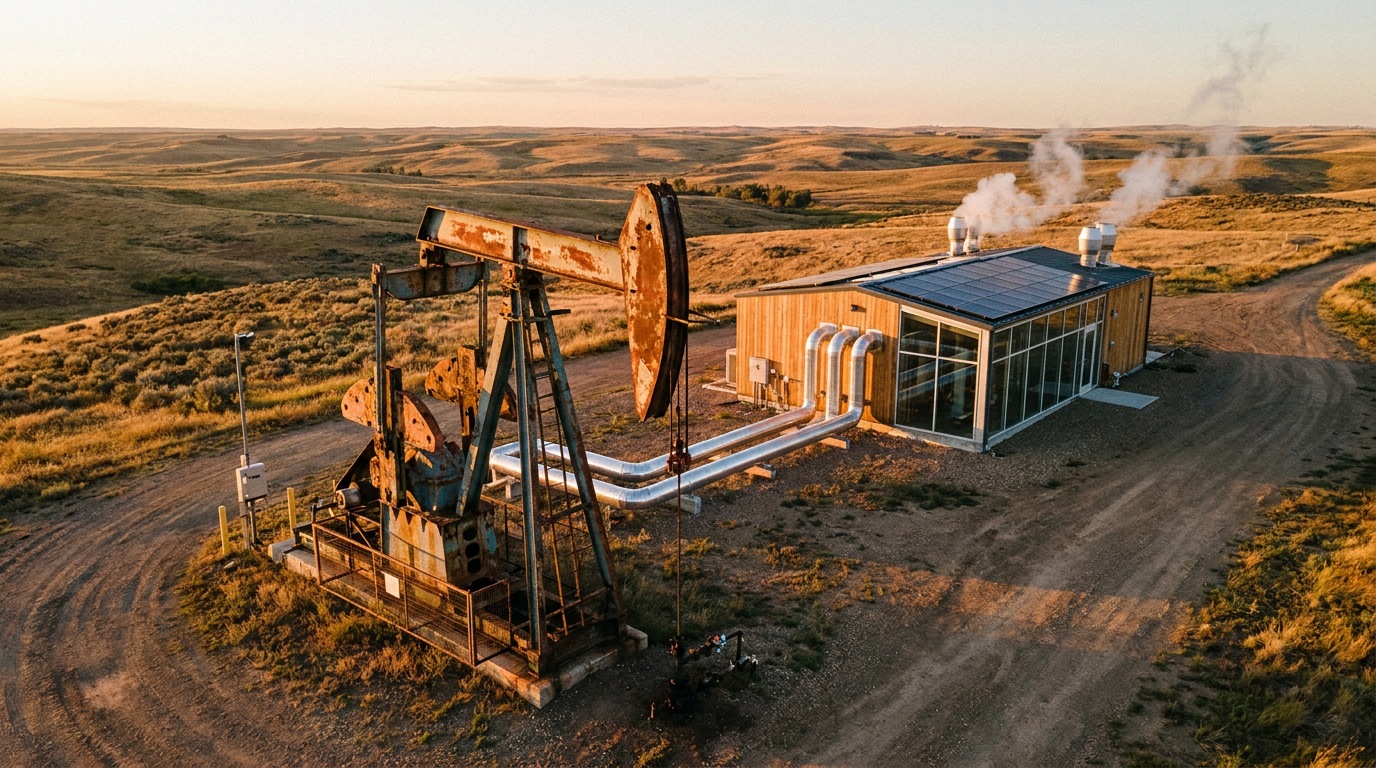
Across the United States, millions of inactive oil and gas wells sit idle, relics of a century of fossil fuel extraction. These abandoned sites are often environmental liabilities, quietly leaking heat-trapping methane into the atmosphere and posing risks of groundwater contamination. For state governments and fossil fuel companies, dealing with this legacy infrastructure is a monumental financial burden. Properly plugging and sealing a single orphaned well can cost anywhere from $75,000 to over $150,000, depending on its depth and condition. With an estimated two to three million disused wells scattered across the country, the total cleanup bill stretches into the hundreds of billions of dollars.[1][2]
But a growing coalition of energy startups, geoscientists, and state policymakers are proposing a radical shift in perspective: what if these costly environmental liabilities are actually half-finished clean energy projects? The concept of repurposing abandoned oil and gas wells for geothermal energy is rapidly gaining traction as a pragmatic bridge between the fossil fuel era and a zero-carbon future. By tapping into the natural heat radiating from the Earth's crust, these pre-drilled holes could provide a consistent, weather-independent source of baseload power that solar and wind simply cannot match.[1][2][6]
The economic logic driving this transition is incredibly compelling for the renewable energy sector. In traditional geothermal energy development, drilling deep into the Earth's subsurface is the single largest financial hurdle, often accounting for more than half of a project's total capital expenditure and carrying significant exploration risk. By utilizing existing wellbores that already reach depths of two to three kilometers, geothermal developers can bypass the most expensive and risky phase of construction entirely. Industry analysts estimate that this infrastructure reuse could theoretically unlock up to 34 gigawatts of global geothermal electricity capacity by 2030, fundamentally altering the economics of the sector.[2][4]

Extracting this subterranean heat relies on a few distinct technological approaches, the simplest of which is known as co-production. Toward the end of their economic lifespan, many mature oil wells produce significantly more water than hydrocarbons—sometimes yielding up to 98 percent hot water and only 2 percent oil. Historically, operators treated this hot fluid as a costly waste byproduct that had to be carefully managed and disposed of. Today, engineers can route that exact same fluid through surface heat exchangers to capture its thermal energy before reinjecting the cooled water back into the reservoir, turning a waste stream into a revenue stream.[2][4]
However, directly producing formation fluids from deep underground can lead to severe scaling, equipment corrosion, and the need for continuous, expensive chemical treatments. To circumvent these operational issues, the geothermal industry is increasingly turning to Closed-Loop Geothermal (CLG) systems, which are also referred to as wellbore heat exchangers. In this advanced setup, a specialized tube-in-tube coaxial pipe is inserted directly down the existing steel well casing. A working fluid, such as water or a specialized refrigerant, is pumped down the outer ring of the pipe, absorbing ambient heat from the surrounding rock as it descends deep into the earth.[4][5]
Once the working fluid reaches the hot bottom of the wellbore, it reverses course and travels back up the insulated inner tube to the surface, retaining its newly acquired thermal energy. Because the system is entirely closed-loop, the working fluid never physically touches the reservoir rock or mixes with the naturally occurring underground brine. This elegant design eliminates the risk of groundwater contamination, conserves local water resources, and maintains the natural pressure of the geologic formation, making it an exceptionally environmentally benign method of continuous heat extraction.[4][5]

Because the system is entirely closed-loop, the working fluid never physically touches the reservoir rock or mixes with the naturally occurring underground brine.
Transforming this captured heat into usable electricity requires specialized surface equipment, particularly when dealing with the moderate temperatures typical of exhausted oil fields. Most repurposed hydrocarbon wells offer bottom-hole temperatures between 40 and 70 degrees Celsius. While this is not nearly hot enough to generate the high-pressure steam used in conventional geothermal power plants, it is perfectly sufficient to drive an Organic Rankine Cycle (ORC) engine. In an ORC system, the geothermal heat is transferred to a secondary fluid—like isobutane—which has a much lower boiling point than water. The isobutane flashes into vapor at these lower temperatures, spinning a turbine to generate zero-emission electricity.[2][5]
Several innovative startups are aggressively moving this technology from theoretical academic models to real-world commercial deployment. Gradient Geothermal, a US-based clean energy company, is currently demonstrating how disused wells can be transformed into active, profitable power producers. In Pierce, Colorado, the company is retrofitting wells that had been abandoned for years, utilizing their proprietary organic Rankine cycle sleds to capture waste heat and convert it into usable electricity for the local grid. Their internal models suggest that out of the millions of idle wells in the United States, over 500,000 possess the right depth and thermal profiles to be suitable for geothermal conversion.[2]
Similar momentum is rapidly building at the state and policy levels as governments look for creative ways to manage their orphaned well crises. In Oklahoma, a state grappling with over 20,000 identified orphan wells, legislators recently advanced the Well Repurposing Act to create a clear legal framework for companies to acquire and convert these sites. Concurrently, researchers at the University of Oklahoma secured federal funding to retrofit four old oil wells in the city of Tuttle. Rather than generating electricity, the Tuttle project aims to pipe the extracted thermal energy directly into local public schools and homes, providing clean, affordable heating during the winter months.[1]

This direct-use application of geothermal heat is often the most efficient and economically viable path for older, shallower wells. When subsurface temperatures fall short of the thermodynamic threshold needed for electricity generation, the raw heat can still be highly valuable for district heating networks, industrial crop drying, greenhouse agriculture, and large-scale aquaculture. By replacing the natural gas, propane, or heating oil typically used for these thermal processes, direct-use geothermal systems offer immediate and highly localized carbon emission reductions, fundamentally decarbonizing the heating sector of nearby communities.[2][4][6]
Despite the immense promise of this technological pivot, significant technical and regulatory hurdles remain before it can be scaled globally. Not every abandoned well is a viable candidate for a second life. A recently concluded European Union initiative, the TRANSGEO project, meticulously evaluated the repurposing potential of thousands of deep boreholes across Germany, Austria, and Central Europe. The researchers found that many older wells suffered from degraded steel casing integrity, inadequate cement sealing, or were situated in areas completely lacking nearby heat demand. Ultimately, they estimated that only 1 to 10 percent of the existing borehole inventory might be technically and economically feasible for conversion.[3]

Furthermore, the legal landscape surrounding well ownership and environmental liability is notoriously complex and varies wildly by jurisdiction. Transferring an orphaned well from a bankrupt fossil fuel operator to a renewable energy developer requires crystal-clear regulatory guidelines to ensure the new operator is not unfairly burdened with the environmental liabilities of the previous owner's historical oil spills or methane leaks. State and federal agencies are only just beginning to draft the necessary frameworks to facilitate these asset transfers safely and legally.[1][6]
Beyond the hardware and the subterranean heat, the geothermal transition offers a profound human benefit: it provides a seamless, dignified pivot for the existing energy workforce. The core skills required to drill, case, and manage a deep geothermal well are nearly identical to those used in the oil and gas sector. By repurposing the physical infrastructure of the fossil fuel era, the industry can simultaneously repurpose its human capital, ensuring that drilling engineers, roughnecks, and geoscientists have lucrative, sustainable careers building the clean energy economy.[1][6]
How we got here
Early 2010s
Academic researchers begin publishing feasibility studies on extracting geothermal heat from depleted hydrocarbon reservoirs.
2019
GreenFire Energy successfully field-tests its closed-loop wellbore heat exchanger technology at the Coso geothermal field.
2023
The European Union launches the TRANSGEO project to evaluate the repurposing potential of thousands of deep boreholes across Central Europe.
Spring 2026
Oklahoma advances the Well Repurposing Act to create a legal framework for converting the state's 20,000 orphan wells into geothermal assets.
Viewpoints in depth
Geothermal Innovators
Startups and engineers focused on the massive scalable potential of closed-loop systems.
This camp views the millions of abandoned wells not as liabilities, but as the largest untapped clean energy resource on the planet. By utilizing advanced closed-loop heat exchangers and Organic Rankine Cycle engines, they argue that the geothermal industry can bypass its biggest historical bottleneck: the exorbitant cost of exploratory drilling. Companies in this space emphasize that even low-temperature wells can be bundled together to provide gigawatts of reliable, 24/7 baseload power, fundamentally altering the renewable energy landscape.
Environmental & Policy Advocates
Groups focused on mitigating methane leaks and groundwater pollution while generating clean energy.
For environmental advocates, the primary appeal of well repurposing is remediation. Orphaned wells are notorious for leaking methane—a potent greenhouse gas—and contaminating local aquifers. This camp argues that incentivizing geothermal companies to take over these sites solves two crises at once: it safely seals and monitors dangerous legacy infrastructure, and it provides zero-emission heating and electricity to local communities. They advocate for streamlined regulatory frameworks that allow these transfers without absolving the original fossil fuel companies of their historical pollution liabilities.
Geoscience Researchers
Academics and geologists focused on the technical constraints and realistic viability of well conversion.
While optimistic about the technology, researchers urge caution regarding the actual scale of the opportunity. Studies from initiatives like the European TRANSGEO project highlight that the vast majority of abandoned wells suffer from degraded steel casing, poor cement jobs, or are located in geological zones with insufficient heat flow. This camp emphasizes that rigorous, well-by-well integrity testing is required, and they project that only a small fraction—perhaps 1 to 10 percent—of global wells will ultimately prove both technically safe and economically viable for commercial power generation.
Energy Transition Analysts
Industry observers focused on the economic second-life of assets and workforce continuity.
Analysts view well repurposing as the ultimate 'just transition' for the fossil fuel workforce. The exact skills required to operate a geothermal well—drilling, casing, reservoir engineering, and fluid dynamics—are identical to those used in oil and gas extraction. This perspective highlights that repurposing infrastructure allows oil companies to pivot their business models and retain their highly skilled workers, turning a declining extractive industry into a sustainable, long-term thermal management sector.
What we don't know
- Exactly how many of the world's millions of abandoned wells have sufficient casing integrity to safely support high-pressure closed-loop systems.
- How state and federal courts will ultimately assign liability if a repurposed well begins leaking historical fossil fuel contaminants.
- Whether the cost of retrofitting older, degraded wells will ultimately exceed the cost of drilling new, purpose-built geothermal wells in certain geologies.
Key terms
- Orphaned well
- An inactive oil or gas well that has no solvent owner of record, leaving the state responsible for its cleanup and plugging.
- Closed-Loop Geothermal (CLG)
- A system where a working fluid circulates underground in sealed pipes to absorb heat without ever touching the surrounding rock or groundwater.
- Organic Rankine Cycle (ORC)
- A power generation process that uses a fluid with a lower boiling point than water to create vapor and drive a turbine at moderate temperatures.
- Baseload power
- The minimum amount of electric power needed to be supplied to the electrical grid at any given time, requiring consistent, 24/7 generation.
- Working fluid
- A liquid or gas, such as isobutane or specialized refrigerants, used to absorb and transfer heat within a mechanical or thermodynamic system.
Frequently asked
Can any abandoned oil well be used for geothermal energy?
No. Wells must have intact casing, sufficient depth, and adequate bottom-hole temperatures. Researchers estimate only 1% to 10% of existing wells meet all technical and economic criteria.
Does this process cause earthquakes like fracking?
No. Closed-loop geothermal systems only circulate fluid within sealed pipes to extract heat. They do not inject high-pressure wastewater into the rock, which is the primary cause of induced seismicity.
How hot does the water need to be to generate electricity?
While traditional geothermal requires temperatures above 150°C, modern Organic Rankine Cycle engines can generate electricity from repurposed wells with temperatures as low as 40°C to 70°C.
Who pays for the conversion of these wells?
Currently, a mix of private geothermal startups, venture capital, and federal grants fund these projects, though new state laws are being drafted to incentivize private investment.
Sources
Source coverage
6 outlets
4 viewpoints surfaced






[1]Canary MediaEnvironmental & Policy Advocates
Can abandoned oil wells be tapped for geothermal power?
Read on Canary Media →[2]Clean Power HourGeothermal Innovators
Repurposing Oil & Gas Wells for Geothermal Energy with Gradient Geothermal
Read on Clean Power Hour →[3]ThinkGeoEnergyGeoscience Researchers
TRANSGEO project concludes with insights on repurposing oil wells
Read on ThinkGeoEnergy →[4]ResearchGateGeothermal Innovators
Geothermal Energy Production from Abandoned Oil and Gas Wells
Read on ResearchGate →[5]ASCE LibraryGeoscience Researchers
Utilization of existing hydrocarbon wells for geothermal system development
Read on ASCE Library →[6]Factlen Editorial TeamEnergy Transition Analysts
Synthesis by Factlen editorial team
Read on Factlen Editorial Team →
Every angle. Every day.
Get energy stories with full source coverage and perspective breakdowns delivered to your inbox.