
How Enhanced Geothermal Systems Are Unlocking Clean Baseload Power
By adapting oil and gas drilling techniques, next-generation geothermal projects are creating artificial underground reservoirs to deliver 24/7 carbon-free electricity. With major facilities coming online in 2026, the technology promises to solve the grid's reliance on intermittent solar and wind.
By Factlen Editorial Team
- Geothermal Developers
- Focused on scaling EGS technology to provide commercial 24/7 clean energy.
- Subsurface Scientists
- Focused on the engineering challenges of extreme heat and seismic monitoring.
- Energy Policy Analysts
- Focused on regulatory support, grid integration, and workforce transition.
What's not represented
- · Local communities near drilling sites
- · Natural gas peaker plant operators
Why this matters
Solar and wind power are cheap but intermittent, forcing grids to rely on natural gas when the sun sets. Enhanced geothermal provides a massive, scalable source of 24/7 clean energy that can stabilize the grid, power AI data centers, and offer a direct job transition for fossil fuel workers.
Key points
- Next-generation geothermal uses oil and gas drilling techniques to create artificial reservoirs, decoupling the technology from natural hot springs.
- Fervo Energy's Cape Station in Utah is set to deliver 100 megawatts of clean baseload power by late 2026.
- The technology provides 24/7 firm electricity, making it highly attractive to tech companies powering AI data centers.
- The U.S. Department of Energy and bipartisan legislation are heavily funding research to reach 'superhot' temperatures for even greater efficiency.
The transition to clean energy has a massive, glaring vulnerability: the sun sets, and the wind stops blowing. To keep the grid stable without burning fossil fuels, the world needs "baseload" power—electricity that flows continuously, 24 hours a day.[1]
For decades, the solution has been either nuclear power, which is notoriously slow and expensive to build, or massive battery arrays, which only store a few hours of energy. But a third option is rapidly moving from a fringe science experiment to commercial reality: next-generation geothermal energy.[3][9]
Beneath our feet lies a virtually inexhaustible battery. The Earth's core burns at temperatures exceeding 5,000 degrees Celsius, radiating heat outward through the crust. Yet, despite this immense potential, geothermal energy currently accounts for less than 1% of global electricity generation.[1][4]
The limitation has always been geography. Conventional geothermal plants require a rare geological trifecta: hot rock, natural underground reservoirs of water, and permeable rock that allows that water to flow to the surface as steam. If a region lacks those natural hot springs, it cannot generate power.[1][3]

That geographic lottery is ending. A breakthrough technology known as Enhanced Geothermal Systems (EGS) is decoupling geothermal power from natural hydrothermal conditions. Instead of hunting for natural reservoirs, EGS engineers are building their own.[1][4]
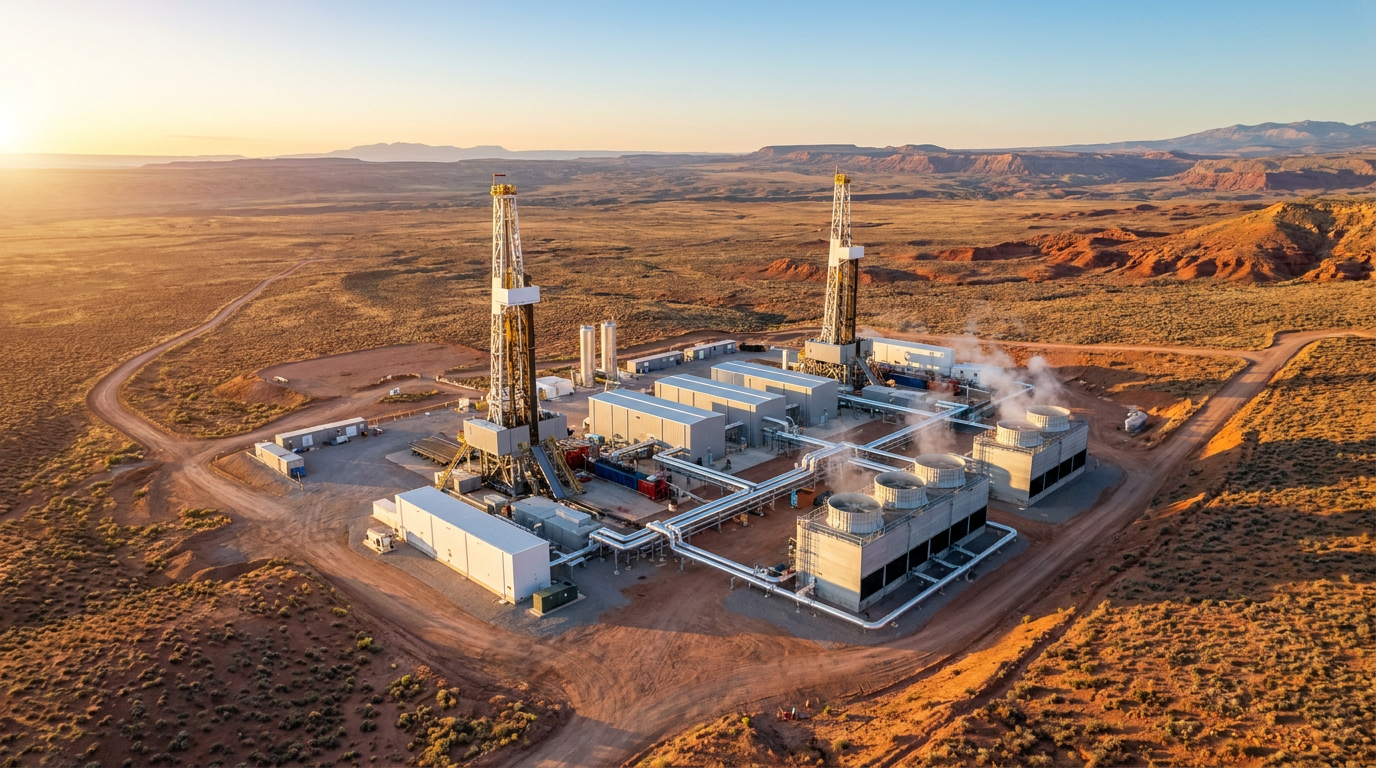
The mechanism borrows directly from the oil and gas industry's shale revolution. Using advanced horizontal drilling, engineers bore thousands of feet into hot, dry, impermeable rock. They then inject high-pressure fluids to create a network of artificial fractures—a process similar to hydraulic fracturing.[1][3][7]
Once the fracture network is established, cold water is pumped down an injection well. The water flows through the artificial cracks, absorbing the intense heat of the surrounding rock, and is drawn back up a production well as superheated fluid to spin a turbine.[1][4]
The undisputed leader in this space is Fervo Energy. In Beaver County, Utah, the Houston-based startup is constructing Cape Station, the world's largest commercial EGS facility. By late 2026, the project's first phase is slated to deliver 100 megawatts of clean, firm power to the grid.[7]
Fervo's rapid progress is backed by massive capital. In late 2025, the company closed a $462 million Series E funding round, followed by a $421 million project financing deal in early 2026. Tech giants like Google are not just investing; they are signing long-term power purchase agreements to fuel their increasingly energy-hungry data centers.[7]

In late 2025, the company closed a $462 million Series E funding round, followed by a $421 million project financing deal in early 2026.
The implications for the U.S. grid are staggering. The Department of Energy and industry analysts estimate that widespread deployment of EGS could unlock up to 150 gigawatts of reliable clean energy in the United States alone—roughly equivalent to the output of 150 nuclear reactors.[3][8]
The transition is also creating a seamless off-ramp for fossil fuel workers. The skills required to drill an EGS well are nearly identical to those used in oil and gas extraction. Rig operators, petroleum engineers, and roughnecks are finding that their expertise is directly transferable to the clean energy economy.[3]
However, engineering the subsurface is not without risks. Creating artificial fractures generates microseismic events—tiny earthquakes. While these are typically too small to be felt at the surface, managing induced seismicity is critical for public acceptance and operational safety.[5]
To monitor this, scientists from the Lawrence Berkeley National Laboratory recently achieved a major breakthrough. They deployed a custom-built seismometer nearly 7,000 feet underground at Cape Station, continuously monitoring the rock for seven months at temperatures reaching 338°F. This unprecedented data allows operators to map the fracture networks safely and precisely.[5]

The next frontier is even hotter. Researchers are now targeting "superhot rock" geothermal, drilling deeper to reach temperatures approaching 400°C. At these extremes, water enters a "supercritical" state, holding exponentially more energy than standard steam.[2][4]
Tapping supercritical water could drastically reduce the number of wells needed to generate power, slashing costs. But it presents brutal engineering challenges. Standard drill bits melt, electronics fry, and the chemistry of the circulating fluids becomes highly corrosive.[4]
To overcome these hurdles, the U.S. Department of Energy is pouring hundreds of millions of dollars into demonstration projects, including the Frontier Observatory for Research in Geothermal Energy (FORGE) in Utah, located right next door to Fervo's Cape Station.[2][8]

Lawmakers are also stepping in. The bipartisan Next-Generation Geothermal Research and Development Act aims to expand field testing for superhot rock technologies, providing the public support necessary to push these systems toward commercial viability.[2]
State-level policy is pulling the demand side. California regulators have issued procurement orders requiring utilities to buy gigawatts of "clean, firm" power, explicitly carving out a market for geothermal to compete against natural gas peaker plants.[6]
How we got here
1960
The Geysers, the first large-scale commercial geothermal plant in the U.S., begins operation in California.
2015
The U.S. Department of Energy launches the FORGE initiative to accelerate EGS research and testing.
2023
Fervo Energy successfully completes a commercial pilot of its EGS technology in Nevada, proving the concept.
Late 2025
Fervo raises $462 million in Series E funding to accelerate construction of its massive Cape Station project.
Early 2026
Lawrence Berkeley National Lab achieves a breakthrough in continuous high-temperature seismic monitoring at Cape Station.
Late 2026
Cape Station Phase 1 is scheduled to come online, delivering 100 MW of clean baseload power to the grid.
Viewpoints in depth
Geothermal Developers & Tech Buyers
Focus on rapid scaling, commercial viability, and powering the AI boom.
Companies like Fervo Energy and their major backers, including Google, argue that EGS is the missing piece of the clean energy transition. They emphasize that by adapting proven oil and gas drilling techniques, geothermal can rapidly scale to meet the surging, round-the-clock energy demands of data centers and heavy industry without relying on fossil fuels.
Subsurface Scientists & Engineers
Focus on the technical hurdles of extreme environments and seismic safety.
Researchers at institutions like MIT and the Lawrence Berkeley National Laboratory view EGS as a massive scientific opportunity that still faces brutal engineering challenges. They focus on the need for advanced materials that can survive "superhot" temperatures, the complexities of mapping artificial fractures thousands of feet underground, and the critical importance of safely managing induced seismicity.
Energy Policy Analysts
Focus on regulatory frameworks, grid integration, and workforce transition.
Policy experts from organizations like the Clean Air Task Force and WRI argue that technology alone won't scale geothermal. They advocate for streamlined permitting on federal lands, targeted tax incentives, and state-level procurement mandates. They also highlight EGS as a unique socio-economic bridge, offering a direct transition for fossil fuel workers whose drilling skills are perfectly suited for the geothermal industry.
What we don't know
- Whether the extreme engineering challenges of 'superhot rock' geothermal can be solved economically.
- How quickly the supply chain for specialized high-temperature drilling equipment can scale to meet projected demand.
- The long-term degradation rate of artificial fracture networks over decades of continuous operation.
Key terms
- Enhanced Geothermal Systems (EGS)
- A technology that creates artificial underground reservoirs by fracturing hot, dry rock, allowing water to circulate and absorb heat for power generation.
- Baseload Power
- The minimum amount of electrical power needed to meet the continuous demands of the grid at any given time, traditionally supplied by coal, gas, or nuclear plants.
- Supercritical Water
- Water that has been heated and pressurized beyond its critical point, causing it to behave as both a gas and a liquid, capable of carrying significantly more energy.
- Induced Seismicity
- Minor earthquakes or tremors caused by human activity, such as injecting fluids deep underground to fracture rock.
- Capacity Factor
- The ratio of a power plant's actual electrical output over a period of time to its maximum potential output; geothermal plants typically have very high capacity factors.
Frequently asked
What is the difference between conventional and enhanced geothermal?
Conventional geothermal relies on naturally occurring underground reservoirs of hot water. Enhanced Geothermal Systems (EGS) create artificial reservoirs by injecting fluid into hot, dry rock to fracture it, allowing geothermal power to be generated almost anywhere.
Does EGS cause earthquakes?
The process of fracturing the rock does create microseismic events, but these are typically too small to be felt at the surface. Operators use advanced deep-well seismometers to monitor and safely manage the fracture process.
Why are tech companies investing in geothermal?
Tech giants like Google need massive amounts of electricity to power AI data centers. Because geothermal provides continuous, 24/7 "baseload" power, it can run data centers around the clock without the carbon emissions of natural gas or the intermittency of solar and wind.
Sources
Source coverage
9 outlets
3 viewpoints surfaced









[1]VallourecEnergy Policy Analysts
How Next-Generation Geothermal Is Redefining Clean Baseload Power
Read on Vallourec →[2]Clean Air Task ForceEnergy Policy Analysts
How the Next-Generation Geothermal Research and Development Act advances superhot rock geothermal
Read on Clean Air Task Force →[3]Center for Climate and Energy SolutionsEnergy Policy Analysts
New Report: How Next-Generation Geothermal Energy Can Meet New Demands with Clean, Firm Electricity
Read on Center for Climate and Energy Solutions →[4]MIT NewsSubsurface Scientists
Next-generation geothermal energy: Promise, progress, and challenges
Read on MIT News →[5]Lawrence Berkeley National LaboratorySubsurface Scientists
Scientists Develop New Technology to Continuously Monitor Geothermal Energy Operations
Read on Lawrence Berkeley National Laboratory →[6]World Resources InstituteEnergy Policy Analysts
As Geothermal Heats Up in US States, Key Policy Levers Can Advance Its Next Generation
Read on World Resources Institute →[7]Canary MediaGeothermal Developers
Fervo nabs $462M to complete massive next-gen geothermal project
Read on Canary Media →[8]U.S. Department of EnergySubsurface Scientists
Enhanced Geothermal Systems Demonstration Projects
Read on U.S. Department of Energy →[9]Factlen Editorial TeamGeothermal Developers
Synthesis by Factlen editorial team
Read on Factlen Editorial Team →
Every angle. Every day.
Get energy stories with full source coverage and perspective breakdowns delivered to your inbox.