
The Fourth Amendment in the Digital Age: How the Constitution Protects Your Smartphone
As technology outpaces traditional law, the US Supreme Court has established new constitutional boundaries to protect digital privacy. Here is how the Fourth Amendment applies to the data in your pocket.
By Factlen Editorial Team
- Civil Liberties Advocates
- Argue for expansive Fourth Amendment protections for all digital data, emphasizing that modern life requires digital participation.
- Law Enforcement & Prosecutors
- Emphasize the need for practical investigative tools to solve crimes and argue that traditional doctrines should still apply to corporate-held data.
- Originalist Legal Scholars
- Focus on tying digital data protections to traditional property rights and common-law trespass concepts rather than subjective expectations of privacy.
What's not represented
- · Technology Companies
- · Victims' Rights Advocates
Why this matters
Your smartphone contains a near-perfect record of your daily life, from your banking details to your physical movements. Understanding how the Constitution protects this data empowers you to navigate the digital world knowing your fundamental rights remain intact.
Key points
- The Fourth Amendment protects against unreasonable searches and seizures, but applying it to digital data required a massive legal shift.
- In 2014, the Supreme Court ruled that police must obtain a warrant to search a smartphone incident to an arrest.
- In 2018, the Court ruled that the government also needs a warrant to access historical cell phone location data from wireless carriers.
- The Court recognized that carrying a smartphone is indispensable to modern life, limiting the traditional Third-Party Doctrine.
- Legal battles continue over the constitutionality of geofence warrants and warrantless electronic searches at international borders.
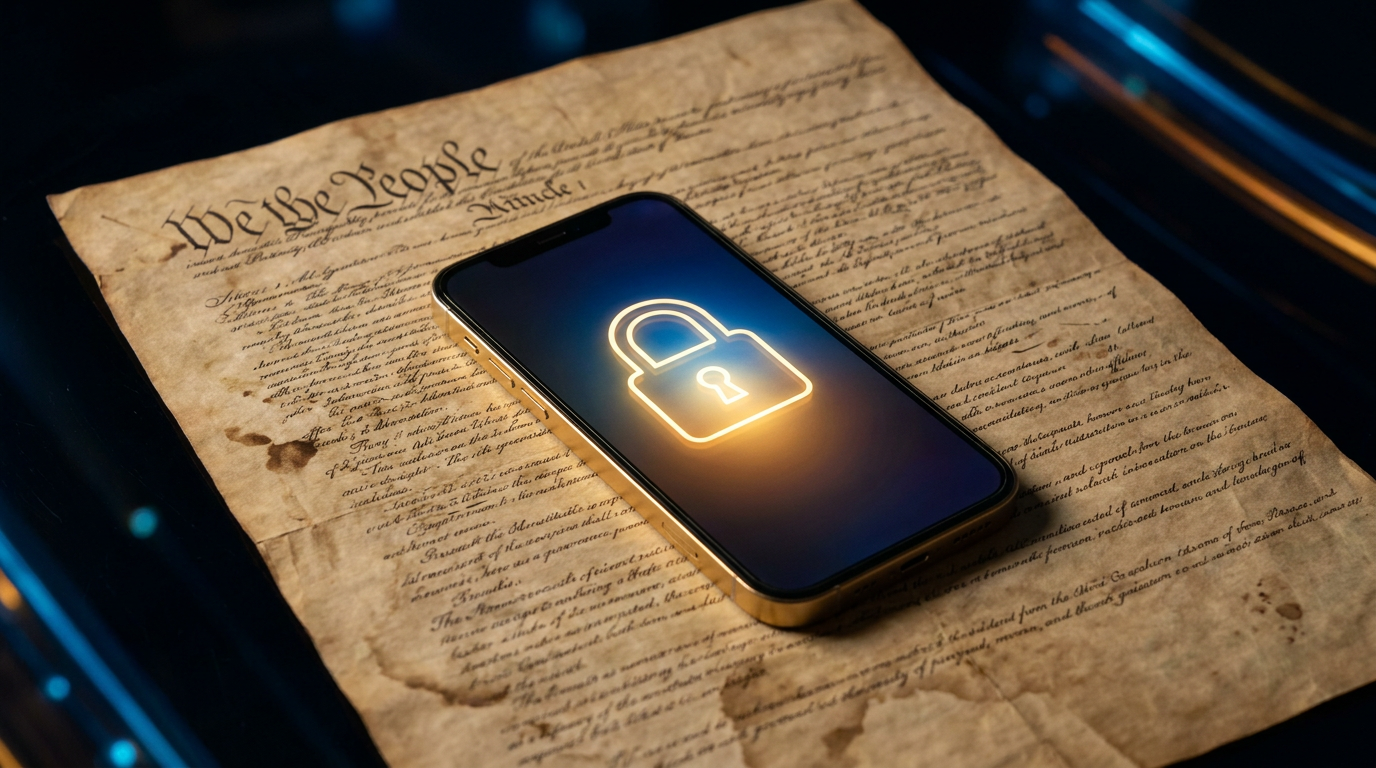
The Fourth Amendment to the United States Constitution was drafted in an era of quill pens and physical lockboxes. It guarantees the right of the people to be secure in their "persons, houses, papers, and effects" against unreasonable searches and seizures. For over two centuries, courts applied this protection to physical spaces: a home, a car trunk, or a filing cabinet. But the invention of the smartphone fundamentally fractured this physical framework. Today, a single device in a person's pocket holds more intimate information than a house full of physical records, containing gigabytes of emails, photographs, banking details, and real-time location history.[1][2]
As digital technology advanced, law enforcement agencies rapidly integrated electronic surveillance into their investigative toolkits. Because early digital data did not fit neatly into the constitutional definition of a physical "effect," courts initially struggled to determine when police needed a warrant to access it. Mechanically applying 18th-century property rules to 21st-century technology threatened to grant the government unprecedented surveillance power simply due to the coincidences of computer design. This tension forced the US Supreme Court to embark on a massive constitutional equilibrium adjustment, redefining privacy for the digital age.[2][7]
The foundation for modern digital privacy was actually laid in 1967 with Katz v. United States. In that case, the Supreme Court ruled that the government could not place a warrantless wiretap on a public telephone booth. The Court established that the Fourth Amendment "protects people, not places," introducing the "reasonable expectation of privacy" test. Under this standard, if a person has a subjective expectation of privacy that society recognizes as reasonable, the government must obtain a warrant supported by probable cause to conduct a search.[1]

The first major smartphone-era test of this standard arrived in 2014 with Riley v. California. Historically, police were permitted to conduct a warrantless "search incident to arrest," allowing them to inspect a suspect's pockets to ensure officer safety and prevent the destruction of evidence. When police arrested David Riley, they searched his smartphone without a warrant and used the digital contents to tie him to a gang shooting. The government argued that searching a phone was no different than searching a physical wallet found on an arrestee.[1][3][7]
In a unanimous and sweeping decision, the Supreme Court rejected the government's argument. Chief Justice John Roberts wrote that comparing a modern smartphone to a physical wallet was "like saying a ride on horseback is materially indistinguishable from a flight to the moon." The Court ruled that because cell phones are "such a pervasive and insistent part of daily life that the proverbial visitor from Mars might conclude they were an important feature of human anatomy," police must obtain a warrant to search the digital contents of a phone seized during an arrest.[4][7]
In a unanimous and sweeping decision, the Supreme Court rejected the government's argument.
While Riley protected the data stored on the device, a massive loophole remained for the data the device transmits. Since the 1970s, the Supreme Court had relied on the "Third-Party Doctrine," which states that individuals have no reasonable expectation of privacy in information they voluntarily hand over to third parties, such as bank records or dialed phone numbers. For decades, law enforcement used this doctrine to argue that because cell phones constantly transmit data to wireless carriers, users voluntarily surrender their privacy rights to that data.[2][5]
This doctrine collided with modern technology in the 2018 case Carpenter v. United States. Police suspected Timothy Carpenter of orchestrating a string of armed robberies. Without obtaining a warrant, prosecutors used the Stored Communications Act to compel Carpenter's wireless carriers to hand over his Cell-Site Location Information (CSLI). The carriers provided 127 days of location data, comprising nearly 13,000 distinct data points that tracked Carpenter's movements with precision, placing him near the scenes of the crimes.[5]

In a landmark 5-4 decision, the Supreme Court ruled that the government's acquisition of Carpenter's location records constituted a search under the Fourth Amendment, requiring a warrant. The Court recognized that historical cell-site records provide the government with "near-perfect surveillance," allowing them to travel back in time to retrace a person's whereabouts, including visits to doctors, churches, and political rallies. The ruling marked a profound shift in constitutional law, acknowledging that digital tracking is fundamentally different from traditional physical surveillance.[2][4]
Crucially, the Carpenter decision explicitly limited the Third-Party Doctrine. The Court noted that carrying a smartphone is indispensable to participation in modern society. Because a phone logs its location automatically by simply being powered on and connecting to nearby towers, the Court concluded that users do not "voluntarily" convey their location in any meaningful sense. This distinction established that Americans do not forfeit their constitutional rights simply by owning modern technology.[3][4]

Despite these sweeping protections, the boundaries of the digital Fourth Amendment remain highly contested. Law enforcement agencies have increasingly turned to "geofence warrants," which compel tech companies like Google to identify every device present within a specific geographic area during a certain timeframe. In cases like Chatrie v. United States, courts are currently grappling with whether these reverse-location searches violate the Fourth Amendment by sweeping up the data of countless innocent bystanders without individualized probable cause.[6]
Another unresolved frontier involves international borders. The government has long maintained broad authority to conduct warrantless searches at border crossings and airports. Civil liberties organizations argue that the logic of Riley and Carpenter should apply equally at the border, requiring agents to obtain warrants before downloading the contents of a traveler's laptop or phone. Additionally, courts remain divided on whether the government can legally compel a suspect to unlock their device using biometric data, such as a fingerprint or facial recognition.[3][7]

The evolution of the Fourth Amendment demonstrates the Constitution's capacity to adapt to unimaginable technological shifts. By requiring warrants for smartphone searches and location tracking, the judiciary has re-established the balance of power between the individual and the state. As wearable devices, smart cars, and biometric databases become ubiquitous, the principles established in Riley and Carpenter will serve as the constitutional bedrock, ensuring that the fundamental right to privacy survives the digital transition.[2]
How we got here
1791
The Fourth Amendment is ratified, protecting 'persons, houses, papers, and effects' from unreasonable searches.
1967
The Supreme Court establishes the 'reasonable expectation of privacy' test in Katz v. United States.
1979
The Court establishes the Third-Party Doctrine in Smith v. Maryland, limiting privacy for shared information.
2014
The Supreme Court rules in Riley v. California that police need a warrant to search a smartphone incident to arrest.
2018
The Supreme Court rules in Carpenter v. United States that the government needs a warrant to access historical cell phone location data.
Viewpoints in depth
Civil Liberties Advocates
Privacy organizations argue that the Fourth Amendment must be interpreted expansively to protect all digital data.
Groups like the ACLU and the Electronic Privacy Information Center (EPIC) argue that the sheer volume and intimate nature of digital data require strict warrant requirements. They contend that participating in modern society necessitates using smartphones, cloud storage, and digital communications, meaning individuals cannot be considered to have 'voluntarily' surrendered their privacy simply by using these essential tools. These advocates are currently pushing courts to extend the logic of the Carpenter decision to ban warrantless border searches of electronics and to strike down geofence warrants.
Law Enforcement
Prosecutors and police emphasize the need for practical investigative tools to solve complex crimes.
Law enforcement agencies argue that while privacy is important, the government must retain the ability to investigate crimes effectively in the digital age. They frequently rely on the Third-Party Doctrine, arguing that when a suspect uses a corporate service—like a cellular network or a tech platform—the resulting business records belong to the company, not the suspect. From this perspective, requiring a warrant for every piece of digital evidence severely hampers investigations into organized crime, terrorism, and serial offenses.
Originalist Legal Scholars
Conservative legal scholars focus on tying digital protections to traditional property rights rather than subjective privacy expectations.
Many originalist scholars and judges criticize the 'reasonable expectation of privacy' test as too subjective and prone to shifting societal norms. Instead, they argue that digital data should be protected under traditional property law and common-law trespass concepts. In this view, hacking a phone or compelling a company to hand over data is a modern equivalent of trespassing on a person's physical 'papers and effects,' providing a more stable constitutional foundation for digital privacy than the Katz standard.
What we don't know
- Whether the Supreme Court will ultimately rule that geofence warrants violate the Fourth Amendment.
- If border patrol agents will be required to obtain warrants before searching the electronic devices of international travelers.
- Whether police can legally compel a suspect to unlock their smartphone using biometric data like a fingerprint or facial scan.
Key terms
- Fourth Amendment
- The constitutional provision protecting Americans from unreasonable searches and seizures by the government.
- Reasonable Expectation of Privacy
- A legal test establishing that a warrant is required if a person has a subjective expectation of privacy that society deems reasonable.
- Third-Party Doctrine
- A legal principle stating that individuals lose their expectation of privacy for information they voluntarily share with third parties, like banks or phone companies.
- Cell-Site Location Information (CSLI)
- Data generated when a mobile phone connects to a nearby cell tower, which can be used to track a person's movements.
- Geofence Warrant
- A controversial investigative tool that compels tech companies to identify all devices present within a specific geographic area during a given timeframe.
Frequently asked
Can the police search my phone if I am pulled over for speeding?
No. Under the Supreme Court's ruling in Riley v. California, police generally must obtain a warrant to search the digital contents of a smartphone, even during a lawful arrest.
Does the government need a warrant to get my location history from my phone carrier?
Yes. The Carpenter v. United States decision established that police must obtain a warrant supported by probable cause to access historical cell-site location information.
Do border patrol agents need a warrant to search my laptop?
Currently, the law is unsettled. The government claims broad authority to conduct warrantless searches at the border, but civil liberties groups are actively challenging this practice in court.
Sources
Source coverage
7 outlets
3 viewpoints surfaced






[1]Electronic Privacy Information Center (EPIC)Civil Liberties Advocates
The Fourth Amendment and Digital Privacy
Read on Electronic Privacy Information Center (EPIC) →[2]Brennan Center for JusticeCivil Liberties Advocates
The Fourth Amendment in the Digital Age
Read on Brennan Center for Justice →[3]American Civil Liberties Union (ACLU)Civil Liberties Advocates
The Supreme Court's Most Consequential Ruling for Privacy in the Digital Age
Read on American Civil Liberties Union (ACLU) →[4]JustiaOriginalist Legal Scholars
Carpenter v. United States, 585 U.S. ___ (2018)
Read on Justia →[5]Princeton Legal JournalOriginalist Legal Scholars
Carpenter v. United States, the Stored Communications Act, & the Third Party Doctrine
Read on Princeton Legal Journal →[6]Pacific Legal FoundationOriginalist Legal Scholars
Supreme Court urged to restore Fourth Amendment protections for digital data
Read on Pacific Legal Foundation →[7]Factlen Editorial TeamLaw Enforcement & Prosecutors
Synthesis by Factlen editorial team
Read on Factlen Editorial Team →
Every angle. Every day.
Get law justice stories with full source coverage and perspective breakdowns delivered to your inbox.