
Global Green Economy Surpasses $10 Trillion Market Capitalization
The global green economy has reached a record $10 trillion market value, driven by surging revenues in clean technology, energy security, and major corporate consolidation. A new London Stock Exchange Group report reveals the sector is now the world's third-largest industry, outpacing broader equity markets.
By Factlen Editorial Team
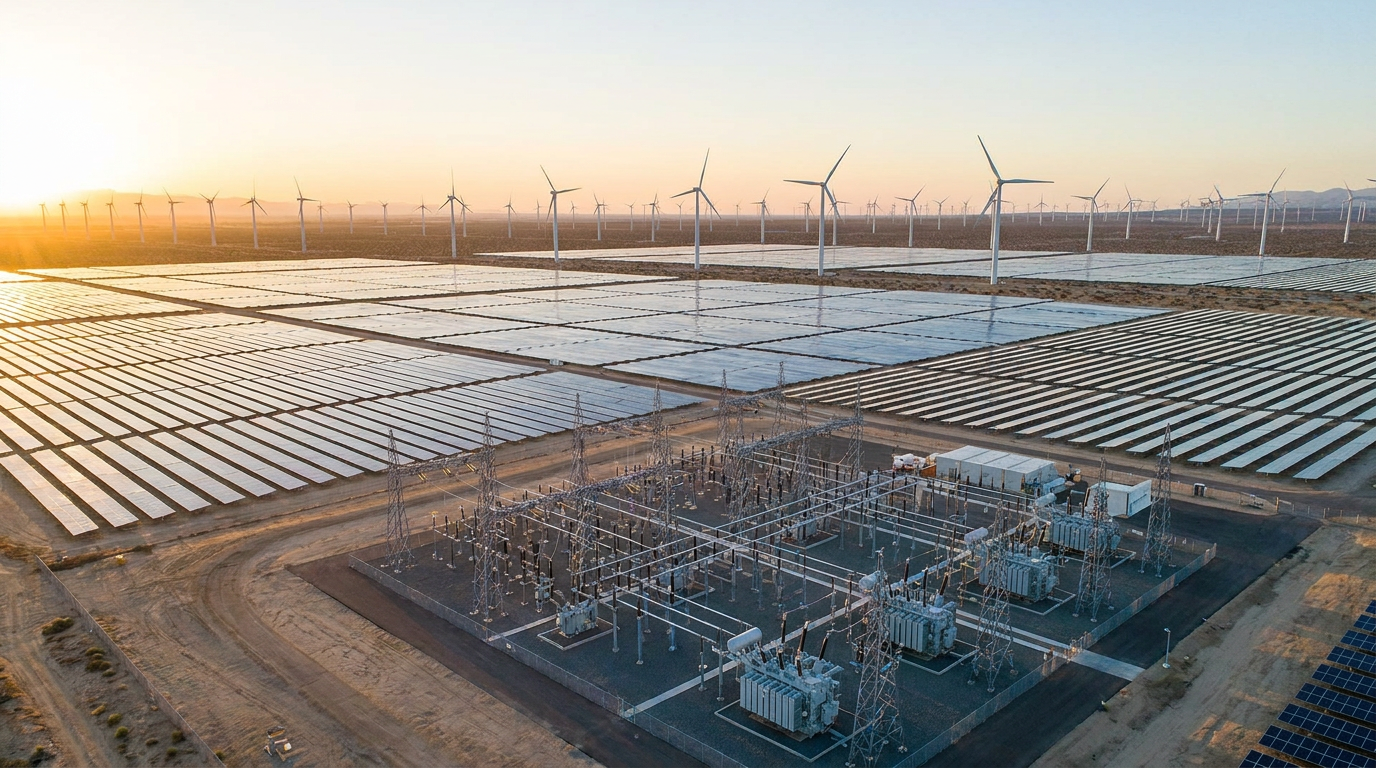
- Sustainable Investors
- Capital allocators focused on the financial outperformance and long-term viability of climate solutions.
- Energy Security Advocates
- Strategists prioritizing domestic supply chains and grid resilience over pure decarbonization.
- Utility Consolidators
- Major power companies leveraging scale to meet unprecedented electricity demand.
What's not represented
- · Fossil Fuel Incumbents
- · Consumer Ratepayers
Why this matters
The milestone signals a structural shift in global markets, proving that climate-focused business lines are now primary drivers of corporate growth and profitability rather than niche initiatives. For investors and workers, the data confirms that the transition to clean energy is increasingly anchored by economic competitiveness and energy security, fundamentally reshaping the industrial landscape.
Key points
- The global green economy has surpassed $10 trillion in market capitalization, according to the London Stock Exchange Group.
- If classified as a standalone sector, it would be the world's third-largest industry, overtaking healthcare.
- Revenues from environmental products and services reached $5.5 trillion, growing at the fastest pace since 2022.
- Companies with high green revenue exposure outperformed the broader equity market by 12.4% over the past year.
- Green-related mergers and acquisitions totaled $4.1 trillion over the past decade, representing 13% of global deal value.
- The sector's growth is increasingly driven by national energy security and economic competitiveness rather than just decarbonization.
The global green economy has officially crossed the $10 trillion threshold in market capitalization, cementing its status as a foundational pillar of global corporate growth. According to a comprehensive report published Wednesday by the London Stock Exchange Group (LSEG), revenue tied to environmental products and services climbed to $5.5 trillion over the past year, expanding at its fastest pace since 2022.[1][2]
To put the scale into perspective, if the green economy were classified as a standalone sector, it would now be the world's third-largest industry. It has officially overtaken healthcare, trailing only the technology and industrial sectors in total market footprint.[2][3]
The LSEG analysis tracked more than 21,000 publicly traded companies globally, evaluating the proportion of their revenues generated from 133 distinct environmental solutions. These range from renewable energy generation and clean water infrastructure to cloud computing efficiency and recycling services.[1][2]

Investors who have backed this transition are seeing tangible rewards. Companies deriving more than 20% of their income from green activities outperformed the broader equity market by 12.4% over the 12 months ending in April 2026.[2][3]
The momentum is starkly visible in benchmark indices. The S&P Global Clean Energy Transition Index has surged more than 80% since the end of 2024, delivering more than double the return of the S&P 500 over the same period.[1][4]

The data also challenges persistent narratives about the financial sacrifices required for sustainability. LSEG found that firms generating more than 50% of their revenues from green activities boast profit margins that are, on average, two to four percentage points higher than their non-green sector peers.[7]
The data also challenges persistent narratives about the financial sacrifices required for sustainability.
Industry analysts point to a fundamental shift in the motivations driving this growth. Jaakko Kooroshy, global head of sustainable investment research at LSEG, noted that the green transition is entering a new phase defined as much by energy security and economic competitiveness as it is by decarbonization.[2][3]
Despite rising geopolitical tensions and fluctuating climate policies in major economies, the sector has proven remarkably resilient. Governments and corporations alike are increasingly viewing clean technology as a strategic imperative to secure domestic supply chains and reduce reliance on volatile fossil fuel markets.[1][7]
Revenue growth was notably broad-based, with 99 of the 133 tracked categories posting gains. Electric vehicles and advanced battery technologies emerged as a particular bright spot, adding $62 billion in new revenue over the past year.[1][3]
The maturation of the green economy is also driving massive corporate consolidation. Mergers and acquisitions have become a critical mechanism for scaling low-carbon technologies, with green-related M&A totaling $4.1 trillion over the past decade—accounting for nearly 13% of total global deal value.[1][2]
This consolidation trend was punctuated in May 2026 by NextEra Energy's blockbuster agreement to acquire Dominion Energy in an all-stock deal valued at approximately $67 billion. The merger is designed to create the world's largest regulated electric utility, explicitly positioned to meet the surging power demands of artificial intelligence data centers.[5][6]

While not a pure-play green company, the combined NextEra-Dominion entity will generate more than $15.9 billion in green-related revenue from wind, solar, nuclear, and battery storage. This represents roughly 36% of the new behemoth's total revenue, illustrating how traditional utilities are aggressively pivoting their portfolios.[1][3]
As electricity demand continues to rise—fueled by the AI boom and the electrification of transport—the capital markets are deepening their support for sustainable infrastructure. Global green bond issuance hit a record $605 billion in 2025, pushing the outstanding volume to $3.3 trillion.[2]
How we got here
2008
LSEG begins tracking and analyzing the global green economy and its revenue exposure.
2022
Green revenue growth experiences a temporary slowdown amid global supply chain disruptions and inflation.
End of 2024
The S&P Global Clean Energy Transition Index begins a massive rally, eventually surging over 80%.
May 18, 2026
NextEra Energy announces a $67 billion acquisition of Dominion Energy to scale its renewable footprint for AI data centers.
June 17, 2026
LSEG publishes its annual report confirming the green economy has surpassed $10 trillion in market capitalization.
Viewpoints in depth
Sustainable Investors
Capital allocators focused on the financial outperformance and long-term viability of climate solutions.
For sustainable investors, the $10 trillion milestone is vindication of a long-held thesis: environmental solutions are not concessionary investments, but rather core drivers of alpha. They point to the 12.4% outperformance of green equities and higher profit margins as proof that the market is actively rewarding companies positioned for the energy transition. This camp argues that as climate risks materialize and energy demand surges, companies lacking a clear green revenue strategy will face severe valuation discounts.
Energy Security Advocates
Policymakers and strategists prioritizing domestic supply chains and grid resilience.
This perspective views the green economy's growth less through the lens of carbon reduction and more as a geopolitical imperative. By investing heavily in domestic renewable generation, advanced batteries, and localized supply chains, nations can insulate themselves from the volatility of global fossil fuel markets. For these advocates, the resilience of green industries despite shifting political winds proves that economic competitiveness and national security have become the primary engines of the transition.
Utility Consolidators
Major power companies leveraging scale to meet unprecedented electricity demand.
Traditional energy providers view the green transition as a massive infrastructure challenge that requires unprecedented scale. Driven by the staggering power requirements of artificial intelligence and data centers, utility giants argue that mega-mergers—like NextEra's $67 billion acquisition of Dominion—are necessary to finance and deploy renewable capacity efficiently. They maintain that only massive, integrated balance sheets can absorb the capital expenditures required to modernize the grid while keeping ratepayer costs manageable.
What we don't know
- How potential changes in U.S. federal climate policy might impact the valuation of domestic green equities.
- Whether the massive utility consolidation trend will face pushback from antitrust regulators or state utility commissions.
- If the rapid growth in AI power demand will outpace the deployment of new renewable generation capacity.
Key terms
- Green Economy
- The aggregate of business lines within publicly listed companies that generate revenue from environmental solutions, such as renewable energy, clean water, and recycling.
- Market Capitalization
- The total dollar market value of a company's outstanding shares of stock, used to measure a company's or sector's size.
- Green Bond
- A fixed-income financial instrument specifically earmarked to raise money for climate and environmental projects.
- Alpha
- A measure of an investment's performance relative to a benchmark index, often used to describe 'excess return'.
Frequently asked
How big is the global green economy?
As of mid-2026, the global green economy has surpassed $10 trillion in market capitalization, making it the equivalent of the world's third-largest industry.
Are green companies profitable?
Yes. Data shows that companies generating more than 50% of their revenues from green activities have profit margins two to four percentage points higher than their non-green peers.
Why did NextEra buy Dominion Energy?
NextEra agreed to acquire Dominion for $67 billion to create a massive utility capable of meeting the surging electricity demands of artificial intelligence data centers, heavily utilizing renewable energy.
What is driving the growth of green industries?
While decarbonization remains a factor, the current growth phase is heavily driven by nations and corporations seeking energy security, supply chain resilience, and economic competitiveness.
Sources
Source coverage
7 outlets
3 viewpoints surfaced







[1]BloombergUtility Consolidators
Green Economy Tops $10 Trillion as Revenue Growth Accelerates
Read on Bloomberg →[2]London Stock Exchange GroupSustainable Investors
Investing in the green economy 2026: Resilience and reacceleration
Read on London Stock Exchange Group →[3]The Business TimesEnergy Security Advocates
Green economy tops US$10 trillion as revenue growth accelerates
Read on The Business Times →[4]FinimizeSustainable Investors
The green economy just hit $10 trillion, and that's a lot of, um, green
Read on Finimize →[5]ForbesUtility Consolidators
NextEra Will Buy Dominion Energy For $67 Billion As AI Spending Accelerates
Read on Forbes →[6]CBS NewsUtility Consolidators
NextEra Energy to acquire Dominion for $67 billion, joining two of the nation's largest utilities
Read on CBS News →[7]Inside Climate NewsEnergy Security Advocates
Green Economy Hits $10 Trillion in Market Value
Read on Inside Climate News →

More in business
See all 6 stories →Creator Economy
The Rise of the Solo Analyst: How Independent Creators Are Building Micro-Media Empires
6 sources

Macro Economy
How the US-Iran Ceasefire is Reshaping Global Markets and Easing Stagflation Fears
7 sources

AI Funding Boom
Anthropic Overtakes OpenAI at $965 Billion Valuation as AI Startup Funding Shatters Records
8 sources

Fusion Energy
Fusion Startup Helion Reaches $15.5 Billion Valuation and Secures First Commercial Licenses
6 sources
Every angle. Every day.
Get business stories with full source coverage and perspective breakdowns delivered to your inbox.