
Fusion Startup Helion Reaches $15.5 Billion Valuation and Secures First Commercial Licenses
Helion Energy has raised $465 million in new funding and received the world's first regulatory licenses to operate a commercial fusion power plant in Washington state. The milestones underscore a rapidly accelerating private race to deliver limitless clean energy to the grid by the end of the decade.
By Factlen Editorial Team
- Commercial Fusion Optimists
- Investors and tech leaders who believe fusion is transitioning from a science experiment to an engineering reality.
- Scientific Skeptics
- Physicists and energy analysts who caution that commercial fusion remains decades away.
- Regulatory Pioneers
- State health and radiation officials establishing the first legal frameworks for fusion power.
What's not represented
- · Local residents in Malaga, Washington, where the commercial plant is being constructed.
- · Traditional utility companies evaluating how to integrate intermittent or novel fusion baseload into the existing grid.
Why this matters
If commercial fusion succeeds, it will fundamentally transform the global economy by providing a nearly limitless, carbon-free source of baseload power. Helion's regulatory approvals and massive valuation signal that financial markets and government agencies are increasingly treating fusion not as a distant science experiment, but as an imminent infrastructure reality.
Key points
- Helion Energy raised $465 million in Series G funding, reaching a $15.5 billion valuation.
- The startup received the world's first commercial operating licenses for a fusion power plant from Washington state.
- Helion is building the 50-megawatt Orion facility in Malaga, Washington, aiming to supply power to Microsoft by 2028.
- The company's Polaris prototype recently achieved plasma temperatures exceeding 150 million degrees Celsius.
- The broader private fusion sector has now attracted over $13 billion in investment across 17 major startups.
The race to harness the power of the stars has crossed a major financial and regulatory threshold. Helion Energy, a Washington-based nuclear fusion startup, has closed a $465 million Series G funding round that catapults its valuation to $15.5 billion.[1][6]
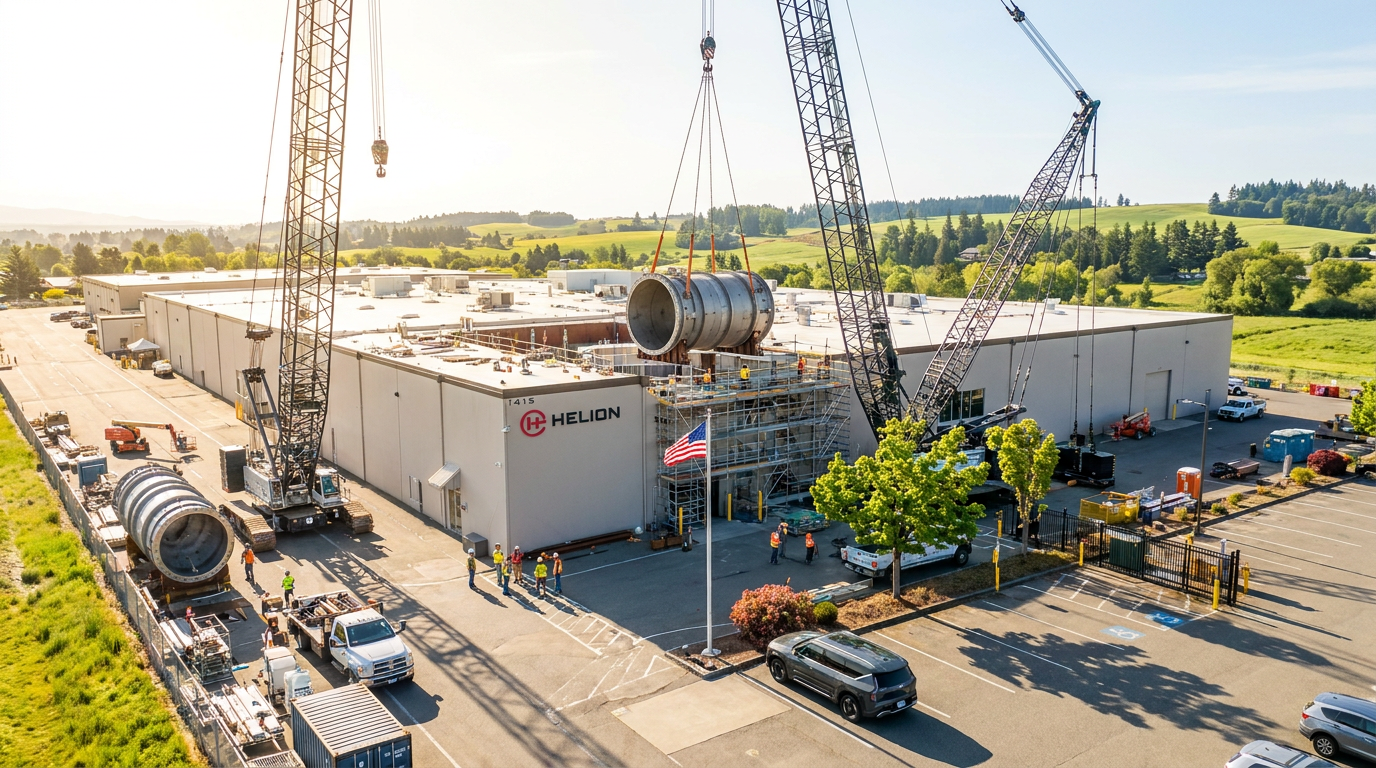
Alongside the massive capital injection, Helion achieved an unprecedented regulatory milestone: securing the world's first commercial operating licenses for a fusion power plant. The Washington State Department of Health issued a Radioactive Materials License and a Radioactive Air Emissions License for the company's under-construction Orion facility in Malaga, Washington.[2][5]
The licenses permit Helion to proceed with the construction of the generator building at the Malaga site, where assembly and office structures are already complete. Unlike previous permits issued in the sector, which were strictly for research and development, these are commercial operating approvals.[2][5]
"Leading radioactive regulatory oversight for the fusion industry in Washington state is an honor and is essential to protecting public health while advancing clean energy," said Jill Wood, director of the state's Office of Radiation.[2]

The regulatory breakthrough was made possible by a 2023 U.S. Nuclear Regulatory Commission decision that fusion technology should be regulated more like particle accelerators and hospital equipment than traditional nuclear fission plants. Because fusion does not carry the risk of a runaway meltdown and produces significantly less long-lived radioactive waste, states have been empowered to oversee the facilities.[2]
Helion's financial backing reflects the soaring confidence of private markets. The Series G round was led by Thrive Capital, with participation from Lux Capital, SoftBank Vision Fund 2, Lightspeed Venture Partners, and Ford Motor Company Executive Chairman Bill Ford. The raise brings Helion's total capital to $1.5 billion.[1][4]
The startup is operating on the industry's most aggressive timeline. Helion holds a power purchase agreement with Microsoft to supply 50 megawatts of electricity to a Central Washington data center by 2028. If successful, it would become the first private fusion company to reach commercial power generation.[2][4]
The startup is operating on the industry's most aggressive timeline.
To hit that target, Helion is relying on a unique technological approach. While many competitors use massive, donut-shaped tokamak reactors, Helion utilizes a Field-Reversed Configuration (FRC). Its Polaris prototype uses magnetic fields to compress plasma donuts from opposite ends of a cylinder, accelerating them toward each other at 100 million miles per hour.[1][4]
The resulting collision compresses the fuel—a mix of deuterium and helium-3—creating the intense heat and pressure required for atomic nuclei to fuse. The reaction causes changes in the magnetic field that directly produce an electric current, bypassing the need for traditional steam turbines.[1][4]

Helion recently reported that its Polaris prototype achieved internal plasma temperatures exceeding 150 million degrees Celsius, well above the threshold generally considered necessary for a commercial fusion power plant.[4][5]
Despite the optimism, significant scientific hurdles remain. No company or academic institution has yet achieved "breakeven"—producing more commercially viable energy from a fusion reaction than the massive amount of electricity required to trigger it.[2][3]
Helion's choice of fuel has also sparked internal and external debate. While a standard deuterium-tritium mix offers a much higher energy gain, Helion pivoted to deuterium-helium-3 because it produces protons rather than hard-to-contain neutrons, simplifying the reactor's engineering. However, helium-3 is exceptionally rare on Earth, requiring Helion to manufacture it in-house.[1][4]
The Everett-based company is far from alone in its quest. Total private investment in the fusion sector has now eclipsed $13 billion, with 17 different startups having raised more than $100 million each.[3]

Commonwealth Fusion Systems, an MIT spinout based in Massachusetts, leads the pack with roughly $3 billion in funding. Commonwealth is building a tokamak reactor called SPARC and aims to demonstrate net energy gain by late 2026 or early 2027, targeting commercial power in the early 2030s.[3]
Other major players include California's TAE Technologies, which has raised nearly $1.8 billion, and international contenders like Germany's Focused Energy and the UK's Tokamak Energy.[3]
As data centers and artificial intelligence workloads drive an unprecedented surge in global electricity demand, the promise of fusion has never been more alluring. With billions in the bank and the first commercial licenses in hand, the race to bottle a star is officially moving out of the laboratory and onto the grid.[2][4]
How we got here
2021
Helion Energy raises $500 million in Series E funding to build its Polaris prototype.
2023
The U.S. Nuclear Regulatory Commission decides fusion should be regulated by states as particle accelerators, not fission plants.
May 2023
Helion signs the industry's first power purchase agreement to provide electricity to Microsoft by 2028.
July 2025
Helion breaks ground on its Orion commercial fusion facility in Malaga, Washington.
June 2026
Helion secures $465 million in new funding and receives the world's first commercial fusion operating licenses.
Viewpoints in depth
Commercial Fusion Optimists
Investors and tech leaders who believe fusion is transitioning from a science experiment to an engineering reality.
This camp points to the sheer volume of private capital—over $13 billion—and the involvement of major tech companies like Microsoft as proof that the fundamental physics risks have been retired. They argue that rapid iterative engineering, combined with advanced AI modeling and new superconducting magnets, will allow startups like Helion to deliver grid-scale electricity before 2030, solving the baseload power crisis driven by AI data centers.
Scientific Skeptics
Physicists and energy analysts who caution that commercial fusion remains decades away.
Skeptics emphasize that no private company has yet achieved a sustained net energy gain (Q>1) where the reactor produces more electricity than it consumes. They note that fusion timelines have historically slipped by decades, and that scaling a prototype to a reliable 50-megawatt commercial plant involves unprecedented materials science challenges. They also question the economic viability of manufacturing rare isotopes like helium-3 at scale.
Regulatory Pioneers
State health and radiation officials establishing the first legal frameworks for fusion power.
Regulators view fusion as fundamentally different from traditional nuclear fission. Because fusion reactors cannot melt down and do not produce long-lived high-level radioactive waste, officials argue they should be regulated under materials and air emissions licenses rather than the strict, decades-long permitting processes required for fission plants. This streamlined approach is designed to protect public health without stifling clean energy innovation.
What we don't know
- Whether Helion or any other startup can successfully achieve and sustain 'breakeven' net energy gain in a commercial setting.
- How much the electricity generated by these first-generation fusion plants will ultimately cost per megawatt-hour.
- Whether Helion can manufacture enough helium-3 fuel in-house to sustain continuous commercial operations.
Key terms
- Nuclear Fusion
- A reaction in which two light atomic nuclei combine to form a single heavier one, releasing massive amounts of energy—the same process that powers the sun.
- Field-Reversed Configuration (FRC)
- A type of fusion device that confines plasma in a closed magnetic field without the need for a central physical coil, allowing for a more compact reactor design.
- Deuterium
- A stable isotope of hydrogen containing one proton and one neutron, commonly extracted from seawater and used as fusion fuel.
- Helium-3
- A rare, non-radioactive isotope of helium with two protons and one neutron, prized in fusion because its reactions produce easily manageable protons rather than destructive neutrons.
- Breakeven (Q>1)
- The critical milestone in fusion research where a reactor generates more energy than is required to heat and maintain the plasma.
- Tokamak
- A traditional, donut-shaped magnetic confinement device used by many fusion projects to hold super-heated plasma.
Frequently asked
What makes Helion's approach different from other fusion startups?
Instead of using massive donut-shaped tokamak reactors, Helion uses a Field-Reversed Configuration that accelerates two plasma donuts into each other at 100 million miles per hour. It also uses a rare deuterium and helium-3 fuel mix to directly generate electricity via magnetic fields.
When will Helion's power plant be operational?
Helion is targeting 2028 to begin supplying 50 megawatts of electricity to a Microsoft data center from its Orion facility in Washington state.
Is fusion power safe?
Yes, regulators consider fusion much safer than traditional nuclear fission. It cannot undergo a runaway meltdown, and Helion's specific fuel mix produces minimal long-lived radioactive waste, which is why it received commercial licenses from state health officials rather than the federal Nuclear Regulatory Commission.
Sources
Source coverage
6 outlets
3 viewpoints surfaced






[1]SiliconANGLECommercial Fusion Optimists
Fusion power startup Helion valued at $15.5B in $465M funding round
Read on SiliconANGLE →[2]GeekWireRegulatory Pioneers
Helion secures world's first regulatory licenses for fusion power plant being built in Washington
Read on GeekWire →[3]TNWScientific Skeptics
17 fusion startups have now raised over $100M each, and the total keeps climbing
Read on TNW →[4]Nuclear Engineering InternationalScientific Skeptics
Helion advances fusion energy program
Read on Nuclear Engineering International →[5]FusionXInvestRegulatory Pioneers
Helion secures first commercial fusion power plant licences
Read on FusionXInvest →[6]Crunchbase NewsCommercial Fusion Optimists
The Week's 10 Biggest Funding Rounds: Megarounds Proliferate
Read on Crunchbase News →
More in business
See all 5 stories →Media Strategy
How the Publisher of Food & Wine is Beating 'AI Slop' With a Giant Human Test Kitchen
6 sources

Creator Economy
The Rise of the Solo Analyst: How Independent Creators Are Building Micro-Media Empires
6 sources

Macro Economy
How the US-Iran Ceasefire is Reshaping Global Markets and Easing Stagflation Fears
7 sources

Every angle. Every day.
Get business stories with full source coverage and perspective breakdowns delivered to your inbox.