
OLED vs. Mini-LED: The 2026 Gaming Monitor Trade-Off Analysis
As display technology reaches new heights in 2026, the choice between OLED and Mini-LED gaming monitors comes down to a strict trade-off between perfect contrast and blinding, durable brightness.
By Factlen Editorial Team
- OLED Purists
- Prioritize absolute contrast, perfect blacks, and instantaneous motion clarity for esports and cinema.
- Mini-LED Brightness Advocates
- Prioritize blinding HDR impact, sustained full-screen luminance, and zero burn-in risk.
- Hybrid Productivity Gamers
- Prioritize hardware longevity, text clarity, and the ability to display static UIs all day without damage.
What's not represented
- · Budget-conscious gamers relying on traditional IPS/VA panels
- · Environmental advocates concerned with the high power draw of 10,000-nit displays
Why this matters
Monitors are no longer just peripherals; they are multi-thousand-dollar investments that dictate the quality of your digital life. Choosing the wrong panel technology for your specific room lighting and daily habits can lead to severe eye strain, washed-out visuals, or permanent hardware degradation.
Key points
- OLED panels offer perfect blacks and infinite contrast by allowing each pixel to turn off independently.
- Mini-LED panels use inorganic materials to achieve up to 10,000 nits of peak brightness without any risk of burn-in.
- OLED's 0.03ms response time provides unparalleled motion clarity for competitive esports.
- Mini-LED's local dimming zones can cause a 'blooming' halo effect around bright objects on dark backgrounds.
- OLED is ideal for dark rooms and varied content, while Mini-LED excels in sunlit rooms and static productivity workflows.
The 2026 display market represents a golden era for gamers, but it has also introduced a paralyzing level of choice. The era of universal compromise is over, replaced by a strict division between two highly refined, competing display philosophies. Shoppers are no longer choosing between "good" and "bad" screens; they are choosing between organic chemistry and inorganic brute force. The two heavyweights—OLED and Mini-LED—have both reached extraordinary levels of performance, making the buying decision a matter of matching the engineering to the user's specific environment.[1][2]
At the core of this debate is a fundamental difference in how light is created. OLED (Organic Light-Emitting Diode) panels are self-emissive, meaning every single pixel generates its own light and can turn off completely independently. Mini-LED, conversely, relies on a liquid crystal display layer illuminated from behind by thousands of microscopic, inorganic Gallium Nitride LEDs grouped into local dimming zones. This structural divide dictates every advantage and flaw each technology possesses.[1][5]
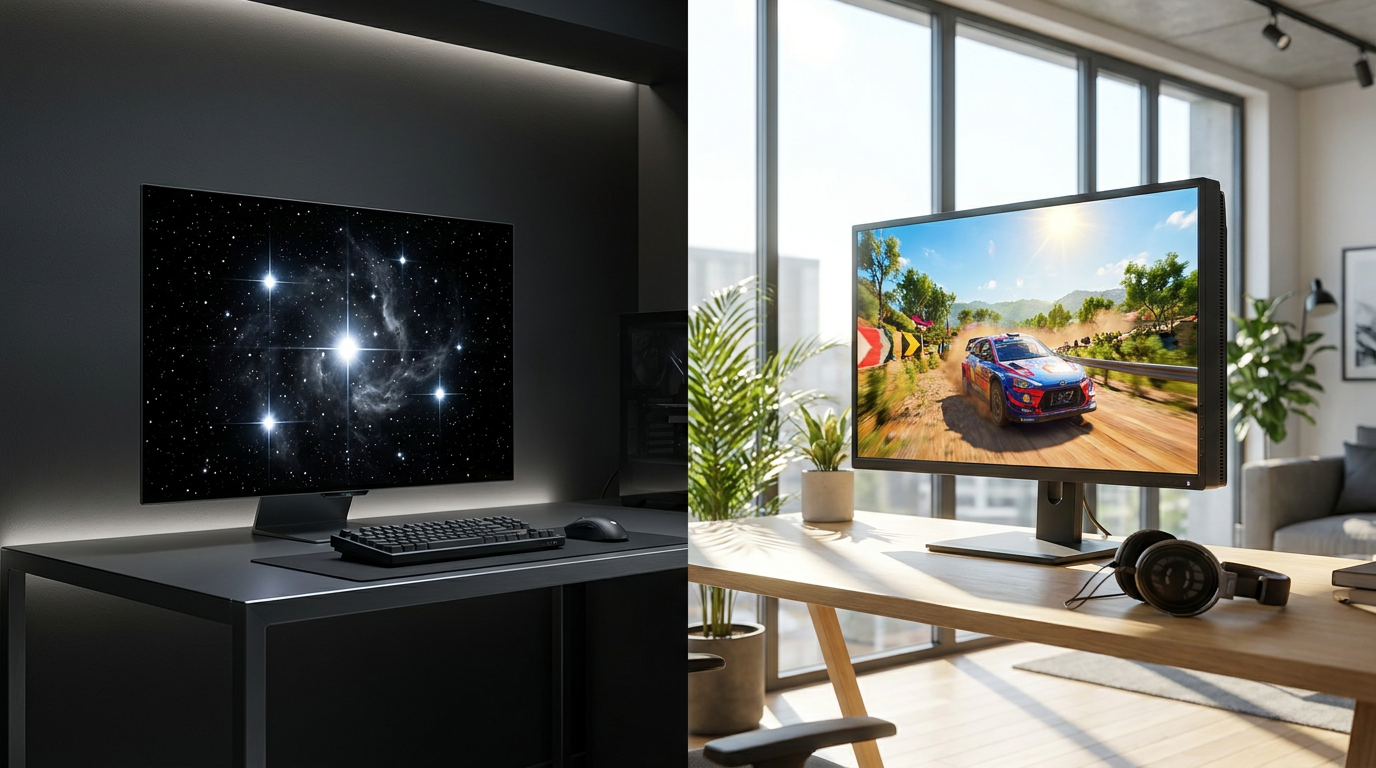
The argument for OLED centers entirely on absolute visual precision. Because each of its millions of pixels operates autonomously, the contrast ratio is effectively infinite. When a game renders a starfield, the stars are piercingly bright while the vacuum of space between them is perfectly, genuinely black. There is zero light bleed, creating a cinematic depth that traditional backlights simply cannot replicate.[2][6]
The evidence for OLED's dominance is most visible in motion clarity, making it the darling of the competitive esports scene. With pixel response times hitting a near-instantaneous 0.03 milliseconds, fast-paced shooters like Valorant or Call of Duty exhibit zero ghosting or motion blur. When a player snaps their crosshair across the screen, the image remains razor-sharp, providing a tangible competitive advantage that LCD-based technologies struggle to match.[1][2]

The argument against OLED, however, remains rooted in its organic chemistry. Despite massive 2026 advancements like Deuterium-stabilized pixels and Tandem OLED structures, organic materials inherently degrade over time. If a user plays the same game with a static heads-up display (HUD) for thousands of hours, or uses the monitor for eight hours a day of coding with static menus, the risk of permanent image retention—burn-in—remains a lingering anxiety.[1][5]
Further evidence of OLED's limitations surfaces in bright environments. To protect the organic pixels from overheating and accelerating degradation, OLED monitors employ an Auto Brightness Limiter (ABL). If a game features a massive, full-screen bright scene—like a snow-covered landscape or a sunlit sports field—the monitor's internal processor will aggressively dim the entire screen. In a sunlit room, this safety mechanism can leave the image looking muted and washed out.[1][4]
The argument for Mini-LED is built on brute-force luminance and inorganic durability. Utilizing highly resilient semiconductor materials, these panels are designed to withstand massive amounts of heat and electrical current for decades without any risk of burn-in. Users can leave static spreadsheets, video editing timelines, or game HUDs on the screen indefinitely without a second thought, offering a peace of mind that OLED cannot provide.[4][5]
The argument for Mini-LED is built on brute-force luminance and inorganic durability.
The evidence for Mini-LED's superiority shines brightest in the 2026 "nit war." Flagship models are now pushing between 5,000 and 10,000 nits of peak brightness, delivering specular highlights—like the glint of sun off a car's chrome bumper or the flash of an explosion—that mimic physical reality. More importantly, Mini-LED can sustain full-screen brightness indefinitely, easily punching through the glare of a window-heavy, sunlit room.[1][4]

The argument against Mini-LED focuses heavily on blooming and motion latency. Because the backlight relies on local dimming zones—even premium 2026 models with 20,000+ zones—the light source is still larger than individual pixels. When a bright object moves across a dark background, a faint halo of light bleeds into the surrounding shadows. Additionally, the physical movement of the liquid crystals limits response times to roughly 1 millisecond, introducing slight motion blur during rapid camera pans.[1][5]
Further evidence against Mini-LED is found in its physical footprint and viewing angles. The complex layers of liquid crystals inherently cause some color shift and washout when the screen is viewed from off-center angles. Furthermore, the massive wattage required to drive 10,000 nits of brightness necessitates substantial internal heat sinks, resulting in thicker, heavier monitor chassis compared to the razor-thin profiles of OLED displays.[1][3]
The 2026 landscape has introduced new innovations that are rapidly closing the gap between the two camps. RGB Mini-LED technology has arrived, replacing the traditional white backlight and color filters with dedicated red, green, and blue microscopic LEDs. This breakthrough significantly boosts color volume and saturation, allowing Mini-LED to challenge OLED's historically superior cinematic color reproduction.[3][5]
Conversely, OLED manufacturers have not surrendered the brightness battle. The latest panels utilize Micro Lens Array (MLA) technology—billions of microscopic lenses that focus light outward—and refined Quantum Dot (QD-OLED) layers to finally cross the 3,000-nit threshold. While still trailing Mini-LED's raw output, these enhancements make modern OLEDs vastly more capable in moderately lit rooms than their predecessors.[1][2]

Ultimately, choosing the right monitor requires an honest assessment of your environment. OLED fits perfectly when your gaming space is light-controlled, your primary focus is competitive esports or cinematic single-player immersion, and you frequently vary your content. It delivers the absolute pinnacle of motion clarity and contrast for those who treat gaming as a dedicated, focused experience.[2][5]
However, OLED does not fit well when your desk sits in a sunlit room with open blinds, or when you use the same monitor for eight hours of daily productivity. If your workflow involves staring at static user interfaces, coding environments, or persistent game HUDs all day, the anxiety of organic panel wear makes OLED a stressful investment.[4][5]
Mini-LED fits perfectly when your monitor lives in a bright, window-heavy room, and when you mix heavy daily productivity with your gaming. It is the definitive choice for users who want blindingly impactful HDR highlights, sharp text rendering for work, and the absolute assurance that their multi-thousand-dollar investment will not suffer from permanent image retention.[3][4]

Conversely, Mini-LED does not fit well for competitive players who demand absolute motion perfection in fast-paced shooters, or for cinephiles who cannot tolerate any light bleed in pitch-black viewing environments. In the dark, the halo effect around bright objects will always remind you that you are looking at a backlight, breaking the perfect illusion that OLED so effortlessly maintains.[1][6]
How we got here
2022
OLED monitors first enter the mainstream gaming market, offering perfect blacks but struggling with low brightness and high burn-in risk.
2024
Mini-LED technology matures, introducing panels with thousands of dimming zones that challenge OLED's dominance in HDR gaming.
2025
OLED manufacturers introduce Micro Lens Array (MLA) and QD-OLED advancements, significantly boosting peak brightness to combat Mini-LED.
2026
The 'nit war' escalates as flagship Mini-LEDs hit 10,000 nits and RGB Mini-LED technology arrives to close the color accuracy gap.
Viewpoints in depth
OLED Purists
Gamers and cinephiles who prioritize absolute contrast and motion clarity above all else.
This camp argues that raw brightness is a secondary metric compared to infinite contrast and pixel response time. For competitive esports players, the 0.03-millisecond response time of OLED is non-negotiable, as it entirely eliminates the motion blur that can obscure targets during rapid camera movements. For cinephiles, the ability of an OLED pixel to turn off completely creates a level of immersion in dark rooms that no backlight technology can replicate, rendering the blooming artifacts of Mini-LED unacceptable.
Mini-LED Brightness Advocates
Users who value blinding HDR impact and zero burn-in risk for bright environments.
Advocates for Mini-LED point out that perfect blacks are irrelevant if the screen is washed out by ambient sunlight. They argue that the true leap in modern HDR gaming comes from specular highlights—the blinding flash of a digital sun or an explosion—which requires the 5,000 to 10,000 nits of sustained brightness that only inorganic LEDs can provide. Furthermore, they view the constant anxiety over OLED burn-in as a dealbreaker, preferring a monitor that can be used recklessly without fear of permanent damage.
Hybrid Productivity Gamers
Professionals who split their time between heavy static workloads and high-end gaming.
This growing demographic uses their primary monitor for eight hours of coding, video editing, or spreadsheet management before launching a game in the evening. For them, Mini-LED is the pragmatic choice. They prioritize the sharp text rendering of standard RGB subpixel layouts and the absolute immunity to static UI burn-in. While they acknowledge OLED's superior gaming performance, they argue that the longevity and peace of mind offered by Mini-LED makes it the only viable option for a mixed-use workstation.
What we don't know
- Whether Tandem OLED technology will definitively eliminate burn-in over a 10-year lifespan, as long-term real-world data does not yet exist.
- If manufacturing costs for RGB Mini-LED will drop enough to make the technology accessible to the mid-range budget market.
- How upcoming display standards will balance the massive power consumption required by 10,000-nit Mini-LED panels with global energy regulations.
Key terms
- Auto Brightness Limiter (ABL)
- A safety feature in OLED displays that automatically dims the screen during bright, full-screen scenes to prevent overheating and panel damage.
- Blooming (Halo Effect)
- A visual artifact on Mini-LED screens where light bleeds from a bright object into surrounding dark areas, caused by backlight zones being larger than individual pixels.
- Gallium Nitride (GaN)
- A highly durable, inorganic semiconductor material used to manufacture the microscopic lights in Mini-LED displays.
- Micro Lens Array (MLA)
- A layer of billions of microscopic lenses applied to OLED panels to focus light outward, increasing peak brightness without requiring more power.
- Burn-in
- Permanent image retention on an OLED screen caused by the uneven degradation of organic pixels after displaying static elements for prolonged periods.
Frequently asked
Does OLED burn-in still happen in 2026?
Yes, though the risk is significantly reduced. While Deuterium-stabilized pixels and Tandem OLED tech have extended panel lifespans, displaying static elements like game HUDs or taskbars for thousands of hours can still cause permanent image retention.
What is RGB Mini-LED?
It is a 2026 advancement that uses dedicated red, green, and blue microscopic LEDs rather than a white backlight with color filters, significantly improving color volume and accuracy.
Which monitor is better for a brightly lit room?
Mini-LED is the superior choice for sunlit rooms. Its high sustained brightness can easily overpower window glare without triggering the auto-dimming safety features found on OLED panels.
Why do competitive esports players prefer OLED?
OLED panels offer a near-instantaneous 0.03-millisecond response time, which entirely eliminates motion blur and ghosting during fast-paced competitive gameplay.
Sources
Source coverage
6 outlets
3 viewpoints surfaced






[1]Tom's HardwareMini-LED Brightness Advocates
The Best Gaming Monitors for 2026: OLED and Mini-LED Compared
Read on Tom's Hardware →[2]RTINGSOLED Purists
Best Gaming Monitors 2026: Lab Tested and Reviewed
Read on RTINGS →[3]What Hi-Fi?Hybrid Productivity Gamers
OLED vs RGB Mini LED: The 2026 Display Showdown
Read on What Hi-Fi? →[4]TechRadarMini-LED Brightness Advocates
Why Mini-LED is winning the bright-room battle in 2026
Read on TechRadar →[5]Ordinary TechHybrid Productivity Gamers
RGB Mini LED vs OLED Monitors: Real-World Performance for Gaming and Professional Work
Read on Ordinary Tech →[6]PCMagOLED Purists
The Best Gaming Monitors for 2026
Read on PCMag →

Every angle. Every day.
Get shopping stories with full source coverage and perspective breakdowns delivered to your inbox.