
How Next-Generation Geothermal Energy Works
Advanced drilling techniques are unlocking the Earth's inexhaustible heat, transforming geothermal energy from a niche regional asset into a globally scalable source of clean, 24/7 baseload power.
By Factlen Editorial Team
- Geothermal Developers
- Argue that engineered geothermal is the ultimate scalable clean baseload power, capable of replacing fossil fuels globally.
- Policymakers & Researchers
- View next-generation geothermal as a critical firm resource needed to stabilize the grid as intermittent renewables expand.
- Market Analysts
- Track the commercial viability of the technology, noting that tech-sector demand is currently bridging the gap for high upfront capital costs.
What's not represented
- · Local communities near proposed drilling sites concerned about water usage and induced seismicity.
- · Legacy oil and gas workers evaluating the transition of their drilling skills to the geothermal sector.
Why this matters
As AI data centers and electrification drive unprecedented demand for 24/7 electricity, intermittent solar and wind are no longer enough. Next-generation geothermal promises to provide the firm, zero-carbon baseload power needed to stabilize the grid without relying on fossil fuels.
Key points
- Conventional geothermal is limited to volcanic regions with natural underground water and permeable rock.
- Enhanced Geothermal Systems (EGS) use horizontal drilling and hydraulic fracturing to create artificial reservoirs in hot, dry rock.
- Advanced Geothermal Systems (AGS) function as closed-loop underground radiators, circulating fluid through sealed pipes without fracking.
- Superhot Rock geothermal aims to drill up to 20 kilometers deep using millimeter-wave vaporization to access 400°C temperatures.
- Tech companies are driving early adoption to secure 24/7 clean baseload power for AI data centers.
The holy grail of the energy transition is a power source that is clean, firm, and available anywhere. Solar and wind have plummeted in cost, but they remain inherently intermittent, requiring massive battery deployments to cover the hours when the sun sets or the wind dies down. Nuclear power provides steady, zero-carbon baseload energy, but new plants take decades to build and face steep regulatory and financial hurdles. Geothermal energy, meanwhile, has always been the sleeping giant of the renewables sector—capable of providing 24/7 power with a tiny surface footprint, yet historically sidelined by its strict geographic limitations.[8]
The fundamental problem with conventional geothermal power is that it requires a rare geological trifecta. To build a traditional plant, developers must find a location that naturally possesses extreme underground heat, a steady supply of natural fluid like water or steam, and high rock permeability so that the fluid can flow freely. This combination is almost exclusively found near tectonic plate boundaries and volcanic regions, such as Iceland, New Zealand, or California’s Geysers. For decades, if a region did not sit on top of a natural hot spring or active fault line, geothermal energy was simply off the table.[5]
That geographic constraint is now being shattered by a wave of "next-generation" geothermal technologies. Instead of spending millions of dollars hunting for the perfect natural underground conditions—and often drilling expensive dry holes—engineers are now creating those conditions artificially. By applying advanced drilling techniques and subsurface engineering, the industry is transitioning from a resource-extraction model to a manufacturing model. This shift promises to unlock the Earth’s inexhaustible heat virtually anywhere on the map, transforming geothermal from a niche regional asset into a globally scalable baseload power source.[8]
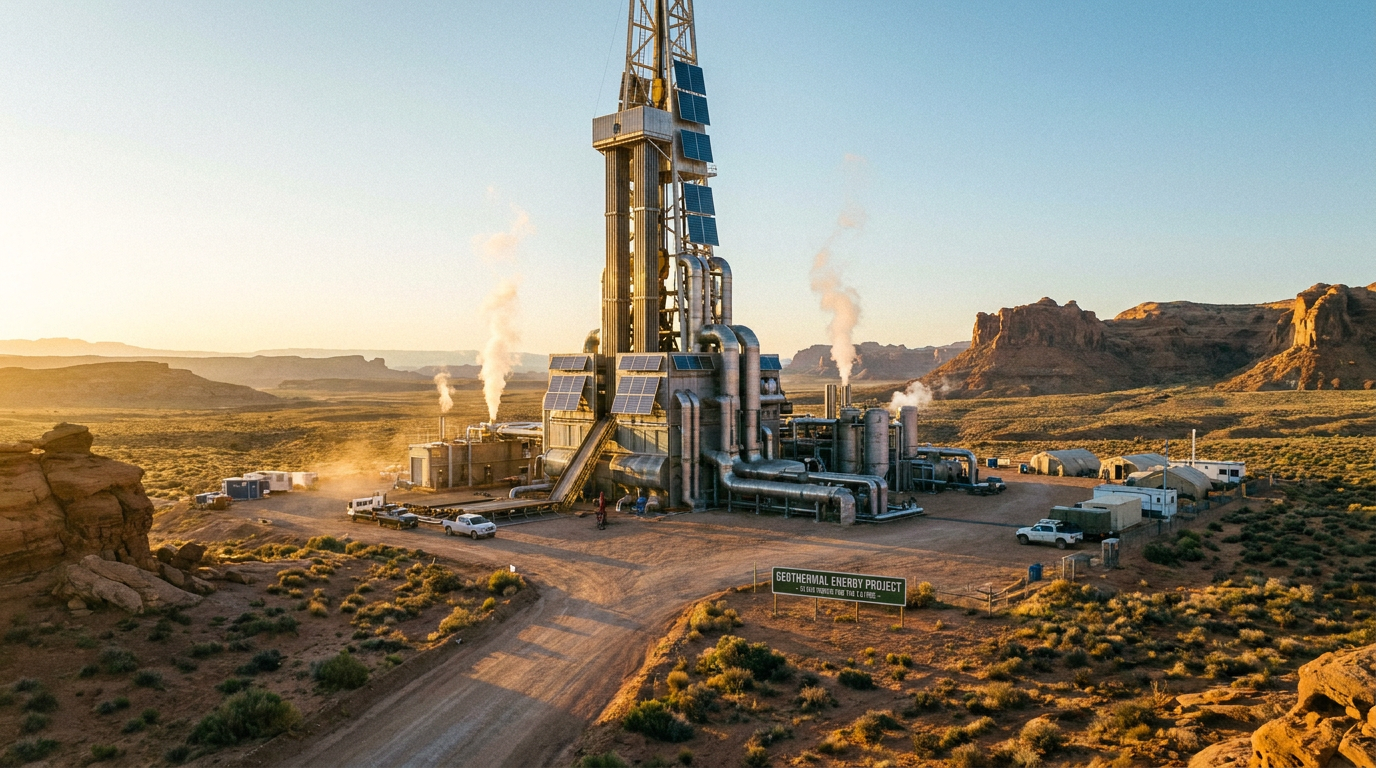
The most mature of these new approaches is the Enhanced Geothermal System (EGS). EGS represents a fascinating technological crossover, borrowing heavily from the very industry it aims to replace. It utilizes the horizontal drilling and hydraulic fracturing techniques pioneered during the oil and gas sector's shale revolution. But instead of cracking rock to extract trapped hydrocarbons, EGS developers fracture hot, dry rock to create an artificial underground radiator.[3][5]
In a typical EGS setup, engineers drill thousands of feet down into impermeable basement rock that is naturally hot but lacks fluid or cracks. Once at the target depth, the drill turns horizontally. High-pressure water is then injected into the wellbore to create a vast, controlled network of millimeter-thin fractures in the rock. This stimulation process creates the permeability that nature failed to provide, turning solid granite into a highly efficient heat-exchange reservoir.[1][7]

To complete the system, a second well—the production well—is drilled to intersect this newly created fracture network. Cold water is pumped down the injection well and forced through the hot, fractured rock. As the water sweeps through the artificial reservoir, it absorbs the Earth's ambient heat. The superheated water is then drawn up the production well to the surface, where it flashes to steam and spins a turbine to generate electricity, before being cooled and reinjected in a continuous cycle.[1]
The U.S. Department of Energy has heavily backed this approach through its Frontier Observatory for Research in Geothermal Energy (FORGE) initiative. Located in Milford, Utah, the FORGE site serves as a dedicated underground field laboratory for the entire industry. In 2024, the FORGE team achieved a major milestone by successfully creating a geothermal reservoir from scratch in crystalline granite, proving that EGS stimulation works in hard rock environments. Recognizing the breakthrough, the DOE extended the project's funding with an additional $80 million through 2028.[1][2]
Building directly on this proof of concept, commercial developers are scaling EGS rapidly. Fervo Energy, currently the leading independent power producer in the EGS space, has moved beyond pilot testing and is constructing Cape Station, a massive commercial facility in Utah. Fervo's approach utilizes multi-stage fracturing techniques that allow them to stack multiple horizontal wells, drastically increasing the power output per square foot of surface land.[3]
Scheduled to begin delivering power to the grid in 2026, Cape Station will initially provide 100 megawatts of clean electricity. However, Fervo has already secured agreements to expand the site's capacity to 500 megawatts, making it one of the largest geothermal developments in the world. This massive scale-up demonstrates to utility companies and investors that engineered reservoirs can operate reliably at utility scale, moving EGS out of the experimental phase and into commercial reality.[3]

Scheduled to begin delivering power to the grid in 2026, Cape Station will initially provide 100 megawatts of clean electricity.
While EGS relies on creating artificial cracks in the rock, another next-generation approach—Advanced Geothermal Systems (AGS)—eliminates the need for fluid exchange entirely. AGS functions as a massive, closed-loop underground heat exchanger. Rather than injecting water into the rock formation, AGS developers circulate a proprietary working fluid through completely sealed pipes that are embedded deep within the hot rock.[7]
In an AGS architecture, the heat transfers conductively through the walls of the pipe into the circulating fluid, which then returns to the surface to generate power. Because the system is entirely closed, it never extracts natural brine from the earth, nor does it require high-pressure hydraulic fracturing to create permeability. This eliminates the risk of induced seismicity and ensures zero water loss, making AGS highly attractive for deployment near urban centers or in water-scarce regions.[7]
Companies like Eavor and Vallourec are pioneering these closed-loop "radiator" designs. Eavor is currently deploying its multilateral closed-loop systems in southern Germany, drilling to depths of 4.6 kilometers to reach temperatures of 175°C. Because AGS systems are highly predictable and modular, they are being explored not just for electricity generation, but for direct industrial heating and district heating networks, replacing natural gas boilers in urban environments.[7]
The ultimate frontier of next-generation geothermal, however, lies even deeper: Superhot Rock (SHR) geothermal. While current EGS and AGS projects operate at depths of 2 to 4 kilometers and temperatures around 200°C, SHR targets depths of 10 to 20 kilometers, where rock temperatures exceed 400°C. Tapping into these extreme environments could fundamentally alter the economics of energy production.[4][5]
When water is pumped into environments exceeding 374°C and 220 bar of pressure, it enters a "supercritical" state—behaving simultaneously as a liquid and a gas. Supercritical fluid holds significantly more enthalpy and moves with far less friction. Consequently, a single supercritical geothermal well could potentially produce five to ten times the energy of a conventional well, allowing a small geothermal footprint to match the gigawatt-scale output of a major nuclear or coal plant.[4][7]
The primary barrier to Superhot Rock geothermal is the physical limitation of drilling. Conventional mechanical drill bits, which rely on grinding and crushing, are quickly destroyed by the extreme heat and pressure found in deep granite and basalt. To reach 20 kilometers down, the industry needs a fundamentally new way to penetrate the Earth's crust.[4]
To solve this, Quaise Energy is adapting millimeter-wave technology originally developed for nuclear fusion research at the Massachusetts Institute of Technology. Instead of physically touching the rock, Quaise uses a powerful gyrotron to direct a high-energy electromagnetic beam down the borehole. This millimeter-wave beam literally melts and vaporizes the rock ahead of it, allowing the drill to advance without any downhole mechanical hardware that could melt or break.[4]

In a major milestone achieved in July 2025, Quaise successfully deployed a hybrid rig in a Texas granite quarry, using millimeter waves to drill past 100 meters in the field for the first time. The company is now targeting depths of one kilometer in 2026. By combining conventional rotary drilling for the softer upper crust with millimeter-wave vaporization for the deep basement rock, Quaise aims to make superhot geothermal accessible anywhere on the planet.[4]
The commercial demand for all these next-generation technologies is surging, driven largely by the technology sector. The rapid expansion of artificial intelligence and cloud computing has triggered a massive spike in data center construction. These facilities require enormous amounts of 24/7 electricity, a demand profile that intermittent solar and wind simply cannot satisfy without cost-prohibitive battery storage.[5][6]
Tech giants are already stepping in as early adopters to accelerate the industry. Google partnered with Fervo Energy to power its Nevada data centers, utilizing a novel "clean transition tariff." This financial structure, which guarantees a premium price for first-of-a-kind firm clean power, is now being adopted by California regulators as a model for broader grid procurement, signaling to developers that there is a guaranteed market for their electrons.[3][6]

The U.S. Department of Energy estimates that next-generation geothermal could provide up to 120 gigawatts of firm capacity in the United States alone by 2050. By combining the drilling innovations of the oil and gas sector with the limitless heat of the Earth's core, advanced geothermal is poised to become the quiet, reliable backbone of the global clean energy transition.[1][5][8]
How we got here
2021
The California Public Utilities Commission issues a landmark procurement order for 1 GW of clean, firm resources, kickstarting geothermal demand.
2024
The DOE's Utah FORGE laboratory successfully creates a geothermal reservoir from scratch in crystalline granite.
July 2025
Quaise Energy successfully deploys a millimeter-wave hybrid rig in the field, drilling past 100 meters without downhole hardware.
2026
Fervo Energy's Cape Station in Utah is scheduled to begin delivering its first 100 MW of commercial EGS power to the grid.
Viewpoints in depth
Geothermal Developers' view
Engineered geothermal is the ultimate scalable clean baseload power.
Companies pioneering EGS, AGS, and Superhot Rock technologies argue that geothermal is the only renewable resource capable of providing 24/7 baseload power with a minimal surface footprint. By transitioning from a resource-extraction model (hunting for natural hot springs) to a manufacturing model (engineering the subsurface anywhere), developers believe they can achieve the same rapid cost declines seen in the shale gas and solar industries. They view their technologies not just as a supplement to the grid, but as a direct, one-to-one replacement for retiring coal and nuclear plants.
Policymakers and Researchers' view
Advanced geothermal is a critical firm resource for grid stability.
Government agencies like the U.S. Department of Energy and state utility commissions view next-generation geothermal as an essential insurance policy for the clean energy transition. As the grid becomes increasingly reliant on intermittent solar and wind, grid operators need 'firm' clean power to prevent brownouts during extreme weather or multi-day lulls in wind. Researchers at facilities like Utah FORGE are focused on de-risking the technology through open-source data sharing, ensuring that the foundational science of subsurface engineering is available to accelerate commercial deployment.
Market Analysts' view
Tech-sector demand is bridging the gap for high upfront capital costs.
Energy market analysts point out that while the technology is proven, the economics of deep drilling remain challenging. The upfront capital expenditure required to drill multiple wells several kilometers deep is immense. However, analysts note that the massive electricity demands of AI data centers have created a unique market dynamic. Tech giants are willing to pay a premium for first-of-a-kind clean firm power, effectively subsidizing the industry's early scale-up and driving the cost-learning curve down for future utility-scale deployments.
What we don't know
- How quickly millimeter-wave drilling can scale from 100-meter field tests to 20-kilometer commercial wells.
- The long-term thermal degradation rate of artificial EGS reservoirs over decades of continuous heat extraction.
- Whether the high upfront capital costs of deep drilling can fall fast enough to compete with cheap solar-plus-battery installations.
Key terms
- Enhanced Geothermal Systems (EGS)
- A technology that creates artificial underground reservoirs by injecting high-pressure water to fracture hot, dry rock.
- Advanced Geothermal Systems (AGS)
- A closed-loop system that circulates fluid through sealed underground pipes to absorb heat conductively, without extracting natural fluids.
- Supercritical Fluid
- A state of matter reached at extreme temperatures and pressures where water behaves as both a liquid and a gas, holding significantly more energy.
- Gyrotron
- A high-power vacuum tube that generates millimeter-wave electromagnetic beams, originally used in fusion research and now adapted to vaporize rock.
Frequently asked
Is next-generation geothermal the same as fracking?
EGS uses similar hydraulic fracturing techniques to the oil and gas industry to create permeability. However, it injects water rather than chemical cocktails, and extracts heat rather than fossil fuels.
Can advanced geothermal be built anywhere?
In theory, yes. The Earth's crust is hot everywhere if you drill deep enough. The challenge is developing drilling technology capable of reaching those depths economically.
Why are tech companies investing in geothermal?
Data centers require massive amounts of 24/7 electricity. Geothermal provides the firm, zero-carbon baseload power that intermittent solar and wind cannot guarantee around the clock.
Does closed-loop geothermal cause earthquakes?
No. Advanced Geothermal Systems (AGS) circulate fluid through sealed pipes and do not fracture the rock or alter underground pressures, eliminating the risk of induced seismicity.
Sources
Source coverage
8 outlets
3 viewpoints surfaced








[1]U.S. Department of EnergyPolicymakers & Researchers
Enhanced Geothermal Systems (EGS) Pilot Demonstrations
Read on U.S. Department of Energy →[2]Utah FORGEPolicymakers & Researchers
Frontier Observatory for Research in Geothermal Energy
Read on Utah FORGE →[3]Fervo EnergyGeothermal Developers
Fervo Energy: Next-Generation Geothermal
Read on Fervo Energy →[4]Quaise EnergyGeothermal Developers
Quaise Energy Achieves Drilling Milestone with Millimeter Wave Technology
Read on Quaise Energy →[5]BloombergNEFMarket Analysts
Next-Generation Geothermal Energy Explained
Read on BloombergNEF →[6]World Resources InstituteMarket Analysts
Next-Generation Geothermal Energy: Clean, Firm Power
Read on World Resources Institute →[7]VallourecGeothermal Developers
Advanced Geothermal Systems (AGS) Explained
Read on Vallourec →[8]Factlen Editorial TeamMarket Analysts
Synthesis by Factlen editorial team
Read on Factlen Editorial Team →


Every angle. Every day.
Get guides stories with full source coverage and perspective breakdowns delivered to your inbox.