
US and Iran Sign Historic Memorandum to End Conflict as Lebanon Ceasefire Faces Immediate Strain
The United States and Iran have digitally signed a 14-point memorandum of understanding to halt hostilities and reopen the Strait of Hormuz, opening a 60-day window for nuclear negotiations. However, the broader peace effort faces immediate hurdles as a fragile ceasefire in Lebanon is tested by renewed strikes.
By Factlen Editorial Team
- Diplomatic Mediators & Observers
- Emphasizes the complex multilateral negotiations, the role of international mediators, and the broader implications for global energy security.
- US Administration Advocates
- Focuses on the deal as a victory of American strength and a necessary step to stabilize global markets without committing taxpayer funds.
- Regional Security Skeptics
- Prioritizes the immediate military threats on the ground, particularly the fragile Lebanon ceasefire and the risk of Hezbollah rearming.
What's not represented
- · Lebanese Civilians
- · Global Energy Markets
Why this matters
This agreement aims to end a 100-day conflict that triggered a global energy crisis and disrupted shipping through the Strait of Hormuz. If the 60-day negotiation window succeeds, it could fundamentally reshape Middle Eastern security and global oil markets; if it fails, the region risks an immediate return to open warfare.
Key points
- The US and Iran have digitally signed a 14-point memorandum to end over 100 days of direct conflict.
- The agreement opens a 60-day window to negotiate a permanent resolution to Iran's nuclear program.
- A central pillar of the pact is the reopening of the Strait of Hormuz and the lifting of US naval blockades.
- The deal requires a ceasefire in Lebanon, which is currently facing severe strain from renewed cross-border strikes.
- US envoys and the Iranian Foreign Minister are convening in Switzerland to begin technical implementation talks.
The United States and Iran have taken a historic step back from the brink of an all-out regional war, digitally signing a 14-point memorandum of understanding designed to end more than 100 days of direct military conflict.[4]
The agreement, executed remotely by U.S. President Donald Trump and Iranian President Masoud Pezeshkian, establishes a strict 60-day window to negotiate a permanent, binding treaty regarding Tehran's nuclear program.[2][4]
The immediate impacts of the memorandum are already reshaping the region's security posture. The United States has agreed to lift its naval blockade on Iranian ports, while Tehran has committed to reopening the Strait of Hormuz—a critical maritime chokepoint that handles a massive share of the world's daily oil supply.[3][4]
Mediated heavily by diplomats from Pakistan and Qatar, the breakthrough aims to resolve a cascading crisis that erupted in late February following U.S. and Israeli strikes on Iranian territory, which subsequently triggered a global energy shock.[4]

However, the entire diplomatic framework hinges on a highly volatile prerequisite: a sustained and verifiable ceasefire in Lebanon between Israel and the Iran-backed militant group Hezbollah.[3][5]
That mandated ceasefire officially took effect on Friday afternoon, but the reality on the ground has immediately tested the diplomatic guardrails designed to keep the broader peace process on track.[5][6]
Within hours of the deadline, Lebanese state media reported Israeli artillery shelling and drone strikes in the southern Nabatieh region, while Israeli officials vehemently disputed claims of Hezbollah attacks, insisting they had halted all offensive operations and would only respond to provocations.[1][3][6]
The friction along the Lebanese border has already disrupted the carefully choreographed diplomatic schedule unfolding thousands of miles away in Europe.[3]
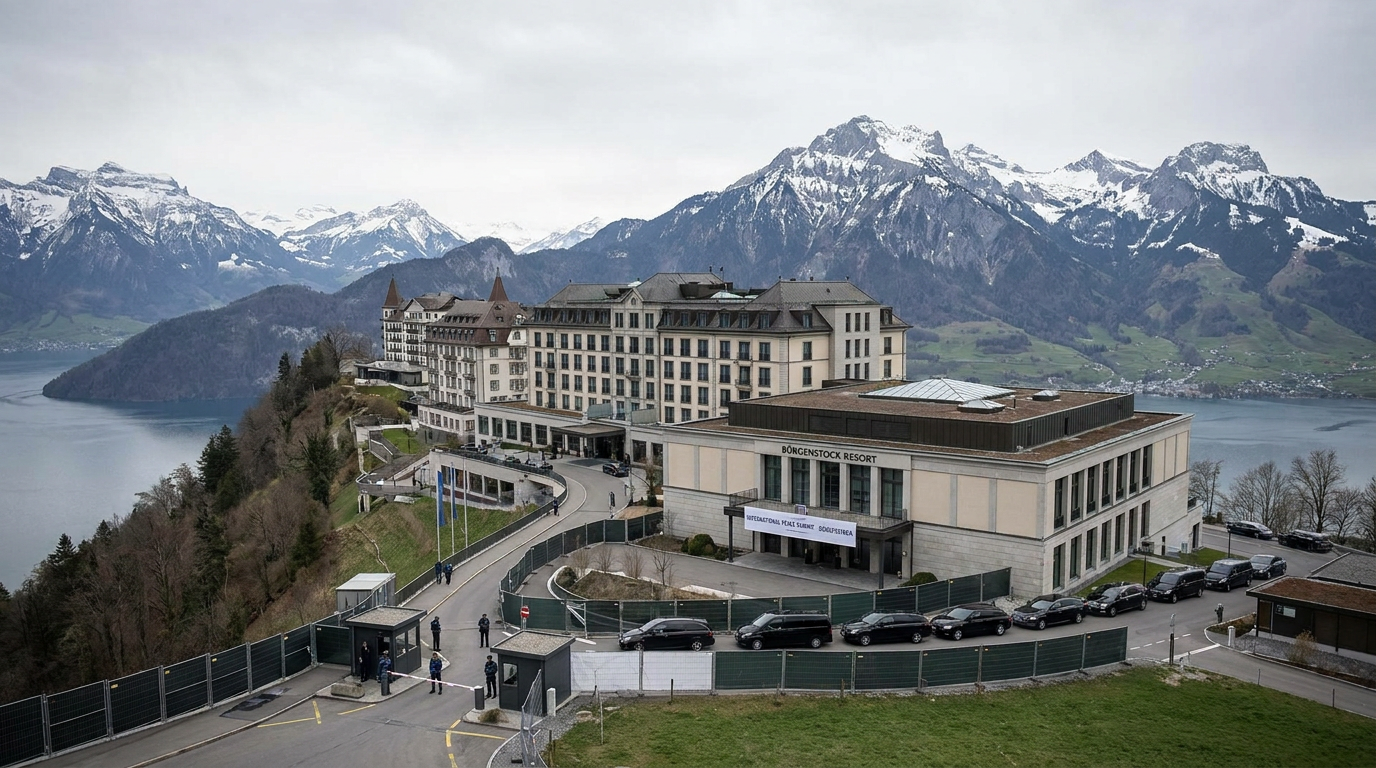
Initial implementation talks were slated to begin Friday at the Buergenstock mountaintop resort in Switzerland, with U.S. Vice President JD Vance expected to lead the American delegation in high-stakes preliminary meetings.[3][7]

Initial implementation talks were slated to begin Friday at the Buergenstock mountaintop resort in Switzerland, with U.S.
Vance abruptly canceled his travel plans as the violence in Lebanon flared, signaling Washington's insistence that the proxy conflict must demonstrably cool before high-level, face-to-face negotiations can proceed.[3][5]
Despite the delay at the vice-presidential level, the diplomatic machinery continues to move forward. U.S. special envoy Steve Witkoff and former White House adviser Jared Kushner have traveled to Switzerland to lay the groundwork for technical discussions.[5][7]
Iranian Foreign Minister Abbas Araqchi is also scheduled to arrive in the alpine nation, marking the highest-level direct engagement between the two adversaries' diplomatic corps in years.[5][6]
If the talks survive the immediate turbulence in Lebanon, negotiators face a daunting 60-day sprint to finalize a permanent nuclear accord that satisfies both Washington's security demands and Tehran's economic imperatives.[3][4]
The Trump administration has outlined a framework that includes immediate waivers on Iranian oil exports and the potential unfreezing of billions in Iranian assets during the negotiation period, provided Iran halts specific enrichment activities.[4]

The most ambitious—and controversial—element of the proposed final deal is a $300 billion regional reconstruction and economic development fund intended to stabilize the Middle East post-conflict.[3]
U.S. domestic politics are already fracturing over the terms of the memorandum. Republican allies, including Senator Tommy Tuberville, have praised the agreement as a triumph of "peace through strength," arguing that the administration forced Iran to the table without committing American taxpayer dollars to the reconstruction fund.[2]
Conversely, skeptics in Washington warn that lifting the naval blockade and providing any form of sanctions relief will inevitably enrich the regime, echoing historical debates over previous nuclear accords and warning that Iran will use the capital to fund proxy networks.[2]
In Tehran, the memorandum has received the crucial endorsement of Supreme Leader Ayatollah Ali Khamenei, though hardline military advisers have publicly warned that Iran must preserve its strategic leverage in the Strait of Hormuz to maintain deterrence for decades to come.[2][3]
For now, the global economy is closely watching the Strait of Hormuz, where early reports indicate a surge in commercial shipping traffic as the blockade lifts and insurance premiums begin to adjust to the de-escalation.[2][3]
The next 60 days will determine whether this fragile memorandum serves as the foundation for a lasting Middle Eastern security architecture, or merely a brief, chaotic pause in a devastating regional war.[4]
How we got here
Feb 28, 2026
US and Israel launch attacks on Iran, triggering a 100-day conflict and global energy crisis.
June 14, 2026
Mediators from Pakistan and Qatar announce a finalized draft of the US-Iran peace agreement.
June 17, 2026
US President Trump and Iranian President Pezeshkian digitally sign the 14-point memorandum of understanding.
June 19, 2026
A ceasefire between Israel and Hezbollah officially takes effect in Lebanon, though violations are immediately reported.
June 20, 2026
US and Iranian envoys travel to Switzerland to begin technical negotiations for a permanent treaty.
Viewpoints in depth
The Trump Administration's View
Framing the deal as a victory of "maximum pressure" and "peace through strength."
U.S. officials and their domestic allies argue that the 100-day military campaign successfully forced Iran to the negotiating table on American terms. They emphasize that the agreement secures the reopening of the Strait of Hormuz without committing U.S. taxpayer dollars to the proposed $300 billion reconstruction fund, placing the financial burden on regional partners and unfrozen assets instead.
Iranian Hardliners' View
Viewing the agreement with deep suspicion while prioritizing the lifting of economic blockades.
While Supreme Leader Ayatollah Ali Khamenei has endorsed the memorandum, powerful factions within Iran's military establishment remain highly skeptical. Senior advisers have publicly warned that Iran must not surrender its strategic leverage in the Strait of Hormuz, arguing that the nation's regional deterrence capabilities must be preserved to prevent future U.S. or Israeli aggression.
Israeli Security Establishment's View
Focused on the immediate threat from Hezbollah and skeptical of Iran's long-term compliance.
Israeli defense officials are primarily concerned with the immediate tactical situation on their northern border. They maintain that military operations in Lebanon will resume forcefully if Hezbollah violates the ceasefire terms. Furthermore, there is deep-seated skepticism in Jerusalem regarding the 60-day window, with many officials doubting that Iran will genuinely abandon its nuclear ambitions despite the diplomatic framework.
What we don't know
- Whether the fragile ceasefire between Israel and Hezbollah will hold long enough for the Switzerland talks to progress.
- How the proposed $300 billion reconstruction fund will be financed, as the US insists it will not contribute taxpayer money.
- If Iran will agree to the stringent nuclear verification measures demanded by the US during the 60-day window.
Key terms
- Memorandum of Understanding (MoU)
- A formal agreement between two or more parties that establishes a framework for future negotiations, though it is not always legally binding.
- Strait of Hormuz
- A narrow, strategically critical waterway between the Persian Gulf and the Gulf of Oman through which a significant portion of the world's oil supply passes.
- Hezbollah
- A heavily armed, Iran-backed Shia political and militant group based in Lebanon.
Frequently asked
What does the 14-point memorandum actually do?
It immediately halts hostilities, lifts U.S. naval blockades, reopens the Strait of Hormuz, and establishes a 60-day window to negotiate a permanent nuclear treaty.
Is the war in Lebanon over?
A ceasefire officially took effect, but it remains highly fragile, with both Israeli strikes and Hezbollah drone activity reported shortly after implementation.
Who is paying for the $300 billion reconstruction fund?
The exact funding sources are undetermined. The Trump administration has stated that U.S. taxpayers will not contribute, suggesting regional partners or the unfreezing of Iranian assets may play a role.
Sources
Source coverage
7 outlets
3 viewpoints surfaced







[1]Al JazeeraDiplomatic Mediators & Observers
US envoy headed for Switzerland, Israeli strikes on Lebanon threaten talks
Read on Al Jazeera →[2]Fox NewsUS Administration Advocates
WATCH: Tuberville backs Trump’s Iran deal as Democrat blasts ‘surrender’
Read on Fox News →[3]The GuardianDiplomatic Mediators & Observers
US-Iran talks postponed in Switzerland amid Israel-Hezbollah tensions
Read on The Guardian →[4]CBS NewsDiplomatic Mediators & Observers
Iran peace deal to be signed Sunday and strait reopened immediately, Trump says
Read on CBS News →[5]South China Morning PostRegional Security Skeptics
US envoy Witkoff, Iranian minister to meet in Switzerland for talks
Read on South China Morning Post →[6]The Jerusalem PostRegional Security Skeptics
Iranian Foreign Minister to travel to Switzerland on Sunday for US-Iran talks
Read on The Jerusalem Post →[7]AxiosUS Administration Advocates
Trump envoy Witkoff headed to Switzerland for Iran nuclear talks
Read on Axios →
Every angle. Every day.
Get news politics stories with full source coverage and perspective breakdowns delivered to your inbox.