
Smart Bassinets vs. Traditional Sleepers: The 2026 Trade-Off Analysis
As smart bassinets equipped with AI cry detection become increasingly popular, parents face a stark choice between high-tech automated soothing and the budget-friendly accessibility of traditional bedside sleepers.
By Factlen Editorial Team
- Tech-Forward Parents
- Value automation and data to maximize sleep.
- Practical Traditionalists
- Prioritize budget, simplicity, and physical bedside access.
- Pediatric Safety Experts
- Focus purely on firm, flat surfaces and back-sleeping compliance.
What's not represented
- · Families with multiples (twins/triplets) who face unique space and cost constraints
- · Second-hand market buyers navigating warranty and hygiene concerns
Why this matters
Where a newborn sleeps dictates how much rest the entire family gets. Choosing the right bassinet balances a family's budget, the mother's physical postpartum recovery, and the household's overall sleep quality during the grueling first six months.
Key points
- Traditional bassinets offer unmatched bedside access and portability at a fraction of the cost.
- Smart bassinets use microphones and sensors to automatically soothe babies with motion and sound.
- Consumer Reports awarded its highest overall bassinet score to a $270 traditional model.
- Smart sleepers can cost up to $1,700, though monthly rental programs offer a middle ground.
- The choice fundamentally trades physical accessibility for automated nighttime assistance.
Choosing where a newborn sleeps for their first six months is one of the most high-stakes decisions exhausted expecting parents face. The baby gear market in 2026 is sharply divided into two distinct philosophies: the traditional, manual bassinet and the high-tech, automated smart sleeper. For decades, a standard bassinet was simply a safe, cozy basket on legs. Today, technology has transformed the nursery, introducing robotic cribs that listen, analyze, and physically respond to a waking infant. Parents are left staring at price tags that range from $100 to nearly $2,000, wondering if a bassinet that plugs into the wall is a genuine lifesaver or an overpriced luxury. Understanding the fundamental trade-offs between these two approaches is essential for families trying to balance their budget, their physical recovery, and their desperate need for sleep.[8]
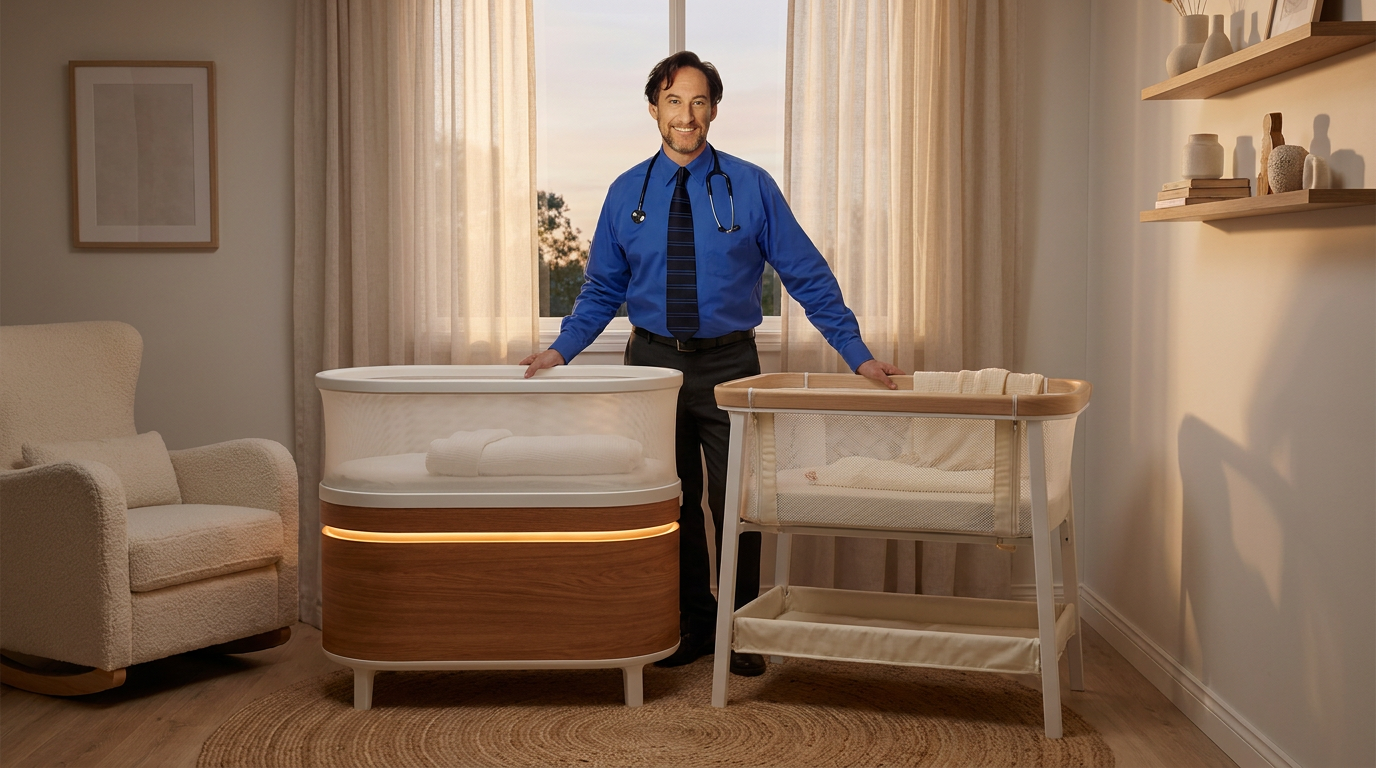
The core mechanism of a traditional bassinet, such as the Halo BassiNest or the Maxi-Cosi Iora, is elegant simplicity. These units provide a firm, flat, and safe sleeping surface surrounded by breathable mesh walls. They do not require Wi-Fi, they do not have companion smartphone apps, and they do not move unless a parent physically pushes them. The parent remains the sole engine of soothing. If an infant wakes at 2:00 a.m. needing to be rocked back to sleep, the caregiver must lean over the side of the bed and manually sway the basket. While some premium traditional models include battery-operated vibration or a simple nightlight, the fundamental design relies entirely on human intervention to calm a fussy baby.[2][6]
The case for traditional bassinets rests heavily on cost-effectiveness, physical accessibility, and portability. Priced typically between $100 and $300, they leave ample room in a family's budget for other newborn essentials. Beyond the financial advantage, traditional models excel at physical proximity. Bedside sleepers like the Halo BassiNest feature a 360-degree swivel and a lowering side wall, allowing a parent to reach their baby, soothe them, or lift them for feeding without ever swinging their legs out of bed. For mothers recovering from a Cesarean section, this drop-down access is not merely a convenience; it is a critical, pain-reducing feature that smart bassinets currently cannot replicate. Furthermore, traditional bassinets are lightweight and easy to move from room to room, offering flexible safe sleep spaces throughout the house.[6]

The primary argument against traditional bassinets is the sheer physical toll they demand from sleep-deprived parents. Because the bassinet cannot soothe the baby independently, every minor fuss, grunt, or startle reflex requires the parent to wake up and intervene. A traditional cradle stops moving the exact moment the parent stops pushing it. For infants who struggle to connect their sleep cycles and require constant motion to stay asleep, the manual nature of a standard bassinet can lead to severe parental exhaustion. There is no automated safety net to prevent a mild stirring from escalating into a full-blown meltdown, meaning the caregiver absorbs the full brunt of nighttime wakefulness.[3]
The evidence supporting the efficacy of traditional bassinets is robust, particularly when evaluated on safety and fundamental design. In recent Consumer Reports testing, the traditional Maxi-Cosi Iora earned a score of 89 out of 100—the highest rating across all bassinet categories, beating out every smart model on the market. Testers praised its simple, sturdy, and flawless execution of safe sleep principles. The American Academy of Pediatrics strictly recommends that infants sleep on their backs on a firm, flat surface, a standard that traditional bassinets meet without introducing complex mechanical variables. For families who prioritize a proven, distraction-free sleep environment, the data confirms that a well-built traditional bassinet performs its core job perfectly.[2][7]
The evidence supporting the efficacy of traditional bassinets is robust, particularly when evaluated on safety and fundamental design.
On the other side of the nursery divide sits the smart bassinet, a category pioneered by the Happiest Baby SNOO and now populated by advanced competitors like the Cradlewise and the Maxi-Cosi Starling. The core mechanism of these devices transforms the bassinet from a passive piece of furniture into an active participant in infant care. Equipped with built-in microphones, motion sensors, and AI-driven cry analysis, smart bassinets detect when a baby is stirring or fussing. Before the infant can fully wake up and cry, the bassinet automatically responds by deploying a customized combination of white noise and physical motion—ranging from a gentle sway to a rhythmic bounce—designed to mimic the soothing environment of the womb.[1][4][5]

The case for smart bassinets is built entirely around the promise of recovered sleep. For parents lacking nighttime help or dealing with a notoriously fussy sleeper, a smart bassinet acts as an 'extra set of hands.' By intervening at the first sign of restlessness, these devices can successfully soothe a baby back to sleep without the parent ever having to leave their pillow. Reviewers and pediatric sleep consultants consistently note that the responsive motion effectively shortens the time it takes for newborns to resettle. Additionally, companion apps provide detailed sleep tracking data, helping data-driven parents identify patterns and predict nap times. For many families, the ability to buy back even one or two hours of sleep a night justifies the entire investment.[3][5]
The arguments against smart bassinets center on their exorbitant cost, bulky footprints, and rigid design limitations. Retailing between $950 and $1,700, these devices represent a massive upfront financial commitment for a product that a baby will typically outgrow in just four to six months. The Cradlewise is a notable exception, as it converts into a mini-crib that lasts up to 24 months. Furthermore, smart bassinets are heavy pieces of machinery that must remain tethered to a wall outlet, eliminating the portability that traditional bassinets offer. They also lack the drop-down sides of bedside sleepers, meaning parents must physically sit up and bend over the high walls to retrieve their infant—a significant drawback for C-section recovery.[4][5]

The evidence regarding smart bassinets highlights their undeniable effectiveness at soothing, alongside strict safety caveats. Forbes gear editors who tested the SNOO reported that it definitively helped infants transition from waking hourly to sleeping through the night, particularly for babies who demand constant motion. However, safety experts emphasize that smart features do not replace fundamental safe sleep practices. The American Academy of Pediatrics and 2026 federal safety standards dictate that even automated bassinets must maintain a firm, flat surface without inclined positioning. While the technology excels at extending sleep cycles, pediatricians remind parents that the bassinet is merely a tool to support good sleep habits, not a magic cure-all that overrides a baby's need to feed or be held.[1][7]
When weighing the ultimate trade-off between cost and sleep, parents must quantify the investment. Purchasing a $1,695 SNOO or a $950 Maxi-Cosi Starling is a stark contrast to buying a $270 Maxi-Cosi Iora. To bridge this gap, a robust rental market has emerged, allowing families to rent premium smart bassinets for a monthly fee. This mitigates the financial risk if the baby simply does not respond to the automated motion. Conversely, the trade-off between accessibility and automation forces a choice between physical comfort for the parent and automated soothing for the baby. A traditional bedside sleeper offers unmatched physical access for nighttime nursing, while a smart bassinet requires more physical effort to retrieve the baby but theoretically reduces the total number of times that retrieval is necessary.[6][8]
Ultimately, a smart bassinet fits well when a family has the budget—or access to a rental program—and highly values automated assistance. It is the ideal choice for parents who do not have a partner or family help for night shifts, as the device genuinely serves as a secondary caregiver. It also fits perfectly for families with a highly sensitive or fussy sleeper who startles easily and requires constant motion to stay asleep. Data-loving parents who appreciate app-based sleep tracking and customizable motion settings will find the technology highly rewarding. If maximizing uninterrupted sleep is the absolute highest priority, the smart bassinet delivers on its premium promise.[3][8]
Conversely, a smart bassinet does not fit when a family is on a tight budget or prefers a minimalist approach to baby gear. It is a poor choice for parents who prioritize immediate, barrier-free physical access to their baby for frequent nighttime nursing or who are recovering from abdominal surgery. A traditional bassinet fits perfectly when parents want a simple, highly portable, and budget-friendly safe sleep space that can be easily moved around the house. It remains the undisputed champion for bedside co-sleeping access. Ultimately, if a family is comfortable providing manual soothing and prefers not to rely on algorithms and Wi-Fi to calm their newborn, the traditional bassinet remains a flawless, time-tested solution.[3][8]
Viewpoints in depth
Tech-Forward Parents
Advocates for using technology to maximize parental sleep and track infant data.
This camp views the newborn phase as a sleep-deprivation crisis that technology can solve. They argue that the high upfront cost of a smart bassinet is easily justified by the hours of sleep gained. By relying on automated rocking and white noise, they believe parents can be more rested, patient, and present during waking hours.
Practical Traditionalists
Advocates for simplicity, physical proximity, and budget-conscious baby gear.
This perspective emphasizes that babies have slept safely for millennia without Wi-Fi or AI. They argue that traditional bassinets offer superior physical access—crucial for breastfeeding and C-section recovery—without tethering the bed to a wall outlet. They prefer saving the $1,000+ price difference for diapers, formula, or future childcare costs.
Pediatric Safety Experts
Medical professionals focused strictly on adherence to safe sleep guidelines.
For pediatricians and safety regulators, the technology is irrelevant compared to the structure. Their sole focus is ensuring the bassinet provides a firm, flat surface free of loose bedding, keeping the infant on their back. They caution that while smart features can aid sleep, they must never compromise these fundamental American Academy of Pediatrics guidelines.
What we don't know
- Whether long-term reliance on automated motion makes transitioning to a stationary crib more difficult for some infants.
- How upcoming 2026 federal safety standards might force design changes in future smart bassinet models.
Key terms
- Smart Bassinet
- An infant bed equipped with sensors, motors, and speakers that automatically respond to a baby's cries with motion and sound.
- Bedside Sleeper
- A traditional bassinet with a lowering side wall that sits flush against the parents' bed for easy physical access.
- AAP Safe Sleep Guidelines
- Recommendations by the American Academy of Pediatrics stating babies should sleep on their backs on a firm, flat surface.
- Weaning Mode
- A setting on smart bassinets that gradually reduces automated motion to help babies transition to a stationary crib.
Frequently asked
Are smart bassinets safe for newborns?
Yes, provided they meet federal safety standards for a firm, flat sleep surface and are used without loose blankets or pillows.
Can I rent a smart bassinet instead of buying one?
Yes, several companies offer monthly rental programs for premium models like the SNOO, which significantly reduces the upfront cost.
How long can a baby use a bassinet?
Most babies outgrow a standard bassinet by 4 to 6 months, or whenever they begin to roll over or push up on their hands and knees.
Do smart bassinets require Wi-Fi to work?
Most require Wi-Fi for app connectivity and sleep tracking, though basic motion and sound features can often be operated manually via physical buttons.
Sources
Source coverage
8 outlets
3 viewpoints surfaced







[1]ForbesTech-Forward Parents
Snoo Review: How My Twins Went From Waking Hourly To Sleeping All Night
Read on Forbes →[2]Consumer ReportsPediatric Safety Experts
Best Bassinets of 2026: Smart, Traditional, and Travel
Read on Consumer Reports →[3]Baby enRoutePractical Traditionalists
Is a Smart Bassinet Worth It? A Sleep-Deprived Parent's Guide
Read on Baby enRoute →[4]FathercraftTech-Forward Parents
Cradlewise Review: Is the Smart Crib Worth It?
Read on Fathercraft →[5]Wholesome LinenTech-Forward Parents
2026 Best Smart Bassinets for Baby Sleep Safety
Read on Wholesome Linen →[6]KidobebePractical Traditionalists
SNOO vs Halo BassiNest: Which is Best for Canadian Parents?
Read on Kidobebe →[7]American Academy of PediatricsPediatric Safety Experts
Safe Sleep Recommendations: Back-Sleeping and Firm Surfaces
Read on American Academy of Pediatrics →[8]Factlen Editorial Team
Synthesis by Factlen editorial team
Read on Factlen Editorial Team →
More in shopping
See all 7 stories →Sleep Tech
Do Sleep Trackers Actually Work? The Clinical Evidence on Wearable Accuracy
8 sources
Summer Sales
Amazon, Target, and Walmart Shift Summer Sales to June, Creating a Retail 'Mega-Week'
6 sources

Display Tech
OLED vs. Mini-LED: The 2026 Gaming Monitor Trade-Off Analysis
6 sources
Used EVs
The 2026 Guide to Buying a Used EV: Battery Health, Tax Credits, and What to Know
8 sources

Every angle. Every day.
Get shopping stories with full source coverage and perspective breakdowns delivered to your inbox.