
The Neuroscience of Awe: How 'Everyday Wonder' Rewires the Brain and Reduces Inflammation
New research reveals that experiencing awe—even in small, daily doses—quiets the brain's ego center, lowers inflammation, and dramatically boosts psychological well-being.
By Factlen Editorial Team
- Neuroscientists & Biologists
- Focus on the biological mechanisms of awe, specifically brain networks and inflammation.
- Clinical & Public Health Researchers
- View awe as a scalable, zero-cost intervention for loneliness and aging.
- Cultural Psychologists
- Emphasize the universal, cross-cultural triggers of awe beyond just nature.
What's not represented
- · Urban Planners
- · Educators
Why this matters
In an era of rising loneliness and chronic stress, awe offers a free, accessible biological reset. Understanding how to trigger this emotion in daily life can provide immediate protection against inflammation and anxiety.
Key points
- Awe deactivates the Default Mode Network, quieting the ego and reducing internal rumination.
- Experiencing awe shifts the nervous system into a 'rest-and-digest' state, lowering cortisol and inflammation.
- A UCSF study found that weekly 15-minute 'awe walks' significantly increased joy and compassion in older adults.
- You don't need to travel to experience awe; it can be triggered daily by music, collective movement, or witnessing human kindness.
The modern pursuit of wellness often involves expensive supplements, rigid routines, and complex tracking apps. But neuroscientists and psychologists are increasingly pointing to a free, ancient, and highly accessible emotion as a profound driver of human health: awe. Long relegated to the domains of philosophy and religion, awe is now the subject of rigorous clinical research.[1][3]
Psychologists define awe as the emotion that arises when we encounter something so vast and mysterious that it transcends our current understanding of the world. This encounter forces the brain into a state of "cognitive accommodation"—meaning the mind has to literally stretch and update its internal models to make sense of the experience.[3][5]
Historically, we have associated this feeling with rare, monumental events: standing at the rim of the Grand Canyon, witnessing a total solar eclipse, or looking up at the ceiling of the Sistine Chapel. But recent scientific consensus has shifted dramatically toward "everyday awe," revealing that micro-doses of wonder are not only common but biologically essential.[1][4]
The most striking discoveries regarding awe come from functional magnetic resonance imaging (fMRI) scans of the human brain. When a person experiences awe, a specific network of brain regions known as the Default Mode Network (DMN) rapidly deactivates.[2][5]
The Default Mode Network is the brain's resting-state system, heavily associated with ego, self-reflection, and prospection. When you are ruminating on a past mistake, worrying about a future deadline, or engaging in self-criticism, your DMN is highly active. By quieting this network, awe acts as a neurological reset button, temporarily dissolving the ego and halting the cycle of internal chatter.[1][2]

This psychological shift from a self-centered view to a broader perspective is known in the literature as the "small self" effect. As the ego shrinks, the brain's threat-detection center—the amygdala—also dials down its activity. The nervous system shifts out of the sympathetic "fight-or-flight" mode and into the parasympathetic "rest-and-digest" state.[3][5]
The physiological consequences of this shift are highly measurable. Studies have shown that frequent experiences of awe are robustly correlated with higher vagal tone, which indicates a healthy, flexible nervous system. Furthermore, awe is uniquely associated with lower levels of interleukin-6, a biomarker for the kind of chronic inflammation that drives cardiovascular disease and depression.[2][5]
The physiological consequences of this shift are highly measurable.
To test whether awe could be prescribed as a clinical intervention, researchers at the University of California, San Francisco (UCSF) designed a landmark study involving healthy older adults. The participants were asked to take a 15-minute outdoor walk once a week for eight weeks.[6][7]
Half of the participants were simply told to walk. The other half—the experimental group—were given brief instructions to treat their stroll as an "awe walk." They were asked to consciously shift their attention outward, to look for details in the world they hadn't noticed before, and to cultivate a sense of wonder, whether by observing a complex leaf pattern or the vastness of the sky.[4][6]
The results, tracked through daily emotional surveys, were striking. Over the eight weeks, the awe-walk group reported significant increases in joy, compassion, and gratitude, alongside a measurable decrease in daily distress. The control group, despite walking just as much, did not experience these compounding emotional benefits.[6][7]

The most fascinating evidence from the UCSF study came from selfies the participants were asked to take during their walks. Over the course of the eight weeks, independent raters noted that the smiles of the awe-walk group grew measurably more intense. More revealingly, the participants physically made themselves smaller in the photographic frame over time, allowing the background to dominate the image—a literal manifestation of the "small self" effect.[1][7]
If awe is so beneficial, how do we find it without traveling to a national park? Dr. Dacher Keltner, a pioneering emotion scientist at UC Berkeley, conducted research across 26 different cultures to map the universal triggers of this emotion. He identified eight distinct "wonders of life" that reliably produce awe across the globe.[3][5]
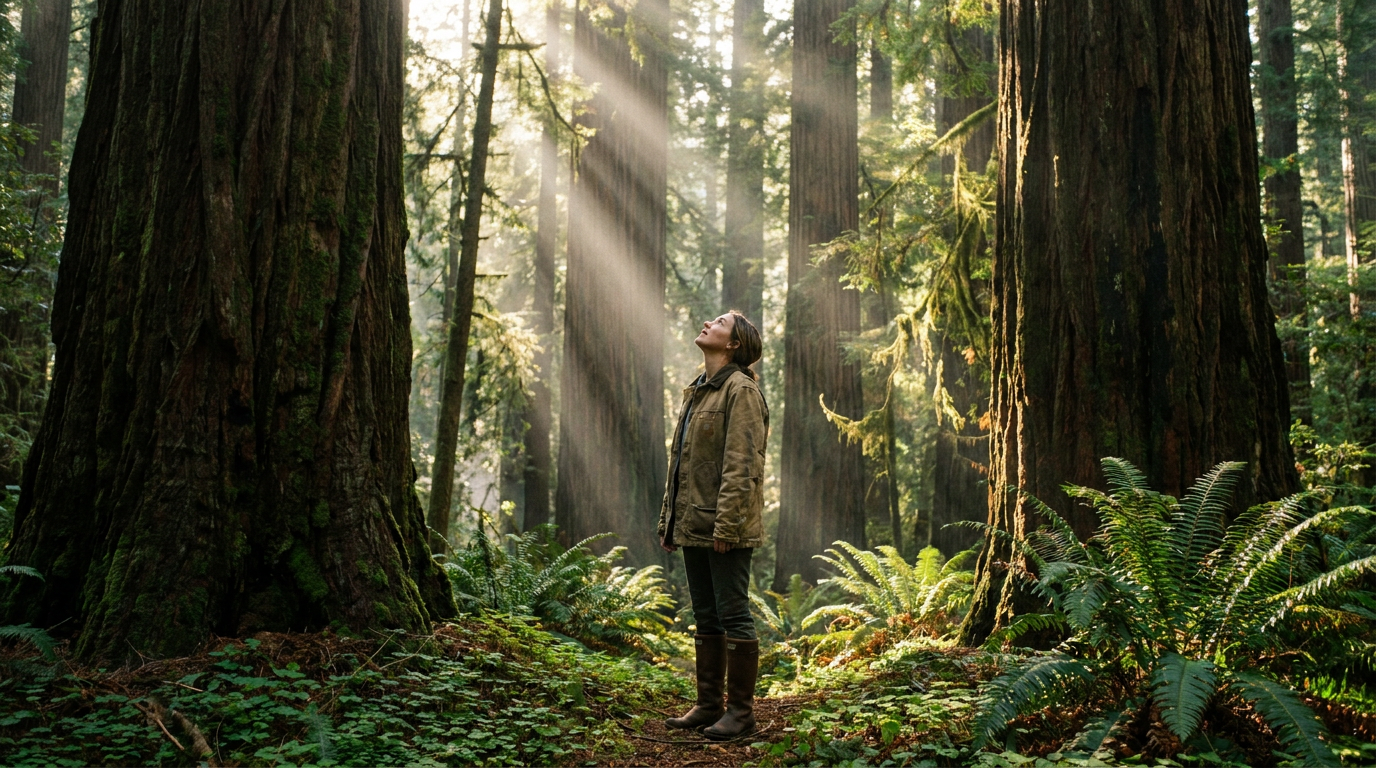
Surprisingly, the most common source of awe worldwide is not nature, but "moral beauty." This occurs when we witness acts of exceptional courage, kindness, or strength in other people. Hearing a story about a stranger risking their life for another, or watching a community rally around a struggling family, triggers the exact same DMN deactivation and vagal nerve stimulation as looking at a towering redwood.[3][4]
Another highly accessible trigger is "collective effervescence"—the electric sensation of moving in sync with a large group of people. This shared consciousness is what people experience when singing in a choir, dancing at a crowded concert, or cheering in unison at a sports stadium. It biologically weaves the individual into a larger social fabric.[1][4]

Music, visual design, and exposure to big ideas also serve as reliable, everyday pathways to awe. A 2025 study found that participants who spent just two minutes engaged with awe-inducing art or music experienced immediate drops in cortisol and reported feeling more uplifted and connected to humanity.[2][5]
However, researchers are careful to note that not all awe is positive. "Threat-based awe" occurs when we encounter vastness that is dangerous, such as a violent tornado or a terrifying geopolitical event. While this still forces cognitive accommodation and shrinks the self, it activates the body's stress response rather than calming it. The health benefits of awe rely entirely on the absence of immediate physical threat.[2][3]

Ultimately, the new science of awe reframes how we think about well-being. It suggests that mental health is not just about looking inward to fix the self, but about looking outward to realize how small the self actually is. By intentionally seeking out micro-moments of wonder, we can build a biological buffer against the stresses of modern life.[1][5]
How we got here
2003
Psychologists Dacher Keltner and Jonathan Haidt publish a landmark paper defining the conceptual framework of awe.
2015
Studies first link the frequent experience of awe to lower levels of inflammatory cytokines like interleukin-6.
2022
UCSF researchers publish findings showing that weekly 15-minute 'awe walks' significantly improve emotional well-being in older adults.
2023
Comprehensive cross-cultural research identifies the 'Eight Wonders of Life,' proving that moral beauty is the most universal trigger of awe.
Viewpoints in depth
Neuroscientists & Biologists
Focus on the biological mechanisms of awe, specifically brain networks and inflammation.
For neuroscientists, awe is not a mystical concept but a measurable physiological state. They focus on how perceived vastness deactivates the Default Mode Network and stimulates the vagus nerve. This camp emphasizes that awe acts as an evolutionary mechanism to shift human beings out of selfish, ego-driven survival modes and into cooperative, pro-social states, which can be tracked via biomarkers like interleukin-6.
Clinical & Public Health Researchers
View awe as a scalable, zero-cost intervention for loneliness and aging.
Public health experts look at the clinical applications of awe, particularly for aging populations facing isolation and cognitive decline. They champion interventions like the 'awe walk' because they are free, require no specialized equipment, and have high compliance rates. This perspective argues that incorporating awe into standard mental health recommendations could significantly reduce the societal burden of stress-related chronic diseases.
Cultural Psychologists
Emphasize the universal, cross-cultural triggers of awe beyond just nature.
Cultural psychologists push back against the idea that awe is exclusively found in elite experiences like traveling to natural wonders. By studying diverse populations, they highlight that 'moral beauty'—witnessing the kindness and courage of others—is the most universal trigger of awe. They argue that community events, music, and collective movement are essential social glues that have evolved to bind human groups together.
What we don't know
- Exactly how long the physiological benefits of a single awe experience last before returning to baseline.
- Whether digital or virtual reality experiences of awe provide the exact same biological benefits as in-person experiences.
Key terms
- Default Mode Network (DMN)
- A network of interacting brain regions that is highly active during mind-wandering, self-reflection, and rumination.
- Cognitive Accommodation
- The mental process of altering one's existing beliefs and schemas to make sense of new, vast, or complex information.
- Vagal Tone
- A measure of cardiovascular function that indicates the activity of the vagus nerve, reflecting the body's ability to relax and recover from stress.
- Collective Effervescence
- The profound feeling of connection and shared consciousness experienced when moving or vocalizing in sync with a large group of people.
- Interleukin-6
- A protein produced by the body that acts as a biomarker for chronic inflammation, often linked to stress and various diseases.
Frequently asked
Do I need to travel to a national park to experience awe?
No. Research shows that 'everyday awe' or micro-awe can be found in daily life through music, observing small details in nature, or witnessing acts of kindness.
What exactly is an 'awe walk'?
An awe walk is a 15-minute stroll where you intentionally shift your focus outward, looking for new details, vastness, or beauty in your environment rather than looking at your phone or ruminating.
How does awe affect the body physically?
Awe lowers heart rate, reduces cortisol (the stress hormone), and decreases markers of chronic inflammation like interleukin-6 by shifting the body into a 'rest-and-digest' state.
What is 'moral beauty'?
Moral beauty is the feeling of awe triggered by witnessing the courage, exceptional kindness, or strength of other people. It is the most commonly reported source of awe worldwide.
Sources
Source coverage
7 outlets
3 viewpoints surfaced







[1]Factlen Editorial TeamCultural Psychologists
Synthesis by Factlen editorial team
Read on Factlen Editorial Team →[2]National Institutes of HealthNeuroscientists & Biologists
Awe as a Pathway to Mental and Physical Health
Read on National Institutes of Health →[3]Greater Good Science CenterCultural Psychologists
The Science of Awe
Read on Greater Good Science Center →[4]Stanford UniversityClinical & Public Health Researchers
Take an 'Awe Walk': The Benefits of Walking with Presence
Read on Stanford University →[5]National GeographicNeuroscientists & Biologists
The science of awe: How it changes your brain and body
Read on National Geographic →[6]ClinicalTrials.govClinical & Public Health Researchers
Awe Walks and Emotional Well-being in Older Adults
Read on ClinicalTrials.gov →[7]Popular MechanicsClinical & Public Health Researchers
An 'Awe Walk' Might Do Wonders for Your Well-Being
Read on Popular Mechanics →



Every angle. Every day.
Get culture stories with full source coverage and perspective breakdowns delivered to your inbox.