
NASA Taps Eric Schmidt's Relativity Space for 2028 Mars Weather Mission
NASA has partnered with Relativity Space to launch the Aeolus orbiter in 2028, aiming to capture the first daily global picture of Martian weather to prepare for future human missions.
By Factlen Editorial Team
- Commercial Space Advocates
- Argue that public-private partnerships lower costs and increase launch cadence for deep-space science.
- Planetary Scientists
- Value the unprecedented daily global atmospheric data to reduce risks for future crewed missions.
- Aerospace Skeptics
- Highlight the high risk of relying on an unproven launch provider that has never reached orbit.
What's not represented
- · Traditional aerospace contractors who may lose out on future NASA planetary missions.
- · Taxpayer watchdog groups monitoring the financial transparency of Space Act Agreements.
Why this matters
Accurate daily weather data is the missing link for safely landing heavy payloads and human crews on Mars. By outsourcing the spacecraft and launch to a private company, NASA is attempting to drastically lower the cost of deep-space science.
Key points
- NASA has selected Relativity Space to launch the Aeolus weather satellite to Mars in 2028.
- The mission will provide the first daily, global measurements of Martian winds, temperatures, and dust.
- Data from Aeolus is critical for designing safe landing systems for future human missions.
- Relativity Space, led by former Google CEO Eric Schmidt, will provide the spacecraft and launch vehicle.
- The spacecraft will also function as an orbital data center, capable of running AI models in space.
- Relativity Space has never reached orbit, making the 2028 timeline highly ambitious.
In a major shift for planetary exploration, NASA has selected California-based Relativity Space to design, build, and launch a new weather satellite to Mars. The mission, scheduled for 2028, will carry the agency's Aeolus instrument suite into Martian orbit to provide the first daily, global measurements of the planet's environment.[1][2]
The collaboration operates under a six-year reimbursable Space Act Agreement, marking a strategic evolution in how NASA conducts deep-space research. While the agency has routinely relied on private companies like SpaceX to ferry cargo to the International Space Station, treating an interplanetary Mars mission as a commercial delivery service is a relatively new frontier. Under this framework, NASA will supply the scientific expertise and instruments, while Relativity Space provides the spacecraft, the launch vehicle, and the interplanetary cruise operations.[3][7][8]
The scientific payload, dubbed Aeolus, is currently being developed at NASA's Ames Research Center in Silicon Valley. It consists of four complementary instruments designed to work in tandem, capturing a comprehensive daily picture of Martian winds, temperatures, dust, and cloud cover. Never before has a single mission provided such a detailed, synchronized view of the Red Planet's atmospheric behavior.[2][5][8]
The suite includes a Doppler Wind and Temperature Sounder to measure vertical profiles up to 60 kilometers above the surface, and a Thermal Limb Sounder to observe water-ice clouds and dust. A Surface Radiometric Sensor Package will measure the planet's surface energy balance, while a Wide-Field Context Camera captures daily global images of atmospheric activity.[4][7][8]

Historically, spacecraft like the Mars Reconnaissance Orbiter, Mars Odyssey, and the recently retired MAVEN mission have studied the Martian atmosphere partially and independently of one another. Aeolus aims to combine all these key parameters into a single, continuous daily dataset, filling a critical gap in planetary science.[4][5][8]
Understanding the Martian atmosphere is not merely an academic exercise; it is an engineering necessity for future exploration. The atmosphere of Mars presents a unique paradox: it is dense enough to cause severe aerodynamic heating during a spacecraft's entry, but too thin to allow for effective braking using traditional parachutes.[5]
This challenge is compounded by the planet's volatile weather. Global dust storms can engulf Mars for months at a time, drastically altering the density of the atmosphere at the exact altitudes where incoming spacecraft need to decelerate before landing. A sudden drop in atmospheric density during descent can lead to a catastrophic crash.[5]

This challenge is compounded by the planet's volatile weather.
The data collected by Aeolus is expected to refine models of this atmospheric behavior, directly influencing the design of entry, descent, and landing (EDL) systems. NASA Administrator Jared Isaacman noted that getting this essential data into the hands of researchers is a prerequisite for safely navigating the atmosphere during future robotic and human missions to the surface.[1][5][7][8]
For Relativity Space, the mission represents a monumental leap in ambition. Founded in 2015 by former SpaceX and Blue Origin engineers, the company initially gained industry attention for its pioneering use of large-scale 3D printing technology to manufacture rocket components. Now, it is responsible for managing an entire interplanetary flight.[3][6][7]
The company's trajectory shifted dramatically in 2025 when former Google CEO Eric Schmidt acquired a controlling stake and installed himself as chief executive. Schmidt has since pivoted the company's focus toward deep-space exploration and orbital infrastructure, backed by significant investments from his family philanthropy, Schmidt Sciences.[1][3][6]

The Aeolus mission will serve as a literal manifestation of Schmidt's stated ambitions. The spacecraft will function as what Relativity calls a "Relay Data Center"—featuring server-class computing and mass storage in Mars orbit. This orbital infrastructure will be capable of running artificial intelligence models on board and beaming large volumes of processed data back to Earth over optical and radio links.[6]
The financial structure of the mission is equally novel. Relativity Space describes Aeolus as flying for a "philanthropic customer," allowing NASA to dedicate its budget strictly to the high-value scientific instruments and data processing pipelines without bearing the full financial burden of developing a launch vehicle and spacecraft.[6][7]
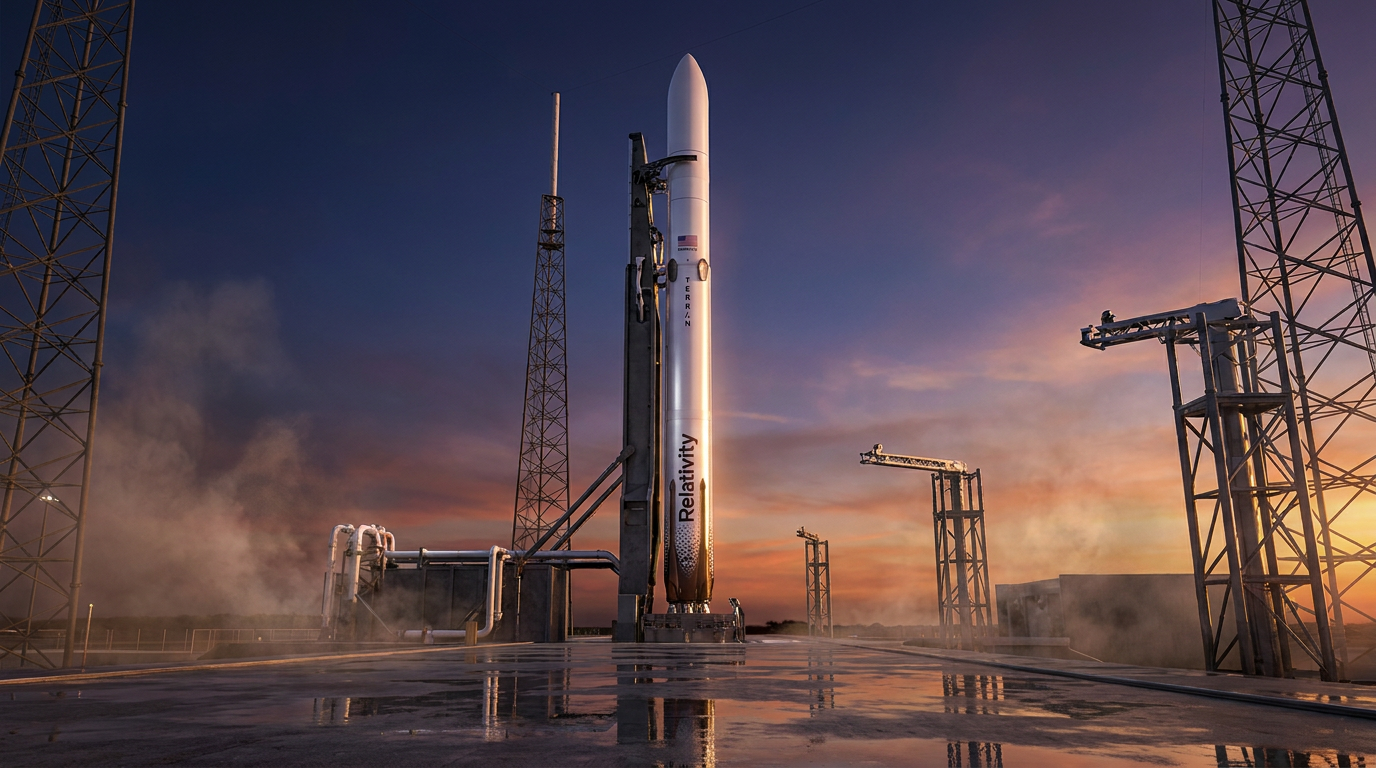
Despite the innovative approach, the partnership carries substantial technical risk. Relativity Space has never successfully reached orbit. Its first 3D-printed rocket, the Terran 1, launched in March 2023 but suffered a second-stage engine failure mid-flight.[1][3][6]
Following that setback, the company abandoned the Terran 1 to focus on developing the Terran R, a much larger, partially reusable launch vehicle. The Terran R has not yet flown, and its maiden launch is currently scheduled for late 2026, leaving a tight timeline to prove the vehicle's reliability before the 2028 Mars launch window.[1][5][6]

If successful, delivering a NASA payload to Mars would give Relativity Space critical deep-space flight experience, instantly transforming it from a struggling startup into a major competitor for lucrative future launch contracts. It also sets up an intriguing dynamic with SpaceX, offering Schmidt's company a chance to reach the Red Planet before Elon Musk's Starship program achieves the same milestone.[3][6][7]
Ultimately, the Aeolus mission tests a new paradigm for planetary science. By pairing NASA's world-class instrumentation with commercial innovation and private capital, the agency hopes to create a "force multiplier" that can deliver more science, more frequently, and at a fraction of the traditional cost.[1][7]
How we got here
March 2023
Relativity Space launches its first 3D-printed rocket, Terran 1, which fails to reach orbit.
2024
NASA begins studying the concept of using commercial delivery services for Mars science payloads.
March 2025
Former Google CEO Eric Schmidt acquires a controlling stake in Relativity Space and becomes CEO.
June 2026
NASA officially announces the public-private partnership for the Aeolus mission.
Late 2026
Relativity Space's larger, reusable Terran R rocket is scheduled to make its debut flight.
2028
Target launch window for the Aeolus mission to Mars.
Viewpoints in depth
Commercial Space Advocates
Supporters of public-private partnerships in deep space exploration.
Proponents argue that treating Mars missions as commercial delivery services is the only sustainable path forward for planetary science. By offloading the cost of launch vehicles and spacecraft buses to private companies—often subsidized by philanthropic or venture capital—NASA can stretch its budget to fly more scientific instruments. They view the Space Act Agreement model, which proved highly successful for resupplying the International Space Station, as the blueprint for increasing the cadence of deep-space discovery.
Planetary Scientists
Researchers focused on the data gap in Martian atmospheric models.
For the scientific community, the primary focus is the unprecedented nature of the Aeolus data. Previous orbiters have provided piecemeal observations of the Martian atmosphere, making it difficult to build cohesive, predictive weather models. Scientists emphasize that without a daily, global understanding of how dust storms alter atmospheric density, designing the heavy-duty entry, descent, and landing (EDL) systems required for future human missions remains dangerously reliant on guesswork.
Aerospace Skeptics
Industry analysts cautious about relying on unproven launch providers.
Skeptics point out the immense risk NASA is taking by partnering with a company that has yet to achieve orbit. Relativity Space's only flight to date ended in failure, and its Terran R rocket is still in development. Critics argue that while the financial terms may be favorable to NASA, entrusting a one-of-a-kind, custom-built scientific payload to an unproven launch vehicle and a first-time interplanetary spacecraft operator introduces a high probability of mission failure, regardless of the private capital backing it.
What we don't know
- The exact financial value of the contract, as neither NASA nor Relativity Space has disclosed the figures.
- Whether the Terran R rocket will be ready and proven reliable in time for the 2028 Mars launch window.
- The specific technical specifications of the 'Relay Data Center' computing hardware that will operate in Mars orbit.
Key terms
- Space Act Agreement
- A legal agreement that allows NASA to partner with commercial entities outside of traditional, heavily regulated government procurement contracts.
- Entry, Descent, and Landing (EDL)
- The critical and dangerous phase of a spacecraft's journey where it enters a planet's atmosphere, slows down, and lands on the surface.
- Doppler Wind and Temperature Sounder
- An instrument that measures the shift in frequency of light or sound waves to determine the speed and temperature of atmospheric winds.
- Aerodynamic Heating
- The extreme heat generated by the friction of a spacecraft traveling at high speeds through a planet's atmosphere.
Frequently asked
What is the Aeolus mission?
Aeolus is a planned 2028 NASA mission to Mars that will use four scientific instruments to provide the first daily, global picture of Martian weather, including winds, dust, and temperatures.
Why is Martian weather important?
Mars experiences massive dust storms that change the density of its atmosphere. Understanding these changes is critical for safely landing heavy spacecraft and future human crews.
Who is building the spacecraft?
Relativity Space, a private aerospace company led by former Google CEO Eric Schmidt, is building the spacecraft and the rocket that will launch it.
Has Relativity Space gone to Mars before?
No. The company has never successfully reached Earth orbit, making this 2028 Mars mission a highly ambitious leap for the startup.
Sources
Source coverage
8 outlets
3 viewpoints surfaced








[1]The VergeAerospace Skeptics
NASA selects Eric Schmidt's rocket company for a 2028 mission to Mars
Read on The Verge →[2]Space.comPlanetary Scientists
NASA picks Relativity Space for 2028 Mars mission
Read on Space.com →[3]TechCrunchCommercial Space Advocates
NASA selects Relativity Space to build and launch Aeolus
Read on TechCrunch →[4]EngadgetAerospace Skeptics
NASA has teamed up with Relativity Space for a Martian orbiter mission
Read on Engadget →[5]Universe MagazinePlanetary Scientists
Mars' atmosphere will be studied for the first time using a commercial spacecraft
Read on Universe Magazine →[6]The Next WebAerospace Skeptics
NASA picked Eric Schmidt's Relativity Space to fly to Mars. It has never reached orbit.
Read on The Next Web →[7]SpaceQCommercial Space Advocates
NASA strikes new public-private partnership with Relativity Space for Mars mission
Read on SpaceQ →[8]NASAPlanetary Scientists
NASA Announces Public-Private Partnership for Mars Atmospheric Science
Read on NASA →


Every angle. Every day.
Get technology stories with full source coverage and perspective breakdowns delivered to your inbox.