
How Quantum Error Correction Unlocked the Fault-Tolerant Era in 2026
Major breakthroughs in error correction and logical qubits have officially moved quantum computing out of the noisy experimental phase. By proving that adding qubits can exponentially reduce errors, researchers have laid the foundation for utility-scale quantum machines.
By Factlen Editorial Team
- Superconducting Scaling & Error Correction
- Advocates for using well-understood superconducting circuits and applying massive software-based error correction to achieve scale.
- Hybrid Enterprise Integration
- Focuses on immediate commercial value by pairing classical supercomputers with quantum co-processors.
- Topological Hardware Stability
- Proponents of building error resistance directly into the physics of the chip to reduce software overhead.
What's not represented
- · Cryptographers preparing for Q-Day
- · Classical supercomputing hardware manufacturers
Why this matters
Quantum error correction is the missing link that turns quantum computers from fragile lab experiments into reliable industrial machines. By solving the noise problem, 2026's breakthroughs clear the path for simulating complex molecules, discovering new drugs, and optimizing global supply chains in days rather than decades.
Key points
- Quantum computing has officially exited the 'noisy' era and entered the fault-tolerant foundation era.
- Quantum Error Correction (QEC) uses entanglement to fix errors without collapsing the quantum state.
- Google's Willow chip proved that scaling up physical qubits can exponentially suppress error rates.
- Microsoft's Majorana 1 chip aims to build error resistance directly into the hardware using topological qubits.
- The industry standard for enterprise use is now Hybrid Quantum-Classical Computing via the cloud.
For decades, quantum computing has been trapped in the "almost there" zone. The promise was always staggering—machines capable of simulating molecular interactions for life-saving drugs or optimizing global supply chains in seconds. But the reality was the "NISQ" era: Noisy Intermediate-Scale Quantum. The machines were powerful in theory, but far too unstable to run complex, sustained calculations in practice.[1][3]
The core problem has always been fragility. Classical computers use bits that sit reliably at 0 or 1. Quantum computers use "qubits" that exist in a delicate superposition of both states. The slightest environmental disturbance—a stray photon, a tiny temperature fluctuation, or even electromagnetic radiation—can cause "decoherence," corrupting the calculation before it finishes.[4][8]
In classical computing, error correction is simple: duplicate the data, check for disagreements, and overwrite the corrupted copy. But the laws of quantum mechanics strictly forbid the copying of unknown quantum states, a principle known as the no-cloning theorem. This fundamental vulnerability meant that early quantum computers were essentially highly sophisticated random number generators once their circuits got too deep.[1][4]
Enter Quantum Error Correction (QEC), the defining breakthrough that has transformed 2026 into the year quantum computing shifted from a physics experiment to a scalable engineering discipline. QEC bypasses the no-cloning rule by using entanglement. Instead of duplicating data, it distributes the information of a single "logical qubit" across dozens or hundreds of physical qubits.[3][6]

If one physical qubit flips or loses its state, the broader entangled network retains the information. Through targeted "syndrome measurements," the system can detect and fix errors without ever directly observing—and thus collapsing—the delicate quantum state itself. It is akin to diagnosing a patient's illness by looking only at their shadow.[4][8]
The theoretical math for QEC has existed for years, but 2026 marked the tipping point where hardware finally caught up. The most dramatic milestone came from Google's Quantum AI division with its "Willow" processor, which proved that the theory works flawlessly at scale.[3][5]
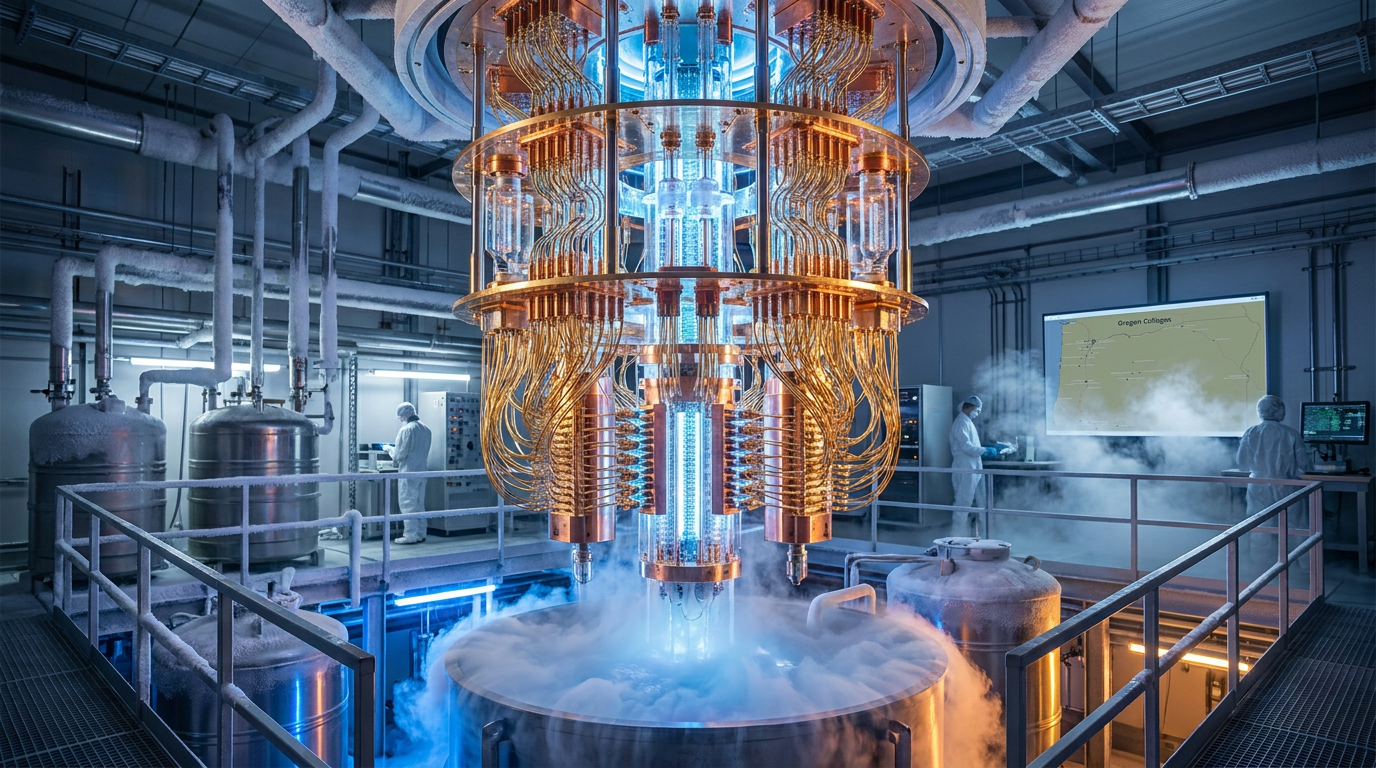
For years, adding more physical qubits to a system actually made it more error-prone, because each new component introduced new noise. Google's Willow chip demonstrated "below-threshold" error correction. By using a 105-qubit superconducting lattice, Google proved that as they increased the number of physical qubits encoding a single logical qubit, the overall error rate decreased exponentially.[3][5]
For years, adding more physical qubits to a system actually made it more error-prone, because each new component introduced new noise.
This exponential suppression of errors is the holy grail of the industry. It proves that fault-tolerant quantum computing obeys the scaling curves theorists predicted, meaning engineers can now reliably build larger systems simply by scaling up the architecture. The physics risk has been retired; what remains is an engineering challenge.[3][8]

While Google pushed the limits of superconducting circuits, Microsoft took a radically different path in early 2026 with the unveiling of its "Majorana 1" chip. Instead of relying entirely on massive software-based error correction, Microsoft engineered "topological qubits" using a new state of matter called topoconductors.[1][5]
These topological qubits leverage Majorana fermions—exotic particles that offer inherent physical resistance to environmental noise. By building stability directly into the hardware, Microsoft aims to drastically reduce the overhead required for error correction, potentially allowing up to one million qubits to fit on a single chip in the coming years.[1][5]

But storing stable quantum information is only half the battle; manipulating it is where things usually fall apart. In February 2026, researchers at ETH Zurich demonstrated a breakthrough technique called "lattice surgery," solving one of the most stubborn bottlenecks in quantum operations.[2]
Traditionally, applying quantum gates (the operations that actually perform calculations) introduces massive new errors. Lattice surgery allows engineers to split a protected logical qubit into two entangled ones mid-operation, continuously fixing errors without ever having to pause the protection to compute.[2][8]
These converging breakthroughs mean the industry is no longer measuring success by raw, noisy physical qubit counts. The new metric is the "logical qubit"—the stable, error-corrected virtual qubit that actually does the work. A machine with 100 logical qubits is vastly more powerful than a machine with 1,000 noisy physical ones.[6][7]
Companies like QuEra and IBM are now publishing roadmaps focused entirely on logical qubits, with startups like Photonic aiming to deploy 40,000 logical qubits in commercial service by 2030. The race is no longer about who can build the biggest chip, but who can build the most reliable one.[7][8]
So, what does this mean for the enterprise today? In 2026, the absolute gold standard is Hybrid Quantum-Classical Computing. Businesses are not buying standalone quantum computers. Instead, algorithms run on standard supercomputers and outsource only the most complex, uncrackable bottlenecks to a quantum processing unit (QPU) via the cloud.[1][3]

This hybrid approach is already accelerating timelines in materials science and pharmacology. By accurately simulating molecular interactions down to the atomic level—something classical supercomputers simply cannot do—hybrid systems are mapping out new highly efficient battery chemistries and drug compounds in days rather than years. The fault-tolerant foundation era has officially arrived.[1][3][8]
How we got here
Pre-2024
The NISQ Era: Quantum computers are highly susceptible to noise, limiting them to short, experimental calculations.
2024-2025
Early demonstrations of logical qubits and the transition to quantum-centric supercomputing architectures.
Early 2026
Google's Willow chip demonstrates below-threshold exponential error suppression at scale.
Feb 2026
Microsoft unveils the Majorana 1 chip, showcasing topological qubits with inherent error resistance.
2030 (Projected)
Industry targets reach tens of thousands of logical qubits in commercial, fault-tolerant service.
Viewpoints in depth
Superconducting Scaling & Error Correction
Advocates for using well-understood superconducting circuits and applying massive software-based error correction to achieve scale.
Companies like Google and IBM argue that the fastest path to utility-scale quantum computing is to use well-understood superconducting circuits and apply massive software-based error correction. By proving that error rates drop exponentially as lattice sizes grow, they believe the remaining challenge is purely an engineering scaling problem. Their roadmaps focus on building massive cryogenic systems capable of housing hundreds of thousands of physical qubits to generate the necessary logical qubits.
Topological Hardware Stability
Proponents of building error resistance directly into the physics of the chip to reduce software overhead.
Microsoft and researchers focused on topological qubits argue that software-based error correction requires too much overhead—often needing thousands of physical qubits to create one logical qubit. By using exotic particles like Majorana fermions, they aim to build qubits that are inherently immune to most environmental noise. This approach, while harder to engineer initially, could drastically shrink the hardware footprint required for fault tolerance, allowing millions of qubits on a single chip.
Hybrid Enterprise Integration
Focuses on immediate commercial value by pairing classical supercomputers with quantum co-processors.
Cloud providers and enterprise engineering firms emphasize that standalone 'quantum supremacy' is a distraction. Their focus is on hybrid orchestration, where classical supercomputers handle 99% of a workflow and seamlessly outsource only the most complex molecular or optimization bottlenecks to a quantum processing unit. For these stakeholders, the success of quantum computing in 2026 is measured not by hardware architecture, but by how easily it integrates into existing enterprise software pipelines.
What we don't know
- Whether topological qubits can be manufactured at the same scale as superconducting circuits.
- Exactly when quantum computers will be powerful enough to break current RSA encryption standards (Q-Day).
Key terms
- Qubit
- The basic unit of quantum information, capable of existing in a superposition of 0 and 1 simultaneously.
- Decoherence
- The process where a quantum system loses its delicate state due to environmental interference, causing calculation errors.
- Logical Qubit
- A stable, error-corrected virtual qubit created by entangling multiple physical qubits together.
- Lattice Surgery
- A technique to manipulate logical qubits mid-calculation without losing their error protection.
Frequently asked
Will quantum computers replace classical computers?
No. Quantum computers excel at specific, highly complex mathematical problems. They will work alongside classical computers in hybrid systems, not replace your laptop or smartphone.
What is the difference between a physical and logical qubit?
A physical qubit is the actual hardware component (like a superconducting circuit), which is prone to errors. A logical qubit is a stable, virtual qubit made by grouping many physical qubits together using error correction.
Why is 2026 a turning point for quantum computing?
2026 marks the shift from the 'noisy' era to the 'fault-tolerant' era. For the first time, adding more physical qubits to a system exponentially reduced the error rate rather than increasing it.
Sources
Source coverage
8 outlets
3 viewpoints surfaced








[1]SpinQuantaTopological Hardware Stability
2026 Qubit Breakthroughs: Quantum Computing Enters the Fault-Tolerant Foundation Era
Read on SpinQuanta →[2]ScienceDailySuperconducting Scaling & Error Correction
A Clever Trick Advances Quantum Computers: Lattice Surgery
Read on ScienceDaily →[3]BQPHybrid Enterprise Integration
Quantum Computing in 2026: From Physics to Engineering
Read on BQP →[4]OriginQCSuperconducting Scaling & Error Correction
What is Quantum Error Correction? A Clear Guide
Read on OriginQC →[5]BlueQubitSuperconducting Scaling & Error Correction
Quantum Error Correction in 2026: Recent Advancements
Read on BlueQubit →[6]RiverlaneSuperconducting Scaling & Error Correction
Quantum Error Correction Report 2026
Read on Riverlane →[7]ProtivitiHybrid Enterprise Integration
The Post-Quantum World: 40,000 Logical Qubits by 2030
Read on Protiviti →[8]Factlen Editorial TeamHybrid Enterprise Integration
Synthesis by Factlen editorial team
Read on Factlen Editorial Team →
Every angle. Every day.
Get technology stories with full source coverage and perspective breakdowns delivered to your inbox.