
Bioluminescent Beaches: The Science and Secrets of Glowing Shores
From Puerto Rico to the Maldives, bioluminescent bays offer one of nature's most magical spectacles. Here is the science behind the glow, where to find it, and how to time your visit.
By Factlen Editorial Team
- Marine Biologists
- Focus on the chemical mechanisms of bioluminescence and its evolutionary purpose as a defense mechanism.
- Ecotourism Operators
- Prioritize the visitor experience, emphasizing the importance of lunar cycles and weather for optimal viewing.
- Conservationists
- Highlight the fragility of these ecosystems and advocate for strict protections against light pollution and chemical runoff.
What's not represented
- · Local residents of Vieques managing the influx of ecotourism.
Why this matters
Understanding the mechanics of bioluminescence not only helps travelers time their visits to witness one of nature's greatest spectacles, but also highlights the fragile balance of coastal ecosystems that require our protection.
Key points
- Bioluminescence is a chemical reaction between luciferin and luciferase that produces cold light.
- Dinoflagellates use this glow as a 'burglar alarm' defense mechanism to startle predators.
- Mosquito Bay in Puerto Rico is the brightest bioluminescent bay in the world.
- The bay fully recovered its glow 18 months after being devastated by Hurricane Maria.
- Optimal viewing requires a New Moon, as bright moonlight washes out the delicate blue glow.
- Conservation rules ban swimming in many bays to prevent sunscreen chemicals from killing the organisms.
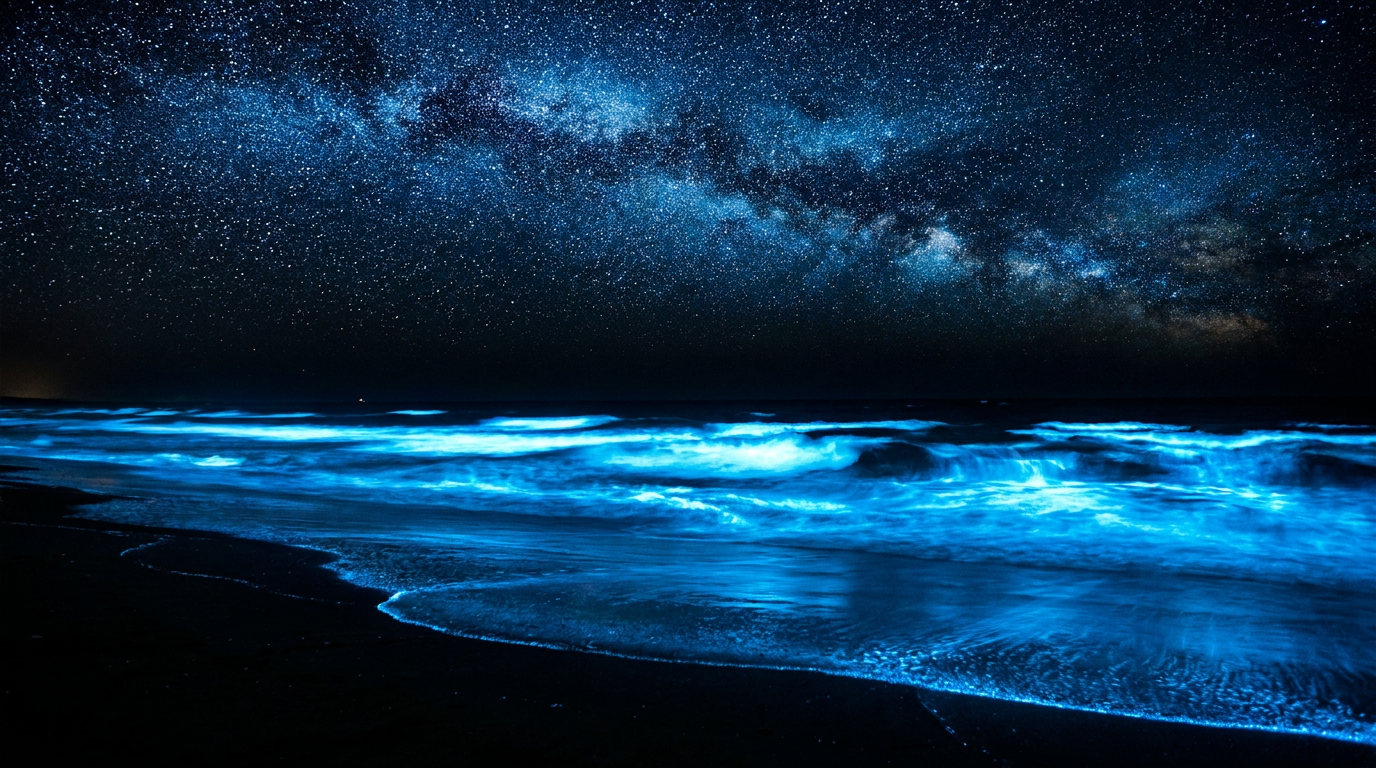
Stepping into the ocean at night and watching the water erupt in neon blue light feels like stepping onto another planet. It is a visual spectacle that has captivated sailors, scientists, and travelers for centuries, turning dark shorelines into shimmering galaxies.[1][5]
But the glowing waters of places like Puerto Rico, the Maldives, and Florida are not magic—they are the result of a highly specific biological mechanism. The primary architects of coastal bioluminescence are dinoflagellates, microscopic single-celled organisms that float in the water column.[1][4]
When agitated by a breaking wave, a kayak paddle, or a swimming fish, these plankton emit a sudden flash of cold, blue-green light. The science behind the glow comes down to a precise chemical reaction that occurs within the organism's body.[1][6]
Inside the dinoflagellate, a light-emitting molecule called luciferin reacts with an enzyme called luciferase in the presence of oxygen. This reaction produces light with almost zero heat, making it an incredibly efficient biological process.[7]

Marine biologists believe this "startle response" acts as an evolutionary burglar alarm. When a predator approaches, the sudden flash of light either startles the attacker or illuminates it, attracting an even larger predator to consume the original threat.[7]
While dinoflagellates are responsible for the glowing bays of the Caribbean, other marine environments rely on entirely different organisms. In Toyama Bay, Japan, the waters glow an electric blue each spring thanks to the firefly squid, which migrate to the surface to mate.[1][5]
In the deep ocean, sailors have long reported "milky seas"—vast expanses of glowing water that can stretch for 40,000 square miles and be seen from space. Researchers at Colorado State University recently compiled 400 years of data, linking this rare phenomenon to a luminous bacteria called Vibrio harveyi.[3]
For travelers seeking the most reliable bioluminescent displays, geography is everything. The undisputed crown jewel of glowing waters is Mosquito Bay, located on the Puerto Rican island of Vieques.[4][5]
For travelers seeking the most reliable bioluminescent displays, geography is everything.
Mosquito Bay holds the Guinness World Record for the brightest bioluminescent bay on Earth. Its unique geography—a shallow lagoon with a narrow inlet—traps the dinoflagellates, while the surrounding red mangroves provide a steady supply of vitamin-rich nutrients from decaying leaves.[2][4]

The fragility of this ecosystem was starkly demonstrated in September 2017 when Hurricane Maria devastated Puerto Rico. The storm stripped the mangroves of their leaves and altered the bay's delicate balance, causing Mosquito Bay to go completely dark.[2]
Local conservationists feared the glow might be lost forever. However, in a remarkable display of ecological resilience, the bay began to recover 18 months later. Today, researchers report that the dinoflagellate concentrations are actually higher than pre-hurricane levels.[2]
Other world-renowned spots include the "Sea of Stars" at Vaadhoo Island in the Maldives, where glowing phytoplankton wash ashore, and Florida's Indian River Lagoon, which peaks in brilliance during the warm summer months.[1][5]
Experiencing these glowing waters requires careful planning, primarily dictated by the lunar cycle. The brightness of the bioluminescence is entirely dependent on the darkness of the sky.[6]
A full moon can easily overpower the delicate blue glow, rendering it almost invisible to the human eye. Ecotourism operators universally recommend booking tours during the New Moon phase, when the sky is pitch black and the contrast is highest.[6]

Weather conditions also play a critical role. Dinoflagellates thrive in warm water temperatures and high salinity. Heavy rainfall can dilute the salt concentration in a bay, temporarily dimming the display until the ecosystem rebalances.[4]
Conservation remains a pressing concern for these rare ecosystems. Bioluminescent bays are highly sensitive to artificial light pollution, which outshines the natural glow, and chemical runoff from sunscreens and insect repellents, which can kill the microorganisms.[2][4]

How we got here
17th Century
Sailors begin recording sightings of massive glowing 'milky seas' in the Indian Ocean.
2006
Mosquito Bay in Vieques, Puerto Rico, is officially recognized by Guinness World Records as the brightest bioluminescent bay in the world.
September 2017
Hurricane Maria devastates Puerto Rico, destroying the mangroves around Mosquito Bay and causing the water to go dark.
March 2019
Researchers report that Mosquito Bay has fully recovered, with dinoflagellate concentrations exceeding pre-hurricane levels.
April 2025
Colorado State University researchers publish a 400-year database to help predict the occurrence of deep-ocean milky seas.
Viewpoints in depth
Marine Biologists
Scientists focus on the chemical efficiency and evolutionary purpose of the glow.
For marine biologists, bioluminescence is a marvel of chemical engineering. The reaction between luciferin and luciferase produces light with almost 100% efficiency, meaning virtually no energy is wasted as heat. Researchers view the glow not as a tourist attraction, but as a critical survival mechanism—a 'burglar alarm' that protects microscopic plankton by startling predators or illuminating them for larger hunters.
Ecotourism Operators
Guides emphasize the logistical challenges of timing tours with natural cycles.
Tour operators must constantly manage visitor expectations against the realities of nature. Because the glow is easily washed out by ambient light, operators heavily promote tours during the New Moon phase. They must also navigate unpredictable weather; heavy rains can dilute the salinity of a bay, temporarily dimming the dinoflagellates and requiring operators to pause tours until the ecosystem rebalances.
Conservationists
Advocates warn that human interference threatens the survival of bioluminescent bays.
Conservation groups point to the near-loss of Mosquito Bay after Hurricane Maria as proof of how fragile these ecosystems are. They advocate for strict regulations, such as banning motorized boats and swimming, to prevent chemical runoff from sunscreens and insect repellents from poisoning the water. Protecting the surrounding mangrove forests, which provide essential nutrients to the plankton, remains their top priority.
What we don't know
- Exactly how climate change and rising ocean temperatures will alter the global distribution of bioluminescent plankton blooms.
- The precise biological triggers that cause massive, deep-ocean 'milky sea' events to suddenly appear and disappear.
Key terms
- Bioluminescence
- The biochemical emission of light by living organisms.
- Dinoflagellate
- A microscopic, single-celled marine organism responsible for the glowing waters in many coastal bays.
- Luciferin
- The light-emitting compound found in bioluminescent organisms.
- Luciferase
- The enzyme that catalyzes the oxidation of luciferin, resulting in the production of light.
- Phytoplankton
- Microscopic marine algae that form the base of the aquatic food web.
Frequently asked
Can I swim in a bioluminescent bay?
In most protected areas like Mosquito Bay, swimming is banned. This prevents chemicals from sunscreen, lotions, and bug spray from poisoning the delicate microorganisms.
When is the best time to see bioluminescence?
The best viewing is during a New Moon when the sky is darkest, and during warmer months when water temperatures encourage plankton blooms.
Why did Puerto Rico's Mosquito Bay go dark in 2017?
Hurricane Maria destroyed the surrounding red mangroves, which provide essential nutrients for the glowing organisms. The bay has since fully recovered.
Do all glowing beaches use the same organisms?
No. While Caribbean bays rely on dinoflagellates, places like Toyama Bay in Japan glow due to firefly squid, and deep-ocean 'milky seas' are caused by luminous bacteria.
Sources
Source coverage
7 outlets
3 viewpoints surfaced






[1]Outside MagazineEcotourism Operators
The Best Bioluminescent Beaches Around the World
Read on Outside Magazine →[2]Environmental Defense FundConservationists
A brilliant bio bay went dark, but shines again
Read on Environmental Defense Fund →[3]Colorado State UniversityMarine Biologists
Predicting milky seas: researchers compile 400 years of bioluminescence data
Read on Colorado State University →[4]Discover Puerto RicoConservationists
Puerto Rico's 3 Must-See Bioluminescent Bays
Read on Discover Puerto Rico →[5]Beach.comEcotourism Operators
The Best Bioluminescent Beaches Around the World
Read on Beach.com →[6]Sea Quest Kayak ToursEcotourism Operators
Why Reading a Lunar Calendar is Crucial for the Best Bioluminescent Kayaking Tour
Read on Sea Quest Kayak Tours →[7]Factlen Editorial TeamMarine Biologists
Synthesis by Factlen editorial team
Read on Factlen Editorial Team →


Every angle. Every day.
Get travel stories with full source coverage and perspective breakdowns delivered to your inbox.