
How AI and Crowdsourced Data Are Engineering Turbulence Out of the Skies
Airlines and meteorologists are deploying supercomputers, real-time data sharing, and advanced fly-by-wire algorithms to predict and neutralize the invisible threat of Clear Air Turbulence.
By Factlen Editorial Team
- Aviation Engineers
- Focus on the physical resilience of the airframe and automated flight controls.
- Meteorologists & Data Scientists
- Focus on predicting the invisible through high-resolution modeling and AI.
- Airline Operations
- Focus on real-time data sharing, fuel efficiency, and passenger safety.
What's not represented
- · Nervous flyers
- · Flight attendants
Why this matters
As climate patterns shift, the frequency of invisible Clear Air Turbulence is rising. Understanding how modern aviation uses crowdsourced data, AI forecasting, and structural engineering to neutralize this threat can transform a passenger's flight anxiety into confidence.
Key points
- Modern commercial aircraft are engineered to withstand aerodynamic forces far beyond naturally occurring turbulence.
- Clear Air Turbulence (CAT) is invisible to traditional onboard weather radar, making it historically difficult to avoid.
- Airlines are now crowdsourcing the sky, using automated aircraft sensors to share real-time turbulence data globally.
- Artificial intelligence and supercomputing are allowing meteorologists to forecast invisible turbulence with unprecedented precision.
- Advanced fly-by-wire systems can detect sudden atmospheric shifts and adjust control surfaces in milliseconds to smooth the ride.
The universal anxiety of turbulence is a familiar experience for millions of travelers. The sudden drop, the rattling overhead bins, and the illuminated seatbelt sign can make it feel as though the aircraft is being pushed to its absolute physical limits.
But from an engineering and meteorological standpoint, the narrative is entirely different. Turbulence is a matter of passenger comfort and cabin safety, not a threat to the structural integrity of a modern commercial airliner. The aviation industry has largely solved the physics of surviving rough air; the new frontier is avoiding it entirely.[7]
To understand why planes do not break in the sky, one must look at how they are built on the ground. Before a new jetliner design is ever certified to carry passengers, its airframe undergoes rigorous "ultimate load" testing. Engineers intentionally bend the wings upward using massive hydraulic rigs to simulate kinetic forces far beyond anything found in nature.[6]
During the testing of the Boeing 787 Dreamliner, the aircraft's composite wings flexed upward by approximately 25 feet (7.6 meters) before the test concluded. The Airbus A350 achieves a similar flex of over 17 feet under comparable conditions. This flexibility is an engineered safety feature; rigid wings would snap under pressure, but flexible wings absorb the kinetic energy of rough air, much like the suspension system of an off-road vehicle.[6]

Because the airframe is practically invincible to atmospheric bumps, the aviation industry's focus has shifted from structural survival to proactive avoidance. The ultimate goal is to ensure that passengers never spill their coffee, regardless of the weather outside.[7]
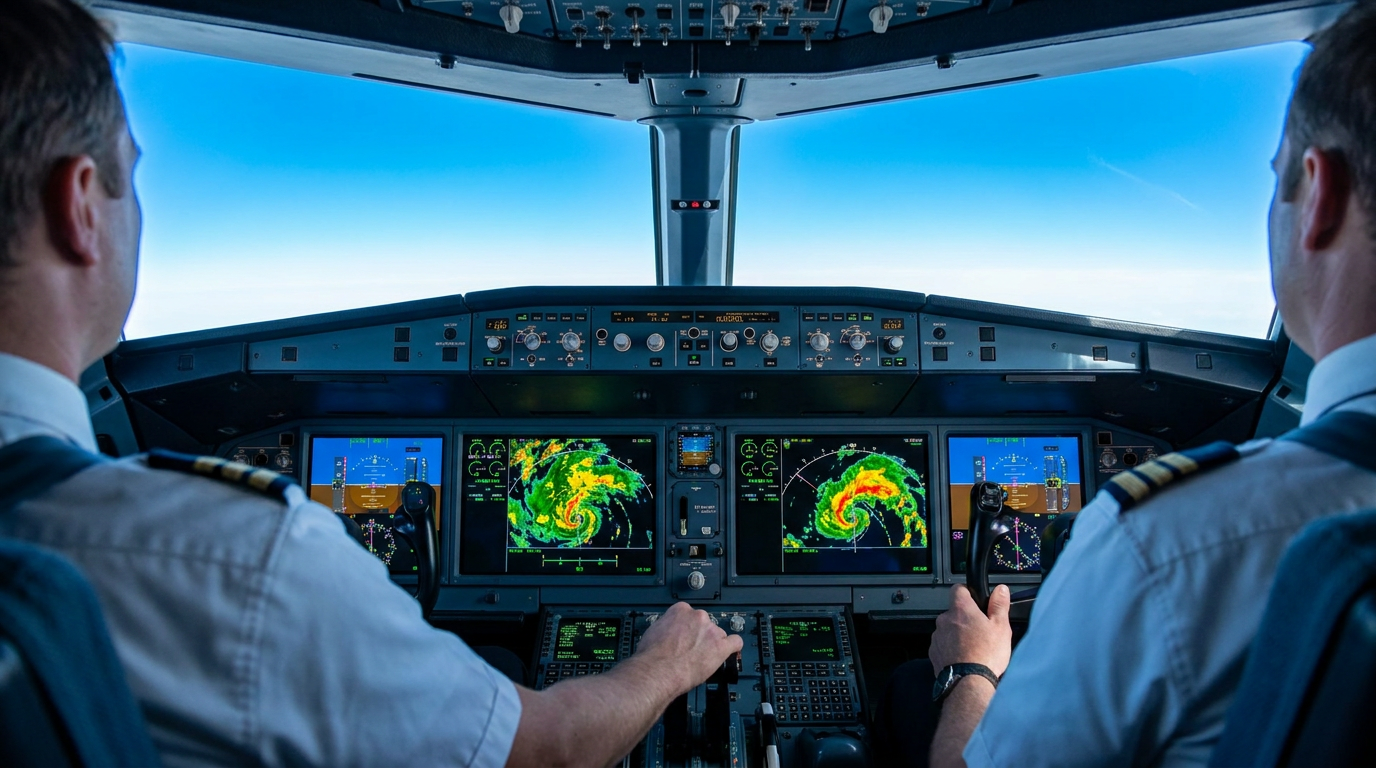
The primary adversary in this effort is Clear Air Turbulence (CAT). Unlike the turbulence associated with thunderstorms—which is packed with water droplets and easily visible on a plane's onboard weather radar—CAT occurs in completely cloudless skies. It is typically caused by the collision of air masses moving at different speeds, often near the edges of the jet stream.[3]
Because CAT is invisible to traditional radar, pilots have historically relied on generic weather forecasts and subjective radio reports from aircraft flying ahead of them. But this reactive, analog approach is being rapidly replaced by a massive, automated data-sharing revolution.[5]
But this reactive, analog approach is being rapidly replaced by a massive, automated data-sharing revolution.
At the center of this shift is the International Air Transport Association's (IATA) Turbulence Aware platform. Launched as a global data exchange, the system essentially turns every participating commercial flight into a high-tech meteorological sensor.[1]
When an aircraft encounters rough air, its onboard computers instantly calculate the Eddy Dissipation Rate (EDR)—an objective, mathematical measurement of the atmosphere's turbulent state. This EDR data, along with the plane's exact altitude and GPS coordinates, is beamed down to ground servers in real time.[1]

The platform anonymizes the data and instantly broadcasts it to the navigation displays of other aircraft in the vicinity. In 2024 alone, participating airlines generated nearly 51.8 million of these automated turbulence reports. If a flight hits a pocket of invisible CAT, the planes trailing ten minutes behind it already have the exact coordinates and can adjust their altitude to find smooth air.[1]
While crowdsourcing the sky handles the immediate tactical environment, predicting where turbulence will form hours in advance requires immense computational power. This is where national meteorological agencies step in to map the future of the atmosphere.[2]
The NOAA Aviation Weather Center operates the Graphical Turbulence Guidance (GTG) system, which ingests millions of data points to produce a combined forecast of clear air, mountain wave, and convectively induced turbulence for flight dispatchers.[2]
To push these forecasts even further, meteorologists are now deploying artificial intelligence and supercomputing. The UK Met Office, working in tandem with aviation tech firms like AVTECH, utilizes machine learning to analyze over 50 billion weather observations daily.[4]

This AI-driven approach allows atmospheric dynamics to be modeled at an ultra-fine 10-kilometer resolution, a massive leap from the historical industry standard of 140-kilometer grids. Instead of a pilot receiving a vague warning that a broad region might be bumpy, they receive flight-specific, high-resolution alerts pinpointing the exact mile where the jet stream is fracturing.[4][5]
Even with perfect data, some turbulence is unavoidable during the climb or descent phases of a flight. For these moments, aircraft manufacturers are developing active mitigation technologies. Modern fly-by-wire systems feature gust suppression algorithms that detect sudden shifts in air pressure outside the fuselage.[7]
Within milliseconds—faster than human reflexes can process—the aircraft's computers command the ailerons and elevators to counteract the motion, actively smoothing the ride. This is why manufacturers like Airbus explicitly recommend that pilots keep the autopilot engaged during severe turbulence; the computer is designed to maintain structural safety margins without overreacting to sudden trajectory changes.[3][7]

The convergence of flexible composite materials, crowdsourced EDR data, and AI-driven supercomputing has fundamentally changed the nature of flight. While climate patterns may be shifting the behavior of the atmosphere, aviation technology is evolving faster. The invisible threat of turbulence is being systematically mapped, quantified, and engineered out of the passenger experience.[4][7]
How we got here
1940s
The concept of the "gust envelope" is developed by engineers to calculate safe turbulence penetration speeds for aircraft.
2018
IATA launches the Turbulence Aware platform to begin crowdsourcing real-time atmospheric data from commercial flights.
2024
Participating airlines generate a record 51.8 million automated turbulence reports in a single year, proving the scale of the data network.
2026
Meteorological agencies deploy AI-driven supercomputers to model Clear Air Turbulence at ultra-fine 10-kilometer resolutions.
Viewpoints in depth
Aviation Engineers
Focus on the physical resilience of the airframe and automated flight controls.
For aerospace engineers, turbulence is a solved physical problem. The structural limits of modern composite aircraft far exceed any kinetic force the atmosphere can produce. Their current focus has shifted from structural survival to "ride quality"—developing fly-by-wire algorithms that use micro-adjustments of the ailerons and elevators to actively cancel out the bumps, much like noise-canceling headphones for aerodynamics.
Meteorologists & Data Scientists
Focus on predicting the invisible through high-resolution modeling and AI.
Atmospheric scientists view turbulence as a massive data challenge. Because Clear Air Turbulence (CAT) lacks the water droplets needed to reflect traditional radar, it must be predicted through complex fluid dynamics. By leveraging supercomputers and machine learning, this camp is moving the industry away from broad, generic regional forecasts toward hyper-localized, 10-kilometer resolution models that can pinpoint exactly where the jet stream is fracturing.
Airline Operations
Focus on real-time data sharing, fuel efficiency, and passenger safety.
For airline dispatchers and operations centers, turbulence is a logistical and financial friction point. Unnecessary altitude changes to avoid poorly forecasted weather burn excess fuel, while unexpected severe turbulence risks passenger injury and costly aircraft inspections. This camp champions crowdsourced data platforms like IATA's Turbulence Aware, viewing real-time, fleet-wide data sharing as the ultimate tool to optimize routes and ensure cabin safety.
What we don't know
- How shifting global climate patterns will alter the long-term frequency and intensity of the jet stream.
- Whether smaller regional airlines will be able to afford the integration costs of advanced real-time data platforms.
- The absolute upper limit of AI forecasting accuracy when dealing with chaotic fluid dynamics in the upper atmosphere.
Key terms
- Clear Air Turbulence (CAT)
- Turbulence that occurs in cloudless regions of the sky, typically caused by wind shear near the jet stream, making it invisible to standard weather radar.
- Eddy Dissipation Rate (EDR)
- A standardized, mathematical metric used by aviation computers to measure the exact intensity of atmospheric turbulence.
- Ultimate Load
- An engineering testing standard where an aircraft's structures, such as its wings, are subjected to extreme forces to ensure they will not fail in flight.
- Fly-by-wire
- An electronic flight control system where a pilot's inputs are processed by a computer, which then moves the aircraft's control surfaces using algorithms.
Frequently asked
Can turbulence cause a modern commercial plane to crash?
No. Modern airframes are subjected to "ultimate load" tests that bend their wings to extreme angles, proving they can withstand kinetic forces far beyond any naturally occurring turbulence.
Why is Clear Air Turbulence (CAT) considered so dangerous?
CAT occurs in cloudless skies and lacks the water droplets that traditional onboard weather radar relies on, meaning it can strike without visual warning if not properly forecasted.
Should pilots turn off the autopilot during severe turbulence?
No. Manufacturers like Airbus recommend keeping the autopilot engaged, as the computer is designed to maintain structural safety margins without overreacting to sudden trajectory changes.
What is Eddy Dissipation Rate (EDR)?
EDR is an objective, mathematical metric calculated by an aircraft's computers to measure the exact intensity of turbulence, replacing subjective human pilot reports.
Sources
Source coverage
7 outlets
3 viewpoints surfaced







[1]International Air Transport Association (IATA)Airline Operations
Turbulence Aware Platform
Read on International Air Transport Association (IATA) →[2]NOAA Aviation Weather CenterMeteorologists & Data Scientists
Graphical Turbulence Guidance (GTG)
Read on NOAA Aviation Weather Center →[3]AirbusAviation Engineers
Operating in Turbulence: Flight Crew Guidelines
Read on Airbus →[4]AVTECH SwedenMeteorologists & Data Scientists
AI-Enhanced Forecasting: The Future of Weather Intelligence
Read on AVTECH Sweden →[5]The Weather CompanyMeteorologists & Data Scientists
The Role of Predictive Technologies in Aviation Safety
Read on The Weather Company →[6]AvioSpaceAviation Engineers
Aircraft Structural Limits and Wing Flex
Read on AvioSpace →[7]Factlen Editorial TeamAirline Operations
Synthesis by Factlen editorial team
Read on Factlen Editorial Team →

Every angle. Every day.
Get travel stories with full source coverage and perspective breakdowns delivered to your inbox.