
How Mycelium is Turning Agricultural Waste into Bio-Fabricated Furniture
Designers and material scientists are replacing toxic foams and engineered woods by growing furniture from the root structures of fungi. The resulting mycelium composites are fire-resistant, VOC-free, and fully compostable within six months.
By Factlen Editorial Team
- Bio-Fabrication Pioneers
- Designers and startups focused on replacing toxic plastics with circular, grown materials.
- Material Science Researchers
- Academics and engineers focused on the structural limits and mechanical properties of fungal composites.
- Biophilic Design Advocates
- Architects and interior designers prioritizing the health and sensory benefits of natural indoor environments.
What's not represented
- · Traditional furniture manufacturers reliant on MDF and polyurethane
- · Commercial forestry and timber industry representatives
Why this matters
The fast furniture industry relies heavily on petroleum-based foams and formaldehyde-laced woods that off-gas toxins into homes and sit in landfills for centuries. Bio-fabricated furniture offers a fully circular alternative that improves indoor air quality and safely returns to the earth at the end of its life.
Key points
- Mycelium, the root structure of fungi, is being used to grow furniture by binding agricultural waste.
- The resulting composites are lightweight, fire-resistant, and completely free of toxic VOC emissions.
- Unlike petroleum-based foams, mycelium furniture can be safely composted in a garden within six months.
- The material is naturally hydrophilic, making water absorption a key engineering challenge for outdoor use.
- Startups are scaling production to offer luxury, bio-fabricated alternatives to fast furniture.
The modern home is filled with petroleum. From the polyurethane foam cushioning our sofas to the formaldehyde-laced resins binding our engineered wood cabinets, the global furniture industry relies heavily on toxic, non-biodegradable materials. These synthetic components off-gas volatile organic compounds into our living spaces and ultimately spend centuries sitting in landfills. But a quiet revolution is taking root in the world of interior design, one that swaps synthetic chemistry for biology.[7]
Designers and material scientists are no longer just building furniture; they are growing it. The secret ingredient driving this paradigm shift is mycelium—the vast, underground root-like network of fungi. By harnessing its natural binding properties, a new wave of bio-fabricated furniture is emerging, offering a glimpse into a fully circular economy where a chair can literally be composted in a backyard garden at the end of its life.[7]
To understand how a mushroom becomes a piece of luxury furniture, one must look at the biology of mycelium. In nature, mycelium acts as the Earth's recycling system. It secretes enzymes that break down organic matter, binding the soil together with microscopic, thread-like filaments called hyphae. Bio-fabrication essentially hijacks this natural process, redirecting the fungus to consume and bind specific waste materials instead of forest debris.[7]
The manufacturing cycle begins with agricultural waste—such as hemp husks, flax, sawdust, or crop residues. This substrate is sterilized and inoculated with a specific strain of fungal spores. The inoculated mixture is then packed tightly into a custom 3D-printed mold. Over the course of one to four weeks, the mycelium feeds on the agricultural waste, growing rapidly and weaving a dense, cohesive matrix that takes the exact shape of the mold.[1][2]

Once the desired density and shape are achieved, the growth must be stopped. The piece is removed from the mold and subjected to a slow drying or baking process. This dehydrates the material and renders the fungus completely inert, ensuring that a newly purchased coffee table will not suddenly sprout mushrooms in a humid living room.[6]
The resulting material, known as a Mycelium-Based Composite (MBC), possesses physical properties that rival traditional synthetic foams and engineered woods. According to material scientists, MBCs can achieve a compressive strength of 0.2 to 2.0 megapascals, depending on the density of the substrate used. This makes the material remarkably lightweight yet strong enough to support the weight of an adult.[2][5]
Beyond basic structural integrity, mycelium composites offer surprising secondary benefits that synthetic materials struggle to match. The material is naturally fire-resistant, achieving a Class A fire rating. This resistance is due to the high concentration of chitin—a tough, naturally occurring polymer found in fungal cell walls and the exoskeletons of crabs and insects.[5]
Mycelium also excels in acoustic attenuation. The porous, cellular structure of the dried fungal network acts as a sonic sponge, absorbing high-frequency sound waves that typically bounce off hard surfaces. Architectural design firms are already leveraging this property to produce highly effective, hypoallergenic acoustic wall panels for noisy commercial spaces and open-plan offices.[6]

The porous, cellular structure of the dried fungal network acts as a sonic sponge, absorbing high-frequency sound waves that typically bounce off hard surfaces.
Perhaps most importantly for indoor air quality, mycelium furniture is entirely VOC-neutral. Unlike conventional particleboard and medium-density fibreboard (MDF), which rely on synthetic glues that slowly release toxic chemicals into the home for years, mycelium is self-binding. The living fungus itself acts as nature's glue, eliminating the need for artificial adhesives entirely.[1][5]
Pioneers in the bio-design space have spent over a decade proving the commercial viability of these composites. New York-based biomaterials company Ecovative, widely considered the leader in the field, developed MycoBoard as a direct replacement for engineered wood. They also created MycoFlex, a 100% mycelium foam designed to replace the polyurethane cushioning traditionally used in upholstery and packaging.[1]
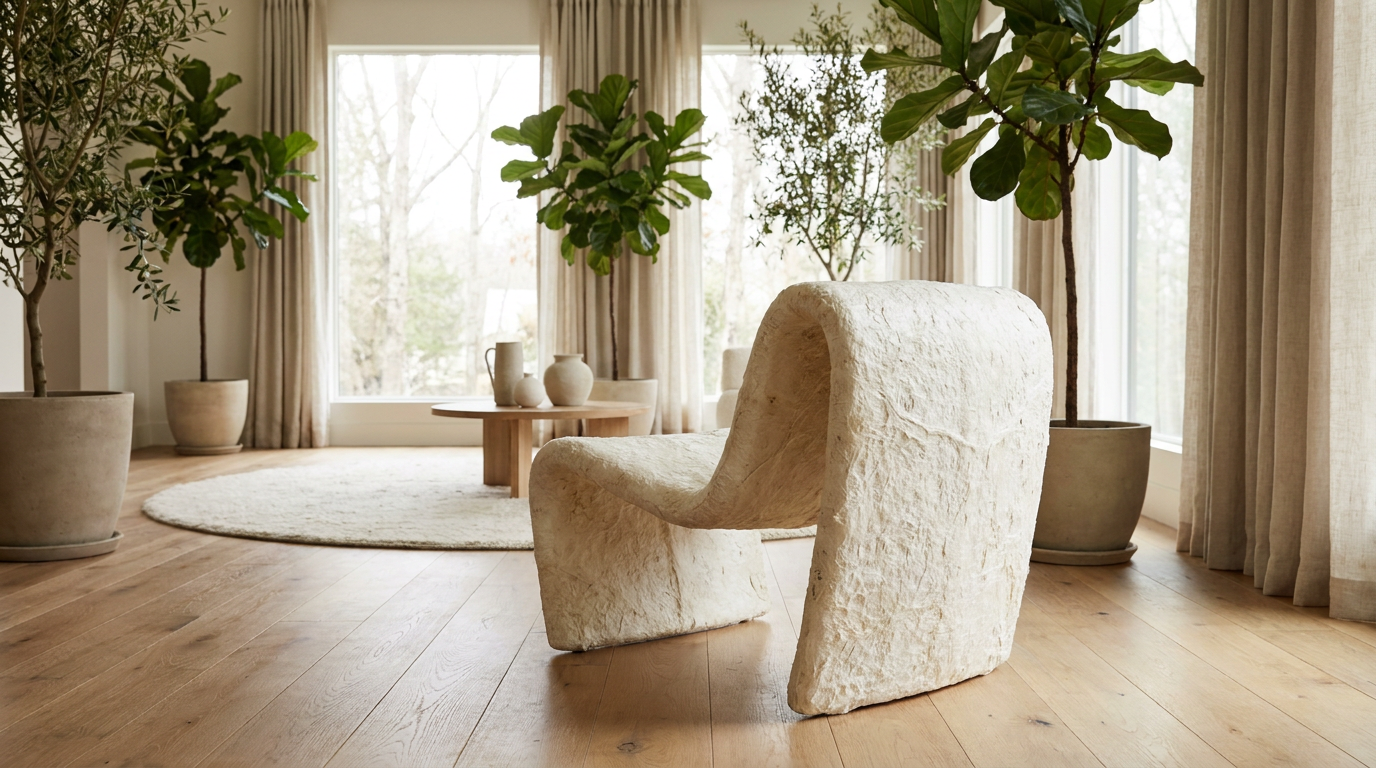
The aesthetic possibilities of grown materials are also expanding rapidly. At recent European design festivals, Dutch startup Aifunghi debuted its "Roots" collection—a series of upholstered chairs featuring a distinctive, organic texture. By successfully producing these pieces on a semi-industrial scale, the company is proving that bio-fabricated furniture can meet the exacting aesthetic and volume demands of the luxury market.[3]
The environmental impact of this technology extends far beyond the end product; it begins with the raw materials. In India, the design studio Anomalia is using mycelium to bind vast quantities of agricultural crop residue. By diverting this agricultural waste stream into furniture production, they are actively preventing the widespread practice of crop burning, which severely worsens the region's air pollution crisis.[4]

Anomalia's modular mycelium blocks are remarkably efficient. A single block weighs just 1.5 kilograms but can withstand compressive loads of up to 1.5 tons. The studio envisions a future where entire interior partitions, custom shelving units, and even architectural facades are grown locally from regional agricultural waste.[4]
Despite the immense promise, mycelium composites face significant engineering hurdles before they can fully replace traditional materials. The most pressing challenge identified by researchers is water absorption. Mycelium is inherently hydrophilic; untreated composites can absorb water rapidly, increasing in weight by up to 580% if left in direct contact with moisture for extended periods.[2]
This vulnerability to moisture means that, currently, mycelium furniture is strictly for indoor use unless it is treated with natural sealants or bio-resins. Furthermore, the growing process itself is highly sensitive. The mycelium requires precise temperature and humidity controls, and any bacterial contamination during the incubation phase can ruin an entire batch of furniture.[2][7]
Scaling up from artisanal, small-batch production to global industrial manufacturing also requires entirely new supply chains. Factories producing grown furniture must function more like vertical farms or commercial breweries, managing living organisms and sterile environments rather than simply assembling inert, pre-cut parts.[1][7]
Yet, the ultimate appeal of mycelium furniture lies in its end-of-life cycle. Conventional fast furniture clogs landfills for centuries, slowly leaching microplastics and synthetic chemicals into the soil and groundwater. In stark contrast, a mycelium chair, once broken into pieces, will safely biodegrade in a standard garden compost heap within six months, returning its nutrients directly to the earth.[4][7]

As consumers and designers increasingly demand materials that heal rather than harm the environment, bio-fabrication represents a profound shift in how we interact with the built environment. We are slowly moving away from an era of extracting and synthesizing, and entering an era where we collaborate with nature to grow the objects we need.[7]
How we got here
2007
Ecovative is founded in New York to explore mycelium as a sustainable replacement for plastic foams.
2016
Ecovative debuts its first fully grown mycelium furniture line at the Greenbuild International Conference.
2021
Design studios globally begin testing mycelium composites using local agricultural waste to prevent crop burning.
2025
Mycelium furniture reaches semi-industrial scale with major collections debuting at European design festivals.
Viewpoints in depth
Bio-Fabrication Pioneers
Designers and startups focused on replacing toxic plastics with circular, grown materials.
This camp views mycelium as the ultimate solution to the furniture industry's waste crisis. By utilizing agricultural byproducts that would otherwise be burned or discarded, they argue that bio-fabrication can turn a massive pollution source into a valuable commodity. Their primary goal is scaling production from artisanal, small-batch studios to semi-industrial facilities, proving that grown materials can meet the aesthetic and volume demands of the global luxury market without compromising on compostability.
Material Science Researchers
Academics and engineers focused on the structural limits and mechanical properties of fungal composites.
While optimistic about the sustainability metrics, researchers emphasize the engineering hurdles that remain. They point to mycelium's inherently hydrophilic nature, noting that untreated composites can absorb massive amounts of water, severely compromising their structural integrity. This camp is actively experimenting with different fungal strains, substrate densities, and natural bio-resins to improve the material's water resistance, tensile strength, and long-term durability against wear and tear.
Biophilic Design Advocates
Architects and interior designers prioritizing the health and sensory benefits of natural indoor environments.
For this group, the appeal of mycelium extends beyond its end-of-life compostability; it is about creating healthier living spaces today. They highlight the material's natural acoustic attenuation, thermal neutrality, and complete lack of VOC emissions. By eliminating formaldehyde-based glues and synthetic foams, biophilic designers argue that mycelium furniture acts as a physiological intervention, reducing indoor air pollution and creating a sensory connection to the natural world that modern, sterilized interiors lack.
What we don't know
- Whether bio-fabricated furniture can achieve the decades-long durability of solid hardwood under heavy daily use.
- How quickly the industry can scale supply chains to compete with the low cost of petroleum-based fast furniture.
- Which natural, biodegradable sealants will prove most effective at waterproofing mycelium for outdoor applications.
Key terms
- Mycelium
- The vegetative, root-like network of a fungus, consisting of a mass of branching, thread-like hyphae.
- Bio-fabrication
- The process of using living organisms, such as bacteria or fungi, to grow and manufacture materials and products.
- Chitin
- A tough, protective polymer found in the cell walls of fungi and the exoskeletons of insects, providing natural fire resistance.
- Volatile Organic Compounds (VOCs)
- Harmful chemicals, often found in conventional furniture glues and paints, that slowly off-gas into indoor air over time.
- Substrate
- The base material or surface—such as agricultural waste—on which an organism like mycelium grows and feeds.
Frequently asked
Will mycelium furniture grow mushrooms in my house?
No. The material is baked at the end of the manufacturing process, which kills the spores and renders the fungus completely inert.
How strong is a chair made of mushrooms?
Mycelium composites can achieve a compressive strength comparable to medium-hardwood or high-density foam, easily supporting the weight of an adult.
Can mycelium furniture be used outdoors?
Currently, untreated mycelium is highly absorbent and vulnerable to moisture, making it suitable only for indoor use unless coated with a waterproof sealant.
What happens when I throw it away?
Unlike synthetic furniture that sits in landfills for centuries, mycelium composites can be broken into pieces and safely composted in a garden within six months.
Sources
Source coverage
7 outlets
3 viewpoints surfaced







[1]EcovativeBio-Fabrication Pioneers
Ecovative turns mushroom mycelium into sustainable materials for modern products
Read on Ecovative →[2]North Carolina State UniversityMaterial Science Researchers
Mycelium-Based Composites: Properties and Applications
Read on North Carolina State University →[3]HomecruxBio-Fabrication Pioneers
Aifunghi Redefines Sustainable Luxury With Innovative Mycelium Furniture
Read on Homecrux →[4]Green ProphetBio-Fabrication Pioneers
Anomalia's 'Grown Not Built' collection brings mycelium furniture to India
Read on Green Prophet →[5]Nuvira SpaceMaterial Science Researchers
The Bio-Fabricated Interior: Why Mycelium Furniture is the Silent Architect of Neuro-Wellness
Read on Nuvira Space →[6]Materials AssembleBiophilic Design Advocates
Growing Mycelium Furniture and Acoustic Panels
Read on Materials Assemble →[7]Factlen Editorial TeamBiophilic Design Advocates
Synthesis by Factlen editorial team
Read on Factlen Editorial Team →
Every angle. Every day.
Get home stories with full source coverage and perspective breakdowns delivered to your inbox.