
Restaurants Are Deploying Back-of-House AI to Bring Back 'Hyper-Hospitality'
Rather than replacing front-of-house staff with screens, the 2026 wave of restaurant technology is automating grueling kitchen tasks to give servers more time to connect with guests.
By Factlen Editorial Team
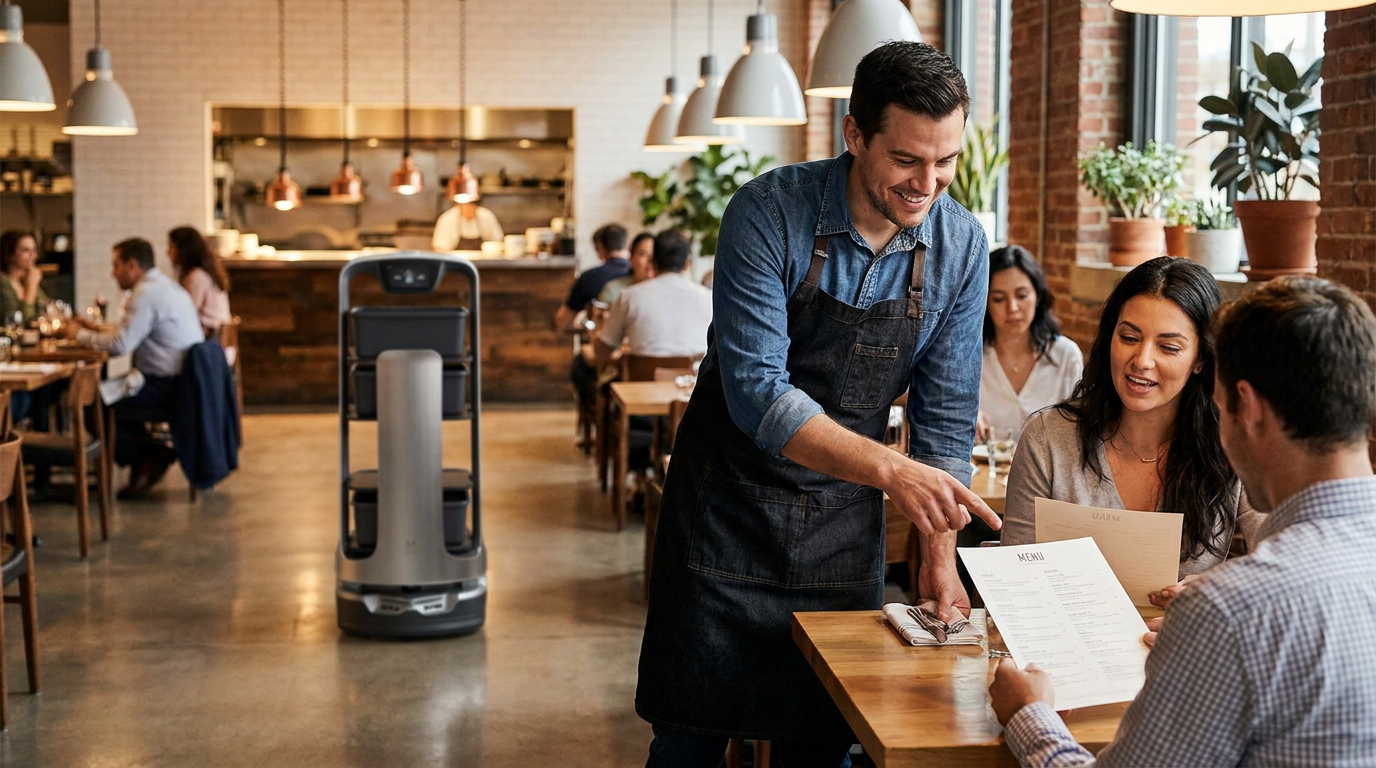
- Industry Operators
- Focused on margin protection, supply chain efficiency, and using AI to offset persistent inflation and food costs.
- Hospitality Advocates
- Argue that the ultimate goal of technology is to remove operational friction so staff can focus entirely on the guest experience.
- Workforce Strategists
- View back-of-house automation primarily as a retention tool to reduce employee burnout and modernize restaurant careers.
What's not represented
- · Independent mom-and-pop restaurant owners who lack the capital for enterprise AI.
- · Front-line kitchen staff adapting to algorithmic prep schedules.
Why this matters
By shifting automation from the dining room to the kitchen, restaurants are solving the industry's burnout crisis while ensuring that diners paying premium prices receive genuine, unhurried human hospitality.
Key points
- Restaurants are moving away from front-of-house automation like QR codes and ordering tablets.
- Investment is now pouring into back-of-house AI and robotics to handle inventory, prep, and heavy lifting.
- By automating grueling tasks, operators are reducing staff burnout and turnover.
- The ultimate goal is 'hyper-hospitality,' giving servers more time to connect with guests.
The restaurant industry in 2026 is navigating a fascinating paradox: the more advanced its technology becomes, the more human its dining rooms feel. After years of experimenting with QR-code menus, tabletop ordering tablets, and front-of-house service robots, operators are quietly reversing course. The new consensus is that guests dine out specifically for human connection, prompting a massive shift in where capital is deployed.[2]
Instead of trying to automate the server, the industry is aggressively automating the clipboard, the inventory sheet, and the heavy lifting. By deploying artificial intelligence and robotics in the back of the house, restaurants are stripping away the grueling, invisible friction of hospitality. The result is a resurgence of "hyper-hospitality," where staff have the time and mental bandwidth to actually engage with the people sitting at their tables.[2][4][6]
The financial stakes for this shift are monumental. According to the National Restaurant Association’s 2026 projections, U.S. industry sales are expected to hit a record $1.55 trillion this year, supported by a workforce of 15.8 million people. Yet, operators remain squeezed by persistent inflation and high commodity costs. To protect margins without alienating diners, restaurants are turning to data-driven efficiency rather than simply raising menu prices.[1][3]

Black Box Intelligence data from May 2026 illustrates this delicate balancing act. While same-store sales grew by 1.8%, overall foot traffic saw a slight decline. Consumers are not abandoning restaurants, but they are becoming highly selective, treating dining out as a protected, premium occasion. When guests visit less frequently but spend more per visit, the tolerance for a mediocre, transactional experience drops to zero.[5][6]
This dynamic has exposed what industry analysts call the "Hospitality Gap"—the divide between the warm, personalized service guests expect and the rushed, task-heavy reality that servers often face. To close this gap, operators are investing heavily in what is being termed "humanoid augmentation."[2]
To close this gap, operators are investing heavily in what is being termed "humanoid augmentation."
In practice, humanoid augmentation means deploying robotics for repetitive, non-guest-facing tasks. Automated systems are now routinely handling floor cleaning, heavy lifting in the stockroom, and precise frying oil management. By offloading the physical toll of these chores, restaurants are actively reducing the burnout that has historically plagued the sector.[2][4][7]
Beyond physical robotics, artificial intelligence has moved from a buzzword to the operational backbone of the modern kitchen. AI systems are now deeply integrated into the entire value chain, forecasting daily demand with hyper-local precision, optimizing prep schedules, and dynamically managing inventory to slash food waste.[3][4]

For a line cook or a kitchen manager, this means arriving for a shift to find that the system has already analyzed the weather, local events, and historical data to generate an exact prep list. The cognitive load of guessing how many tomatoes to slice or how much dough to proof is entirely removed, allowing culinary teams to focus on execution and quality control.[3][4][7]
The impact on workforce retention has been profound. With 77% of restaurant operators citing employee recruitment and retention as a significant challenge, automation is no longer viewed as a threat to jobs, but as a critical tool for keeping staff happy. When the worst parts of a restaurant job are automated, turnover drops, and operators can cross-train their teams for higher-value, guest-facing roles.[4][7]

This operational overhaul is particularly visible in the casual dining sector, which is experiencing a renaissance. As the price gap between fast food and sit-down restaurants narrows, casual chains are leaning hard into the experiential side of dining. A server who doesn't have to spend twenty minutes in the back manually counting inventory can spend that time guiding a guest through a new menu or managing a complex allergy request.[6]
The shift also extends to sustainability, which has transitioned from a marketing slogan to an operational necessity. AI-driven demand forecasting directly reduces the over-purchasing that leads to food waste, while smart kitchen systems ensure full ingredient utilization. Diners in 2026 are increasingly demanding this level of transparency, and the technology finally exists to deliver it profitably.[3][7]
Ultimately, the 2026 restaurant landscape proves that technology and traditional hospitality are not mutually exclusive. By using data to handle the complex, invisible logistics of food service, operators are reclaiming the time and energy needed to provide the authentic, human-centric experiences that define a great meal out.[2][6]
How we got here
2020–2022
Pandemic-era tech focuses heavily on contactless front-of-house solutions like QR codes and ordering kiosks.
2023–2024
Early experiments with AI center on drive-thru voice bots and dynamic pricing models.
2025
Operators recognize the 'Hospitality Gap' as guests push back against overly automated, impersonal dining rooms.
Early 2026
Major industry reports confirm a pivot toward back-of-house 'humanoid augmentation' to improve staff retention and guest experience.
Viewpoints in depth
Industry Operators
Focused on margin protection and supply chain efficiency.
For the groups managing hundreds of locations, the appeal of AI is purely mathematical. Squeezed by persistent inflation and a cooling labor market, operators view back-of-house automation as the only viable way to protect margins without endlessly raising menu prices. By optimizing inventory and reducing food waste, they can fund the higher wages necessary to retain top-tier front-of-house talent.
Hospitality Advocates
Argue that technology's highest purpose is removing operational friction.
This camp believes the industry lost its way during the pandemic by trying to automate the guest interaction itself. They argue that dining out is fundamentally an emotional purchase, not just a caloric one. By relegating robots to the stockroom and AI to the prep sheet, they believe restaurants can finally close the 'Hospitality Gap' and return to the warm, personalized service that builds long-term brand loyalty.
Workforce Strategists
View automation primarily as a tool to reduce employee burnout.
Labor analysts point out that the restaurant industry has historically relied on grueling physical labor and high turnover. They see 'humanoid augmentation' as a long-overdue modernization of the restaurant career. By offloading the heavy lifting and the cognitive load of inventory management to machines, operators can offer safer, less exhausting jobs, transforming high-turnover roles into sustainable careers.
What we don't know
- Whether smaller, independent restaurants will be able to afford the upfront capital required for advanced back-of-house AI systems.
- How quickly consumers will accept the presence of robotic assistants navigating the periphery of dining rooms, even if they aren't taking orders.
Key terms
- Humanoid Augmentation
- The use of robotics to assist human workers with heavy lifting and repetitive tasks, rather than replacing them.
- Back-of-House (BOH)
- The operational areas of a restaurant hidden from guests, including the kitchen, prep areas, and stockrooms.
- Hospitality Gap
- The disconnect between the personalized service diners expect and the rushed experience they often receive due to staff being overburdened with tasks.
- Demand Forecasting
- Using AI and historical data to predict exactly how much food a restaurant will sell on a given day, reducing waste and prep time.
Frequently asked
Are robots going to replace restaurant servers?
No. The current trend is actually the opposite. Restaurants are using robots for back-of-house chores like cleaning and heavy lifting so that human servers have more time to interact with guests.
How does AI help reduce food waste?
AI analyzes weather, local events, and past sales to predict exactly what customers will order. This allows kitchens to prep only what is needed, drastically cutting down on unsold food.
Why are casual dining restaurants investing in this now?
With inflation pushing up the cost of dining out, customers expect a premium experience. Automating kitchen logistics helps restaurants keep prices stable while improving the quality of service.
Sources
Source coverage
7 outlets
3 viewpoints surfaced







[1]National Restaurant AssociationWorkforce Strategists
2026 State of the Restaurant Industry
Read on National Restaurant Association →[2]FastCasualHospitality Advocates
The 2026 restaurant landscape is more data-rich than ever, but it remains a people-first business
Read on FastCasual →[3]McKinsey & CompanyIndustry Operators
How cost consciousness, shifting tastes, and channel choices are reshaping the US restaurant landscape
Read on McKinsey & Company →[4]TastewiseIndustry Operators
The six most impactful restaurant industry innovations in 2026
Read on Tastewise →[5]Black Box IntelligenceIndustry Operators
May 2026 Restaurant Performance: Resilience Amidst Persistent Macroeconomic Friction
Read on Black Box Intelligence →[6]Restaurant DiveHospitality Advocates
Casual chains need to prioritize experience to win in 2026
Read on Restaurant Dive →[7]Sustainable Culinary SolutionsWorkforce Strategists
2026 Restaurant Trends: Labor Efficiency Over Labor Dependence
Read on Sustainable Culinary Solutions →


Every angle. Every day.
Get food drink stories with full source coverage and perspective breakdowns delivered to your inbox.