
How Next-Generation Geothermal is Unlocking 24/7 Clean Power
By borrowing drilling techniques from the oil and gas industry, enhanced geothermal systems are turning the Earth's deep heat into a scalable, carbon-free baseload energy source.
By Factlen Editorial Team
- Energy Researchers & Policy
- Government agencies and academic institutions focused on fundamental science, cost reduction, and safety.
- Geothermal Industry
- Companies developing and supplying the technology to scale EGS commercially.
- Market Analysts & Offtakers
- Financial observers and tech companies tracking the commercial viability and grid impact of firm clean power.
What's not represented
- · Local communities living near proposed EGS development sites
- · Water conservation advocates concerned about fluid usage in arid regions
Why this matters
Next-generation geothermal technology is unlocking a massive, 24/7 source of carbon-free electricity that can be deployed almost anywhere. By solving the intermittency problem of wind and solar, it provides the firm baseload power desperately needed to fuel the AI boom and decarbonize the global grid.
Key points
- Enhanced Geothermal Systems (EGS) use horizontal drilling and fracturing to create artificial reservoirs in hot, dry rock.
- Unlike wind and solar, geothermal provides 24/7 baseload power with a capacity factor exceeding 90 percent.
- Fervo Energy's Cape Station in Utah is expected to deliver 100 megawatts of clean power to the grid by late 2026.
- Drilling times and costs for EGS wells have plummeted by roughly 70 percent since 2022.
- The U.S. Department of Energy aims to cut the cost of EGS by 90 percent to $45 per megawatt-hour by 2035.
- Tech giants are heavily investing in geothermal to secure firm, carbon-free power for AI data centers.
The holy grail of the energy transition has always been a power source that is entirely clean, yet never stops running. For decades, solar and wind have dominated the renewable conversation, but their inherent intermittency—ebbing with the weather and the setting sun—requires massive battery storage or fossil-fuel backups. Geothermal energy, which taps the near-limitless heat of the Earth's crust, has long offered a distinctive advantage: 24/7 baseload power. Yet, conventional geothermal has remained a geographic niche, restricted to regions with natural hot springs or volcanic activity, satisfying less than 1 percent of global energy demand.[4][7]
That geographic limitation is rapidly dissolving. A wave of "next-generation" geothermal technologies is borrowing the heavy-duty engineering of the oil and gas industry to unlock the heat beneath our feet, virtually anywhere on the planet. By applying horizontal drilling and hydraulic fracturing—the very tools that sparked the shale revolution—engineers are creating artificial underground reservoirs in hot, dry rock. This approach, known as Enhanced Geothermal Systems (EGS), is transforming geothermal from a location-bound geological lottery into a scalable, manufactured energy solution that can be deployed near major population centers.[4][5][7]
The mechanics of EGS are both brutal and precise. In formations that lack natural fluid pathways, developers drill injection wells thousands of feet deep into solid rock where temperatures exceed 300°F. They pump fluid down under extreme pressure to create a network of microscopic fractures, effectively shattering the rock to create permeability. A second "production" well is drilled to intersect this artificial fracture network. As water circulates down the injection well, it absorbs the intense subterranean heat, travels through the fractures, and is drawn up the production well to drive steam turbines on the surface.[5][7]

The theoretical promise of EGS is staggering. The U.S. Department of Energy (DOE) estimates that more than five terawatts of heat resources exist beneath the United States—enough to meet the electricity needs of the entire world. Capturing even a fraction of this could affordably power over 40 million American homes, prompting the DOE to launch the "Enhanced Geothermal Shot," an initiative aimed at slashing the cost of EGS by 90 percent to $45 per megawatt-hour by 2035.[2]
Moving from theoretical models to commercial reality has been the primary hurdle for the industry, but recent operational data suggests developers have crossed a critical threshold. Fervo Energy, a Houston-based developer backed by major technology investors, recently concluded operations at its Project Red pilot facility in Nevada. Project Red served as a rigorous, real-world testbed, accumulating over two years of continuous operating history. The facility definitively proved that horizontal well EGS systems can deliver steady, predictable thermal output in line with fundamental physics models, effectively de-risking the core subsurface engineering.[1]
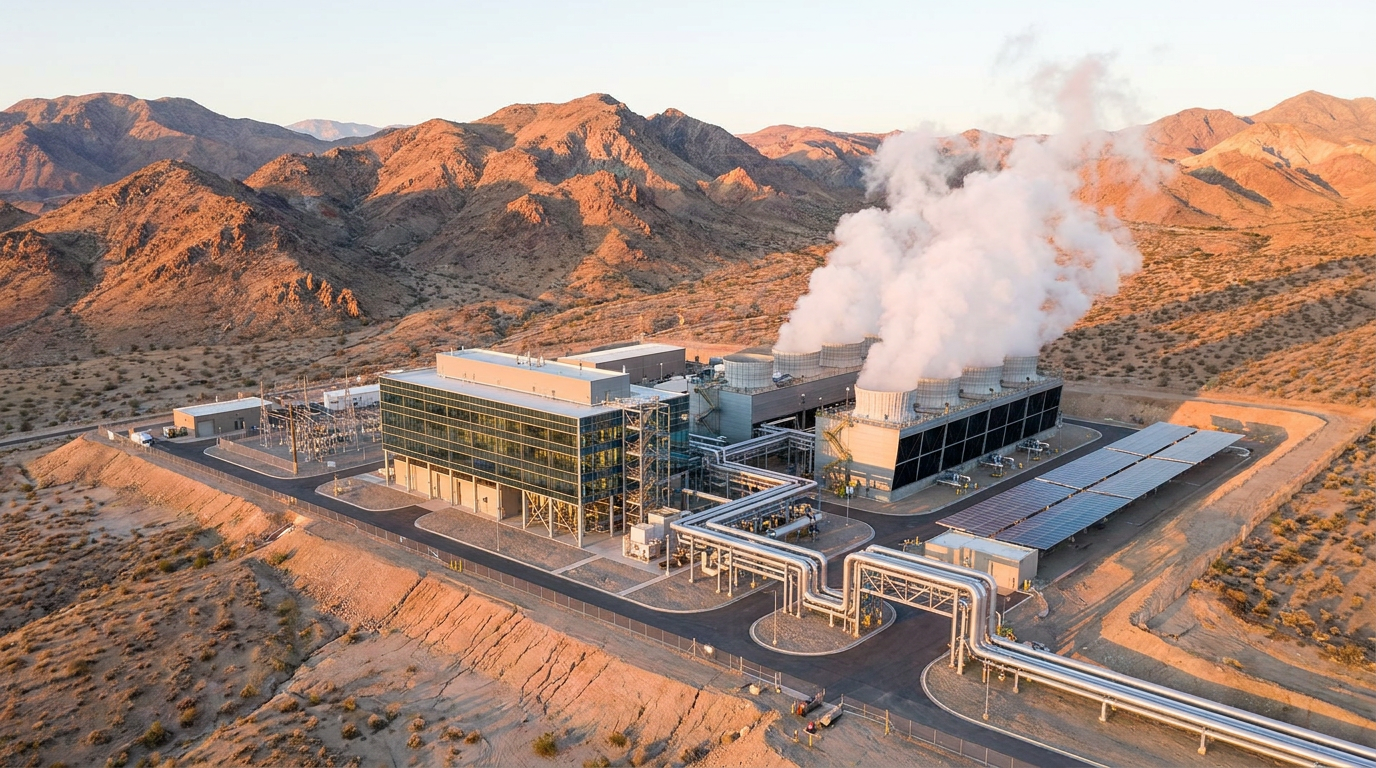
Armed with the validation of Project Red, the industry is now scaling up aggressively. Fervo's flagship development, Cape Station in Beaver County, Utah, is poised to become the world's largest next-generation geothermal facility. Situated adjacent to the DOE's Frontier Observatory for Research in Geothermal Energy (FORGE), Cape Station is currently under construction and is expected to deliver its first 100 megawatts of firm, clean electricity to the grid by late 2026. The site is fully permitted to eventually expand to 2 gigawatts of capacity.[1][6]
Armed with the validation of Project Red, the industry is now scaling up aggressively.
The economics of EGS are improving at a blistering pace, mirroring the early cost-curve declines of the solar and wind booms. Between 2022 and 2025, developers at Cape Station reduced their drilling time per well by approximately 70 percent, driving down per-foot drilling costs by a similar margin. These massive efficiency gains are largely driven by the adoption of polycrystalline diamond compact drill bits and advanced fiber-optic sensing arrays that provide continuous, real-time visibility into subsurface conditions, allowing drilling teams to optimize their approach on the fly.[1][6]
This rapid technological maturation is colliding perfectly with a massive, unprecedented surge in global electricity demand. The explosive expansion of artificial intelligence, the buildout of hyperscale data centers, and the broader push for industrial electrification have created an insatiable appetite for new power generation. Crucially, technology giants like Google and Microsoft require "firm" power—electricity that flows continuously, regardless of weather conditions or time of day—to meet their ambitious 24/7 carbon-free energy pledges without relying on fossil fuels.[4][6]

Geothermal is uniquely positioned to fill this void. Unlike a solar farm, which typically operates at a capacity factor of 20 to 30 percent, a geothermal plant boasts a capacity factor exceeding 90 percent, rivaling nuclear energy. Furthermore, geothermal's physical footprint is remarkably small; a modern geothermal facility requires roughly 12 percent of the land area needed for a comparable solar installation, minimizing land-use conflicts and preserving agricultural space.[4][8]
The financial markets have taken notice of this alignment between technological readiness and surging demand. In the first quarter of 2025 alone, the geothermal sector attracted $1.7 billion in funding. Fervo Energy recently closed a massive $462 million Series E funding round, followed by hundreds of millions in non-recourse project financing, signaling that institutional investors now view EGS as a bankable infrastructure asset rather than a speculative science experiment.[6]

Despite the overwhelming commercial momentum, scaling EGS to a national level is not without significant technical and environmental challenges. The most prominent public concern is induced seismicity. The very act of fracturing deep rock under extreme pressure to create artificial permeability inherently generates micro-earthquakes. While these seismic events are typically of very low magnitude and are rarely felt at the surface, careful monitoring and active reservoir management are absolutely essential to ensure that fluid injection does not trigger larger, damaging tremors in nearby fault lines.[3]
To mitigate this risk, researchers are deploying unprecedented monitoring technologies. At Cape Station, geophysicists from the Lawrence Berkeley National Laboratory recently achieved a major breakthrough by continuously monitoring microseismic activity nearly 7,000 feet underground for seven months. Using custom-built seismometers capable of surviving 338°F temperatures, scientists are gathering high-fidelity data on how rock fractures form, allowing operators to optimize stimulation techniques while strictly managing seismic risks.[3]

Water consumption is another critical variable. EGS requires millions of gallons of water to stimulate the reservoir and circulate heat. While most systems are designed as closed loops—meaning the water is continuously recycled rather than consumed—initial fracturing and inevitable subsurface fluid losses require a reliable water source. In arid regions like the American West, where geothermal potential is highest, developers must navigate complex water rights and prioritize conservation.[5][8]
Looking ahead, the trajectory of next-generation geothermal appears exceptionally steep. The DOE estimates that under the right conditions, EGS could produce over 90 gigawatts of electricity in the U.S. alone. As drilling costs continue to fall and standardized modular designs streamline construction, geothermal is poised to break out of its geographic confines. By harnessing the heat of the Earth's core, the energy industry is unlocking a dispatchable, carbon-free baseload that could fundamentally rewire the global grid.[1][4][6][8]
How we got here
1960
The Geysers geothermal field in California begins generating electricity at scale, proving conventional geothermal viability.
Sept 2022
The U.S. Department of Energy launches the Enhanced Geothermal Shot, aiming to cut EGS costs by 90% by 2035.
Oct 2023
Fervo Energy's Project Red in Nevada achieves commercial operations, proving horizontal EGS physics at field scale.
Late 2025
Fervo Energy raises a $462 million Series E to accelerate the massive Cape Station development in Utah.
Late 2026
Cape Station Phase I is scheduled to deliver its first 100 megawatts of continuous clean power to the grid.
Viewpoints in depth
Geothermal Developers
Focused on scaling operations and driving down costs through oil and gas technology.
Companies like Fervo Energy argue that the geothermal industry's historical stagnation was a technology problem, not a resource problem. By adopting the horizontal drilling and hydraulic fracturing techniques perfected during the shale revolution, developers believe they can manufacture geothermal reservoirs anywhere there is hot rock. Their primary objective is moving from bespoke, one-off pilot projects to standardized, modular deployments that can rapidly drive down capital costs and attract utility-scale power purchase agreements.
Tech & Data Center Operators
Desperate for firm, carbon-free power to fuel the artificial intelligence boom.
Hyperscalers like Google and Microsoft have made aggressive pledges to power their operations with 24/7 carbon-free energy. However, the intermittent nature of wind and solar makes this nearly impossible without massive, cost-prohibitive battery storage. These companies view next-generation geothermal as the missing piece of the puzzle—a clean baseload source that can match the relentless, around-the-clock power draw of modern AI data centers. Their willingness to sign early, premium-priced power purchase agreements is providing the crucial revenue certainty needed to get first-of-a-kind EGS projects financed.
Subsurface Researchers
Prioritizing safe deployment, seismic monitoring, and fundamental physics validation.
Scientists at national laboratories and research universities are highly optimistic about EGS but emphasize the need for rigorous, long-term monitoring. Their focus is on understanding the complex geomechanics of deep rock fracturing at extreme temperatures. Researchers stress that while induced seismicity is a known and manageable risk, operators must maintain strict protocols and transparent data sharing to avoid triggering damaging tremors or depleting local water resources. They advocate for continued government funding of field laboratories like Utah FORGE to de-risk the technology before widespread commercial rollout.
What we don't know
- Whether the aggressive cost-reduction targets set by the DOE ($45/MWh by 2035) can be met as projects move from ideal geological sites to more challenging rock formations.
- How local communities will respond to the widespread deployment of hydraulic fracturing techniques for clean energy, given historical opposition to the practice in the oil and gas sector.
- The long-term thermal lifespan of artificially created EGS reservoirs, and how frequently they will need to be re-stimulated to maintain power output.
Key terms
- Enhanced Geothermal Systems (EGS)
- A technology that creates artificial underground reservoirs in hot, dry rock by injecting fluid to create microscopic fractures.
- Baseload Power
- The minimum amount of electric power needed to be supplied to the electrical grid at any given time, requiring energy sources that run continuously.
- Capacity Factor
- The ratio of actual electrical energy output over a given period to the maximum possible electrical energy output over that same period.
- Induced Seismicity
- Minor earthquakes and tremors that are caused by human activity that alters the stresses and strains on the Earth's crust, such as fluid injection.
- Horizontal Drilling
- A drilling process in which the well is turned horizontally at depth, exposing more of the wellbore to the target rock formation.
Frequently asked
What is the difference between conventional and enhanced geothermal?
Conventional geothermal relies on naturally occurring hot springs and permeable rock. Enhanced Geothermal Systems (EGS) artificially create permeability in hot, dry rock by injecting fluid to create microscopic fractures.
Does EGS cause earthquakes?
The fracturing process creates micro-earthquakes, which are typically too small to be felt at the surface. However, rigorous seismic monitoring is required to ensure these micro-seismic events do not trigger larger tremors.
Why are tech companies investing in geothermal energy?
Tech companies need massive amounts of electricity for AI data centers. Geothermal provides clean, carbon-free power that runs 24/7, unlike wind and solar which are intermittent.
How much water does an EGS plant use?
While initial fracturing requires millions of gallons of water, operating plants typically use closed-loop systems that continuously recycle the water, minimizing long-term consumption.
Sources
Source coverage
8 outlets
3 viewpoints surfaced







[1]Fervo EnergyGeothermal Industry
Project Red and Cape Station Operations
Read on Fervo Energy →[2]U.S. Department of EnergyEnergy Researchers & Policy
Enhanced Geothermal Shot
Read on U.S. Department of Energy →[3]Lawrence Berkeley National LaboratoryEnergy Researchers & Policy
Custom sensor monitors seismicity for months straight more than a mile below ground
Read on Lawrence Berkeley National Laboratory →[4]Columbia UniversityEnergy Researchers & Policy
How Next-Generation Geothermal Is Redefining Clean Baseload Power
Read on Columbia University →[5]VallourecGeothermal Industry
Beyond Natural Permeability: Understanding Next-Generation Geothermal
Read on Vallourec →[6]Carbon CreditsMarket Analysts & Offtakers
U.S. Geothermal Boom: Fervo Energy Leads with $462M Funding
Read on Carbon Credits →[7]MITEnergy Researchers & Policy
Geothermal basics and next-generation technologies
Read on MIT →[8]Factlen Editorial TeamMarket Analysts & Offtakers
Synthesis by Factlen editorial team
Read on Factlen Editorial Team →
Every angle. Every day.
Get energy stories with full source coverage and perspective breakdowns delivered to your inbox.