
How Neuroaesthetics is Turning Interior Design into a Science of Well-Being
Advancements in brain-mapping technology are revealing exactly how room layouts, lighting, and textures biologically alter our stress levels and mood. This emerging field, known as neuroaesthetics, is transforming interior design from a purely visual art into an evidence-based wellness practice.
By Factlen Editorial Team
- Architects & Interior Designers
- Focus on translating scientific data into practical, functional, and beautiful spaces.
- Neuroscientists & Clinical Researchers
- Focus on empirical data, brain imaging, and measurable physiological outcomes.
- Public Health & Urban Planners
- Focus on democratizing restorative environments for broader societal benefit.
What's not represented
- · Low-income renters unable to alter their living spaces
- · Traditional decorators who prioritize subjective artistic expression over scientific metrics
Why this matters
Understanding the biology of design empowers you to arrange your home or workspace in ways that actively lower your blood pressure, improve your focus, and protect your long-term mental health.
Key points
- Neuroaesthetics merges neuroscience and design to measure how environments affect human biology.
- Brain scans reveal that aesthetically pleasing spaces activate the orbitofrontal cortex, releasing serotonin.
- Thoughtful design can lower cortisol levels by up to 20% and reduce resting heart rates.
- Biophilic design uses natural light and organic patterns to reduce cognitive load and visual fatigue.
- Acoustics and circadian lighting are critical for creating multisensory, restorative spaces.
- These evidence-based principles are increasingly used in hospitals and schools to improve outcomes.
Most people have experienced the sensation of walking into a specific room and feeling an immediate, almost involuntary sense of relief. For decades, this phenomenon was dismissed as a subjective quirk of personal taste or simply the result of "good vibes." However, a rapidly growing scientific discipline is proving that our reaction to interior spaces is not merely psychological, but deeply biological. Welcome to neuroaesthetics, the convergence of neuroscience, cognitive psychology, and architecture. By utilizing advanced brain-mapping technologies, researchers are discovering exactly how the proportions of a room, the texture of a sofa, and the quality of ambient light send direct signals to the human nervous system, actively shaping our emotional and physical well-being.[5][7]
Historically, interior designers and architects relied heavily on intuition, historical precedent, and aesthetic training to craft inviting spaces. While they knew their work made people feel better, they lacked the empirical data to explain the underlying mechanisms. That paradigm shifted as functional magnetic resonance imaging (fMRI) and wearable biometric trackers became sophisticated enough to measure human responses to spatial environments in real time. Today, neuroaesthetics documents the precise physiological changes that occur when we encounter thoughtful design, transforming interior decoration from a purely visual art form into a measurable, evidence-based wellness practice.[2]
The biological mechanism behind this phenomenon is rooted in the brain's reward circuitry. When a person enters a harmonious, aesthetically pleasing environment, fMRI scans reveal heightened activity in the orbitofrontal cortex—the region of the brain associated with emotional regulation, decision-making, and the processing of rewards. This neural activation triggers the release of neurotransmitters like serotonin and dopamine. In essence, the brain perceives spatial beauty as a biological reward, generating a chemical cascade that makes the occupant feel calmer, more focused, and inherently safer within their surroundings.[6]
The impact of these environments extends far beyond temporary mood elevation, actively altering the body's autonomic nervous system. Clinical research demonstrates that thoughtfully designed spaces can induce a parasympathetic state, commonly known as "rest and digest." In these optimized environments, heart rates slow down, blood pressure drops, and the production of cortisol—the body's primary stress hormone—can decrease by up to twenty percent. By mitigating the chronic low-grade stress induced by harsh lighting or chaotic layouts, neuroaesthetic design acts as a form of preventive healthcare, physically shielding the body from the exhausting effects of environmental overstimulation.[1][2]

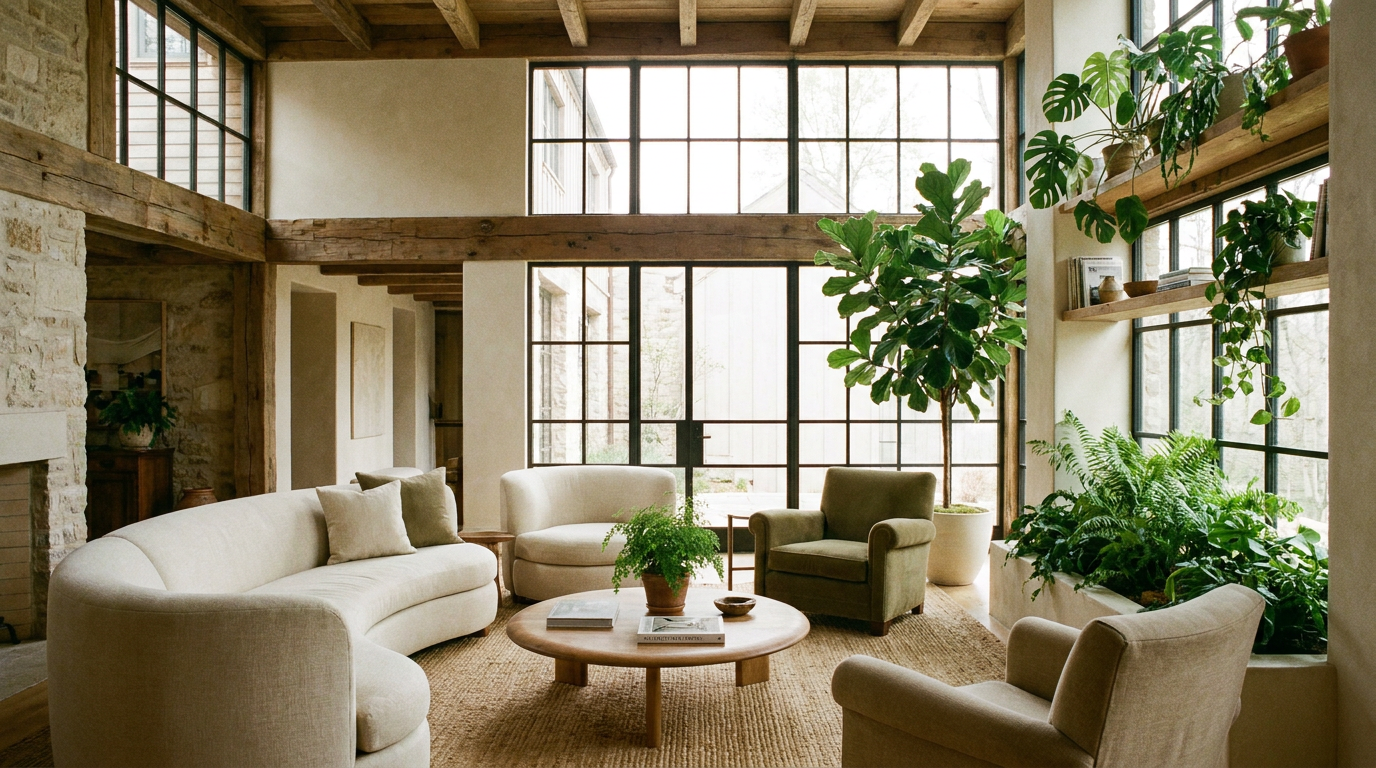
A central pillar of neuroaesthetic application is biophilic design, which operates on the evolutionary premise that the human brain is hardwired to seek out and thrive in nature. For hundreds of thousands of years, our ancestors relied on natural environments for survival, meaning our nervous systems are deeply calibrated to natural stimuli. Bringing elements of the outdoors inside—through abundant natural light, indoor vegetation, and organic materials like stone and wood—directly taps into this biological preference. Studies consistently show that exposure to these biophilic elements accelerates stress recovery and significantly reduces symptoms of anxiety.[1][3]
For hundreds of thousands of years, our ancestors relied on natural environments for survival, meaning our nervous systems are deeply calibrated to natural stimuli.
The neurological preference for nature extends to the specific shapes and patterns we surround ourselves with. The human brain processes biomorphic forms and fractal patterns—the repeating, scalable geometries found in leaves, waves, and wood grain—with remarkable visual efficiency. When interior spaces incorporate these natural geometries rather than relying exclusively on harsh, rigid right angles, the brain expends less energy decoding the environment. This reduction in "cognitive load" prevents visual fatigue and allows the mind to allocate its resources toward creativity, problem-solving, and emotional regulation.[7]
Spatial harmony and symmetry play an equally critical role in signaling safety to the subconscious mind. A balanced room layout is not just an aesthetic preference; it is a neurological imperative. When a space is cluttered, highly asymmetrical, or difficult to navigate, the brain must constantly work to map the environment and assess potential obstacles, which subtly elevates stress levels. Conversely, intuitive layouts with clear sightlines and balanced proportions allow the nervous system to stand down. The environment feels predictable and secure, fostering a profound sense of tranquility and mental clarity.[4][7]

Color and lighting, long considered the foundational tools of interior design, are now being understood through the lens of neurobiology rather than mere color psychology. The hues we surround ourselves with elicit specific, measurable autonomic responses; soft blues and muted greens have been shown to physically lower heart rates, while warmer earth tones foster a sense of grounding. Furthermore, the integration of circadian lighting systems—which adjust in color temperature and intensity to mimic the natural progression of the sun—helps regulate the brain's melatonin production, directly improving sleep quality and daytime alertness.[3][5]
Crucially, neuroaesthetics emphasizes that human perception is multisensory, meaning that visual beauty alone is insufficient if other senses are under assault. The acoustic environment of a room is a major determinant of physiological stress. Unpredictable ambient noise or harsh echoes maintain the brain in a state of hyper-vigilance, keeping cortisol levels elevated. By incorporating sound-absorbing textiles, acoustic panels, and intentional furniture placement, designers can dampen chaotic noise and replace it with restorative acoustic profiles, proving that a truly healthy space must sound as good as it looks.[2]
The implications of this science extend far beyond the realm of luxury residential design, offering transformative potential for public and institutional architecture. Healthcare facilities are increasingly adopting neuroaesthetic and biophilic principles, driven by data showing that patients with access to natural light and nature-inspired environments require less pain medication and experience accelerated recovery times. Similarly, educational institutions are redesigning classrooms to optimize sensory input, resulting in measurable improvements in student concentration, cognitive development, and overall academic performance.[1][3]

The real estate and construction industries are rapidly institutionalizing these scientific findings, recognizing that mental well-being is a tangible metric of building quality. Frameworks like the WELL Building Standard have expanded to include neuro-based design principles, offering certifications for spaces that actively support cognitive clarity and emotional balance. As consumer awareness grows, homes and offices that are intentionally engineered to reduce stress and foster psychological resilience are commanding significant premiums, signaling a permanent shift in how the market values interior environments.[4]
Ultimately, the rise of neuroaesthetics represents a profound reimagining of our relationship with the built environment. It challenges the outdated notion that interior design is a superficial pursuit, repositioning it as a critical component of human biology and public health. By acknowledging that our surroundings continuously shape our brain chemistry, we gain the power to design spaces that actively care for us. The homes and workplaces of the future will not simply be places where we exist; they will be highly calibrated instruments designed to nurture our minds, heal our bodies, and elevate the human experience.[5][7]
How we got here
1990s
Advancements in fMRI technology allow scientists to observe the brain's real-time response to beauty and art.
2014
Foundational studies link aesthetically pleasing environments directly to the orbitofrontal cortex and emotional regulation.
2022
Scoping reviews in public health journals confirm the measurable physiological benefits of biophilic design on stress and anxiety.
2025
Neuroaesthetics becomes a mainstream credential in interior design, integrated into standards like the WELL Building Standard.
Viewpoints in depth
Neuroscientists & Clinical Researchers
Focus on empirical data, brain imaging, and measurable physiological outcomes.
For the scientific community, neuroaesthetics is a way to quantify the human experience. Researchers rely on fMRI scans, heart-rate variability monitors, and cortisol testing to prove that aesthetic experiences are not subjective luxuries, but biological necessities. They argue that our nervous systems are constantly scanning our environments for threats or safety, and that 'beauty' is simply the brain's reward signal for an environment that promotes survival and well-being.
Architects & Interior Designers
Focus on translating scientific data into practical, functional, and beautiful spaces.
Design professionals view neuroaesthetics as a validation of their long-held intuitions. By understanding the biological mechanisms behind why a room 'feels right,' designers can intentionally engineer spaces that reduce cognitive load. They advocate for integrating biophilic elements, circadian lighting, and acoustic dampening not just as aesthetic choices, but as essential components of a client's daily mental health toolkit.
Public Health & Urban Planners
Focus on democratizing restorative environments for broader societal benefit.
Public health advocates emphasize that the benefits of neuroaesthetics must extend beyond luxury residential projects. They push for these evidence-based principles to be mandated in the design of hospitals, public schools, and affordable housing. From their perspective, if a building's design can demonstrably lower blood pressure and accelerate healing, then access to neuroaesthetic architecture is a matter of public health equity.
What we don't know
- How cultural background and individual life experiences alter neurological responses to specific colors or spatial layouts.
- The exact long-term physiological differences between living in a neuro-optimized home versus a standard environment over decades.
- How to effectively scale these bespoke, evidence-based design interventions for low-income and affordable housing projects.
Key terms
- Neuroaesthetics
- The scientific study of how the brain perceives and responds to aesthetic experiences, art, and design.
- Biophilic Design
- An architectural approach that connects building occupants more closely to nature through direct and indirect natural elements.
- Orbitofrontal Cortex
- The area of the brain involved in cognitive processing of decision-making and reward, which lights up in response to beautiful environments.
- Cognitive Load
- The amount of working memory resources used by the brain; cluttered or chaotic rooms increase this load, causing mental fatigue.
- Circadian Lighting
- Lighting systems designed to mimic the natural progression of sunlight throughout the day to support the body's internal clock.
Frequently asked
What exactly is neuroaesthetics?
It is the scientific study of how beauty, nature, and design affect our brains and bodies, using tools like fMRI scans to measure biological responses to environments.
How does biophilic design work?
It incorporates natural elements like light, plants, and wood grain, which the brain evolutionarily recognizes as safe, thereby lowering stress hormones and reducing anxiety.
Do I need a complete remodel to benefit?
No. Small changes like adding indoor plants, maximizing natural light, and reducing visual clutter can immediately lower cognitive load and improve your mood.
Is this just color psychology?
It goes much deeper. While color matters, neuroaesthetics also measures how spatial symmetry, acoustics, and physical textures physically alter brain chemistry and heart rate.
Sources
Source coverage
7 outlets
3 viewpoints surfaced







[1]National Institutes of HealthPublic Health & Urban Planners
Biophilic design and neuroarchitecture: A scoping review
Read on National Institutes of Health →[2]Science in DesignNeuroscientists & Clinical Researchers
The Complete Guide to Neuroaesthetics for Interior Designers
Read on Science in Design →[3]ArchDailyArchitects & Interior Designers
Neuroaesthetics and Neuroarchitecture in Shaping Spaces
Read on ArchDaily →[4]ForbesPublic Health & Urban Planners
The Science of Style: Neuroaesthetics in Interior Design
Read on Forbes →[5]LivingetcArchitects & Interior Designers
Neuroaesthetics Can Help You Understand How Your Home Makes You Feel
Read on Livingetc →[6]Pearl AcademyNeuroscientists & Clinical Researchers
Neuroaesthetics in Interior Spaces: Designing for Mental Well-Being
Read on Pearl Academy →[7]Factlen Editorial TeamArchitects & Interior Designers
Synthesis by Factlen editorial team
Read on Factlen Editorial Team →



Every angle. Every day.
Get lifestyle stories with full source coverage and perspective breakdowns delivered to your inbox.