
The Science of Umami: How to Build Deep Flavor in Plant-Based Cooking
Understanding the biochemistry of glutamate and nucleotides allows cooks to create rich, satisfying plant-based meals without relying on meat or dairy.
By Factlen Editorial Team
- Culinary Scientists
- Focus on the biochemical interactions of amino acids and receptor synergy to explain why certain flavor combinations work.
- Plant-Based Chefs
- Emphasize practical techniques like roasting, layering, and ingredient pairing to create satisfying meatless dishes.
- Fermentation Artisans
- Highlight the role of microbes, particularly koji, in transforming raw ingredients into dense umami seasonings over time.
What's not represented
- · Traditional Japanese home cooks who utilize umami intuitively through dashi without focusing on the biochemical breakdown.
- · Agricultural producers who breed specific tomato or mushroom varieties specifically to maximize their natural glutamate yields.
Why this matters
Mastering umami is the single most effective way to make plant-based meals deeply satisfying. By understanding how specific molecules interact on the tongue, home cooks can transform flat, uninspired vegetables into rich, crave-worthy dishes.
Key points
- Umami is the fifth basic taste, signaling the presence of proteins and essential amino acids.
- Free glutamate is the core molecule of umami, found abundantly in tomatoes, seaweed, and fermented foods.
- Combining glutamates with ribonucleotides (like guanylate in mushrooms) multiplies the savory flavor eightfold.
- Fermentation processes, particularly using koji mold, break down proteins to naturally generate massive amounts of umami.
- Nutritional yeast naturally contains both glutamates and nucleotides, making it a standalone umami powerhouse.
For decades, the most common complaint about plant-based cooking was that it felt like something was missing. Vegetables could be salted, spiced, and roasted to perfection, yet they often lacked the lingering, savory depth that meat and dairy effortlessly provide. That missing element is not fat, and it is not salt. It is umami, the elusive fifth taste that signals the presence of protein and triggers a deep sense of culinary satisfaction.[1][7]
Umami, a Japanese term translating roughly to "pleasant savory taste," was scientifically identified in 1908 by chemist Kikunae Ikeda at the University of Tokyo. While studying kombu dashi—a traditional seaweed broth—Ikeda isolated glutamic acid as the specific molecule responsible for its rich, mouth-filling flavor. He realized that this taste was entirely distinct from sweet, salty, sour, and bitter, operating on its own dedicated receptors on the human tongue.[2][7]
Biologically, our ability to taste umami evolved as a survival mechanism. Just as sweetness signals energy-dense carbohydrates and bitterness warns of potential toxins, umami indicates the presence of essential amino acids and proteins. When umami receptors are triggered, they promote salivation and signal the digestive system to prepare for protein breakdown, creating a physiological response that makes the food feel inherently nourishing.[4][7]
The foundation of umami is glutamate, the most abundant amino acid in the human body and in nature. However, glutamate only registers on our taste buds when it is "free"—meaning it has been broken off from its long protein chains. In animal products, this breakdown happens naturally during aging or slow cooking. In the plant kingdom, cooks must rely on specific ingredients that are naturally high in free glutamates, such as ripe tomatoes, kombu seaweed, and fermented soy products.[1][2]
But glutamate is only half of the umami equation. The true secret to building explosive flavor lies in a biochemical phenomenon known as "umami synergy." This occurs when free glutamates are combined with specific ribonucleotides—namely, inosinate and guanylate. When these compounds hit the tongue simultaneously, they do not just add their flavors together; they multiply them.[2][4]

Research into taste receptors reveals that ribonucleotides alter the physical shape of the umami receptor on the tongue, allowing glutamate to bind more tightly and stay attached longer. The result is a flavor amplification that culinary scientists quantify as an eightfold increase in perceived savoriness. In mathematical terms of taste, one part glutamate plus one part guanylate equals eight parts umami.[4][7]
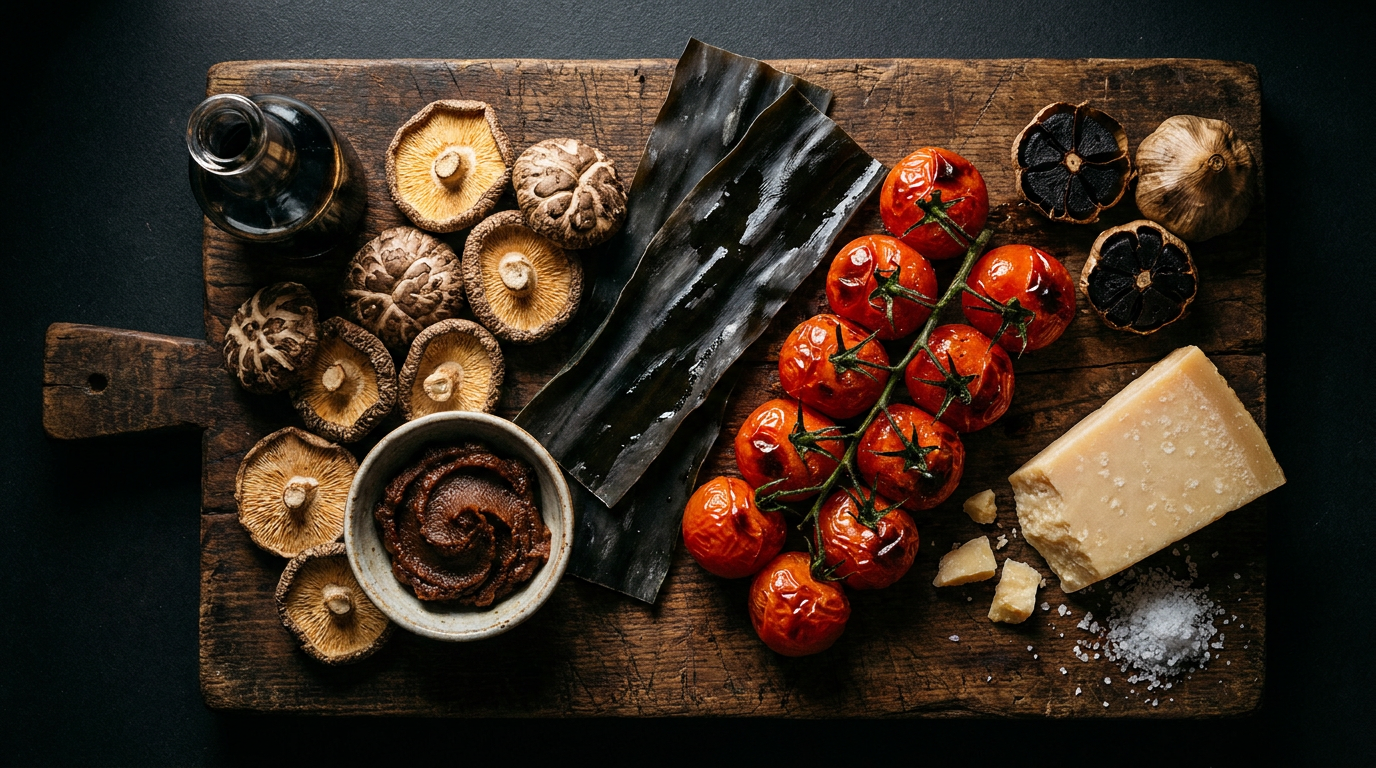
Harnessing this synergy is the key to mastering plant-based cooking. While inosinate is primarily found in animal tissues like dried fish and cured meats, guanylate is abundant in the fungal kingdom. Dried mushrooms—particularly dried shiitake—are extraordinarily rich in guanylate. This explains why the classic Japanese combination of kombu (glutamate) and dried shiitake (guanylate) creates a broth with a savory backbone rivaling any meat stock.[1][4]
Harnessing this synergy is the key to mastering plant-based cooking.
Beyond selecting the right ingredients, cooks can actively generate umami through technique. Heat is a powerful tool for liberating amino acids. When vegetables like tomatoes or onions are roasted, their cell walls break down and their proteins denature, freeing up glutamates. Simultaneously, the Maillard reaction—the browning of amino acids and sugars under high heat—creates entirely new, complex savory compounds.[1][7]
Time is another crucial ingredient. As produce ripens, its internal enzymes break down proteins, naturally increasing its umami content. A fully red, sun-ripened tomato contains significantly more free glutamate than a firm, green one. Similarly, the process of drying mushrooms concentrates their guanylate levels, making a dried shiitake far more potent than a fresh one.[4][7]
However, the most powerful method for unlocking plant-based umami is fermentation. Microbes are essentially microscopic chefs, using their enzymes to dismantle complex proteins into highly flavorful free amino acids. In Japanese cuisine, this process is driven by Aspergillus oryzae, a domesticated mold known as koji. Koji secretes over a hundred different enzymes, including powerful proteases that systematically break down the proteins in soybeans and grains.[3][7]

When koji is applied to soybeans and aged, it produces miso and soy sauce—two of the most concentrated sources of plant-based umami on earth. Modern chefs are increasingly using koji in its simpler forms, such as shio koji (a fermented mixture of koji, salt, and water), to marinate vegetables. The enzymes in shio koji tenderize the plant tissue while depositing free glutamates directly into the ingredient, creating a deep, savory profile without any animal fats.[3][7]
In Western plant-based cooking, nutritional yeast serves a similar role. Often affectionately called "nooch," nutritional yeast is a deactivated strain of Saccharomyces cerevisiae. During its cultivation, the yeast cells synthesize high levels of both glutamic acid and 5'-ribonucleotides. Because it contains both halves of the umami synergy equation naturally, a simple sprinkle of nutritional yeast delivers a massive, complex savory hit to sauces and roasted vegetables.[5][6]

The discussion of glutamate inevitably leads to monosodium glutamate (MSG). MSG is simply the sodium salt of glutamic acid, isolated and crystallized for easy use. The glutamate in MSG is chemically identical to the glutamate found naturally in a tomato, a mushroom, or human breast milk. Decades of rigorous scientific study by global health organizations have consistently reaffirmed its safety, debunking historical stigmas and confirming it as a highly efficient tool for building flavor.[2][6]
Ultimately, building umami in plant-based food requires intentional layering. A chef might start by caramelizing onions and tomato paste (concentrating glutamates), deglaze the pan with a splash of soy sauce (adding fermented amino acids), and simmer the dish with dried mushrooms (introducing guanylate for synergy).[1][7]
By understanding the biochemical mechanics of taste, cooks are no longer limited by the absence of meat. Instead, they can treat the plant kingdom as a vast laboratory of flavor, combining specific molecules to create dishes that are not just acceptable alternatives, but deeply satisfying culinary achievements in their own right.[1][7]
Viewpoints in depth
Culinary Scientists
Viewing flavor as a measurable biochemical equation.
For food scientists, umami is not an abstract culinary concept but a precise chemical interaction. They focus on how free glutamic acid binds to the T1R1 and T1R3 receptors on the human tongue. Their research highlights that ribonucleotides like inosinate and guanylate do not just add flavor; they physically alter the shape of the taste receptor, trapping the glutamate molecule and amplifying the neurological signal sent to the brain. This empirical approach demystifies cooking, turning flavor building into a predictable science.
Plant-Based Chefs
Applying the science of umami to solve the challenge of meatless cooking.
Chefs working in plant-based cuisine view umami as their most critical tool for creating satiating meals. Without the natural glutamates found in animal fats and collagen, they must actively construct a savory backbone. This involves intentional layering: using tomato paste for a base, deglazing with soy sauce, and finishing with nutritional yeast. For these culinary professionals, understanding umami synergy is the difference between a dish that feels like a "meatless compromise" and one that stands entirely on its own merits.
Fermentation Artisans
Relying on microbes and time to unlock deep savory profiles.
Fermentation experts look at umami through the lens of microbial transformation. They rely on organisms like Aspergillus oryzae (koji) to do the heavy lifting of flavor creation. By providing the right environment, they allow the mold's proteases to slowly dismantle the complex proteins in grains and legumes over months or years. To artisans, the highest expressions of umami—like a deeply aged miso or a traditional soy sauce—cannot be rushed with heat, but must be cultivated through patient biological processes.
What we don't know
- While the T1R1 and T1R3 receptors are well understood, scientists are still researching whether other undiscovered receptors on the tongue also contribute to the perception of umami.
- The exact evolutionary timeline of when humans developed a distinct preference for umami—and how it shaped early cooking practices—remains a subject of anthropological debate.
Key terms
- Glutamate
- An amino acid that, when freed from protein chains, binds to specific receptors on the tongue to create the savory taste of umami.
- Guanylate
- A ribonucleotide found abundantly in dried mushrooms that synergizes with glutamate to exponentially increase savory flavor.
- Koji
- A domesticated mold (Aspergillus oryzae) used in Japanese fermentation to break down starches and proteins into sugars and amino acids.
- Maillard Reaction
- A chemical reaction between amino acids and reducing sugars under heat that gives browned food its distinctive flavor.
- Nutritional Yeast
- A deactivated yeast packed with free glutamates and nucleotides, widely used in vegan cooking to add a cheesy, savory depth.
Frequently asked
What exactly is umami?
Umami is one of the five basic tastes, alongside sweet, salty, sour, and bitter. It translates to a "pleasant savory taste" and is triggered by specific amino acids and nucleotides in food.
How do you get umami without meat?
Plant-based umami is achieved by using ingredients naturally high in free glutamates, such as ripe tomatoes, kombu seaweed, fermented soy (miso, soy sauce), and nutritional yeast.
What is umami synergy?
Umami synergy occurs when glutamates are combined with ribonucleotides (like guanylate in dried mushrooms). This combination alters taste receptors, multiplying the savory flavor by up to eight times.
Is MSG safe to eat?
Yes. Monosodium glutamate (MSG) is simply the sodium salt of glutamic acid, chemically identical to the glutamate found naturally in tomatoes and cheese. Decades of research have confirmed it is safe for consumption.
Sources
Source coverage
7 outlets
3 viewpoints surfaced







[1]Le Cordon BleuPlant-Based Chefs
The Science of Plant-Based Umami
Read on Le Cordon Bleu →[2]WikipediaCulinary Scientists
Umami
Read on Wikipedia →[3]Umami ScienceFermentation Artisans
The Science Behind Japan's Most Versatile Fermentation Tool
Read on Umami Science →[4]Lion's Den MushroomsCulinary Scientists
Umami Synergy
Read on Lion's Den Mushrooms →[5]Tofu WorldPlant-Based Chefs
Umami: The Fifth Taste, Built From Molecules
Read on Tofu World →[6]LIVEKINDLYFermentation Artisans
Nutritional Yeast and The MSG Myth
Read on LIVEKINDLY →[7]Factlen Editorial TeamFermentation Artisans
Synthesis by Factlen editorial team
Read on Factlen Editorial Team →


Every angle. Every day.
Get lifestyle stories with full source coverage and perspective breakdowns delivered to your inbox.