
The Evidence Is In: 'Missing Middle' Zoning Reforms Are Successfully Lowering Rents
Years after pioneering cities like Minneapolis and Auckland eliminated single-family zoning, new economic data proves that legalizing medium-density housing drastically curbs rent growth.
By Factlen Editorial Team
- Housing Economists
- Focus on empirical data, causal inference, and synthetic controls to measure the exact impact of housing supply on prices.
- Supply-Side Advocates
- Argue that restrictive zoning is the primary driver of the housing crisis and champion deregulation to spur construction.
- Zoning Traditionalists
- Express concern over neighborhood character and question whether price drops reflect decreased desirability rather than increased supply.
What's not represented
- · Low-Income Renters
- · Local City Council Members
Why this matters
Housing costs are the single largest expense for most households and a primary driver of inflation. The empirical proof that zoning reform actually lowers rents provides a concrete, actionable roadmap for cities to solve the affordability crisis and restore the middle class.
Key points
- For decades, exclusionary zoning laws banned multi-unit housing in most North American neighborhoods, fueling an affordability crisis.
- In 2018, Minneapolis eliminated single-family zoning; over the next five years, its housing stock grew by 12% while rents remained nearly flat.
- A 2025 economic study found Minneapolis rents are now up to 34% lower than they would have been without the zoning reform.
- Auckland, New Zealand, upzoned 75% of its residential land in 2016, sparking a historic construction boom that drastically lowered rent-to-income ratios.
- While upzoning stabilizes market rates, experts caution that direct subsidies are still needed for the lowest-income renters.
For decades, the North American approach to residential development was defined by a strict duopoly: sprawling single-family homes in the suburbs and high-rise apartments in the urban core. This polarization was enforced by exclusionary zoning laws that made it illegal to build anything else on the vast majority of city land. As populations grew and urban land became scarce, this artificial constraint on housing supply helped ignite a generational affordability crisis.[5]
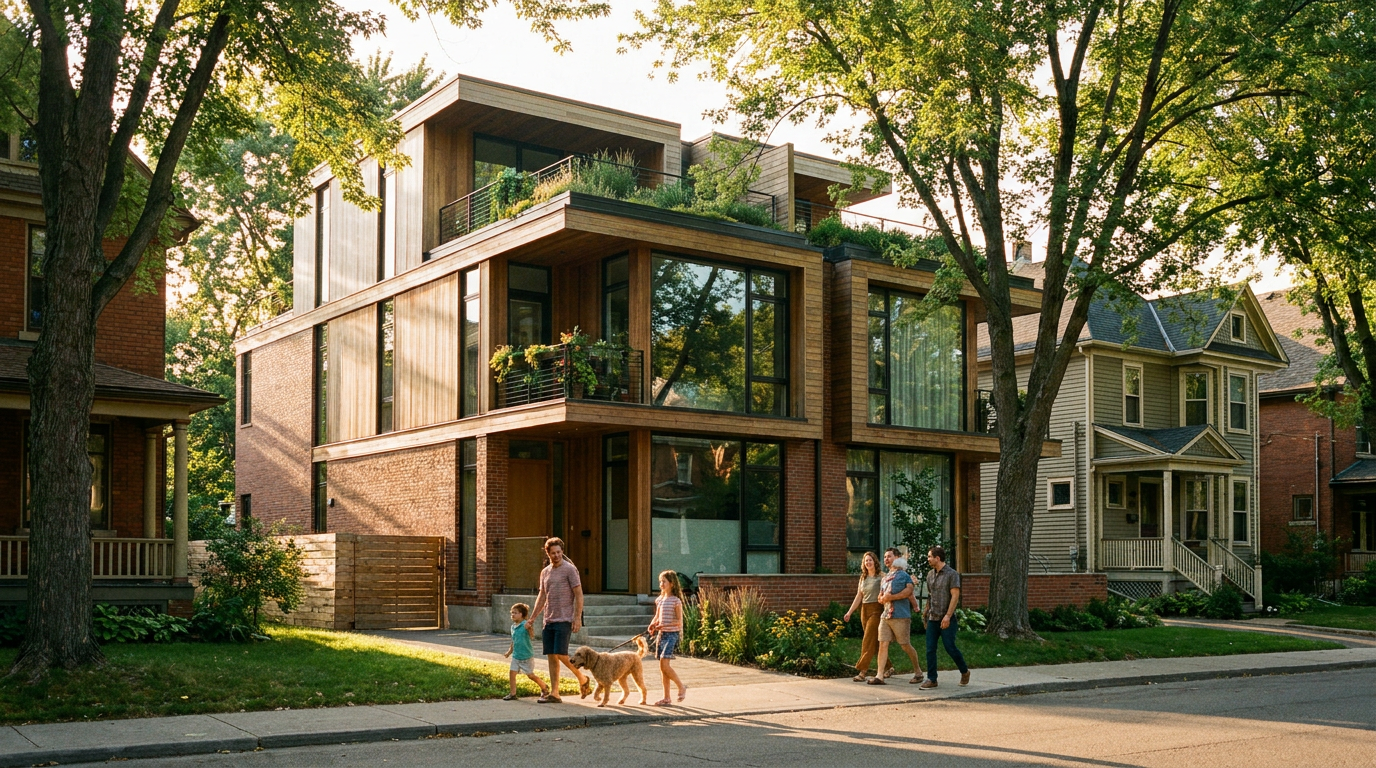
In response, a growing coalition of urban planners and policymakers began championing the legalization of "missing middle" housing. The concept refers to house-scale buildings with multiple units—such as duplexes, triplexes, courtyard apartments, and townhomes—that blend seamlessly into existing low-density neighborhoods. The economic theory was straightforward: allowing more units on a single parcel of land dilutes the land cost per unit, organically creating more affordable housing options without requiring massive public subsidies.[1][5]
For years, the missing middle remained largely theoretical, fiercely debated in city halls but rarely implemented at scale. Homeowners often resisted, citing concerns over neighborhood character, parking congestion, and property values. But recently, the empirical data has finally arrived. Years after a handful of pioneering cities enacted sweeping zoning reforms, economists now have the long-term data necessary to measure whether upzoning actually works to tame runaway housing costs.[2][3][6]
The most prominent American test case is Minneapolis. In late 2018, the city passed its 2040 Comprehensive Plan, becoming the first major municipality in the United States to eliminate single-family exclusive zoning citywide. The reform legalized the construction of two- and three-unit homes on parcels previously restricted to single-family detached houses, while simultaneously eliminating off-street parking minimums and encouraging higher-density development along transit corridors.[1][4][6]
The topline results have been striking. According to an analysis by the Pew Charitable Trusts, Minneapolis successfully decoupled population growth from rent inflation. Between 2017 and 2022, the city expanded its total housing stock by 12 percent. Over that same five-year period, average rents in Minneapolis grew by just 1 percent. By contrast, the rest of Minnesota—which did not implement similar zoning reforms—saw its housing stock grow by only 4 percent while rents surged by 14 percent.[1][4]

To prove that this divergence was actually caused by the zoning reform and not just broader macroeconomic trends, economists Helena Gu and David Munro published a rigorous 2025 study utilizing a "synthetic control" method. They constructed a counterfactual "Synthetic Minneapolis" using data from 83 similar donor cities that did not change their zoning laws, allowing them to isolate the exact impact of the 2040 Plan.[2]
Their findings confirmed the policy's profound impact. Five years after the 2040 Plan took effect, actual rents in Minneapolis were between 17.5 percent and 34 percent lower than they would have been in the synthetic counterfactual. Home purchase prices saw a similar deceleration, sitting 16 percent to 34 percent below the projected baseline. The researchers noted that the price moderation was especially pronounced for smaller, more modestly priced homes and condos.[2]
Home purchase prices saw a similar deceleration, sitting 16 percent to 34 percent below the projected baseline.
However, the mechanism behind this price drop has sparked debate. The Center of the American Experiment, a conservative think tank, points out that the 2040 Plan did not immediately trigger a massive construction boom of triplexes specifically. Instead, the bulk of the new supply came from larger apartment buildings along commercial corridors. Some skeptics argue that the broad relaxation of density restrictions may have actually lowered the perceived amenity value of Minneapolis for certain buyers, suppressing demand and prices through shifting market expectations rather than just raw supply.[1][6]
For an even larger-scale demonstration of supply-side economics, researchers have turned to Auckland, New Zealand. In 2016, facing a severe housing shortage, the city implemented the Auckland Unitary Plan, which upzoned approximately 75 percent of its residential land to allow for medium- and high-density housing. It remains one of the most ambitious zoning reforms ever enacted globally.[3]
The policy unleashed a historic wave of construction. Research from the University of Auckland revealed that housing construction surged to a record high of 12 consented dwellings per thousand residents by 2022. Crucially, state-of-the-art econometric analysis confirmed that this building boom was directly driven by the zoning changes, rather than organic market trends.[3]

The influx of new supply had a massive, measurable impact on affordability. A comprehensive study found that six years after the reforms, rents for three-bedroom family homes in Auckland were 28 percent to 54 percent lower than they would have been without the upzoning. Nominal household incomes in the city rose by 47 percent between 2016 and 2023, while rents grew by just 29 percent—meaning housing actually became significantly more affordable relative to local wages.[3]
The success of Minneapolis and Auckland has provided a powerful, evidence-backed blueprint for other jurisdictions. Recognizing that hyper-local city councils often struggle to overcome neighborhood opposition, several state governments have begun preempting local zoning laws entirely. States including California, Oregon, and Washington have passed sweeping legislation to legalize missing middle housing and accessory dwelling units (ADUs) statewide, effectively forcing municipalities to allow gentle density.[4][5][7]

Early data from these state-level interventions is promising. Following the passage of its ADU legalization laws, California experienced the largest single-year increase in accessory dwelling unit construction in its history. This suggests that when regulatory barriers are removed, homeowners and small-scale developers are highly motivated to add incremental supply to the market.[5]
Despite these victories, researchers caution that zoning reform is not a panacea for all housing woes. While upzoning effectively stabilizes median rents and provides abundant market-rate options for middle-income earners, it does not automatically produce deeply affordable housing for those at the lowest end of the income spectrum. Experts emphasize that direct public subsidies and social housing programs remain essential to bridge the gap for vulnerable populations.[1][7]
Nevertheless, the empirical consensus is now clear: restrictive zoning makes housing expensive, and legalizing density makes it more affordable. By embracing the missing middle, cities are proving that the housing crisis is not an unsolvable law of nature, but a policy choice—one that can be reversed with political will and a commitment to building.[2][3][7]
How we got here
2016
Auckland implements the Unitary Plan, upzoning 75% of its residential land to allow medium-density housing.
Dec 2018
Minneapolis passes the 2040 Comprehensive Plan, becoming the first major US city to end single-family exclusive zoning.
2021
California passes S.B. 9, effectively legalizing duplexes and lot splits statewide.
2024-2025
Major econometric studies are published confirming that the Auckland and Minneapolis reforms successfully curbed rent growth.
Viewpoints in depth
Housing Economists
Focus on the synthetic control data, proving that supply directly curbs rent growth.
Economists utilizing advanced causal inference methods argue that the debate over zoning is largely settled by the data. By constructing 'synthetic' counterfactual cities, researchers have isolated the exact impact of upzoning, proving that adding supply directly lowers rents. They emphasize that even if new construction is market-rate, it triggers a 'filtering' effect that relieves price pressure across all segments of the housing market.
Supply-Side Advocates
Focus on the moral and economic imperative to abolish exclusionary zoning to restore affordability.
Proponents of the 'missing middle' view exclusionary zoning as an artificial, government-imposed constraint that protects wealthy homeowners at the expense of renters and young families. They argue that legalizing duplexes and townhomes is a vital step toward creating more equitable, walkable, and environmentally sustainable cities, and they champion state-level interventions to bypass local NIMBY (Not In My Back Yard) opposition.
Zoning Traditionalists
Focus on the loss of neighborhood character and the argument that price drops might reflect decreased desirability.
Skeptics of sweeping upzoning caution that eliminating single-family zoning fundamentally alters the character of established neighborhoods. They point out that in places like Minneapolis, the reform did not immediately result in a massive wave of triplexes, but rather larger apartment blocks on commercial corridors. Some argue that any resulting drop in home prices may actually reflect a loss of neighborhood amenity value—such as increased congestion and lost parking—rather than a pure supply-side victory.
What we don't know
- How long-term shifts in neighborhood character might eventually alter residential preferences and mobility patterns in upzoned cities.
- Whether the aggressive state-level preemptions of local zoning in places like California will yield the same per-capita supply booms seen in unified municipal efforts like Auckland.
Key terms
- Upzoning
- The process of changing local zoning regulations to allow for higher-density development, such as multi-family apartments, on a given parcel of land.
- Synthetic Control
- A statistical method used by economists to create a simulated counterfactual—like a 'Synthetic Minneapolis'—using data from similar cities to measure the exact impact of a policy.
- Exclusionary Zoning
- Local land-use regulations, such as single-family-only mandates and large minimum lot sizes, that effectively ban denser, more affordable housing types.
- Accessory Dwelling Unit (ADU)
- A smaller, independent residential dwelling unit located on the same lot as a stand-alone single-family home, often called a granny flat or backyard cottage.
Frequently asked
What exactly is missing middle housing?
It refers to house-scale buildings with multiple units—like duplexes, triplexes, and townhomes—that fit seamlessly into walkable, low-density neighborhoods.
Did Minneapolis ban single-family homes?
No. The 2040 Plan simply legalized the construction of two- or three-unit homes on lots that were previously restricted exclusively to single-family detached houses.
Does upzoning eliminate the need for affordable housing programs?
No. While increasing the overall housing supply effectively lowers median rents, experts note that direct public subsidies are still required to house the lowest-income populations.
Sources
Source coverage
7 outlets
3 viewpoints surfaced







[1]Pew Charitable TrustsSupply-Side Advocates
Minneapolis Land Use Reforms Offer a Blueprint for Housing Affordability
Read on Pew Charitable Trusts →[2]EconStorHousing Economists
Zoning Reforms and Housing Affordability: Evidence from the Minneapolis 2040 Plan
Read on EconStor →[3]University of AucklandHousing Economists
The Impact of Upzoning on Housing Construction and Rents in Auckland
Read on University of Auckland →[4]AxiosSupply-Side Advocates
Minneapolis housing policies blueprint for other cities, Pew report
Read on Axios →[5]ReasonSupply-Side Advocates
Missing middle housing policies balance interests while addressing the affordable housing crisis
Read on Reason →[6]Center of the American ExperimentZoning Traditionalists
Did the Minneapolis 2040 Plan work?
Read on Center of the American Experiment →[7]Factlen Editorial TeamHousing Economists
Synthesis by Factlen editorial team
Read on Factlen Editorial Team →


Every angle. Every day.
Get real estate stories with full source coverage and perspective breakdowns delivered to your inbox.