
How Neuroaesthetics is Rewiring Interior Design for Mental Health
The era of stark minimalism is giving way to science-backed interior design, using neuroscience to create homes that actively lower stress and improve cognitive health.
By Factlen Editorial Team
- Holistic Interior Designers
- Focus on translating clinical principles into warm, personalized, and aesthetically beautiful homes that reflect the occupant's lifestyle.
- Clinical Neuroscientists
- Focus on measurable biometric data and evolutionary psychology to dictate optimal spatial conditions.
- Sensory Accessibility Advocates
- Emphasize that sensory processing is highly individualized, warning against a one-size-fits-all approach to calming design.
What's not represented
- · Renters with limited ability to alter their architectural environments
- · Low-income households facing barriers to high-quality, health-optimized housing
Why this matters
By understanding how room shapes, lighting, and textures directly alter brain chemistry, you can make simple, science-backed changes to your home that actively lower your daily stress and improve your cognitive health.
Key points
- Neuroaesthetics is transforming interior design by using brain science to create spaces that actively lower stress.
- Clinical data shows that optimized environments can reduce stress hormones like cortisol by up to 20 percent.
- Sharp angles are being replaced by organic curves, which evolutionary psychology suggests signal safety to the brain.
- Dynamic circadian lighting and natural fractal patterns are being used to passively regulate mood and focus.
The era of the stark, museum-like home is officially ending. In 2026, the interior design industry has shifted its focus away from purely visual, social-media-driven aesthetics toward a deeper priority: how a room makes the human nervous system feel.[1][2]
This profound pivot is being driven by "neuroaesthetics," an emerging discipline operating at the intersection of neuroscience, psychology, and architecture.[6]
For decades, interior design was largely treated as a matter of subjective taste—a choice between velvet or linen, minimalist or maximalist. Today, researchers are utilizing functional MRI (fMRI) machines and biometric sensors to measure exactly how our bodies react to the spaces we inhabit.[5]
The resulting data reveals that our aesthetic preferences are actually biological imperatives. When a person enters a room, the brain's limbic system assesses the environment within milliseconds, triggering either a low-grade stress response or a cascade of calming neurotransmitters.[5][6]

The physiological stakes are surprisingly high. According to clinical measurements, environments that are intentionally optimized for the human nervous system can yield a 15 to 20 percent reduction in stress hormones like cortisol, alongside measurable drops in heart rate and blood pressure.[5]
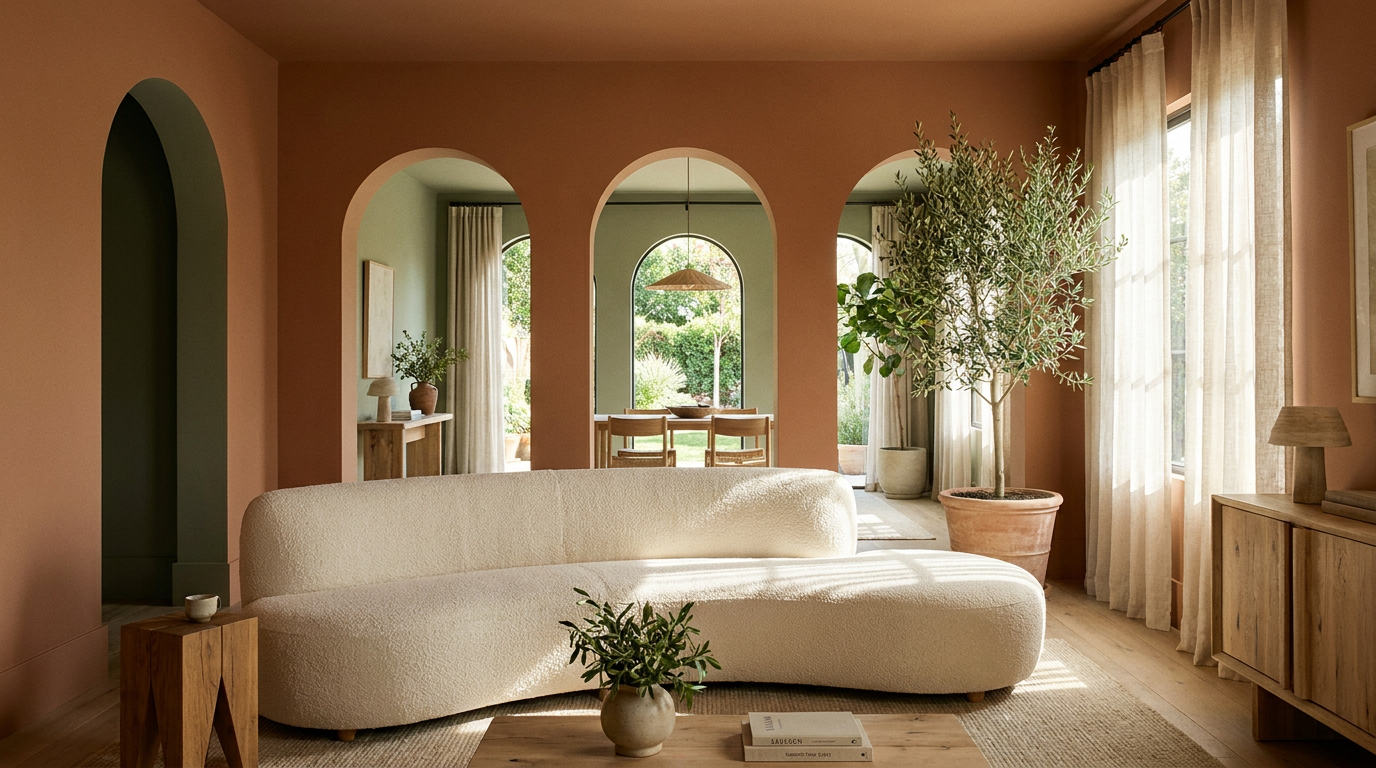
One of the most prominent design shifts born from this research is the rapid abandonment of sharp, rigid geometry in favor of organic, sweeping curves.[1][2]
Evolutionary psychology provides a clear explanation for this trend: sharp edges and sudden angles subconsciously signal danger to the brain's amygdala, keeping the nervous system in a state of mild, exhausting hypervigilance.[5][6]
Conversely, curved furniture, arched doorways, and rounded architectural details mimic the soft forms of the natural world. These shapes signal safety, allowing the brain to drop its defensive posture and genuinely relax.[2][6]

Conversely, curved furniture, arched doorways, and rounded architectural details mimic the soft forms of the natural world.
Beyond geometry, the integration of "biophilic design" has evolved from the simple pandemic-era trend of buying houseplants into a sophisticated, structural necessity.[1]
True biophilia involves embedding natural fractal patterns—the repeating, self-similar geometric shapes found in leaves, snowflakes, and ocean waves—into textiles, wall coverings, and spatial layouts.[5]
Exposure to these natural fractals has been shown to induce a mild meditative state, lowering blood pressure and improving sustained attention without requiring any conscious effort from the occupant.[3][5]
Lighting has also emerged as a critical frontier in neuroaesthetic design. The static, bright-white LED bulbs that dominated the past decade are being rapidly replaced by dynamic circadian lighting systems.[4]

These smart systems automatically adjust their color temperature and intensity throughout the day, mimicking the natural progression of the sun to regulate the body's production of serotonin in the morning and melatonin at night.[4][6]
However, researchers caution that neuroaesthetics is not a flawless, one-size-fits-all prescription. The translation of controlled clinical lab data into messy, highly personalized, lived-in homes carries inherent uncertainty.[6]
Furthermore, human sensory processing is highly individualized. Neurodivergent individuals, for example, process environmental stimuli differently; a visually complex biophilic room that calms one person might feel overwhelmingly cluttered and overstimulating to another.[6]
Despite these variables, the democratization of neuroaesthetic principles means that homeowners no longer need a massive architectural renovation budget to reap the psychological benefits.[1][2]

Simple, accessible interventions—such as swapping harsh overhead lights for warm, eye-level lamps, introducing tactile materials like raw wood and bouclé, or painting a room in grounding, earthy tones—can immediately alter a space's psychological profile.[1][2]
Ultimately, the rise of neuroaesthetics represents a profound and empowering reframing of the domestic space. Homes are no longer viewed merely as stylish containers for our belongings, but as active, healing participants in our daily mental and physical health.[6]
How we got here
1990s
Advancements in fMRI technology allow scientists to first observe how the brain reacts to aesthetic beauty.
2015
Major academic studies confirm that environmental factors like daylight and natural materials measurably improve cognitive performance.
2020–2022
The pandemic forces a global reevaluation of domestic spaces, shifting focus toward mental health and comfort.
2026
Neuroaesthetics becomes a dominant, mainstream interior design standard, replacing stark minimalism with science-backed, sensory-friendly environments.
Viewpoints in depth
The Clinical View
Focuses on the hard biological data behind our aesthetic preferences.
For clinical neuroscientists, design is a matter of evolutionary survival mechanisms. They point to fMRI data showing that sharp angles activate the amygdala—the brain's fear center—because our ancestors associated sharp objects with threats. By prioritizing curved geometry, fractal patterns, and circadian lighting, this camp argues that architects can bypass subjective taste entirely and engineer spaces that reliably lower cortisol, decrease heart rate, and optimize cognitive function across the general population.
The Designer's View
Focuses on translating clinical principles into warm, livable homes.
Holistic interior designers embrace the science of neuroaesthetics but warn against turning homes into sterile, optimized laboratories. They argue that true well-being requires a space to feel personal and curated. For this camp, the goal is to weave neuroaesthetic principles—like tactile "new neutral" materials, soft lighting, and biophilia—into a design that still reflects the homeowner's unique personality and lifestyle, ensuring the space feels like a sanctuary rather than a clinic.
The Neurodivergent View
Highlights the highly individualized nature of sensory processing.
Sensory accessibility advocates caution that neuroaesthetics often relies on averages that don't apply to everyone. For individuals with ADHD, autism, or other sensory processing differences, a highly textured, biophilic room full of fractal patterns might not be calming at all—it could be intensely overstimulating. This perspective emphasizes that truly health-conscious design must be adaptable, allowing occupants to easily adjust lighting, acoustics, and visual complexity to match their specific neurological needs.
What we don't know
- How perfectly clinical fMRI data translates to the long-term, messy reality of everyday domestic living.
- The exact threshold at which biophilic design elements transition from being neurologically calming to visually overstimulating for different individuals.
Key terms
- Neuroaesthetics
- The intersection of neuroscience and design, studying how visual and spatial environments affect brain chemistry and biometrics.
- Biophilia
- The innate human instinct to connect with nature and other living systems.
- Fractal Patterns
- Repeating geometric shapes found in nature, such as the branching of trees or the structure of snowflakes, which have been shown to calm the brain.
- Circadian Lighting
- Artificial lighting systems designed to mimic the natural progression of sunlight throughout the day to support the body's internal clock.
- Amygdala
- The region of the brain responsible for processing emotions, particularly the detection of threats and the triggering of stress responses.
Frequently asked
What exactly is neuroaesthetics?
It is the scientific study of how our brains and bodies respond to visual beauty and spatial environments, using tools like fMRI to measure biological reactions.
Do I need to do a major renovation to apply this?
No. Simple changes like swapping harsh overhead bulbs for warm lamps, adding textured fabrics, and incorporating curved decor can immediately improve a room's psychological profile.
Why are curved shapes considered better for mental health?
Evolutionary psychology suggests that sharp angles subconsciously signal danger to the brain's amygdala, while organic, sweeping curves signal safety and allow the nervous system to relax.
What is biophilic design?
It is an approach that connects indoor environments to nature, not just through houseplants, but by integrating natural light, raw materials, and fractal patterns found in the natural world.
Sources
Source coverage
6 outlets
3 viewpoints surfaced






[1]ForbesHolistic Interior Designers
Eight Design Trends We'll See In 2026
Read on Forbes →[2]DezeenHolistic Interior Designers
Interior designers predict a shift toward "quietly expressive" spaces in 2026
Read on Dezeen →[3]Building and EnvironmentClinical Neuroscientists
Clever classrooms: Summary report of the HEAD project
Read on Building and Environment →[4]Journal of Clinical Sleep MedicineClinical Neuroscientists
Impact of windows and daylight exposure on overall health and sleep quality of office workers
Read on Journal of Clinical Sleep Medicine →[5]Science in DesignClinical Neuroscientists
The Measurable Health Impacts of Neuroaesthetics in Design
Read on Science in Design →[6]Factlen Editorial TeamSensory Accessibility Advocates
Synthesis by Factlen editorial team
Read on Factlen Editorial Team →

Every angle. Every day.
Get home stories with full source coverage and perspective breakdowns delivered to your inbox.