
How Neuroaesthetics and Biophilic Design Are Turning Homes Into Biological Interventions
Interior design is undergoing a medical-grade revolution in 2026. By applying the neuroscience of beauty, architects are creating spaces that actively lower stress, regulate sleep, and improve brain health.
By Factlen Editorial Team
- Neuro-Architects & Researchers
- Scientists pushing for medical-grade, evidence-based architectural standards.
- Biophilic Design Advocates
- Designers focused on integrating natural systems to restore evolutionary balance.
- Commercial & Residential Designers
- Practitioners translating scientific theory into livable, everyday spaces.
What's not represented
- · Low-Income Housing Developers
- · Traditional Decorators
Why this matters
The spaces we inhabit silently dictate our physical and mental health, influencing everything from our stress levels to our sleep cycles. By understanding the biology of design, anyone can transform their home or workplace from a passive backdrop into an active tool for well-being.
Key points
- Interior design is shifting from a purely aesthetic discipline to a science-backed biological intervention.
- Neuroaesthetics uses brain scans to prove that well-designed spaces can lower heart rates and reduce stress hormones by up to 20 percent.
- The 'Neuro-Architecture Triad' evaluates spaces based on coherence, fascination, and hominess.
- Biophilic design in 2026 focuses on immersive indoor ecosystems, circadian lighting, and tactile, organic materials.
- Evolutionary concepts like 'prospect and refuge' dictate that humans need spaces offering both clear sightlines and a sense of protection.
- Thoughtful acoustic and lighting design is increasingly used to support neurodiversity and trauma recovery.
The feeling of walking into a room and instantly exhaling isn't just a matter of personal taste—it is a measurable biological event. For decades, interior design was treated as a purely aesthetic discipline, guided by intuition, trends, and the subjective eye of the designer. But in 2026, the industry is undergoing a profound, science-driven revolution.[6]
Welcome to the era of neuroaesthetics. This emerging field represents the convergence of neuroscience and architecture, studying exactly how the human brain and body respond to the built environment. Rather than simply asking what looks good, researchers and designers are now asking what a space does to our nervous system.[2][5]
People in developed nations spend over 90 percent of their lives indoors, making the built environment our primary habitat. Yet, until recently, we understood very little about its hidden effects on our mental state. Today, advanced brain scanning technology like fMRI and PET scans allows scientists to observe our physiological responses to spatial design in real time.[4][5]
The biological data is striking. When a person enters a thoughtfully designed, aesthetically pleasing space, their heart rate slows and blood pressure drops. The brain's orbitofrontal cortex—a region linked to emotional regulation—lights up, triggering an increase in serotonin and dopamine while reducing stress hormones like cortisol by up to 20 percent.[5]

"Design isn't an aesthetic choice. It's a biological intervention," notes Kay Sargent, a director of thought leadership at the global design firm HOK. Spaces are active agents in human health, shaping how people feel and function before conscious thought even catches up.[2]
To translate these biological responses into practical design, researchers at institutions like the Penn Center for Neuroaesthetics have identified the "Neuro-Architecture Triad." This framework breaks down our psychological experience of a room into three measurable dimensions: coherence, fascination, and hominess.[3][4]
Coherence refers to how easily the brain can organize and comprehend a scene. A cluttered, chaotic room requires immense cognitive effort to process, leading to subtle, chronic stress. Conversely, spaces with clear sightlines, intuitive layouts, and balanced proportions allow the brain to relax.[2][4]
Fascination involves informational richness that captures our interest without overwhelming us. This is often achieved through "biomorphic patterns"—shapes and textures that mimic nature, such as the fractal patterns found in wood grain or the gentle curve of a stone countertop.[1][4]

Fascination involves informational richness that captures our interest without overwhelming us.
The final pillar, hominess, is the dimension of personal ease and comfort. It taps into our evolutionary need for safety, a concept designers refer to as "prospect and refuge." Humans instinctively seek out environments where they have a clear view of their surroundings (prospect) while feeling protected at their back (refuge), such as a cozy reading nook overlooking a larger room.[4][6]
This evolutionary perspective is the driving force behind biophilic design, which has evolved from a niche trend into a foundational architectural standard in 2026. Biophilia is the innate human desire to connect with nature, and integrating it into interiors goes far beyond simply placing a potted plant in the corner.[1][6]
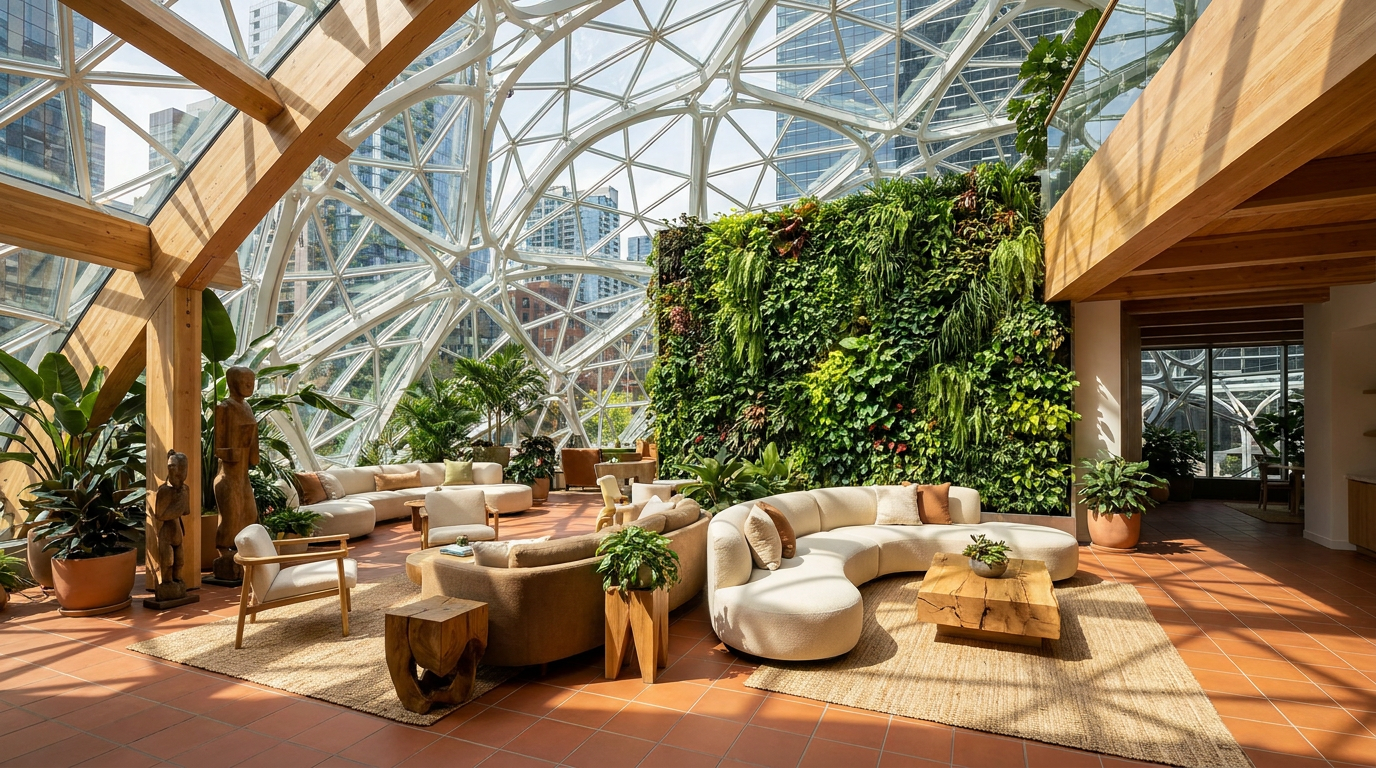
Today's biophilic spaces feature immersive indoor ecosystems. Designers are incorporating floor-to-ceiling living walls, air-purifying moss panels, and dynamic water features that engage multiple senses. Studies show that employees working in these nature-integrated offices report a 15 percent increase in productivity and significantly lower fatigue.[1][6]
Materiality also plays a crucial role in how a space feels. The brain processes the texture and weight of materials before we consciously register them. In 2026, there is a strong shift away from high-gloss, sterile finishes toward warm, earth-rooted palettes and tactile surfaces.[2][6]

Materials like unlacquered brass, honed stone, terracotta, and timber with visible grain stimulate the somatosensory cortex. These honest, imperfect textures signal warmth and authenticity, grounding the occupant and providing a sensory richness that smooth, artificial surfaces lack.[2][6]
Light and sound are equally critical biological inputs. Unpredictable noise elevates cortisol, keeping the body in a heightened state of alert. Designers are increasingly using acoustic panels, soft furnishings, and ambient white noise to create positive acoustic environments that protect focus and emotional stability.[5]
Meanwhile, lighting design has shifted toward biological needs. Because natural light is essential for regulating our circadian rhythms, modern spaces utilize dynamic lighting systems that mimic the progression of the sun. This supports healthy sleep cycles, boosts daytime alertness, and prevents the sluggishness associated with harsh, static fluorescent glare.[1][2]
These principles are proving especially vital in the realms of trauma-informed design and neuro-inclusive spaces. For neurodivergent individuals, or those recovering from trauma, repeated exposure to calming, nature-inspired environments acts as both preventative and healing medicine.[1]

By softening edges, tuning lighting, and reducing visual clutter, designers can create sanctuaries that do not overstimulate the nervous system. It is a profound shift in responsibility: recognizing that the rooms we build have the power to either deplete our energy or actively restore it.[2][6]
Ultimately, the rise of neuroaesthetics proves what many have long suspected: beauty is not a luxury, but a biological necessity. As the science continues to evolve, the interior design industry is moving toward a future where every choice—from the curve of a chair to the color of a wall—is an intentional step toward better human health.[2][5]
How we got here
1990s
Brain scanning technology advances enough to allow neurobiologists to measure physiological responses to beauty in real-time.
2014
Researchers formalize the 'Aesthetic Triad,' creating a brain-based model to evaluate how architecture affects human psychology.
2019
Google and Johns Hopkins debut 'A Space for Being' at Milan Design Week, using wearable tech to track visitors' biological responses to different interior designs.
2025
Major architectural firms begin adopting neuro-inclusive and trauma-informed design standards for commercial and public spaces.
2026
Biophilic design and neuroaesthetics transition from niche trends to foundational, evidence-based requirements in modern interior design.
Viewpoints in depth
Neuro-Architects & Researchers
Scientists pushing for medical-grade, evidence-based architectural standards.
This camp views the built environment through the lens of biology and neuroscience. Researchers argue that because humans spend over 90 percent of their time indoors, interior design should be treated as a public health intervention. By utilizing fMRI and PET scans, they seek to quantify exactly how spatial dimensions—like coherence and fascination—affect heart rates, cortisol levels, and cognitive performance. Their ultimate goal is to establish universal, evidence-based design metrics that prioritize physiological well-being over fleeting aesthetic trends.
Biophilic Design Advocates
Designers focused on integrating natural systems to restore evolutionary balance.
Biophilic advocates argue that modern humans are suffering from a profound disconnect from the natural world. They focus on the 'biophilia hypothesis,' which suggests our nervous systems are evolutionarily wired to seek out nature. For this camp, successful design requires more than just visual representations of the outdoors; it demands immersive ecosystems, dynamic circadian lighting, and tactile organic materials. They point to studies showing that direct and indirect experiences of nature can significantly reduce fatigue, lower stress, and improve focus in both homes and workplaces.
Commercial & Residential Designers
Practitioners translating scientific theory into livable, everyday spaces.
For the designers actually building these spaces, the challenge lies in application. This camp focuses on balancing the rigorous data of neuroaesthetics with the practical constraints of budget, functionality, and client preferences. They emphasize subtle, sensory-rich interventions—such as acoustic dampening, intuitive wayfinding, and the strategic use of color and texture—to create environments that feel effortlessly calming. Their focus is on making neuro-inclusive and trauma-informed design accessible, ensuring that the benefits of biological design are felt in everyday homes and offices, not just high-end installations.
What we don't know
- How long-term exposure to highly optimized neuroaesthetic environments alters baseline brain chemistry over decades.
- The exact degree to which individual cultural backgrounds modify the universal biological responses to specific design elements.
- How to perfectly balance the high costs of immersive biophilic systems with the need for accessible, affordable housing.
Key terms
- Neuroaesthetics
- A branch of neuroscience that explores how visual aesthetics and spatial design influence brain activity and physiological health.
- Biophilic Design
- An architectural framework that connects occupants to nature through natural light, greenery, and organic materials to reduce stress.
- The Aesthetic Triad
- A brain-based model that breaks down our psychological response to architecture into three dimensions: coherence, fascination, and hominess.
- Circadian Lighting
- Artificial lighting systems designed to mimic the natural progression of sunlight, helping to regulate human sleep and wake cycles.
- Somatosensory Cortex
- The part of the brain that processes tactile sensations, such as the texture and weight of materials in a room.
Frequently asked
What is neuroaesthetics?
Neuroaesthetics is the scientific study of how the brain and body respond to beauty, art, and spatial design. It uses tools like brain scans to measure physiological reactions to our environments.
How does biophilic design go beyond just adding houseplants?
While plants are a component, true biophilic design integrates natural light, airflow, organic textures, and evolutionary spatial layouts to create an immersive indoor ecosystem.
What is the 'prospect and refuge' theory?
It is an evolutionary psychology concept suggesting humans feel most comfortable in spaces where they have a clear view of their surroundings (prospect) while feeling protected from behind (refuge).
Can I apply neuroaesthetics to my home on a budget?
Yes. Simple changes like maximizing natural light, reducing visual clutter to improve 'coherence,' and introducing tactile, natural materials can significantly improve a room's biological impact.
Sources
Source coverage
6 outlets
3 viewpoints surfaced






[1]Metropolis MagazineBiophilic Design Advocates
The Science of Stress: Fractals and Neuroaesthetics
Read on Metropolis Magazine →[2]HOKCommercial & Residential Designers
HOK Forward 2026: Beauty as a Biological Necessity
Read on HOK →[3]Penn Center for NeuroaestheticsNeuro-Architects & Researchers
The Aesthetic Triad: Brain-Based Models for Architecture
Read on Penn Center for Neuroaesthetics →[4]National Institutes of HealthNeuro-Architects & Researchers
The visual brain harbours hidden sensitivities to architectural interiors
Read on National Institutes of Health →[5]Science in DesignNeuro-Architects & Researchers
Neuroaesthetics: Where Art Meets Biology
Read on Science in Design →[6]Factlen Editorial TeamCommercial & Residential Designers
Synthesis by Factlen editorial team
Read on Factlen Editorial Team →

Every angle. Every day.
Get home stories with full source coverage and perspective breakdowns delivered to your inbox.