
The Evidence Behind LED Face Masks: Do At-Home Red Light Treatments Actually Work?
Dermatologists and recent clinical trials confirm that at-home LED masks can improve acne and stimulate collagen, but results depend heavily on consistent use and device power.
By Factlen Editorial Team
- Clinical Dermatologists
- Value the proven mechanisms of photobiomodulation but emphasize that home devices cannot match the power of in-office treatments.
- Skincare Consumers
- Prioritize non-invasive, pain-free treatments that offer long-term compounding benefits without the downtime of chemical peels or lasers.
- Device Manufacturers
- Focus on FDA clearance, specific wavelength combinations, and daily usability to justify premium price points.
What's not represented
- · Estheticians who offer mid-tier LED treatments
- · Manufacturers of ultra-budget LED devices
Why this matters
Premium LED face masks cost upwards of $400, promising clinical-grade anti-aging and acne reduction from the couch. Understanding the actual science of light wavelengths and energy dosing separates the devices that genuinely alter cellular function from expensive plastic toys.
Key points
- At-home LED masks utilize photobiomodulation to stimulate cellular energy and boost collagen production.
- Red (630-660 nm) and near-infrared (830-850 nm) wavelengths are clinically proven to reduce fine lines and improve skin texture.
- A 2025 systematic review confirmed that blue and red light combinations significantly reduce acne lesions.
- The efficacy of a mask depends heavily on its irradiance and fluence, not just the color of the light.
- Consistent use over 8 to 12 weeks is required to see structural anti-aging results.
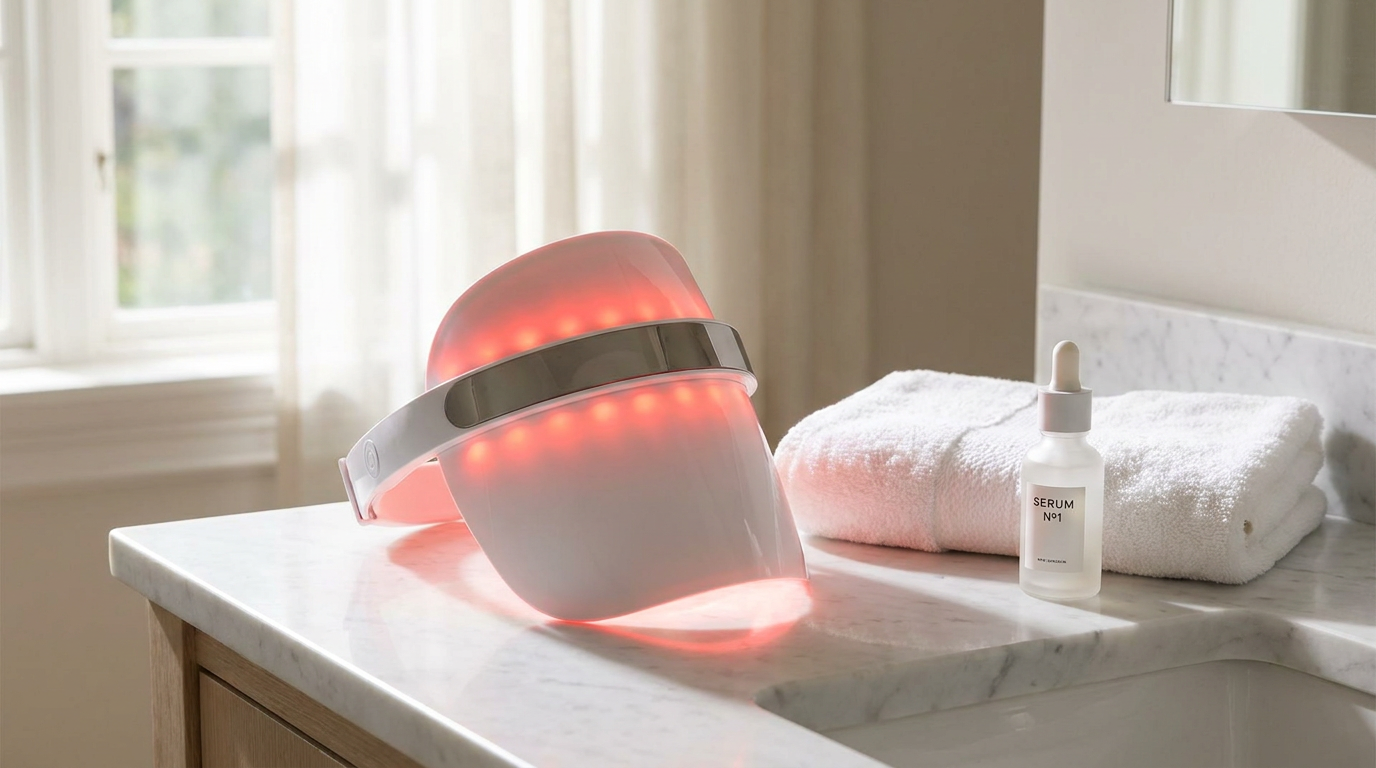
They look like glowing props from a science-fiction film, but LED face masks have rapidly transitioned from niche spa novelties to the most coveted investments in home skincare. Devices from brands like Omnilux and Dr. Dennis Gross now dominate social media and beauty editorials, promising to erase fine lines, calm rosacea, and banish breakouts without a single drop of harsh chemicals.[6][7]
The core mechanism driving this trend is photobiomodulation (PBM). Unlike ultraviolet (UV) light, which damages cellular DNA and accelerates aging, specific wavelengths of visible and invisible light can safely penetrate the skin to stimulate mitochondria—the microscopic powerhouses inside human cells.[3][5]
When these specific light waves hit the mitochondria, they trigger a biochemical boost that increases the production of adenosine triphosphate (ATP). This surge in cellular energy signals fibroblasts in the dermis layer to ramp up their production of collagen and elastin, the structural proteins responsible for keeping skin firm and supple.[3][5]
For anti-aging purposes, the clinical evidence centers almost entirely on two specific wavelengths. Red light, typically calibrated between 630 and 660 nanometers (nm), targets the superficial papillary dermis to reduce redness and smooth surface texture. Near-infrared light, operating invisibly between 830 and 850 nm, penetrates much deeper into the reticular dermis to drive structural collagen support.[5][8]

Clinical trials confirm the efficacy of combining these two wavelengths. Peer-reviewed studies demonstrate that consistent use over an 8-to-12-week period leads to measurable improvements in skin density, elasticity, and a visible reduction in periorbital wrinkles, commonly known as crow's feet.[4]
Beyond anti-aging, LED therapy has proven highly effective for acne management. A comprehensive 2025 systematic review conducted by Mass General Brigham researchers and published in JAMA Dermatology analyzed data from 216 participants across six randomized controlled trials.[1]
The researchers concluded that individuals using at-home LED devices experienced a significant reduction in both inflammatory and non-inflammatory acne lesions compared to control groups. This is achieved by utilizing blue light (around 415 nm) to destroy acne-causing Cutibacterium acnes bacteria, paired with red light to soothe the resulting inflammation.[1][4]
This is achieved by utilizing blue light (around 415 nm) to destroy acne-causing Cutibacterium acnes bacteria, paired with red light to soothe the resulting inflammation.
However, dermatologists caution that not all masks on the market are created equal. The critical, and frequently obscured, metrics for any light therapy device are irradiance (power density) and fluence (the total energy delivered to the skin over time, measured in joules per square centimeter).[2]
The evidence-backed fluence range for facial anti-aging sits between 5 and 20 J/cm² per session. A cheap mask with weak LED bulbs might require an hour of continuous wear to reach this therapeutic threshold, rendering its advertised 10-minute automatic timer functionally useless.[2][5]

This power gap explains why in-clinic treatments remain superior for rapid, dramatic results. As researchers at Stanford Medicine note, clinical LED panels deliver vastly more energy than battery-operated home masks. However, home devices offer the distinct advantage of daily compounding consistency, which is often more practical than weekly clinic visits.[2]
When comparing the premium market leaders, the Omnilux Contour Face and the Dr. Dennis Gross SpectraLite FaceWare Pro consistently dominate independent consumer testing and dermatological reviews.[6][7]
The Omnilux utilizes a flexible, medical-grade silicone design that sits flush against the skin, minimizing light scatter and maximizing absorption. It focuses purely on anti-aging and healing, utilizing 633 nm red and 830 nm near-infrared wavelengths during standard 10-minute sessions.[6][7]

Conversely, the Dr. Dennis Gross mask features a rigid, futuristic design but includes blue light diodes alongside the red, making it a dual-action tool ideal for adult acne. Its higher intensity allows for a rapid 3-minute treatment time, appealing to users who prioritize speed in their routines.[7]
The safety profiles for these FDA-cleared devices are excellent. Because the treatment is non-thermal (it does not generate heat), side effects are generally limited to mild, temporary dryness or transient redness immediately following a session.[1][3]
Consumers should note the regulatory distinction between FDA "cleared" and FDA "approved." Clearance simply means the manufacturer has proven the device is substantially equivalent in safety to an existing legally marketed device, not that the FDA has run independent, multi-year efficacy trials on that specific brand.[6]
Ultimately, the scientific consensus supports premium LED masks as a legitimate, non-invasive tool for skin health, provided users manage their expectations. They are not a rapid replacement for a surgical facelift or prescription acne medication, but rather a scientifically validated, compounding investment in long-term cellular function.[2][8]
Viewpoints in depth
Clinical Dermatologists
The medical community views LED therapy as a valid but mild adjunct treatment.
Dermatologists acknowledge the robust science behind photobiomodulation, particularly the 2025 data confirming its efficacy for mild-to-moderate acne and collagen stimulation. However, they frequently caution patients about the 'dose' problem. Because at-home devices are engineered for foolproof safety, their irradiance is capped. Medical professionals stress that while a $400 home mask can maintain skin health and slowly build collagen over months, it cannot replicate the dramatic, rapid resurfacing achieved by high-powered clinical lasers or prescription retinoids.
Skincare Consumers
Users are shifting toward long-term, non-invasive skin investments.
For the consumer, the appeal of LED masks lies in their zero-downtime profile. Unlike chemical peels or microneedling, which require recovery days and cause visible trauma to the skin, red light therapy is entirely painless and can be done while watching television. Consumer reviews consistently highlight that the most significant hurdle is compliance; the subtle, compounding nature of the results means users must commit to near-daily 10-minute sessions for at least a month before seeing visible changes in redness or fine lines.
Device Manufacturers
Brands are competing on wavelength precision and ergonomic design.
The engineering race among premium brands like Omnilux and Dr. Dennis Gross centers on maximizing light delivery while maintaining user comfort. Manufacturers are increasingly publishing their own clinical trials and emphasizing their FDA-cleared status to separate themselves from cheap, ineffective knock-offs. The current industry focus is on flexible silicone designs that reduce the distance between the diode and the skin, thereby minimizing light scatter and ensuring the maximum possible fluence reaches the target cells.
What we don't know
- The exact optimal 'dose' (duration and frequency) for specific skin conditions, as clinical guidelines for at-home use remain unstandardized.
- Whether the long-term compounding effects of low-power home devices can eventually match the peak results of a single high-power clinical laser session.
- The precise degree to which topical skincare products applied before a session block or scatter the specific light wavelengths.
Key terms
- Photobiomodulation (PBM)
- The scientific term for light therapy; the use of specific wavelengths of light to stimulate cellular function and healing.
- Irradiance
- The power density of the light emitted by the device, typically measured in milliwatts per square centimeter (mW/cm²).
- Fluence
- The total amount of energy delivered to the skin over the duration of a treatment session, measured in joules per square centimeter (J/cm²).
- Fibroblasts
- Cells within the dermis layer of the skin that are responsible for producing collagen and elastin.
- Near-Infrared (NIR) Light
- Invisible light wavelengths (typically 800-900 nm) that penetrate deeper into the skin than visible red light to target deep tissue repair.
Frequently asked
Do I need to wear eye protection while using an LED mask?
Most FDA-cleared red and near-infrared masks are tested to be safe without goggles. However, devices utilizing bright blue light for acne may cause glare, and users with photosensitivity or specific eye conditions should consult a doctor.
Should I apply skincare serums before or after the mask?
Masks should be used on clean, bare skin. Applying products beforehand can block the light waves from penetrating the skin. Serums and moisturizers should be applied immediately after the session.
How long does it take to see results from red light therapy?
Clinical studies indicate that while inflammation and redness may subside within a few weeks, visible improvements in fine lines and collagen production typically require 8 to 12 weeks of consistent use.
What is the difference between FDA cleared and FDA approved?
FDA 'approved' means the agency has rigorously tested a product for efficacy and safety (usually for drugs). FDA 'cleared' means the manufacturer has proven the device is substantially equivalent to another legally marketed, safe device.
Sources
Source coverage
8 outlets
3 viewpoints surfaced








[1]Mass General BrighamClinical Dermatologists
At-home light therapy devices safe and effective for treating mild-to-moderate acne
Read on Mass General Brigham →[2]Stanford MedicineClinical Dermatologists
Red light therapy: What the science says
Read on Stanford Medicine →[3]Harvard Health PublishingClinical Dermatologists
Is red light therapy all hype?
Read on Harvard Health Publishing →[4]Journal of Clinical and Aesthetic DermatologyDevice Manufacturers
Clinical Efficacy of a Wearable LED Device for Mild-to-Moderate Acne Vulgaris
Read on Journal of Clinical and Aesthetic Dermatology →[5]CureusDevice Manufacturers
What to Look for in Red Light Therapy: A Product Guide Backed by Science
Read on Cureus →[6]ForbesSkincare Consumers
Best LED Face Masks, Tested And Reviewed
Read on Forbes →[7]DermForgeDevice Manufacturers
The Dr. Dennis Gross LED Mask vs. the Omnilux LED Mask: Which is Better?
Read on DermForge →[8]Factlen Editorial TeamSkincare Consumers
Synthesis by Factlen editorial team
Read on Factlen Editorial Team →

Every angle. Every day.
Get shopping stories with full source coverage and perspective breakdowns delivered to your inbox.