
A 150-Year-Old Illinois Coal Mine Has Been Transformed Into a Community Solar Farm
A reclaimed coal mine in central Illinois is now generating 9.8 megawatts of clean energy, providing discounted electricity to hundreds of households and local institutions.
By Factlen Editorial Team
- Clean Energy Developers
- Focuses on the technical achievement, grid modernization, and scalable models for repurposing legacy fossil fuel sites.
- Local Government & Community
- Prioritizes economic revitalization, job creation, preserving the county's energy heritage, and lowering utility costs for residents.
- Healthcare & Institutional Subscribers
- Views community solar as a form of preventative medicine that reduces harmful emissions and improves air quality in vulnerable communities.
What's not represented
- · Former coal miners who previously worked in the region's fossil fuel industry
- · Agricultural advocates concerned about land use in rural counties
Why this matters
Transforming brownfields into community solar arrays solves two problems at once: it revitalizes unusable industrial land and expands clean energy access to renters and low-income families who cannot install their own rooftop panels.
Key points
- A 9.8-megawatt community solar project has opened on a 150-year-old former coal mine in Minonk, Illinois.
- The 40-acre site features nearly 17,000 U.S.-manufactured solar panels and is certified as a brownfield.
- Over 650 participants, including 200 low-income households, receive discounted energy credits from the farm.
- Rush University Medical Center and the College of DuPage serve as anchor subscribers, taking 40% of the power.
- The project utilizes DERMS smart-grid technology to help the utility balance renewable energy flow in real time.
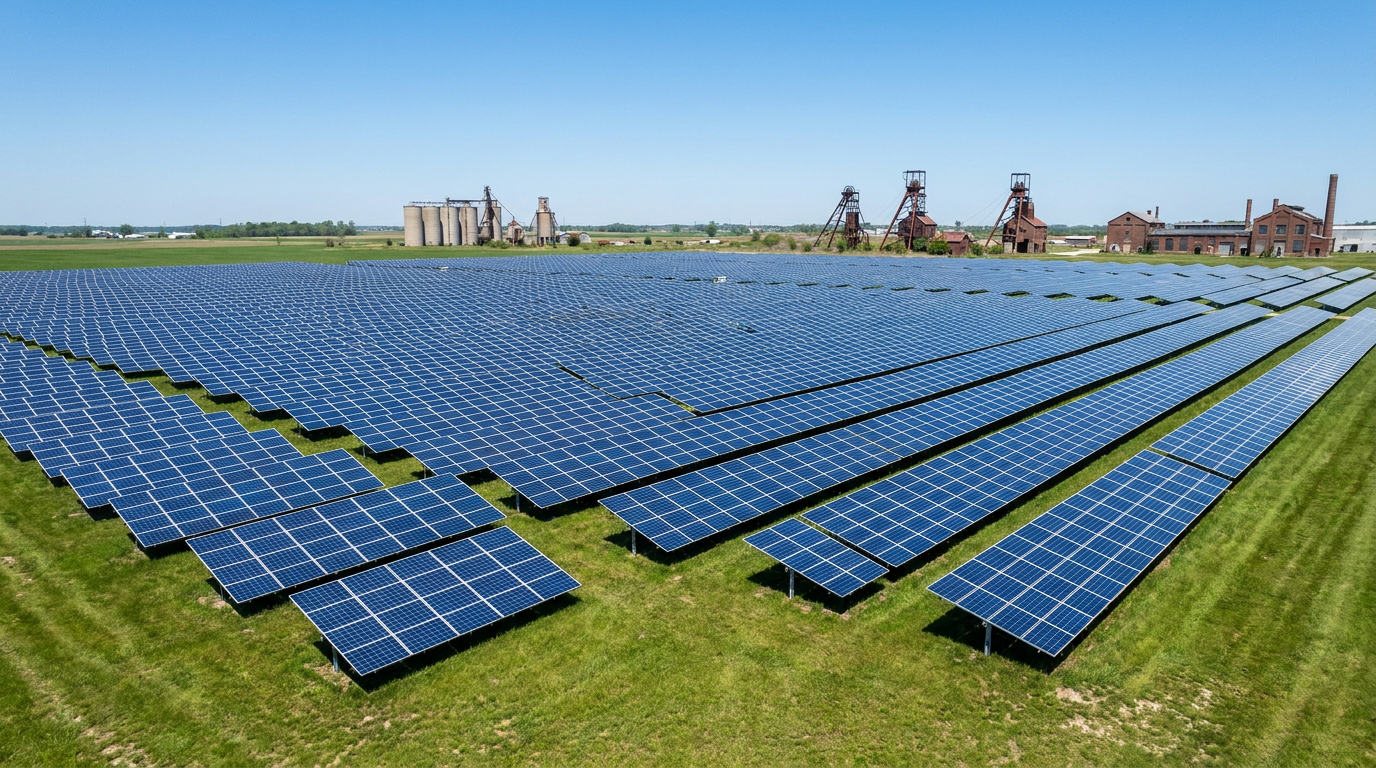
A 40-acre stretch of land in Woodford County, Illinois, that once yielded coal from the Colchester Seam is now harvesting the sun. On June 17, 2026, local officials and clean energy developers officially commissioned a 9.8-megawatt community solar project built directly atop the reclaimed 19th-century coal mine.[1][2][4]
The site, located just outside the city of Minonk, features nearly 17,000 U.S.-manufactured solar panels. Developed by TurningPoint Energy and owned and operated by Nexamp, the twin solar farms represent a deliberate shift in the region's economic and energy strategy, turning a legacy fossil fuel asset into a modern power source.[1][2]
Unlike traditional utility-scale solar that feeds indiscriminately into the grid, this is a "community solar" initiative. It allows local residents who cannot install rooftop panels—such as renters, apartment dwellers, or homeowners with shaded roofs—to subscribe to a portion of the farm's output and receive direct credits on their utility bills.[1][6]
The Minonk projects are nearly fully subscribed, serving over 650 distinct participants. Crucially, the initiative reserves capacity for approximately 200 low-income households, expanding access to clean energy savings for historically underserved families who are often disproportionately burdened by high energy costs.[1][6][8]

The remaining capacity is anchored by two major institutions: Rush University Medical Center and the College of DuPage. Together, these organizations account for 40 percent of the projects' total electricity offtake, providing the long-term financial stability necessary to keep the community subscriptions affordable for individual households.[1][6][7]
For the medical center, the investment is viewed through a distinct public health lens. Ian Hughes, director of environmental sustainability at Rush, described community solar as "preventative medicine," noting that reducing fossil fuel reliance directly improves air quality and respiratory health in vulnerable communities.[5]
For the medical center, the investment is viewed through a distinct public health lens.
The Minonk site is certified as a "brownfield" under the Illinois Shines program, a state initiative that provides specific incentives for repurposing previously disturbed or contaminated land. By utilizing the old mine—which extracted coal for roughly 75 years—developers avoided paving over pristine agricultural land or natural habitats.[1][3][6]
Beyond land reuse, the project is pushing the technical boundaries of the local grid. It is among the first on the Commonwealth Edison (ComEd) system to incorporate Distributed Energy Resource Management Systems (DERMS), a critical upgrade for integrating renewable energy at scale.[1][2][7]

Because solar generation fluctuates with the weather, DERMS acts as a smart traffic controller for electricity. The software allows the utility to monitor and manage the distributed energy resources in real time, balancing electricity demand and ensuring grid reliability without needing to fire up fossil-fuel peaker plants.[5][7]
The construction phase of the project utilized prevailing wage labor, ensuring that the economic benefits of the clean energy transition were shared with skilled local workers. Developers also signed road use agreements to cover future infrastructure maintenance costs for the county, embedding long-term civic support into the project's framework.[3][6]
The project has drawn bipartisan praise for its pragmatic approach to energy and local economics. Illinois State Senator Chris Balkema, who supports an "all-of-the-above" energy strategy, noted that the solar farm builds on the county's energy heritage while attracting new investment and supporting quality jobs right in Woodford County.[2][6]

The Minonk solar farms are just the beginning for the area's renewable energy buildout. TurningPoint Energy has already permitted three additional projects in the city, though they await necessary grid upgrades before construction can begin.[4]
The success in Illinois mirrors a growing national movement to transform the liabilities of the industrial past into the assets of a decarbonized future. By pairing community ownership models with brownfield reclamation, the transition to renewable energy is actively repairing the landscapes left behind by the fossil fuel era.[3][8]
How we got here
Late 1800s – Early 1900s
The Minonk site operates as an active coal mine, extracting from the Colchester Coal Seam for approximately 75 years.
2024
Nexamp and TurningPoint Energy begin development and permitting for a community solar project on the reclaimed land.
June 17, 2026
Local officials and developers officially commission the 9.8-megawatt solar farm, sending power to the ComEd grid.
Viewpoints in depth
Clean Energy Developers
Focuses on the technical achievement, grid modernization, and scalable models for repurposing legacy fossil fuel sites.
For developers like Nexamp and TurningPoint Energy, the Minonk project is a proof-of-concept for the future of the grid. They emphasize that building on brownfields solves the land-use friction that often plagues renewable energy projects. By utilizing advanced Distributed Energy Resource Management Systems (DERMS), they argue that community solar can actively stabilize the grid rather than strain it, acting as a smart, dispatchable asset for utilities.
Local Government & Community
Prioritizes economic revitalization, job creation, preserving the county's energy heritage, and lowering utility costs for residents.
Local leaders view the project as a bridge between the region's industrial past and its economic future. Rather than erasing the county's history as an energy producer, officials like Minonk Mayor Russell Ruestman see the solar farm as a continuation of that legacy. The community perspective heavily values the immediate tangible benefits: prevailing wage jobs during construction, road maintenance agreements, and direct utility bill savings for hundreds of local families who otherwise couldn't afford solar.
Healthcare & Institutional Subscribers
Views community solar as a form of preventative medicine that reduces harmful emissions and improves air quality in vulnerable communities.
Anchor institutions like Rush University Medical Center frame their participation not just as a financial or environmental decision, but as a public health intervention. Sustainability directors argue that reducing the grid's reliance on fossil fuels directly lowers asthma rates and cardiovascular disease in surrounding communities. By guaranteeing 40 percent of the project's offtake, these institutions see themselves as financial enablers that make clean energy accessible to the low-income patients they serve.
What we don't know
- How quickly the local utility, ComEd, will complete the necessary grid upgrades to allow the three additional permitted solar projects in Minonk to begin construction.
- Whether the integration of DERMS technology will demonstrably lower grid management costs for the utility over the long term.
Sources
Source coverage
8 outlets
3 viewpoints surfaced








[1]ElectrekClean Energy Developers
Illinois put community solar on a 150-year-old coal mine
Read on Electrek →[2]Solar BuilderClean Energy Developers
Nexamp, TurningPoint Energy open projects at former Illinois coal mine
Read on Solar Builder →[3]BriefGlance.comLocal Government & Community
Illinois' Solar Blueprint: How a Former Coal Mine Powers a New Economy
Read on BriefGlance.com →[4]WJBC AM 1230Local Government & Community
Minonk flips switch on solar farm, powers thousands of homes
Read on WJBC AM 1230 →[5]Tomorrow's World TodayHealthcare & Institutional Subscribers
Former U.S. Coal Mine to be Turned into a Solar Energy Farm
Read on Tomorrow's World Today →[6]Markets InsiderLocal Government & Community
Nexamp and TurningPoint Energy Celebrate Community Solar Milestone on Former Coal Mine Land in Woodford County
Read on Markets Insider →[7]TipRanksClean Energy Developers
Nexamp Commissions Brownfield Community Solar Projects in Illinois, Integrates DERMS on ComEd Grid
Read on TipRanks →[8]IndexBoxClean Energy Developers
Nexamp and TurningPoint Energy Commission 9.8 MW Community Solar Projects on Reclaimed Coal Mine in Minonk, Illinois
Read on IndexBox →

Every angle. Every day.
Get community stories with full source coverage and perspective breakdowns delivered to your inbox.