
How Community-Owned Grocery Stores Are Eradicating America's Food Deserts
Frustrated by corporate supermarket chains abandoning their neighborhoods, residents across the U.S. are successfully opening cooperative grocery stores to secure fresh food and keep profits local.
By Factlen Editorial Team
- Cooperative Organizers
- Argue that community ownership keeps profits local, creates jobs, and ensures food access isn't dependent on corporate profit margins.
- Public Health Advocates
- Emphasize that reliable access to fresh produce reduces chronic diseases in historically underinvested neighborhoods.
- Retail Analysts
- Note the razor-thin margins of the grocery business and the logistical challenges of maintaining supply chains without corporate scale.
- Factlen Editorial
- Synthesizes the local movements into a national trend of economic empowerment.
What's not represented
- · Corporate Supermarket Executives
- · Commercial Real Estate Developers
Why this matters
Access to fresh, affordable food is a foundational determinant of public health and economic stability. By proving that neighborhoods can successfully build and run their own supermarkets, this movement offers a replicable blueprint for thousands of communities abandoned by corporate retail chains.
Key points
- Over 40 million Americans live in USDA-designated food deserts, lacking easy access to fresh, affordable food.
- Frustrated by corporate chains abandoning their neighborhoods, communities are launching their own cooperative grocery stores.
- New community-owned markets are opening in 2026 in cities like Flint, Michigan, and Del Valle, Texas.
- Local and state governments are increasingly backing these projects with public grants to bridge the steep capital costs.
- Cooperative models keep profits circulating locally and provide residents with a democratic voice in store operations.
For decades, millions of residents in historically underinvested neighborhoods have watched corporate supermarket chains pack up and leave. When the big-box stores retreat, communities are left with convenience stores, gas stations, and dollar stores—outlets where fresh produce is either entirely absent or prohibitively expensive.[8]
The scale of the problem is vast. According to federal data, over 40 million Americans currently live in USDA-designated food deserts, defined as low-income areas where a supermarket is more than a mile away in urban settings or 10 miles away in rural ones. The health consequences of this geographic inequity—including higher rates of diabetes, obesity, and cardiovascular disease—are well documented by public health officials.[7]
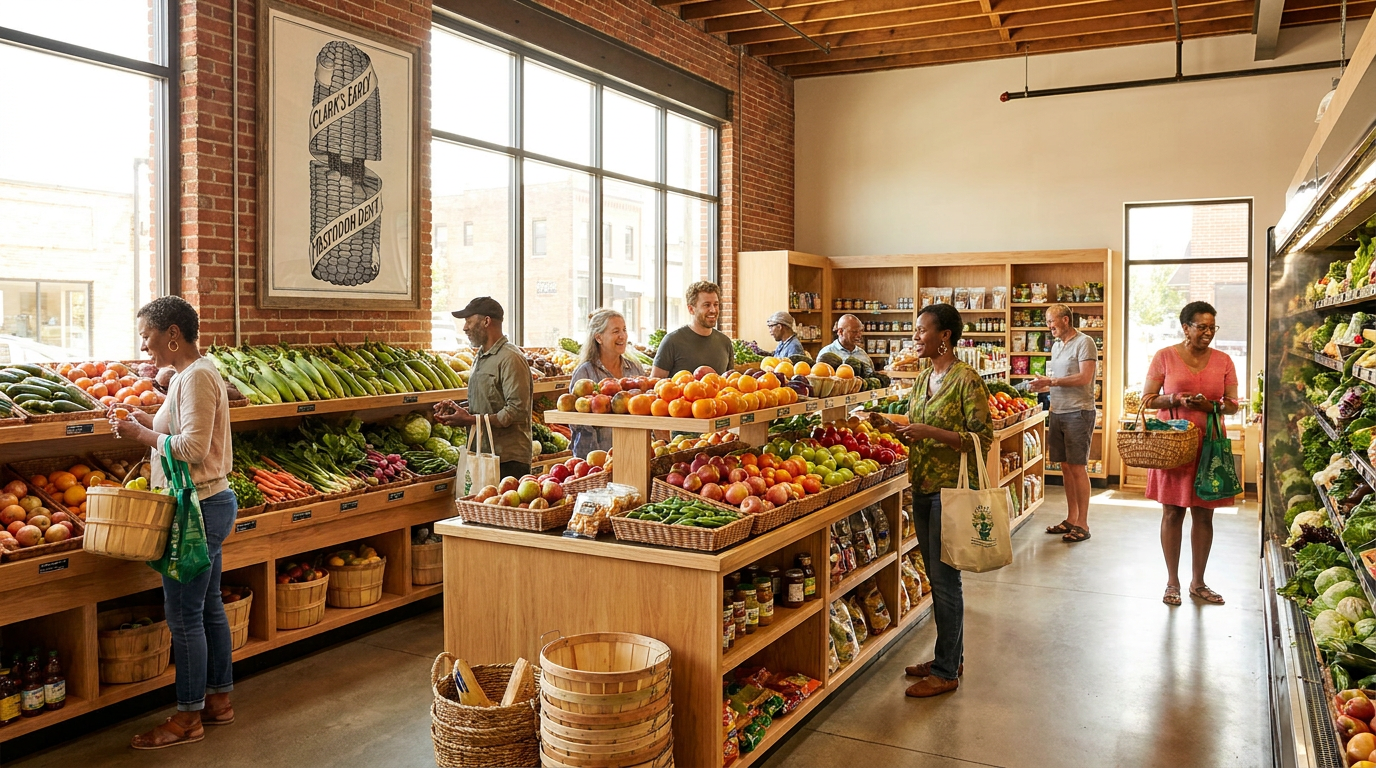
But in 2026, a powerful counter-movement is reaching critical mass. Rather than begging corporate chains to return, residents are pooling their resources to build, own, and operate their own grocery stores. The community cooperative model is surging across the country, transforming abandoned lots and empty storefronts into vibrant hubs of fresh food and local economic power.[8]

"This is a movement of cooperation with people who have historically been excluded from the economy," says Rev. Dr. Reginald Flynn, who helped spearhead the North Flint Food Market in Michigan. After more than a decade of grassroots organizing, the Flint cooperative recently opened its doors, marking the end of a long-standing food desert in the city's north side.[2]
The Flint project is a testament to the perseverance required to launch a co-op. Organizers navigated the COVID-19 pandemic, supply chain disruptions, and soaring equipment costs. Today, the market not only provides fresh produce and hot meals but has also created 40 new jobs for neighborhood residents. It operates on the principle of "Ujamaa"—cooperative economics—ensuring that profits remain within the community.[2]
A similar story is unfolding in Del Valle, Texas, a community just 15 miles southeast of the state Capitol. Despite being surrounded by major developments like the Tesla Gigafactory, Del Valle's 28,000 residents have lacked easy access to a full-scale grocery store. Frustrated by years of waiting for a corporate chain to notice them, residents took matters into their own hands.[1]
Backed by $500,000 in stimulus funding from the American Rescue Plan Act, the Del Valle Food Co-Op is slated to open this fall. The market will be housed in a renovated school portable, stocking fresh fruits, vegetables, and daily staples. Beyond food, the space is designed to host classes and community gatherings, serving as a neighborhood anchor.[1]

Backed by $500,000 in stimulus funding from the American Rescue Plan Act, the Del Valle Food Co-Op is slated to open this fall.
The cooperative model flips the traditional retail script. Instead of answering to distant shareholders, these stores answer to their neighbors. Community members purchase lifetime ownership shares—often ranging from $25 to $200, payable in installments—which grants them a vote in store operations and a share of any eventual dividends.[8]
In South St. Petersburg, Florida, the One Community Grocery Co-op is actively recruiting its target of 300 member-owners to secure a permanent brick-and-mortar location. The neighborhood has lacked a full-service grocery store for nearly a decade following the departure of a Walmart Neighborhood Market and a Sweetbay Supermarket.[3]
While finalizing their location, the St. Petersburg organizers aren't waiting to deliver fresh food. They have launched pop-up markets in partnership with local urban farms, bringing produce directly to the neighborhood. Recently, the city council threw its weight behind the project, approving a $50,000 grant to fund pre-development and feasibility studies.[3]
Local and state governments are increasingly recognizing co-ops as vital infrastructure. In Wilmington, North Carolina, the Northside Food Co-op secured a massive $6.8 million commitment from a local endowment to fund construction and early operating costs for a 2026 opening. In New York, the state government recently awarded $2.1 million to help launch the Electric City Community Grocery in downtown Schenectady.[4][5]
These public-private partnerships are crucial because the grocery business is notoriously difficult. Profit margins typically hover around 1% to 2%, and independent stores lack the massive purchasing power of national conglomerates. Launching a co-op today can require upwards of $4 million to $5 million in capital, a steep climb for grassroots organizers.[6][8]
To survive, community co-ops lean into their unique advantages. They source heavily from local farmers, building regional supply chains that are more resilient to global shocks. They tailor their inventory to the specific cultural and dietary preferences of their neighborhoods, offering a level of personalized service that big-box stores cannot match.[6]

Most importantly, they keep dollars circulating locally. Economic studies consistently show that money spent at cooperative businesses has a significantly higher local multiplier effect than money spent at absentee-owned chains. The wages paid to local workers and the contracts awarded to local farmers create a ripple effect of economic stability.[8]
As the 2026 wave of openings proves, the cooperative grocery model is no longer just a niche concept for affluent progressive enclaves. It has emerged as a practical, scalable solution for working-class neighborhoods determined to reclaim their health and their local economies. By owning the store, these communities are ensuring that they will never be abandoned again.[8]
How we got here
2010s
Corporate grocery chains increasingly consolidate and pull out of low-income urban and rural neighborhoods, expanding America's food deserts.
2020–2021
The COVID-19 pandemic exposes the fragility of corporate supply chains, prompting a surge in grassroots organizing for local food sovereignty.
2024–2025
Local governments begin directing American Rescue Plan Act (ARPA) funds and state grants toward community-owned grocery initiatives.
2026
A wave of cooperative grocery stores successfully opens in historically underinvested neighborhoods across Michigan, Texas, Florida, and North Carolina.
Viewpoints in depth
Community Organizers
Grassroots leaders view co-ops as engines for local autonomy and wealth creation.
For organizers in cities like Flint and St. Petersburg, a grocery store is about more than just food—it is a vehicle for economic justice. By collectively owning the market, residents ensure that profits are reinvested in local jobs and neighborhood infrastructure, rather than being extracted by distant corporate shareholders. They argue that food access should not be dictated by the profit margins of multinational conglomerates.
Public Health Officials
Health experts see reliable food access as the foundation of preventative medicine.
Diet-related chronic illnesses like diabetes and hypertension disproportionately affect residents of food deserts. Public health advocates argue that subsidizing community grocery stores is a highly effective preventative health measure. They point to data showing that reliable, walkable access to fresh produce directly correlates with improved long-term health outcomes and lower community healthcare costs.
Retail Analysts
Industry experts caution about the razor-thin margins of the grocery business.
While supportive of the mission, retail analysts note that independent grocers face an uphill battle. The grocery industry operates on margins of just 1% to 2%. Without the massive purchasing power and supply chain leverage of national chains, co-ops must rely heavily on community loyalty, volunteer labor, and sustained public grants to remain solvent in a fiercely competitive market.
What we don't know
- Whether these independent cooperatives can maintain long-term financial solvency on the grocery industry's razor-thin profit margins.
- How national corporate chains will respond if the cooperative model begins capturing significant market share in urban centers.
- If federal funding for community food initiatives will expand or contract in upcoming legislative cycles.
Key terms
- Food Desert
- A geographic area where residents have limited access to affordable, nutritious food, typically due to the absence of a full-service supermarket.
- Cooperative Economics (Ujamaa)
- An economic model where a business is owned and democratically controlled by the people who use its services, ensuring profits benefit the community.
- Local Multiplier Effect
- The economic phenomenon where money spent at locally owned businesses continues to circulate within the community, generating additional local wealth.
Frequently asked
How much does it cost to join a grocery co-op?
Membership shares typically range from $25 to $200 for a lifetime stake. Many co-ops offer installment plans to ensure the cost is not a barrier to entry.
Do I have to be a member to shop there?
No. While members receive certain perks, discounts, and voting rights, community-owned grocery stores are open to the general public.
Why do corporate grocery stores leave these neighborhoods?
Corporate chains often cite low profit margins, high operating costs, and a preference for affluent suburban markets when deciding to close locations in low-income areas.
Sources
Source coverage
8 outlets
4 viewpoints surfaced








[1]Austin CurrentCooperative Organizers
Del Valle co-op pushes to open long-awaited grocery store this fall
Read on Austin Current →[2]The GrioCooperative Organizers
'We own it': Community-owned grocery store opens in Flint, Mich., marking the end of a longtime food desert
Read on The Grio →[3]FOX 13 NewsCooperative Organizers
South St. Pete grocery co-op moves closer to opening with city grant, growing membership
Read on FOX 13 News →[4]WHQRCooperative Organizers
New Hanover Community Endowment announces $6.8 million for Northside Food Co-op
Read on WHQR →[5]New York State GovernmentPublic Health Advocates
Governor Hochul Announces Funding to Expand Food Access
Read on New York State Government →[6]New Hope NetworkRetail Analysts
Prairie Food Co-op opens DuPage County's first community-owned grocery store
Read on New Hope Network →[7]USDA Economic Research ServicePublic Health Advocates
Food Access Research Atlas
Read on USDA Economic Research Service →[8]Factlen Editorial TeamFactlen Editorial
Synthesis by Factlen editorial team
Read on Factlen Editorial Team →
Every angle. Every day.
Get community stories with full source coverage and perspective breakdowns delivered to your inbox.